
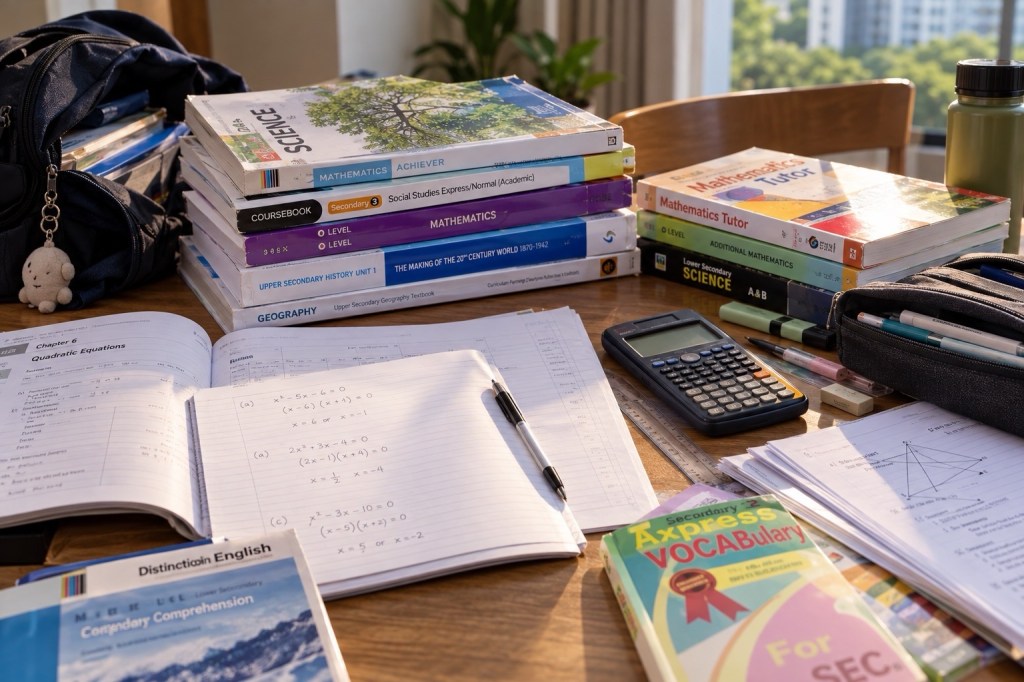
What should a PG2 Secondary 1 student in Sengkang know before their first Science practical lesson in 2027? The essentials are follow the teacher’s instructions, wear the required safety protection, do not touch chemicals or apparatus without permission, keep the workspace clear, and report any injury, spill or breakage immediately. PG2 is Posting Group 2 for school admission. The child’s actual G1, G2 or G3 Science level determines the syllabus and task demand; laboratory safety applies to every student.
In a Sengkang secondary-school laboratory, students may learn to identify a hazard, choose a measurement tool, read a scale correctly, plan a fair comparison, record results with units and explain a conclusion using evidence. These are valuable even before national examination preparation begins. A student who can repeat a definition but cannot read a measuring cylinder or explain which variable changed is missing a practical learning step.
This guide is designed for Compassvale, Rivervale, Fernvale and Anchorvale families preparing for the Secondary 1 transition. It uses published 2026 MOE-school laboratory safety rules as examples and separates what parents can safely practise at home—such as reading scales, interpreting a supplied graph or planning a fair test—from experiments that must remain under a teacher’s supervision. It does not claim that every Sengkang school has the same room layout, equipment or assessment schedule.
The laboratory checklist students should know by heart
- Enter the laboratory only with a teacher’s presence or permission; preparation rooms and storerooms are out of bounds.
- Read the activity and listen to the demonstration before handling any apparatus or substances.
- Wear the eye protection and other equipment specified for the activity, and tie back long hair where required.
- Keep bags, food, drinks and unrelated objects away from the working area.
- Never taste chemicals, handle an unidentified substance or improvise an unsanctioned experiment.
- Do not run, play practical jokes or operate gas, electrical or other equipment without the teacher’s instruction.
- Report spills, broken glass, discomfort, injury or unfamiliar hazards immediately; do not conceal them.
- Clean the work area and dispose of waste only as instructed, then wash hands thoroughly.
Who sets the rules: school, teacher and subject level
MOE schools publish their own science-laboratory regulations. Temasek Secondary’s 2026 handbook and Geylang Methodist School (Secondary)’s 2026 laboratory guidance both emphasise permission, careful handling, no eating or drinking, reporting incidents and following the teacher’s exact instructions. Junyuan Secondary and Ngee Ann Secondary give further examples of how schools manage laboratory, workshop and food-room safety.
These official examples establish a consistent safety principle, but they are not substitutes for the posted school’s own handbook. The type of apparatus, specific protective equipment and response to each substance are determined by the actual school and laboratory activity. Do not memorise a different school’s rules and then argue that an instructor must allow the same action in every laboratory.
A pupil taking G2 Science may investigate familiar physical changes while another pupil works on more demanding analysis in G3 Science. Both must observe the same fundamental habits of permission, safe handling and accurate reporting. A Posting Group label does not grant special permission to bypass a safety precaution.
Laboratory safety versus being afraid to try
Good safety teaching should create confidence rather than panic. A beginner may feel nervous because there are unfamiliar containers, instruments, warning signs and practical instructions. The goal is to ask a question before proceeding, listen carefully and recognise a risky action. A child who pauses to request clarification is behaving responsibly, not demonstrating a weakness in Science.
Parents can reinforce this at home without staging risky experiments. Ask the learner to identify three actions that require adult approval, explain why the workbench should remain clear, and describe whom they would tell if glassware broke. The child should understand that reporting a small mistake early can prevent harm, whereas hiding it can endanger classmates.
Some school rules contain very detailed descriptions of handling burners, corrosive substances and gases. Those are for supervised school work. This article deliberately does not provide a step-by-step home protocol for using laboratory gas burners or mixing chemicals. At home, focus on the scientific reasoning and safety judgment underlying the classroom activity.
Safety labels and GHS hazard pictograms
Laboratory labels help students recognise potential dangers. The Globally Harmonised System (GHS) uses recognised hazard pictograms for categories such as flammable substances, corrosive materials and other chemical hazards. A learner should read the container label and follow the teacher’s instructions rather than infer that a colour or a familiar-looking bottle makes a substance safe.
A classroom task may ask students to match a warning to an appropriate safe response. The answer is not simply ‘be careful’. It should identify what exposure or action presents the risk and how the school’s procedure reduces it. For instance, eye protection is used where an activity could cause eye injury; a clear workbench reduces the likelihood of knocking over apparatus. Exact protective measures depend on the material and task.
| When a pupil notices… | Safe next step | What not to assume |
|---|---|---|
| An unfamiliar bottle or missing label | Do not touch it; alert the teacher | That colour or container shape identifies the contents |
| A spill or broken glass | Move clear and alert the teacher immediately | That the student should pick it up bare-handed |
| A strange smell during an activity | Stop and seek the teacher’s instruction | That smelling more closely is the right way to investigate |
| An unclear procedure | Ask the teacher before proceeding | That trial-and-error with apparatus is harmless |
| A wet or obstructed floor | Keep clear and inform the appropriate staff | That classmates will notice and solve it themselves |
Measurement is where good science becomes visible
A scientific conclusion needs evidence, and evidence often begins with measurement. Pupils need to identify the quantity, select a suitable instrument, read the scale, record a value and include an appropriate unit. Common lower-secondary quantities include length, mass, temperature, time interval and volume. The exact apparatus and precision required depend on the curriculum and teacher.
The difference between 25 and 25 cm matters: without a unit, a reader may not know whether the student measured a length, a temperature or another quantity. Likewise, writing a measured value to excessive decimal places can suggest precision the instrument cannot support. Scientific communication is strongest when it describes the observation faithfully, not when it looks impressively numerical.
| Quantity | Typical school instrument | Example unit |
|---|---|---|
| Length | Ruler or measuring tape | mm, cm or m |
| Mass | Electronic balance | g or kg |
| Temperature | Approved laboratory thermometer or sensor | °C |
| Time interval | Stopwatch or timer | s or min |
| Liquid volume | Measuring cylinder, where instructed | mL or cm³ |
Parents can make a safe practice question from a printed diagram of a ruler or thermometer. Ask the child what the smallest marked division is and which value the pointer shows. Avoid turning a kitchen spoon or a smartphone app into an invented laboratory standard. A school may use digital probes or specific apparatus whose correct reading method must be taught by the Science teacher.
How to read a measuring cylinder without guessing
For a transparent liquid in a graduated cylinder, the surface can be curved—a meniscus. In an appropriate school activity, students learn to take the reading at eye level and use the specified part of the meniscus, following teacher guidance and the type of liquid involved. Looking down from above can cause a parallax error, and forgetting the unit can make an otherwise correct reading incomplete.
A safe at-home exercise is to use an illustration rather than actual laboratory glassware. Suppose the diagram shows marked values at 10, 20 and 30 mL with five equal divisions between 20 and 30. Each interval represents 2 mL. The pupil should be able to explain why the scale cannot be read as if every division were 1 mL. The example tests numeracy and careful observation.
Now change the markings. Can the child calculate the size of one division from the distance between labelled values? This transfer task is more useful than memorising that every measuring cylinder works identically. Different instruments have different scales and allowable precision.
What a fair test really means
A fair investigation changes the independent variable while trying to keep other relevant conditions controlled, and measures the dependent variable. It also uses a clear method and enough observations to support a cautious conclusion. A student should know not merely the three terms but what each represents in the actual question.
Take a safe paper-based example: a student is shown records of two plants kept under different lighting conditions. The study also changed container size and water amount. The data may show that the plants grew differently, but the pupil cannot confidently attribute the whole difference to light. More than one condition changed. A good answer explains the limitation rather than making a simple unsupported causal statement.
For a better proposed comparison, the pupil can describe keeping plant type, starting condition, water and container size as similar as practical while changing the specified lighting variable. That is a design explanation; the family does not need to buy hydroponic equipment or conduct an unsupervised experiment. The teacher decides whether any real practical work is suitable.
Observation, inference and conclusion are not synonyms
| Term | What it means | Illustrative sentence |
|---|---|---|
| Observation | What was seen, measured or recorded | The sample’s measured mass decreased by 2 g. |
| Inference | An explanation suggested by the observations | The change may involve loss of material or moisture. |
| Conclusion | A judgment tied to the stated question and evidence | The recorded mass decreased under the tested conditions. |
| Limitation | What the evidence cannot establish securely | The record does not isolate which component caused the decrease. |
A pupil who writes ‘the mass fell because all the water evaporated’ has added an explanation that may not be proved by mass alone. An answer that names several plausible causes and indicates what additional observation is needed can demonstrate stronger scientific thinking. This distinction becomes increasingly useful in lower-secondary practical work and later examination questions.
Graphs: labels, units, trends and honest claims
When a question provides a graph, the first job is to read the title and axes. Which quantity is independent? Which is measured? What units and scale are used? Then describe the trend before offering a cause. A pupil who jumps straight to ‘it increased because…’ may misread an axis or treat correlation as proof of causation.
A useful safe exercise is to provide a printed table showing temperature at times 0, 2, 4 and 6 minutes, then ask the student to draw or interpret a line graph. The parent need not heat anything. Questions can include: What was the highest recorded value? What does the interval between two readings represent? Can we know the exact temperature at every second between them?
Scientific writing should be proportionate to the evidence. If readings are missing between two points, a smooth drawn line is a model or visual connection, not independent proof of every intermediate value. Ask the pupil to distinguish what was recorded from what was estimated. This habit protects against confident but unjustified answers.
Accuracy, precision and repeats
Accuracy concerns closeness to a correct or accepted value where one exists; precision concerns how closely repeated values agree. Students sometimes call a result ‘accurate’ merely because it has many digits. That is not valid. A digital readout can display several decimals while the experiment contains a systematic error.
Repeating a measurement may help reveal random variation, but repetition does not automatically fix a badly calibrated instrument or unfair method. The correct improvement depends on the problem. For example, if a pupil uses a scale whose zero is not set correctly, recording the same biased value three times does not make it true. The pupil should explain why checking the instrument matters.
A parent can ask the child to compare these three imaginary readings: 12.1, 12.0 and 12.2 cm. They are close to each other. Without knowing the actual reference length or the instrument’s calibration, we should not claim perfect accuracy. We can say that the values show relatively little spread. That distinction is simple enough to practise without any hazards.
Common practical report structure
- Question or aim: What is the investigation trying to find out?
- Variables: Which condition changes, which is measured and what should remain controlled?
- Safe method: Record the teacher-approved process at the required detail, without improvising.
- Results: Present observations in a readable table with units.
- Graph or calculation: Apply the correct scale, formula or comparison.
- Conclusion: Answer the investigation question using the recorded evidence.
- Evaluation: Identify a meaningful limitation or improvement linked to the actual method.
Three common learning gaps in a PG2 entrant’s first Science term
The student memorises definitions but cannot answer ‘why’
A pupil may state that a substance dissolves without explaining what an observation shows. Ask them to name the evidence and build a cause-and-effect sentence using the relevant taught concept. Use the teacher’s syllabus wording and one safe diagram or table. Do not make the child learn a more demanding G3 chapter before the underlying G2 explanation is secure.
The student measures correctly but omits units
The calculation and scale may be right, but a result written as ’16’ can be unusable. Train a small independent checking habit: quantity, number, unit and sensible precision. Then test the habit on a changed question. The goal is self-monitoring, not a parent editing every homework line.
The student reads a graph but overstates the conclusion
For example, a graph may show that one group had higher average values under the recorded conditions. The child writes ‘this method always works better’. Ask what the graph actually compares and whether the sample or conditions justify the word ‘always’. A revised sentence that states the observed difference and its limits is more defensible.
What if the pupil misses a practical session?
Do not encourage the student to recreate laboratory work at home with household chemicals or improvised equipment. Inform the school of the absence, follow the Science teacher’s instructions and ask what learning must be recovered. A teacher-approved alternative might include interpreting a recorded dataset, reviewing a safe demonstration or attending a supervised catch-up if the school offers one.
A child who missed a session because of illness may need support understanding what was physically done and why. The parent can ask the pupil to annotate an apparatus diagram or explain a provided result. The teacher controls whether a practical component must be assessed in a particular way and what evidence may be accepted.
The relationship between Science practicals and ALP projects
Some Sengkang secondary schools publicise Applied Learning Programmes involving urban farming, flight or technology. Such projects can use scientific inquiry skills, but they are not automatically the same thing as a core Science lesson. A Science investigation may assess variables and evidence, while an applied project may integrate design, teamwork and a community problem. Each should be read on its own terms.
For example, North Vista Secondary’s farming activities connect naturally to plant growth and sustainability; Compassvale’s aeronautics activities can prompt questions about testing and evidence. The school determines who participates in optional deeper tiers and which subjects are assessed. A PG2 student should neither assume access nor exclude themselves without checking school information.
A safe two-week preparation plan for home
| Period | Focus | No-hazard practice |
|---|---|---|
| Days 1–2 | Laboratory rules and hazard awareness | Explain safe responses to illustrated scenarios. |
| Days 3–4 | Units and scales | Read labelled ruler and thermometer diagrams. |
| Days 5–6 | Variables | Identify what changes and what must remain controlled in a written scenario. |
| Days 7–8 | Tables and graphs | Add headings, units and a correctly scaled visual from provided numbers. |
| Days 9–10 | Observation versus inference | Rewrite an unsupported claim as a cautious evidence-based explanation. |
| Days 11–12 | Precision and checking | Compare repeated fictional measurements and look for a bias. |
| Days 13–14 | Transfer | Explain a new scenario without prompts, then review the earliest mistake. |
This timetable is an editorial learning model, not the assigned practical syllabus or a substitute for qualified supervision. It deliberately uses paper tasks, supplied data and reasoning rather than chemical reactions, heat sources or risky equipment. A family should use it only if it supports the child’s actual subject, level and teacher’s guidance.
Questions parents should ask the Science teacher
- What is my child’s current Science G level, and what is the specific practical learning objective?
- Which laboratory safety procedures and protective equipment are required in this school?
- Which instrument-reading and graph skills will be assessed?
- Does the child’s difficulty concern scientific knowledge, interpreting the question or reporting the evidence?
- What should the pupil do if a measurement appears unusual or an instruction is unclear?
- If the pupil is absent, how should missed supervised practical learning be recovered?
- What one safe practice task at home would reinforce the current topic without requiring apparatus?
Frequently asked questions
Are safety rules different for PG2 students?
The school’s laboratory safety rules apply to all students. PG2 is an admission route, not a permission category. Practical tasks and assessment demands follow the subject’s actual G level and teacher instructions.
Can my child practise with household chemicals?
Do not recreate laboratory chemical or heating experiments at home without the school’s authorised procedure and appropriate qualified supervision. Use safe diagrams, provided data and explanation questions instead.
Is a high laboratory practical mark enough to move from G2 to G3?
Not automatically. Any subject-level change follows school and MOE criteria, sustained performance and readiness. One practical score is only one piece of evidence.
What if the learner breaks equipment?
They should alert the teacher immediately and not handle broken glass or spilled material themselves. The school will apply its safety and incident procedures.
Why do teachers insist on units when the number is correct?
The unit identifies what physical quantity the number represents and helps others interpret or compare evidence. A unit-free result may be ambiguous.
Does a graph showing two changes prove that one caused the other?
Not on its own. Consider controlled variables, repeated evidence, alternative explanations and limitations before making a causal claim.
Official safety references and connected eduKate guides
- Temasek Secondary — 2026 student laboratory safety rules.
- Geylang Methodist School (Secondary) — laboratory safety and GHS hazards.
- Junyuan Secondary — safety in Science, Food and D&T rooms.
- Ngee Ann Secondary — special-room safety requirements.
- Serangoon Garden Secondary — science-laboratory safety rules.
- MOE Full Subject-Based Banding — understand actual G-level subjects.
- eduKate Sengkang — PG2 versus G2 under Full SBB.
- eduKate Sengkang — weighted assessments and reports.
- eduKate Sengkang — Common Curriculum and practical learning.
- eduKate Sengkang — comparison of local ALP and LLP programmes.
- The Complete Sengkang Guide.
Editorial and safety check: 7 November 2026. This article teaches safety principles and evidence-based scientific thinking; it is not a laboratory operating procedure or authorisation to handle chemicals, flames or electrical apparatus. The child must follow their school’s current rules and the teacher’s instructions. All examples are fictional, paper-based or discussion activities.
PG2 Sengkang: more education decisions and practical guides — November 2026: 2027 ALP versus LLP: Sengkang school programmes · 2027 school absences, MCs and Parents Gateway · 2027 ECG, MySkillsFuture and career exploration · The Complete Sengkang Guide. All rules and school arrangements should be checked with current official sources.
