
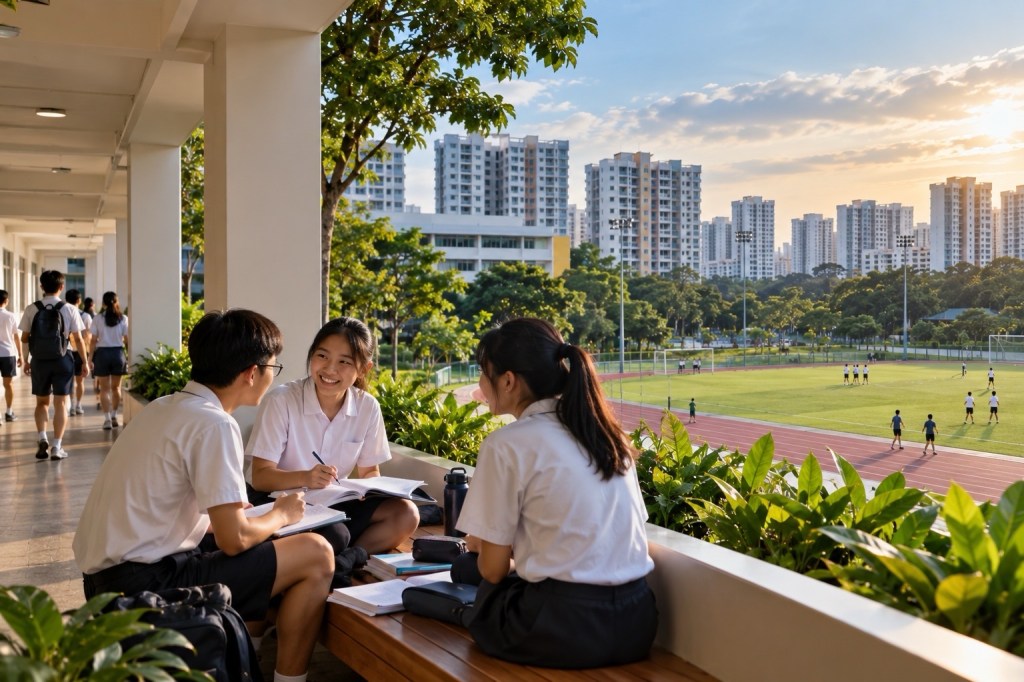
The direct answer: PG2 does not determine NSG eligibility
Can a PG2 pupil in Sengkang take part in the National School Games in 2027? Yes, if the pupil meets the applicable sport and age rules, is selected or registered through the school, and follows the competition’s requirements. PG2 means Posting Group 2, the Secondary 1 admission route under Full Subject-Based Banding. It is not a sports division, an award category or a restriction that prevents the child from playing for a school team.
The National School Games (NSG) provide inter-school competitive sporting experiences organised within Singapore’s school-sport system. At secondary level, families often hear of C Division and B Division. These commonly correspond to younger and older students respectively, but formal eligibility follows the event’s year-of-birth and sport-specific rules, which can differ from a simplified ‘Secondary 1 equals C Division’ slogan.
For Compassvale, Rivervale, Anchorvale and Fernvale households, the useful information is practical: which sports the assigned school offers, how trials work, when training occurs, how the competition schedule changes the day, what the child can do when not selected, and how to balance schoolwork, rest and travel. This guide explains the decision process without inventing the 2027 fixtures or guaranteeing team selection.
C Division versus B Division — compare the correct rules
These seasonal periods are drawn from 2026 school examples, not a confirmed calendar for 2027. Some events run in a different part of the year; competition venues and formats can be changed. A family should use the official National School Games portal and the school’s 2027 sports notice once the relevant competition information is available.
Do not decide a division solely from the child’s school class or their year of birth without checking the correct competition year’s regulation. A birth-year boundary can differ between seasons, and specific sports can have additional competition or safety conditions. The school teacher-in-charge is best placed to interpret the current rulebook for the actual event.
| Question | C Division | B Division |
|---|---|---|
| Who commonly competes? | Younger secondary students, often Sec 1 and 2 | Older secondary students, often Sec 3 to 5 |
| Formal age eligibility | Follow the 2027 sport’s published birth-year table | Follow the 2027 sport’s published birth-year table |
| Illustrative 2026 timing | Some school notices placed many C Division events roughly May–August | Some school notices placed many B Division events roughly January–April |
| What determines the actual match day? | The sport’s current official fixtures | The sport’s current official fixtures |
| Does the pupil’s PG2 label matter? | No | No |
What happens between joining a sports CCA and representing the school?
Selecting a sports CCA and representing the school at NSG are related but separate processes. A school may welcome interested beginners into an activity while selecting a smaller team for a particular match or event. Selection can involve technical ability, fitness, role within a team, safety, commitment, sports-specific rules and the number of available places.
A student who joins basketball may first practise passing, movement, positioning and communication. A football player may learn receiving the ball, decision-making and support play. A pupil interested in athletics might learn how to train progressively and manage the specific event. These experiences are educational even when the child is not selected for the first competition.
Ask the school’s teacher or coach whether there is an open trial, a development squad or an assessment stage. Do not pressure a child to claim experience they do not have, or assume that a paid external sports programme guarantees school team entry. A respectful, interested beginner can learn a great deal before the first competitive appearance.
Parents should also check how students who are not in the final roster participate meaningfully. A child may practise, assist the team, learn a new position or compete later if appropriate. The value of sport is not restricted to a medal or a place in a starting lineup.
Sports CCAs that Sengkang parents can investigate
Seng Kang Secondary’s 2026 CCA list includes sports such as badminton, basketball, football, netball and hockey, with particular school-listed eligibility by team. North Vista Secondary’s highlights link to its 2026 NSG fixtures and results, including activities such as netball, basketball, football, golf, cross country, taekwondo, swimming and other events. These are concrete entry points for research, not proof that every option will be open to every 2027 pupil.
A programme listing can include sports in which the school enters competitions without operating a large general-entry CCA every year. The precise selection, staffing, venues and competition schedule can change. Before choosing a school for sporting reasons, ask whether the activity is currently offered, what an ordinary pupil can attend and how the school supports beginners.
A school’s 2026 results may also be an imperfect way to judge fit. A team that placed highly last year may have very demanding practices or limited places. Another school could provide a more accessible programme for a pupil still discovering their interest. A parent should compare the actual experience, not rely solely on one trophy photograph.
How official competition rules work
The Singapore Schools Sports Council publishes general and sport-specific rules governing entries, registration, divisions, competition format, reporting, attire, officials and conduct. Different sports have different match structures. A swimming event, football fixture and badminton tournament cannot safely be treated as one template.
Some sports have individual entries and relay or team events. Others have leagues, zones, tiers or stages. A parent who sees a school’s ‘League 3’ result should not assume it means the same performance ranking as a school in a different sport or event format. The governing rulebook and the competition context are necessary to interpret the result.
All student athletes must follow authorised instructions on safety, eligibility and sportsmanship. The teacher-in-charge coordinates school procedures; a parent should not submit an independent entry form to force an NSG position or ask a child to play under another student’s registration.
What a normal match or competition day may involve
Competition events can end later than ordinary school lessons. The correct return route should not be guessed from a map of the school’s home campus. Some teams travel together and return as a group; other arrangements are possible under school policy. Ask explicitly what happens before assuming a child can independently leave the venue.
A typical school sports day may be exciting but tiring. A reasonable plan includes hydration, suitable meals, recovery and adequate sleep. A young athlete who has been on a long bus journey should not be sent directly into hours of late-night revision without considering the following school day.
| Stage | What the student needs | What the family should know |
|---|---|---|
| Before the day | Official selection, reporting time, kit and school briefings | Venue, supervisor, dismissal and contact arrangements |
| Travel to venue | Use the transport plan authorised by the school | Whether the student travels with the team |
| Warm-up and event | Follow coach, teacher and officials; use correct equipment | Appropriate food, water, rest and known restrictions |
| After the event | Recover and follow reporting or return instructions | When and where the child will be released |
| Return to learning | Complete essential missed work according to school guidance | Which subject tasks actually need catching up |
Safety and health come before a competition result
Participation should follow age-appropriate training and safe supervision. If the pupil reports a possible injury, severe pain, head impact or other concerning symptoms, tell the responsible teacher or coach and seek appropriate medical care. Do not encourage a child to play through a suspected serious injury because the school has an important match.
Sport-specific warm-ups, protective equipment, hydration and recovery should follow the school’s authorised programme. The family need not invent a separate intense training schedule at home. Extreme exertion, unverified supplements or rapid weight-change routines are not necessary for every pupil to participate successfully in school sports.
If the child has a health or accessibility need affecting training, contact the relevant school staff privately. A suitable response may involve a modified activity, additional planning or an individual medical assessment. The original PG2 status is irrelevant to whether the student deserves safe participation.
A student athlete can have G2 and G3 subjects
Under Full SBB, a pupil admitted through PG2 may study some subjects at G2 and others at G3 where eligible. That does not separate the student from the wider CCA community. School sports can bring together classmates with different academic subject profiles; the game itself has its own eligibility and teamwork demands.
A pupil may miss a scheduled academic lesson while representing the school at an authorised competition. Parents should ask the teacher what was taught and how essential work can be recovered. Do not assume an NSG match cancels every assignment or that the student needs to complete every missed worksheet in one evening.
A practical learning repair is to identify one missing concept, work through a representative example, ask the pupil to explain the method and then try an unfamiliar version. If the issue is simply a missed notice or submission deadline, repair the organisational routine instead. Extra worksheets cannot fix a problem the parent has not identified.
How competition experience relates to LEAPS 2.0
The LEAPS 2.0 co-curricular framework recognises Participation, Achievement, Leadership and Service. Sports representation may contribute to the appropriate achievement record, while consistent CCA attendance supports participation and other activities may develop leadership or service. These domain levels are evaluated under school and national criteria.
A medal does not automatically give two CCA bonus points. The framework’s Excellent attainment generally requires Level 3 in every domain and Level 4 in at least one, subject to the official record. A child who is not selected for NSG may still develop a strong co-curricular profile through ongoing contribution.
Similarly, a medal does not guarantee admission to a JC, polytechnic or another programme. Where co-curricular bonus points are applicable, later admissions still require the student’s actual subject levels, grades and course prerequisites. See the related LEAPS 2.0 guide for the separate attainment calculation.
Why league tables can mislead a parent choosing a school
A parent comparing 2026 sports results might assume that the school with the highest placement is automatically the best for their child. That conclusion ignores CCA access, coaching for beginners, the sports the pupil actually enjoys, travel, the school culture and whether the student is likely to participate meaningfully.
One learner may love netball but find the nearest school does not offer the appropriate team. Another may be curious about badminton and want a welcoming programme rather than immediate elite competition. A third may already represent a club outside school and need careful coordination with the school’s schedule. These families can arrive at different sensible school preferences.
Posting Group eligibility still comes first for school admission. A famous sports programme does not allow a pupil to bypass the relevant PSLE group, previous indicative cut-off or official posting criteria. Once the school is an eligible option, compare the real student experience rather than assuming ‘national champion’ describes every pupil’s daily life.
Travel from Sengkang after a late match
Families in Fernvale, Rivervale, Anchorvale and Compassvale use different combinations of the Sengkang LRT, North East Line and buses. A child may know the route home from school but not the route from a sports venue elsewhere in Singapore. Ask whether transport is provided, where dismissal occurs, and which adult remains responsible until the appropriate handover.
Children should know what to do if a preferred service is delayed or if they feel unsafe. That includes staying in an agreed safe place and asking the supervising teacher or appropriate transport staff for assistance. Do not tell the pupil to take an unfamiliar shortcut after dark or accept a ride from an unknown person.
From January 2026, school-time personal smartphone and smartwatch restrictions became stricter. The family should check how emergency contact is handled during supervised CCA activities rather than assuming the pupil can answer texts throughout training or competition. The correct method is the school’s current communication and dismissal procedure.
A five-part training-week routine
- Plan: confirm the actual school training or competition dates each week.
- Prepare: pack authorised sports attire, water, meals and essential learning materials.
- Participate: follow the teacher and coach, practise safely and respect teammates.
- Recover: allow sufficient rest and report pain, injury or other concerns promptly.
- Review: identify one sporting skill and one schoolwork routine to improve.
Worked family case: a pupil joins basketball but is not in the first roster
Consider a fictional Secondary 1 pupil who enjoys basketball and begins school CCA training. The school chooses a more experienced team for the next NSG fixture. The pupil feels disappointed and concludes that they have failed. A useful adult response is to ask the coach which development steps are available and help the child identify one improvement goal, perhaps movement off the ball or accurate passing under pressure.
That goal can be practised at approved school sessions, then reviewed through feedback. The pupil can still build friendships, effort and confidence without an immediate competition appearance. A parent who promises a future place may create another disappointment, so it is better to describe the real training process.
Worked family case: NSG week collides with schoolwork
A second fictional pupil is studying G2 English and G3 Mathematics. Their authorised competition causes them to miss one Mathematics explanation. They return tired and attempt to copy the worksheet late at night, making several errors. The better plan is to check the teacher’s instructions, identify the key concept, sleep adequately and work through a short targeted task at a suitable time.
If the pupil still cannot choose the correct method, the family can show the actual attempt to the teacher. That protects learning without treating sports as a problem to eliminate. A sound routine lets the pupil grow both athletically and academically.
Worked family case: the return route is unfamiliar
A third pupil from Fernvale is selected for a game at a venue outside Sengkang. The family clarifies whether the school supplies transport and exactly where pupils are released. They agree on a safe contact procedure and check the relevant public-transport route if independent travel is authorised.
On the day, a timetable change occurs. Rather than wandering away from the venue, the pupil asks the supervising teacher for the updated dismissal instruction. The key skill is recognising uncertainty and using an authorised source—not memorising every route in Singapore.
Nine questions for a sports-CCA briefing
- Which sports CCAs and divisions does the school currently enter in the National School Games?
- What are the exact 2027 sport-specific eligibility and birth-year requirements?
- How are trials, beginner development and selection handled?
- Are training times different during the competition season?
- How will students obtain permission for schoolwork missed due to authorised events?
- What supervision, health and injury-reporting practices apply?
- How are pupils transported to and from external match venues?
- How is the actual participation or achievement reflected in school records?
- What opportunities remain for students who are not selected for a particular match?
Frequently asked questions
Can a PG2 student represent a school at NSG?
Yes, if eligible and selected through the school’s rules. PG2 is an admission grouping and does not determine sports-team registration.
Is C Division only for Secondary 1?
No. It is commonly associated with lower-secondary pupils, but the official age and sport rules for the 2027 competition determine eligibility.
Are 2027 NSG fixtures already the same as the 2026 schedule?
No such assumption is justified. The school and official NSG portal should be checked for confirmed 2027 dates.
Does joining the sports CCA automatically place a child on the NSG team?
No. Schools can have team selection, event entries and capacity restrictions. CCA learning continues beyond a competition roster.
Can a student still have a good CCA record without NSG medals?
Yes. LEAPS recognises multiple domains and activities. Medals are not the only useful evidence of development.
Does an NSG medal automatically provide two admission bonus points?
No. Excellent attainment is determined by the complete LEAPS 2.0 record across four domains, subject to later admissions rules.
Should my child train while injured because the competition is important?
Do not encourage that. Notify the teacher or coach and seek medical advice as appropriate. A safe return to activity matters more than one result.
Can a G2 student play alongside a G3 student?
Sports participation follows team, age and event rules rather than academic G-level labels. Mixed school life is consistent with Full SBB.
Which school in Sengkang is best for National School Games?
There is no universal answer. Check actual PG2 admission eligibility first, then the specific sport, development opportunities, culture, training, safety and commuting needs.
Official information and connected Sengkang resources
Reviewed 7 November 2026. Historical school schedules and results are identified as examples, not claims about 2027 fixtures or a school promise to admit or select any applicant. Each sport’s 2027 NSG rules determine exact division eligibility. School and coach instructions govern participation and safety. All case studies are illustrative.
- National School Games — official competition portal and rules.
- North Vista Secondary — 2026 NSG fixtures and results in the school highlights.
- Seng Kang Secondary — published sports CCA options.
- Tampines Secondary — sport-specific C/B division training example.
- Chua Chu Kang Secondary — 2026 National School Games participation.
- MOE — Full Subject-Based Banding.
- eduKate Sengkang — school CCA choices and sports.
- eduKate Sengkang — LEAPS 2.0 attainment and bonus points.
- eduKate Sengkang — student concession travel and fare planning.
- eduKate Sengkang — outdoor cohort camps and safety.
- The Complete Sengkang Guide.
PG2 Sengkang 2027: more guides on health, arts, outdoor education and sports: 2027 Secondary 1 health screening, HPV9 and dental consent · 2027 Singapore Youth Festival performing arts · 2027 Secondary 1 outdoor camps and safe packing · The Complete Sengkang Guide. Check the current official school notice for event dates, health consent and participation arrangements.
