
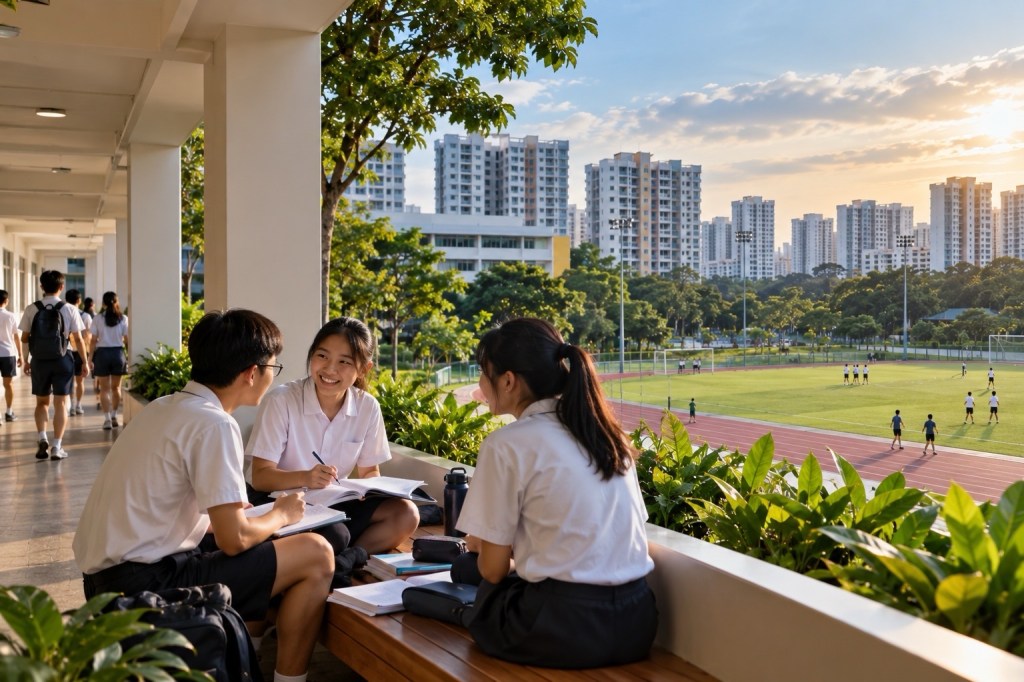
What is PG2 in Sengkang, and what should a family do after Secondary 1 posting? PG2 means Posting Group 2, a route used to admit eligible students into secondary school under Full Subject-Based Banding. A child entering through PG2 usually begins most subjects at G2, with possible subject-level flexibility. But the day-to-day success of a new secondary student depends on more than that label: how the child gets to school, what happens after CCA, the family’s budget, the child’s friendships and whether schoolwork fits into a sustainable routine.
For Sengkang parents planning the 2027 Secondary 1 intake, this guide builds a first-90-days checklist for households in Compassvale, Rivervale, Anchorvale, Fernvale, Buangkok and Sengkang Central. It also answers familiar local searches: which LRT loop might be relevant, how to check a new school campus, what to budget for, where to find financial help, and how to work out whether a learning difficulty needs tuition or a better routine.
Did you know that Outram Secondary School began admitting its new Secondary 1 cohorts at 48 Anchorvale Crescent from 2026, while earlier cohorts continued at its York Hill campus during the transition? A family using the wrong campus address could plan an entirely wrong commute. That is the type of practical detail that a Sengkang education page should solve: the right rule, the right location, the right next action.
The quick plan: nine things to organise
- Confirm the correct school and campus. Check the school’s official Secondary 1 information, not only the name in the posting result.
- Understand PG2 versus G2. Posting Group is the entry route; G level is the level of an individual subject.
- Test the real journey. Include the walk, LRT or bus direction, weather and after-CCA return.
- Follow the actual school notices. Uniform, textbooks, reporting details, device policy and first-day items differ by school.
- Discuss CCA with the child. Interests, training days and travel determine whether the weekly plan is sustainable.
- Check costs and assistance. Review fees, meals, travel, uniforms, supplies and the current MOE Financial Assistance Scheme.
- Set up one reliable communication route. Parents Gateway, school website and class notices take priority over forwarded rumours.
- Observe the first academic weak link. A specific English, Mathematics or Science difficulty is more useful than ‘PG2 students need extra help’.
- Review at 7, 30, 60 and 90 days. Change what is not working before fatigue and missed tasks become normal.
Official starting points: MOE Secondary 1 Posting, MOE SchoolFinder and Complete Sengkang Guide.
Contents
Jump to: PG2 basics · Residential areas · Transport · Campus check · Costs & assistance · CCA · School notices · Days 1–7 · Days 8–30 · Days 31–60 · Days 61–90 · Local facilities · FAQ
What PG2 affects — and what it does not
A Posting Group informs admission into Secondary 1 and guides the initial subject level for most subjects. It is not a separate school building, an instruction to attend a school near home, or a permanent limit on what a child can study. Under Full Subject-Based Banding, the old stream labels were removed for the relevant cohorts and subjects can be studied at different G levels.
This means a child who entered through PG2 may be eligible to take one or more subjects at G3 if the criteria and school offer are met. The school can also consider further subject-level adjustments at appropriate points as performance develops. The PG2 label itself tells parents nothing reliable about the child’s friendships, travel confidence, sporting talent, language strengths or family responsibilities.
Parents sometimes ask whether a PG2 student will need more tuition, longer homework hours or a stricter after-school routine than a PG3 student. There is no useful universal answer. The sensible plan follows the pupil’s actual work and practical needs. A student who struggles with a bus transfer does not need a harder Maths worksheet. A student who misinterprets the question in Science needs an explanation and a new example, not more transport rules.
For detailed admission criteria, see our PG2 in Sengkang explanation of PSLE Scores and Posting Groups and the Sengkang PG2 school and historical cut-off guide. This page focuses on what a family can do after the administrative decision.
Does PG2 change which LRT or bus a child uses?
No. A child uses the route connecting the actual home with the actual assigned school. That route might include the North East Line, one of the Sengkang LRT loops, a bus, walking or a combination. The same trip would apply regardless of the child’s Posting Group.
Does PG2 change school costs automatically?
No. Fees, uniforms, meal needs, textbooks, transport, CCA requirements and financial-assistance eligibility are governed by the relevant school, transport and assistance arrangements. The Posting Group is not a fee tier.
Does PG2 tell you which CCA is best?
No. A CCA should reflect the child’s interest, reasonable participation requirements and the actual school’s offerings. The child should be invited into that decision.
Sengkang is several different journeys, not one point on a map
Sengkang can feel compact on a regional map, but day-to-day journeys are not identical. Fernvale and Anchorvale are in the west and northwest of the town, Rivervale lies across eastern neighbourhoods, Compassvale covers another important residential area, while Sengkang Central and the Buangkok area have their own rail and bus access patterns.
A parent should begin with the actual home building and the school entrance, not the geographical centre of Sengkang. If the nearest LRT station is a comfortable walk away, that may be useful. But a station that looks close on a map could involve a long exposed walk, extra road crossings or an inconvenient change of direction.
Use this family worksheet as a starting point:
| Household area | First practical question | What to verify |
|---|---|---|
| Compassvale | Is walking or an LRT/bus connection easier? | Exact home block, school gate and sheltered route |
| Rivervale | Does the eastern loop or a direct bus make sense? | Actual stop, direction, transfer and evening return |
| Anchorvale | Is the school near Farmway or another west-loop stop? | Exact campus, walking approach and safe crossings |
| Fernvale | How convenient is the western-side route? | Home-to-stop walk and service timing on school days |
| Sengkang Central | Is a direct route preferable to an LRT transfer? | Peak demand, platform and bus boarding points |
| Buangkok area | Does the North East Line or a local bus help? | Home’s station access and the school’s actual location |
The table is a planning prompt, not a timetable. Services, routes, station access and school entrances can change. Check the latest information through the LTA rail network and journey planning information, SBS Transit and the school’s own guidance.
Why a school in the neighbouring town might work better
For a family in the eastern side of Sengkang, a school in Hougang or Punggol may be more practical than one elsewhere in Sengkang. The town boundary does not determine how long the journey feels, what a bus connection involves or whether the pupil gets home safely after CCA.
If you are still at the school-selection stage, compare the real school choices with the child’s PSLE result and selected Posting Group. A school outside Sengkang is not automatically available simply because it is close, but it should not be ruled out solely because of its postal town.
What if the family may move house?
A planned house move changes the realistic journey and sometimes the home support available. If a family expects to relocate before the child starts school, analyse both locations. Do not assume an intended future address will provide an admissions advantage; Secondary 1 posting uses the stated rules, and home distance is not the S1 tie-break.
How to plan MRT, LRT, bus and walking safely
The North East Line and the Sengkang-Punggol LRT are operated by SBS Transit, while LTA provides public transport maps and journey planning resources. For many Sengkang children, school journeys combine a short local walk with a rail segment or a bus. A family that chooses only the shortest app estimate may miss the experience of a crowded platform, a confusing loop direction or a late-day journey.
Use four separate checks: the route, the walking connection, the direction of travel and the backup. A correct LRT station name is not enough if the pupil boards the wrong loop or exits on the wrong side.
Check 1: the exact school entrance
Open the school’s current contact and travel page. Some schools have more than one gate, and the route to one gate may be different from the route used for visitors. Confirm which entrance Secondary 1 students use and whether it is open for normal arrival.
If the map shows a school footprint rather than its entrance, do not pretend the journey is fully planned. Walk the last segment or verify it with the school.
Check 2: a school-day trial
When possible, travel from home to school at approximately the intended arrival period, then return home around the likely CCA end of day. The child should learn which direction to travel, where to change, and whom to contact if the service is disrupted.
Do not memorise one precise travel time as a guarantee. The real journey varies with walking pace, waiting, crowding and weather. Record a comfortable range, a latest reasonable departure time and a backup plan.
Check 3: the wet-weather route
Ask where the pupil will shelter if rain starts during the walk, whether a road crossing is safe in poor visibility and where a dry change of shoes or socks might be stored if permitted by school rules. Make sure the child can handle an umbrella without having to run across a road.
A helpful parent question is, ‘What will you do if the first bus is full?’ The answer should be an actual alternative, such as waiting safely for the next service or using an agreed backup, rather than ‘I will be late and panic’.
Check 4: the after-CCA route
A journey that is convenient at 7 a.m. may feel different after a longer day. Check the CCA timetable once confirmed, then test the likely homeward route. Consider whether the student has eaten, whether the path remains safe and whether an adult needs to be available for a temporary transition period.
The goal is eventual student independence, not asking a child to navigate a confusing journey with no preparation. Adults can reduce supervision as the pupil demonstrates reliable skills.
Do not confuse commute quality with posting priority
For Secondary 1, the defined tie-breaks in a score tie are citizenship, school-choice order and computerised balloting when needed. Distance is not the tie-break. But reducing exhaustion and giving the child a predictable route can be an excellent reason to prefer one eligible school over another.
Check the right school campus: Outram’s Anchorvale example
Outram Secondary School provides a concrete reason to consult current school pages. The school started accepting new Secondary 1 students at its Sengkang Anchorvale campus from 2026, while the York Hill campus continued serving older cohorts during the transition. Official contact information identifies the Anchorvale campus as 48 Anchorvale Crescent, Singapore 549936.
A parent who searches ‘Outram Secondary’ and immediately plans a commute to York Hill is solving the wrong problem for a 2027 Secondary 1 entrant. The school’s official contact page and Anchorvale location guide identifies local access such as Farmway LRT and nearby buses.
This matters beyond one school. Buildings may be renovated, new campuses opened and school entrances changed. If an older article, an aunt’s recollection and the current official school page disagree, start by checking the official page and asking the school when necessary.
A useful five-field school address card
Write the official school name, actual campus address, entrance used by the child, preferred travel route and school contact method on a card that the student can understand. Add a fallback contact plan that does not depend solely on the child’s smartphone.
This reduces uncertainty when the ordinary plan fails. It is more useful than a long printout of every possible bus service in the town.
Secondary 1 costs: what to budget and where to ask for help
Families often calculate tuition fees first, but school-related expenses begin with ordinary essentials. A realistic budget should consider school uniforms, PE attire, shoes, textbooks, stationery, school meals, daily transport, CCA equipment and any permitted personal-learning device arrangements. The actual list depends on the school and family, so use the school’s booklist and notices rather than an estimated shopping basket from a blog.
Distinguish one-off items from recurring items. Uniform and textbook purchases are often upfront; transport and school meals recur. A smaller repeated cost can matter more across a term than a large one-time purchase.
| Type of expense | Questions to ask | Best information source |
|---|---|---|
| Uniform and PE attire | How many sets are genuinely needed? | Official school instructions |
| Textbooks and workbooks | Which titles and editions are required? | Current school booklist |
| Transport | What is the student concession fare and travel pattern? | Official transport and concession information |
| Meals | What is a typical school-day spending plan? | Family budget and school canteen guidance |
| CCA | Is special equipment or attire required? | School and CCA teacher |
| Devices and connectivity | What device rules or school arrangements apply? | School’s ICT notice |
| Additional learning support | Is the need specific and verified? | Marked work, student and teacher conversation |
The MOE Financial Assistance Scheme
The MOE Financial Assistance Scheme supports eligible Singapore Citizen students with applicable school expenses. At government and government-aided schools, assistance can include fees, textbooks, attire, meals and transport, depending on the current rules and eligibility.
Do not rely on an old household-income threshold. Rates, income criteria and administration may be updated. Check MOE’s current page and the new school’s instructions. Ask the school office if you need help applying or if family circumstances have changed.
Sengkang families can also check whether the particular school offers its own school-based financial assistance. The process may be coordinated through the school, and families should not assume that every school follows an identical application procedure or offers identical supplementary support.
What about the cost of tuition?
Tuition is not a compulsory consequence of PG2. A student who can explain lesson content, practise independently and correct mistakes may need only a reliable home routine and ordinary school support. If a specific persistent gap emerges, ask whether teacher feedback, targeted practice or additional instruction is appropriate.
A sensible question for any provider is, ‘What exactly will you do differently for this child, and how will we know it works?’ A small group can provide opportunities for feedback, but the actual teaching design and suitability matter more than the sales phrase.
CCA, recreation and sleep: the hidden timetable
Secondary school asks children to handle more than academic subjects. Co-Curricular Activities can build friendships, commitment, leadership and personal interests. They also occupy time and may finish later than an ordinary school day. Planning only for school lessons and homework makes the family week look easier than it really is.
Begin by asking the child what activities they enjoy and what the school’s actual CCA offerings are. If a pupil enjoys badminton, choir, design or a uniformed group, inspect the current school list and training commitments rather than assuming every Sengkang school offers the same options.
An honest weekday budget
Start with the fixed pieces: school arrival, lessons, CCA on relevant days, journey home, meals, rest and bedtime. Only then place homework and short revision tasks into the available time. If there is no reasonable period left for family conversation or sleep, the schedule needs revision.
Avoid designing a week in which a Secondary 1 child attends school all day, travels home, completes a large tuition package and then does ‘extra practice’ until late every evening. An overloaded schedule can reduce concentration and make a genuine learning difficulty harder to identify.
A model that parents can adapt
On an ordinary non-CCA day, plan for the pupil to arrive home, eat and decompress, check the next day’s homework, complete the most urgent task, prepare the bag and have family or leisure time. On a CCA day, reduce extra study tasks and pay closer attention to the return journey.
This is a flexible sequence, not a promise of the same minute-by-minute timetable for every child. Working parents, caregivers and students with additional responsibilities will need a different structure. The test is whether the routine can actually be repeated.
Food and hydration matter more than a ‘perfect’ planner
A long day is harder when a child skips a meal or forgets water. Ask whether the student understands how to buy food at school, has a manageable allowance and knows what to do if a meal is missed. Use the school’s policy on eating and personal items.
When a family discusses allowance, include it in the student’s growing numeracy. Ask the child to track actual spending for a week and notice which items are essential. The exercise can teach budgeting without turning every purchase into a lecture.
After S1 posting: documents, dates and communications
After receiving a posting outcome, parents should read the assigned school’s website and official communication channels for instructions about reporting, uniform, books, devices and other arrangements. There is not one universal shopping or registration procedure that can be safely copied from last year’s post in another school.
For the 2025 PSLE cohort’s 2026 Secondary 1 admission, SEAB advised families to refer to their posted schools’ websites for reporting and purchasing details, with school instructions also available through Parents Gateway for applicable families. The 2027 intake’s actual notices and dates must be checked afresh; do not reuse the 2025 results-release or submission deadline.
The essentials file
Keep the official posting result and school notices in a folder accessible to the relevant adult. Add the booklist, vendor or purchase instructions, uniform arrangements, transport plan and key school contacts. If the family shares caregiving, make sure each responsible adult knows which notice is current.
This reduces the chance that somebody purchases an outdated textbook or follows a forwarded message about the wrong year. It also gives the new student an orderly starting point.
How to reduce parent chat confusion
When a message in a group chat says ‘The school changed everything’, verify it against the school’s current official notice. Ask whether the screenshot is dated, for the right cohort and for the correct campus. A rumour can spread faster than a correction, especially during school transitions.
Give the child an age-appropriate version of this habit: ‘If you are unsure, check the timetable or ask the teacher. Do not guess silently.’ It builds information literacy as well as practical organisation.
Days 1–7: learn the school before trying to optimise it
The first week is about orientation and reliability. There will be new faces, lessons, routes, names, rooms and rules. Parents who immediately judge the entire school experience by one difficult homework task may miss the bigger adaptation process.
Use a daily conversation with two questions: ‘What is one thing that became easier today?’ and ‘What is one thing you need help understanding tomorrow?’ These questions allow a child to report both progress and uncertainty without requiring a long emotional performance.
Day 1: find the basics
Check the route, the arrival process, where the child goes first and how the school communicates changes. The pupil should know how to ask a school staff member for help and how to contact a caregiver through the school if the expected plan fails.
Avoid introducing a complicated productivity app on the same day the child receives a new timetable. One paper checklist or a simple digital note is sufficient.
Days 2–3: recognise timetable patterns
Ask the pupil which books and materials were actually used. Compare that against the timetable. If an item was forgotten, identify the step that failed. Did the child misread an abbreviation, forget to check the portal, or pack before the next day’s schedule was confirmed?
Make one correction to the routine, then let the student try it again. Independence grows by making the sequence repeatable, not by being scolded for a mistake whose cause is unclear.
Days 4–5: identify a safe support network
Ask which teacher or school staff member the pupil would approach for a lost item, a route question, a confusing assignment or a concern about a classmate. School names and numbers are useful, but the child should also know how to ask for help in ordinary language.
Friends take time. A pupil who has not found a close friend in five days has not automatically failed to settle in. Watch how the child experiences school over several weeks and keep an open, non-judgemental conversation.
Day 7: review the journey and bag
Does the child know the morning departure plan? Can they explain their return journey after a normal day? Is the bag prepared using the actual next-day timetable? Fix these predictable sources of stress before adding unnecessary academic workload.
Days 8–30: find the real learning gaps
After the initial novelty fades, classwork gives more useful information about subject needs. Under Full SBB, a PG2 student may have a mixture of subject levels. A timetable showing G2 English and G3 Mathematics is not evidence that the school made a mistake; it may reflect the student’s eligibility and subject-level offer.
Instead of asking, ‘Is my child good enough for G3?’, inspect what the child can actually do. Choose a few representative tasks and ask for explanations.
English: identify the difference between reading and answering
Give the student a short paragraph from an appropriate school text. Ask what it says, which phrase provides evidence and how to write a clear answer. If the learner understands the passage but cannot construct a relevant response, target the evidence-to-answer step. Extra vocabulary lists alone may not fix it.
Try changing one detail in the text. Does the child adjust the inference? If not, the student may be memorising an answer shape rather than reading the evidence.
Mathematics: check operations and models
Ask the student to expand 3(x + 2) and explain why the answer is 3x + 6 rather than 3x + 2. If they can calculate correctly but cannot explain the distribution, work on the meaning of the brackets. Then use another example with a minus sign and see whether the principle transfers.
A child who fails the changed example needs a clearer model, not a lecture about being in PG2. The error is specific and teachable.
Science: distinguish observation from explanation
Ask: ‘Two plants grew differently. What evidence would we need before claiming the difference came from sunlight?’ The child should recognise the need to compare conditions rather than assert a cause from the outcome alone.
This small scientific habit supports later experimental reasoning. It also teaches caution when reading internet claims about the neighbourhood, traffic, air quality or public projects.
Record just one target per subject
For example: English — support every inference with evidence. Mathematics — apply the multiplier to every term in brackets. Science — name the changed, measured and controlled variables. Revisit those targets using new examples rather than changing them after every mistake.
A parent may be surprised how much more progress becomes visible when the success criterion is a clear explanation rather than another completed worksheet.
Days 31–60: build independence and a sustainable week
The second month is a good time to reduce reminders that the child can now handle. If the pupil can reliably prepare a school bag, stop packing it for them. If the child can navigate a well-practised trip, allow age-appropriate independence while keeping a clear contingency plan.
Independence does not mean adults disappear. The parent remains interested and available, but the child takes increasing ownership of manageable responsibilities.
Use a two-column review
Ask the child to write ‘Things I can now do without help’ and ‘Things I still need help practising’. The first column might include the route, timetable, finding assignments and asking for clarification. The second might include explaining a Science answer or tracking CCA equipment.
The exercise helps the learner see progress even if a recent test was disappointing. It also tells adults where assistance will be most effective.
Adjust the homework plan by the actual CCA calendar
If Monday and Wednesday are longer CCA days, avoid treating them like ordinary short days. Put tasks requiring more sustained attention on a more suitable day when possible, while keeping school deadlines intact.
Do not aim for a beautiful planner that collapses whenever training runs late. Aim for a routine that survives the occasional delay or change.
Bring the student into choices about support
If the learner is repeatedly stuck on the same step, discuss what would help: a teacher consultation, a worked example, a short peer discussion, an additional explanation, or carefully selected tuition. The child should understand what the support is meant to solve.
Avoid turning tuition into a punishment for a disappointing result. A useful programme should explain the learning need, plan a response and evaluate whether it works.
Watch the whole child
School progress includes physical routines, social relationships, interests, time outside and the ability to ask for help. Persistent distress, isolation or unsafe situations deserve timely adult and school attention. Do not try to diagnose a child from a single blog checklist; speak with appropriate school staff and qualified professionals when needed.
Days 61–90: evaluate progress without overreacting
By the end of roughly three months, families often have enough ordinary evidence to compare expectations against reality. The aim is not to demand a perfect report card. It is to find what changed, what remains difficult and what the next school-term adjustment should be.
Use four dimensions: travel, organisation, learning, and belonging. Each dimension has a useful question. Is the commute predictable? Are materials and deadlines managed better? Can the learner explain more than before? Does the child have people to approach for support?
A 90-day family scorecard
| Dimension | A useful observation | Sensible next action if it is not working |
|---|---|---|
| Journey | Child can explain the normal route and backup | Practise one confusing transfer or contact step |
| Organisation | Materials and assignments are usually ready | Simplify checklist and review it at a fixed time |
| English | Answers contain relevant evidence | Model evidence-to-explanation reasoning |
| Mathematics | Method and meaning can both be explained | Re-teach one misconception and transfer it |
| Science | Claims refer to controlled evidence | Compare examples and identify missing controls |
| CCA | Student participates and manages the return | Discuss scheduling and support with school |
| Social wellbeing | Child knows who can offer help | Speak with a trusted teacher and monitor |
| Rest and home life | Week is repeatable without chronic overload | Reduce unnecessary extras or revise travel plan |
A meaningful scorecard is not necessarily a numerical grade. Write one observation and one next action for each item that matters. A student may improve travel confidence rapidly while still needing support in writing. Those are two separate truths.
Should the parent request a change in subject level?
Only if there is a specific case based on demonstrated performance, readiness and the school’s actual eligibility and review process. Published Full SBB guidance allows subject-level adjustments at appropriate assessment junctures; an online label is not an entitlement to an immediate switch.
Bring examples of actual work and ask the school what evidence matters. A child who is thriving at G2 and enjoys learning may have a strong basis for later development. A child taking one subject at G3 but struggling with travel and homework may need practical support rather than additional academic acceleration.
When the routine is going well, leave room for life
One of the most useful parent decisions is to stop adding interventions when the child is managing well. Time with family, a walk, a library visit or unstructured conversation has value beyond test preparation.
Revisit the plan at natural school milestones or when conditions change. It should be a living system, not an exhausting weekly audit.
Sengkang places that help a family reset and learn
The estate offers resources outside school and tuition. Using them well is part of a practical education plan because curiosity, reading, exercise and ordinary time together should not be crowded out by academic logistics.
Sengkang Public Library at Compass One
Sengkang Public Library is located at Compass One shopping mall, according to the Singapore government’s description of the library network. It offers a local option for borrowing books, discovering interests and practising independent reading without requiring the family to buy every new title.
An effective library visit need not be long or academic. Invite the child to choose a book they actually want to read and ask what was surprising about it. For a reluctant reader, a short, accessible text may be more productive than a book selected only for prestige.
The government’s 2025 response on Sengkang Public Library also points to Punggol Regional Library at One Punggol as a larger resource serving the North-East Region. Verify opening hours and current services on NLB’s official channels before visiting.
Sengkang Riverside Park
Sengkang Riverside Park is a local option for a family walk, observation of plants and wildlife, and a break from screens. NParks places it by the Punggol River and identifies Farmway and Kupang LRT as nearby access points for different sections of the park.
A Science learner can practise observing rather than speculating. ‘We saw two kinds of insects near the wetland’ is an observation. ‘There must be more insects because this is the cleanest water in Sengkang’ is a stronger claim requiring evidence not provided by one walk.
A Humanities learner can ask how a park connects neighbourhoods and why a footbridge, shaded route or wetland might matter to residents. The activity combines local knowledge, language and reasoning without turning the outing into a full examination exercise.
Punggol and Hougang as part of daily Sengkang life
Libraries, sports facilities and community activities do not stop at planning-area borders. Families may find that a Punggol library, a Hougang activity or a nearby park connector fits their route and interests better. The right choice is the facility that people will realistically use, not the one with the most impressive name.
The Complete Sengkang Guide provides broader local reading on food, housing, transport, things to do and schools. This PG2 guide supplies the transition checklist; the hub helps residents solve the wider questions of life in the town.
FAQ: PG2 school travel, family planning and S1 routines
What does PG2 stand for in Sengkang?
Posting Group 2. It is the national admission route under Full Subject-Based Banding, not a local Sengkang-specific school course.
Does PG2 mean my child must take all subjects at G2?
No. It guides the initial level for most subjects, with individual subject-level flexibility for eligible students.
Is PG2 the same as Normal (Academic)?
G2 subject standards were mapped from the former N(A) level, but the Full SBB framework removed the old streams for new S1 cohorts from 2024. PG2 is not merely an old stream under a new name.
Do I need to live near a school to receive S1 posting priority?
No. Home distance is not the Secondary 1 posting tie-break. It still matters greatly to the child’s everyday journey.
Which Sengkang LRT route should a student take?
That depends on the exact home and school locations, the correct loop direction and the current services. Use LTA and SBS Transit journey information rather than an undated route recommendation.
Where is the new Outram Secondary School Sengkang campus?
48 Anchorvale Crescent, Singapore 549936. Its new Secondary 1 cohorts have attended the Anchorvale campus from 2026. Confirm actual directions on the official school website.
Should a child travel to school alone from the first day?
That depends on the child’s readiness, the actual route and family circumstances. Practise the journey and build safe help and backup arrangements before reducing adult support.
How much does a PG2 student pay for school?
Posting Group alone does not determine expenses. Fees, attire, books, meals and transport depend on the school and family, with financial assistance available to qualifying students.
Is there financial help for uniforms, textbooks, food and travel?
MOE’s Financial Assistance Scheme can support eligible Singapore Citizen students. Check the latest MOE eligibility and benefit rules and ask the school office about applications.
How do I choose a CCA?
Start with the child’s interests, the school’s actual offerings, participation expectations and the time required, including the return journey.
Is tuition compulsory for PG2?
No. Match any outside support to a specific diagnosed learning difficulty and check whether school support and targeted home practice already meet the need.
What if my child is strong in Maths but weaker in English?
Look at each subject separately. An eligible subject-level offer and the actual diagnosed skill needs matter more than a single PG label. Use the PG2 versus G2 and G3 subject guide.
What should I prioritise in the first week?
The correct journey, school reporting instructions, timetable, materials, help contacts and a calm conversation about the child’s experience.
What should I review after 90 days?
Journey independence, organisation, subject-specific learning, CCA workload and whether the child has a trusted support network. Focus on observable changes and one clear next action.
Does the 2027 SEC change a new Secondary 1 student’s first-day preparation?
No. SEC begins with students graduating in 2027. A child entering Secondary 1 in 2027 will not sit the SEC that year. The student’s immediate task is the transition into secondary school.
Official source desk and related guides
- MOE Secondary 1 Posting — official result, submission and school-selection procedures.
- MOE SchoolFinder — current school profiles and historical admission ranges.
- MOE Full SBB — Posting Groups and subject levels.
- SEAB 2025 PSLE posting guidance for the 2026 intake — an example of official school-reporting and parent-notice arrangements, not the 2027 deadlines.
- Outram Secondary School campus details — Anchorvale and York Hill.
- LTA rail network — current transport network and journey planning.
- MOE financial assistance — eligibility, benefits and application.
- NParks: Sengkang Riverside Park — recreation and access information.
- PG2 in Sengkang: eligibility and PSLE Scores.
- Sengkang PG2 school selection and six choices.
- PG2 versus G2 and G3 subject learning.
- The Complete Sengkang Guide.
Information reviewed on 6 November 2026. This is a practical family-planning guide, not a promise of a particular school place, route duration, grant award or academic result. Follow the current official school, MOE, LTA and service-provider information where details change.
The best first 90 days of secondary school do not look identical for every family. A worthwhile plan helps a student arrive safely, understand the day’s work, recover from mistakes, keep meaningful interests and become a little more independent each week. That is how a Posting Group becomes a starting point for learning rather than the limit of a child’s story.
