
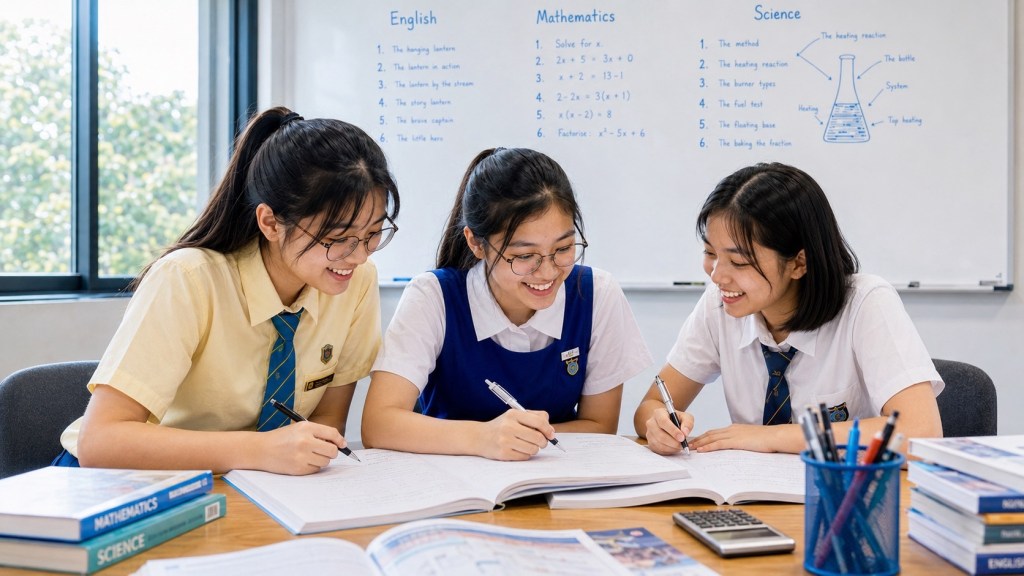
Active and passive voice change how a sentence presents an action. For Sengkang children, begin by identifying who or what performs the action and who or what receives it. ‘Hana opened the folder’ and ‘The folder was opened by Hana’ describe the same basic event while giving the reader different starting points.
This family guide explains the sentence roles, verb forms and meaning checks behind those changes. It includes original examples, a fictional paragraph, diagnostic prompts and independent practice with explained answers. Use the sections that fit current schoolwork; the more complex forms are extensions rather than a fixed primary-level timetable.
Did you know? A sentence containing ‘was’ is not automatically passive. ‘Hana was tired’ describes a state, while ‘The folder was opened’ presents an action affecting the folder. Looking for one familiar word is less reliable than checking the complete structure and meaning.
EDUKATE SENGKANG · FAMILY LEARNING
Choose your next learning step
Route 1: Track the roles — Identify the action and the affected object.
Route 2: Build simple forms — Keep tense and agreement clear.
Route 3: Read a paragraph — Compare transformation with editing.
Route 4: Try the practice — Check eight tasks with explained answers.
Route 5: Read the FAQs — Resolve common voice questions.
Full chapter index · Subject learning entrance · Sengkang neighbourhood guide
Contents
Chapters 1–6
Chapters 7–12
Chapters 13–18
Chapters 19–24
Chapters 25–25
Begin with a clear action: ‘Hana carried the folder.’ Hana performs the carrying, and the folder is the thing carried. In this active sentence, Hana is the subject and the folder is the object. Naming both roles gives the child something concrete to track when the sentence changes its presentation.
In ‘The folder was carried by Hana’, the folder becomes the grammatical subject. Hana remains the person who performed the carrying, expressed in the by phrase. The event has not become a different event merely because the subject changed. This distinction between sentence position and real-world role is central to understanding the passive.
Ask two questions separately: ‘What is the subject of this sentence?’ and ‘Who did the carrying?’ In the passive example, the answers differ. If a child assumes that the subject always performs the action, a passive sentence can become confusing. Use pointing and names before relying on grammatical labels alone.
Keep early examples short and unambiguous. A familiar object and a straightforward action leave room to think about the structure. Once the roles are secure, longer phrases can be added. There is little benefit in making the first transformation difficult because of unfamiliar vocabulary as well as unfamiliar grammar.
A straightforward active-to-passive transformation needs an object that can become the passive subject. ‘Maya painted the sign’ has the sign as its object, so ‘The sign was painted by Maya’ works. The child can point to the thing affected by the painting and follow it into the new sentence.
‘Maya arrived’ does not have that kind of object. An ordinary passive such as ‘Was arrived by Maya’ does not follow. Do not force every sentence into a pattern just because an exercise concerns voice. First check how the verb is being used in the particular sentence.
Some verbs have more than one use. ‘Amir opened the door’ has an object, while ‘The door opened’ does not present an object in the same structure. The second sentence is not passive merely because the door undergoes a change. Ask about the grammar of the actual sentence rather than assigning one permanent label to every use of a verb.
An effective sorting activity uses a small mixed set: ‘Nina lifted the box’, ‘The child slept’, ‘Amir cleaned the table’ and ‘The guests arrived’. Invite the child to identify which sentences support the introductory passive pattern and explain the object in each suitable case. Recognising an unsuitable transformation is part of understanding the method.
Take the active statement ‘The caretaker checks the gate every morning.’ A corresponding passive is ‘The gate is checked by the caretaker every morning.’ The gate becomes the subject. Is supplies the present simple form of be for that singular subject, and checked is the past participle of check.
Keep the time meaning stable. ‘The gate was checked’ would normally shift the sentence into a past-time presentation. If the task asks for a voice change while preserving the original meaning, that change is not appropriate. Ask the child to identify the original tense before selecting the passive helper.
For a plural subject, use the matching form: ‘The gates are checked every morning.’ The subject of the passive now controls is or are. Do not choose is because the caretaker is singular when the passive subject is the gates. Sentence roles and agreement must be reconsidered after the transformation.
Use a small checklist in spoken form: identify the object, make it the subject, choose the appropriate be form, use the past participle and decide whether the agent should be expressed. Then reread for meaning. The checklist is a support for reasoning, not a requirement to write a long explanation beside every simple example.
| Active | Passive | Time and agreement check |
|---|---|---|
| Hana checks the folder. | The folder is checked by Hana. | Present; singular folder |
| Hana checks the folders. | The folders are checked by Hana. | Present; plural folders |
| Hana checked the folder. | The folder was checked by Hana. | Past; singular folder |
‘Hana carried the folder’ becomes ‘The folder was carried by Hana.’ The active event is in the past, so was fits the singular passive subject. With a plural object, ‘Hana carried the folders’ becomes ‘The folders were carried by Hana.’ The time stays past while agreement responds to the new subject.
Compare the incorrect ‘The folders was carried by Hana.’ The problem is not that passive sentences are inherently difficult. The new subject is plural and needs were in this context. Ask the child to underline the folders and connect it to the be form. This makes the repair specific.
Compare another error: ‘The folder was carry by Hana.’ The passive needs the past participle carried. Was alone does not supply the complete passive verb phrase. The child must check both the be form and the participle rather than treating them as interchangeable signs of past time.
Try a new example after teaching: ‘Amir washed the brushes.’ A suitable transformation is ‘The brushes were washed by Amir.’ Ask why were is used and what washed contributes. An independently explained parallel example shows more than copying the first corrected sentence.
For many regular verbs, the past simple and past participle share a form: painted, cleaned and carried. That resemblance can hide the fact that the passive uses a participle. An irregular example makes the distinction clearer: ‘Maya wrote the note’ becomes ‘The note was written by Maya’, not ‘was wrote’.
Try ‘Amir took the photograph’ and ‘The photograph was taken by Amir.’ The past simple took and participle taken differ. Keep a short record of a few verbs appearing in current reading rather than attempting to memorise an enormous list in one sitting. Each form should be used in a meaningful sentence.
If a child writes ‘was writed’, they may understand the passive structure but not the conventional participle. If they write ‘written by Maya’ without an appropriate finite verb in a complete sentence task, the issue is different. Diagnose the actual gap before repeating the whole lesson from the beginning.
A reliable dictionary can help verify an unfamiliar verb’s forms. Ask the child to check the relevant entry and place the participle back into their sentence. The reference tool should support a decision the learner understands. Selecting a word because it looks more advanced does not establish that its grammatical form fits.
In ‘The children clean the room’, the subject is the children. In ‘The room is cleaned by the children’, the passive subject is the room. The form is matches room, even though children remains plural later in the sentence. The by phrase identifies the agent but does not control that agreement.
Reverse the number pattern: ‘The teacher checks the papers’ becomes ‘The papers are checked by the teacher.’ The teacher is singular, but the papers is the plural passive subject. Ask the child to ignore neither phrase; each has a different job. The agreement decision concerns the grammatical subject.
Longer noun phrases need the same care. ‘The box of pencils was moved’ has box as the head of the singular subject phrase. ‘The pencils in the box were moved’ has pencils as the head of the plural subject phrase. A nearby noun does not automatically determine the verb form.
Use two colours if helpful: one for the full subject phrase and another for the be form. Then ask for an oral explanation without the colours. The support should make the relationship easier to notice and eventually unnecessary. It should not become a colouring exercise disconnected from the sentence’s meaning.
‘Hana is painting the sign’ presents an action in progress. A corresponding passive is ‘The sign is being painted by Hana.’ The phrase is being painted retains that in-progress meaning. Changing it simply to is painted would alter the presentation and can suggest a regular process or other context rather than the same ongoing event.
For past continuous, compare ‘The children were cleaning the room’ with ‘The room was being cleaned by the children.’ Was agrees with the singular room and being cleaned preserves the continuous passive structure. The active helper were does not remain unchanged simply because it appeared in the original sentence.
Keep the number of new demands manageable. A child who is still uncertain with the simple past passive may not need a full continuous-passive lesson immediately. Show the contrast when it addresses current work or a question from reading. The purpose is accurate understanding, not reaching the longest possible verb phrase.
Ask what information would be lost if being disappeared. Have the child imagine a scene in progress and compare it with a general statement. This connects the form to meaning and prevents the phrase from becoming an unexplained extra word inserted during transformation.
‘Maya has written the note’ can become ‘The note has been written by Maya.’ The passive includes been before the past participle written. The whole phrase has been written preserves the perfect construction. Do not reduce it to was written merely because both sentences can concern an earlier event; their grammatical presentation differs.
With a plural passive subject, use have: ‘The notes have been written.’ With a past perfect construction, ‘Maya had written the note’ becomes ‘The note had been written by Maya.’ The original time relationship should guide the choice. A transformation task asks for more than keeping the main action word recognisable.
Introduce these forms through a clear pair rather than a dense table of every possible tense. Ask which part carries agreement, which part connects to the perfect structure and which is the action’s participle. If those labels exceed current learning, keep the explanation in ordinary language and return to the sentence pair.
These are useful extension examples for families whose children encounter them in schoolwork or reading. They do not imply that every younger learner should master the entire set at once. Select a pattern the child can explain and practise a nearby new example before adding another.
‘The class will display the poster’ becomes ‘The poster will be displayed by the class.’ Will remains, be introduces the passive structure and displayed is the participle. The sentence still concerns the planned or predicted future action expressed in the original. The new subject changes the starting point, not the basic event.
A modal can also remain: ‘You must return the folder’ becomes ‘The folder must be returned.’ Must expresses an obligation; may would express a different meaning. Do not swap one modal for another merely because both fit grammatically before be. Meaning preservation includes certainty, possibility and obligation.
Try ‘The children can complete the puzzle’ and ‘The puzzle can be completed by the children.’ Ask what can contributes. Then contrast must. Both versions are grammatical, but they are not equivalent statements. A fluent sentence can still fail a transformation if it changes the original message.
Keep an eye on the main verb form. ‘The poster will be display’ is incomplete for the intended passive; displayed is needed. A child who can identify that specific error may require participle practice rather than another explanation of subject and object. Use the smallest useful repair.
A negative must remain negative when meaning is preserved. ‘Hana did not open the folder’ becomes ‘The folder was not opened by Hana.’ Removing not would reverse the claim. The active helper did is no longer needed in that position because the passive verb phrase uses was with the participle.
For a question, compare ‘Did Hana open the folder?’ with ‘Was the folder opened by Hana?’ The passive question places was before the subject. It is not completed by adding a question mark to ‘The folder was opened by Hana’ if the task asks for the ordinary neutral written question pattern.
A question word also has a role. ‘When did Hana open the folder?’ can become ‘When was the folder opened by Hana?’ When still asks for the time. Check that the transformed question requests the same information rather than asking who opened it or whether it was opened at all.
Do not introduce every possible question pattern in one exercise. Start with a short yes-or-no pair, then one question-word pair. Ask the child to predict a possible answer to each. Matching the answer category provides a meaning check alongside the grammatical transformation.
‘She invited him’ can become ‘He was invited by her.’ Him becomes he when it occupies the subject position, while she becomes her after by. The people and event remain the same. A child who simply moves the original pronouns without changing their forms may produce ‘Him was invited by she’.
Use names first if the pronouns obscure the roles: ‘Maya invited Amir’ and ‘Amir was invited by Maya.’ Then replace each name with the appropriate pronoun in its new grammatical position. This separates role tracking from pronoun-form knowledge and makes the source of an error easier to identify.
Try ‘They helped us’ and ‘We were helped by them.’ We agrees with were in the past passive, and them follows by. Ask the child to say who received the help and who provided it. The grammatical changes should not make the participants switch real-world roles.
Keep references clear across a paragraph too. Even a correctly formed passive can become confusing if several people are referred to as they or them without enough context. Sometimes retaining a name is the simplest edit. Avoid replacing every noun with a pronoun merely to reduce repetition.
A passive sentence can omit the agent when the identity is unknown, obvious or unimportant for the purpose. ‘The folder was found under the table’ reports the finding without naming the finder. That may be sufficient in one context. In another, the finder is the main point and should be identified.
Omitting an agent can reduce information. ‘Hana opened the folder’ and ‘The folder was opened’ are related, but the second does not explicitly preserve who opened it. In a task requiring all original information, include by Hana. In an editing task aimed at concision, the surrounding context may justify omission.
Ask the child to name the task before deciding. Are they practising a complete transformation, writing a report or choosing a natural sentence for a story? There is no universal rule that every passive must end with a by phrase. Equally, there is no reason to remove an important agent automatically.
Give two versions of a sentence and ask what a reader learns from each. ‘The sign was repaired’ gives an event. ‘The sign was repaired by the caretaker’ adds responsibility for that action. The discussion connects grammar to information rather than treating the shorter version as always better.
Active and passive versions can differ in emphasis and flow. If a paragraph is already discussing a poster, ‘The poster was painted by Hana’ keeps that topic at the beginning. If the paragraph is about Hana’s actions, ‘Hana painted the poster’ may connect more naturally. Read the surrounding sentences before declaring one version preferable.
Try these two sequences: ‘Hana collected the brushes. Hana painted the poster. Hana put it away.’ The repeated subject keeps attention on Hana. A different sequence might be ‘The poster was wet. It was carried carefully to a drying shelf.’ The passive continues attention on the poster while the carrier may be unimportant in that context.
Neither voice automatically makes writing formal, lively or sophisticated. A direct active sentence often communicates an action clearly, while a well-chosen passive can organise information effectively. The useful question is what the reader needs to follow next. Grammar serves that decision.
Ask the child to explain a choice rather than convert every sentence. They might say, ‘I kept the folder first because the paragraph is about what happened to it.’ That is a meaningful editing reason. Requiring passive voice everywhere can produce awkward writing and conceal whether the child understands its purpose.
Consider the fictional statement ‘The model was damaged.’ It identifies an event affecting the model but does not say who or what caused it. The sentence can be accurate when the cause is unknown. It can also leave an important question unanswered if the writer has relevant information and the reader needs it.
Ask what the sentence establishes and what it leaves open. It does not prove that a person deliberately damaged the model. It does not identify a responsible person. It does not tell us whether the damage was accidental. Avoid filling those gaps from imagination merely because the passive does not state an agent.
Now compare ‘A falling book damaged the model.’ That active sentence supplies a cause. The equivalent passive ‘The model was damaged by a falling book’ retains it. The agent or cause need not be a person with an intention. Tracking the action accurately helps prevent moral judgments being inferred from grammar alone.
This makes a useful reading habit beyond a worksheet. When an important event is described, ask whether the source identifies the relevant actor or cause and whether more information is needed. Do not label every passive as evasive. Judge the information provided and the purpose of the statement.
‘The sign was painted by Hana with a broad brush’ gives two different relationships. By Hana identifies the person who did the painting. With a broad brush identifies an instrument used. The phrases are not interchangeable merely because both follow the passive verb.
Compare ‘The note was written by Amir’ with ‘The note was written with a blue pen.’ The first answers who wrote it; the second answers what was used. A sentence can state both, either or neither depending on the information available and the writing purpose.
Keep the examples within ordinary introductory uses. English prepositions have many relationships, and not every by phrase in every sentence names an agent. ‘The folder was left by the door’ can use by to mean near, with the door as a location rather than the performer of leaving.
Ask the child to test the meaning of the phrase, not just locate the word by. Could the named person or thing perform or cause the action in the intended event? Does the phrase instead describe a place, method or time? This prevents a simple passive clue from becoming another unreliable word-spotting rule.
‘The room was quiet’ contains was, but it describes a state through an adjective. It does not present the room as receiving a quieting action in the same structure as ‘The room was cleaned.’ The presence of be is one clue to inspect, not a sufficient test by itself.
‘The children were drawing’ is active past continuous. The children perform the drawing, and were drawing is not a passive verb phrase. A corresponding passive with an object would need more information: ‘The children were drawing a map’ can become ‘A map was being drawn by the children.’
Some participle-like forms can describe a state, and context may make their analysis less straightforward. For an introductory lesson, choose clear action examples and do not demand an absolute classification of every short phrase such as ‘The door was closed’ without context. It can describe an event or a resulting state in different uses.
Teach a practical question: is the sentence presenting an action affecting its subject, using the relevant passive structure? Then check the full clause. A learner who can explain a clear contrast is making better progress than one who labels every was sentence passive with great confidence.
Here is a fictional paragraph: ‘Hana carried the class poster to the drawing table. Amir checked the title. The children added a blue border. Their teacher displayed the finished poster near the classroom door.’ These are original teaching events, not a report about an actual Sengkang class or child.
Identify the objects: the class poster, the title, a blue border and the finished poster. Each active sentence supports an ordinary passive transformation. Also notice the time frame: carried, checked, added and displayed describe past events. The transformed version should retain that time frame unless a separate revision is intended.
Before transforming, ask what the paragraph is about. It could be a recount of the children’s actions or a description of the poster’s preparation. Both are possible writing purposes. A mechanical transformation exercise and a paragraph-improvement task therefore have different success criteria.
Try one sentence independently first. ‘Amir checked the title’ becomes ‘The title was checked by Amir.’ Explain the singular title, the past form was and the participle checked. Once that is secure, the child can attempt the remaining sentences with fewer prompts.
A complete passive transformation of the paragraph could be: ‘The class poster was carried to the drawing table by Hana. The title was checked by Amir. A blue border was added by the children. The finished poster was displayed near the classroom door by their teacher.’ The agents and basic sequence are retained.
That version demonstrates form control, but a writer might prefer a mixture for a natural paragraph. For example: ‘Hana carried the class poster to the drawing table, where Amir checked the title. The children added a blue border. The finished poster was then displayed near the classroom door.’ The final agent is omitted in this edited version.
Discuss the information difference. The mixed version no longer explicitly says the teacher displayed the poster. It may be acceptable if that identity is unnecessary for the writing purpose, but it is not a complete information-preserving transformation. Make that trade-off visible instead of calling the version universally better.
Ask the child to justify one choice: retaining an agent, keeping an active sentence or making the poster the subject. A strong explanation connects structure with the intended message. Copying a model paragraph can make the page tidy without showing whether the learner can make that decision independently.
If a child writes ‘Hana was carried by the poster’, the participants have switched roles. Return to the event: who carried what? Use names and objects to rebuild it before discussing tense. A perfectly formed passive can still describe the wrong action.
If the child writes ‘The poster was carry by Hana’, the roles may be correct while the participle needs repair. If they write ‘The posters was carried’, agreement needs attention. If they write ‘The poster is carried’ for a specific past event, the tense presentation has changed. These errors need different explanations.
Check meaning beyond the main action. Was the original negative retained? Did must become may? Did a plural object become singular? Did a time phrase disappear? A transformation can preserve the people and verb yet lose an important condition. Read the original and revised versions side by side.
Finish the diagnostic with a nearby independent example. Keep the vocabulary familiar while changing the number or tense that caused difficulty. Record the specific support needed. ‘Tracks roles; needs a cue for irregular participles’ gives a useful next target and avoids turning one error into a broad label about English ability.
Check determiners as well as verbs. ‘A child opened the folder’ does not identify the child in the same way as ‘The child opened the folder.’ A corresponding passive can retain that distinction: ‘The folder was opened by a child.’ Replacing a with the silently adds an identification assumption. Small words can preserve or alter information even when the main transformation is correct.
Try a second contrast involving quantity: ‘Two children carried the boxes’ should retain two children and the plural boxes if the task requires all details. ‘The box was carried by the children’ changes both the object number and the description of the group. Ask the learner to circle quantities and determiners before transformation, then check them afterwards.
A useful final comparison is to rebuild the active from the proposed passive. If ‘The boxes were carried by two children’ returns to ‘Two children carried the boxes’, the roles and quantities align. This reverse check does not prove every nuance has been preserved, but it exposes many accidental changes. Combine it with the time, negative and modal checks rather than relying on one test alone.
Task one: change ‘Hana checks the labels’ into the present simple passive while retaining the agent. Task two: change ‘Amir painted the sign yesterday’ into the past simple passive. For each, identify the new subject and explain the form of be.
Task three: repair ‘The note was wrote by Maya.’ Task four: change ‘They helped us’ into the past simple passive. Keep the same people in the same real-world roles and explain any pronoun changes.
Task five: change ‘The class will display the poster’ into the passive. Task six: change ‘Hana did not open the folder’ into the passive. Preserve the future meaning in the first and the negative meaning in the second.
Task seven: decide whether ‘The children were drawing’ is passive. Explain the roles and verb phrase. Then add an object to form ‘The children were drawing a map’ and give a corresponding passive version.
Task eight: compare ‘The model was damaged’ with ‘The model was damaged by a falling book.’ State what additional information the second provides. Does the first sentence prove that someone deliberately damaged the model? Explain the information limit.
Work independently before reading the answers. A parent can select tasks that fit the child’s current learning. For a beginner, tasks one, two and three may provide enough evidence. The continuous form and information-limit discussion can be explored separately without turning one sitting into a test of every chapter.
Answer one: ‘The labels are checked by Hana.’ The labels is the plural passive subject, so are fits the present simple construction. Checked is the participle. The original singular subject Hana does not control the new verb’s agreement.
Answer two: ‘The sign was painted by Amir yesterday.’ The sign is singular and the event remains past, so was painted is appropriate. Keeping yesterday preserves the stated time detail. A different placement such as ‘Yesterday, the sign was painted by Amir’ can also work.
Answer three: ‘The note was written by Maya.’ Written is the participle needed after was in this passive. Wrote is the past simple form used in an active sentence such as ‘Maya wrote the note.’ The distinction appears clearly with this irregular verb.
Answer four: ‘We were helped by them.’ Us changes to we in the subject position, and they changes to them after by. We refers to the people receiving help, while them refers to those providing it. Were fits the past passive with we.
Answer five: ‘The poster will be displayed by the class.’ Will remains and the passive uses be displayed. Answer six: ‘The folder was not opened by Hana.’ Not preserves the negative claim. ‘The folder was opened’ would reverse it, while ‘is not opened’ would change the tense presentation.
Answer seven: ‘The children were drawing’ is active past continuous, with the children performing the action. It is not passive merely because were appears. With the added object, a corresponding passive is ‘A map was being drawn by the children.’ Being drawn preserves the continuous passive form.
Answer eight: the second sentence identifies a cause, a falling book. The first reports damage without identifying a cause or an actor. It does not prove deliberate action by a person. A careful reader can recognise the missing information without inventing an explanation.
Compare answers by meaning and structure rather than insisting on one exact word order for every phrase. If a child’s version places yesterday elsewhere but remains clear, that may be acceptable. If it omits an agent in a task requiring the agent, explain the information loss. A valid alternative and an altered message are different cases.
Choose three everyday fictional actions: someone opens a folder, paints a sign or checks a label. Write a name, an action and an object on separate cards. Build an active statement, then ask the child to make the object the new subject while preserving the event.
Start with names instead of pronouns and regular verbs instead of irregular ones. Once the child explains the basic pattern, change one feature at a time. A plural object tests agreement; an irregular verb tests the participle; a negative tests meaning preservation.
Let the child set a sentence for you and explain your answer. If you make a deliberate error, invite a specific repair rather than a vague verdict of wrong. Ask which participant, verb form or detail needs attention. The teaching value lies in the explanation.
A quiet activity at home fits a Sengkang family routine without requiring an outing or paid material. Stop after a small successful set and return to normal reading or writing. The skill becomes useful when the child can recognise a voice choice in an actual paragraph, not only manipulate cards.
Use four questions when reviewing a transformation: who did what, what is the new subject, does the verb preserve time and agreement, and has the original information been retained? These checks cover different decisions. Do not replace them with a single instruction to make the sentence sound right.
In a writing task, add a purpose question: why choose this voice here? The answer may concern keeping the topic first or focusing on an affected object. If the child has no useful reason to change a clear active sentence, leaving it active can be a sound choice.
Keep a brief record of one independent success and one next step. For example, ‘Can form past passive with plural subjects; next check irregular participles.’ Such a note is more actionable than a percentage when the practice set mixes several kinds of decision.
If uncertainty persists in current schoolwork, share a concrete sentence pair and the child’s explanation with the teacher. Ask which form or reasoning step is being taught next. That keeps family support aligned with the actual task rather than assuming every learner should cover every extension in this guide immediately.
Is passive voice always bad writing?
No. It can help organise information around an affected object or an event whose agent is unknown or unimportant. Choose it when that serves the reader. A sentence does not improve merely because it has been made passive, and an active sentence does not improve merely because it is shorter.
Does every passive need a by phrase?
No. An agent may be omitted when the context permits. In a task requiring all original information, include a supplied agent if removing it would lose that information. The writing purpose and instructions determine whether omission is suitable.
Does was always mean passive?
No. ‘Hana was tired’ describes a state, and ‘Hana was drawing’ is active continuous. Check the complete structure and roles. A single word can be a useful clue to inspect but cannot establish the classification on its own.
Can every active sentence become passive?
Not through the introductory object-to-subject pattern. An appropriate object is needed in the relevant use of the verb. ‘The children slept’ does not support an ordinary transformation such as ‘Was slept by the children.’ Examine the actual sentence rather than forcing a pattern.
Why does my child write was wrote?
They may know the passive needs a helper but confuse the past simple form with the participle. Compare wrote in an active sentence with written in the passive. A short set of meaningful irregular-verb pairs can address that specific gap.
Must younger children learn all the forms here?
No. Select the forms encountered in current lessons and reading. Continuous and perfect passives can be extensions. Secure role tracking and simple forms before adding several new demands at once.
How can I judge a different answer from the model?
Check whether it preserves the event, participants, time, number, polarity and other required details, and whether its grammar is sound. Phrase order can sometimes vary. A changed meaning is more significant than a harmless difference in where a time phrase appears.
A useful voice change preserves the event while changing how the sentence presents it. Identify the roles, choose the new subject and build the verb phrase carefully. Then check the original details. Those steps explain why a transformation works and help a child repair a new example independently.
For related foundations, use the pronoun reference guide and the guide to asking questions. For checking a complete piece of writing, continue to editing Primary English.
The next useful step can be one sentence the child explains without help. Ask why its subject and verb fit, what information it retains and whether the chosen voice serves its reader. That is a stronger learning result than a page of transformed sentences whose meaning has never been discussed.
Sources and further reading
British Council LearnEnglish: active and passive voice
Reviewed 21 October 2026. Original eduKateSengkang family-learning material. Select examples to fit current schoolwork and teacher guidance.
