
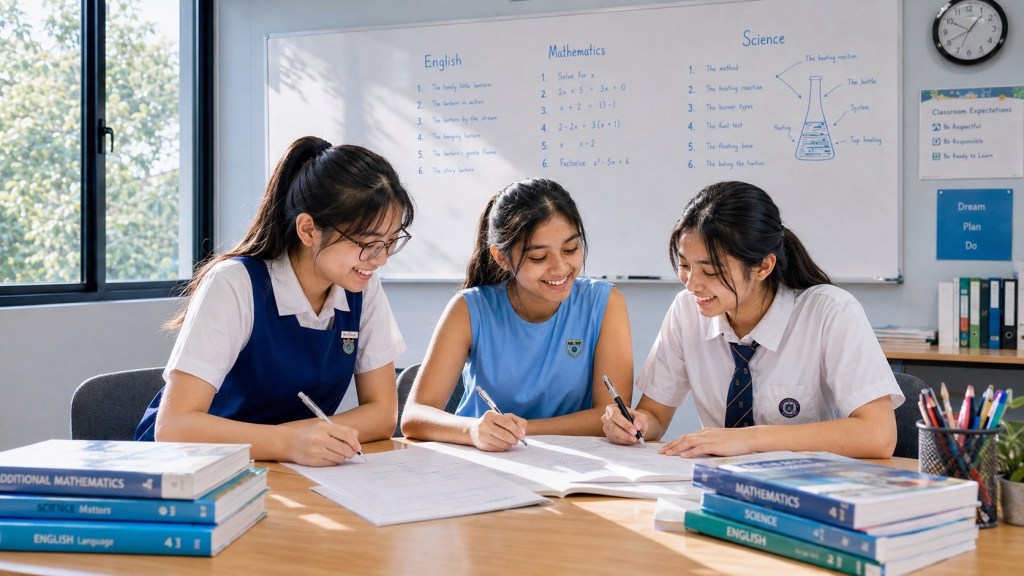
Did you know? Combined Science revision can become clearer when you keep each science’s topics distinct and connect shared skills deliberately. Confirm your pair and G level, make two topic lists, then practise choosing the relevant concept before calculating or writing an explanation.
If you mix up terms, compare their meanings in context rather than memorising one general science paragraph. If one science is weaker, give it extra practice while maintaining the other. If questions feel unfamiliar, identify the system, evidence and required relationship before deciding which knowledge to use.
SEAB lists G2 Science pairs under K223, K224 and K225, and G3 pairs under K326, K327 and K328: Physics–Chemistry, Physics–Biology and Chemistry–Biology respectively. G1 Science is a separate syllabus. Use the current requirements for your actual pair; a combined course is not the same route as taking two pure sciences.
Find your next learning step
eduKateSengkang · Effective learning series
Start with the pair and the level · Separate topic knowledge before mixing questions · Compare similar words by their actual meaning · Give the weaker science extra time with a floor for both · Check whether you can select and transfer independently
Contents: eight practical study steps
- Start with the pair and the level
- Carry primary skills forward with new precision
- Separate topic knowledge before mixing questions
- Compare similar words by their actual meaning
- Link calculations to the scientific relationship
- Explain evidence and practise required practical skills
- Give the weaker science extra time with a floor for both
- Check whether you can select and transfer independently
Write down your confirmed subject name, G level and syllabus code from school. Divide the topic list into its two sciences and mark what has been taught. Use the appropriate syllabus as a scope check rather than relying on a pure-science resource to decide what you must learn.
Posting Groups concern secondary admission; G levels describe individual subjects. Your revision plan should follow the subject you actually take. Ask the teacher which resources match that route and how the assessment and practical requirements apply to your cohort.
Primary 1–2 pupils can develop observation and number habits through age-appropriate learning; this is not a claim of a separate primary Science examination at those levels. Primary 3–4 Science builds useful observation and explanation habits. Primary 5–6 and PSLE work can strengthen evidence selection and fair-test reasoning.
Secondary science adds more specialised models, terminology and mathematical relationships. Keep the habit of asking what changed and what evidence supports the answer, while learning the new concept accurately. A familiar primary explanation may need development before it fits a secondary question.
Choose one topic from each science and write what its central concepts explain. Attempt a short question in each separately, checking the reasoning. If a concept is missing, learn it with a worked example and try a comparable problem before introducing a mixed set.
When both are becoming manageable, alternate questions and name the relevant concept before answering. This checks selection as well as knowledge. Avoid combining unfamiliar topics so early that every error becomes impossible to diagnose.
Keep a small note of terms you confuse. State what each means in the relevant scientific context and add a teacher-checked example. Identify the system or process in the question before deciding that a familiar word calls for the same explanation everywhere.
For instance, noticing the word energy does not tell you the complete mechanism. Ask which transfer or change the question concerns and what model explains it. The useful comparison is between meanings and relationships, not just the spelling of terms in two chapters.
Identify what quantities are known and what must be found. Choose the relationship that fits the situation, keep units visible and check whether the result makes sense. A correct arithmetic operation can still answer the wrong scientific question.
After feedback, distinguish a concept-selection error from an algebra, unit or arithmetic error. Practise the actual weak step, then return to the complete task. Useful maths habits support both sciences, but the scientific model determines which calculation is appropriate.
For a data question, identify the relevant trend or comparison and connect it to the scientific idea. Distinguish an observation from the explanation offered for it. When evaluating an investigation, address the specific measurement or control that affects the question.
For the 2027 G2 pairs, experimental skills are assessed through theory questions; there is no practical test. The G3 pairs include a practical test worth 15%. Follow teacher-supervised preparation for your actual syllabus: explaining an investigation on paper and carrying it out require different practice.
Use recent marked work to identify the weaker topic or skill, rather than choosing from an overall feeling. Protect a manageable revision task for each science, then give an additional slot to the current gap. One confident component does not remove the need to revisit it.
A week can include retrieval in both sciences, a focused repair in one and a short mixed set afterwards. Fit the plan around schoolwork and other subjects. If the workload remains unmanageable, ask the teacher which prerequisite deserves attention first.
Try a short mixed set without the original notes. Before each answer, identify the concept and explain why it applies. Afterwards, record whether errors concern knowledge, selection, explanation or calculation. Use that record to choose the next session.
Parents can ask the student to demonstrate one repaired step and one remaining question. Compare similar early and later attempts instead of measuring progress by pages completed alone. Clearer concept choice, more precise explanations and less prompting are useful signs to discuss with the teacher.
Continue with the learning series
How students study SEC G1, G2 and G3 subjects
Official syllabus and source checks
Checked on 10 October 2026. Confirm the texts, assessment requirements and course arrangements for your examination year with your teacher.
SEAB 2027 G2 Physics–Chemistry (K223)
SEAB 2027 G2 Physics–Biology (K224)
SEAB 2027 G2 Chemistry–Biology (K225)
SEAB 2027 G3 Physics–Chemistry (K326)
SEAB 2027 G3 Physics–Biology (K327)
SEAB 2027 G3 Chemistry–Biology (K328)
SEAB 2027 G3 school-candidate syllabus directory
