
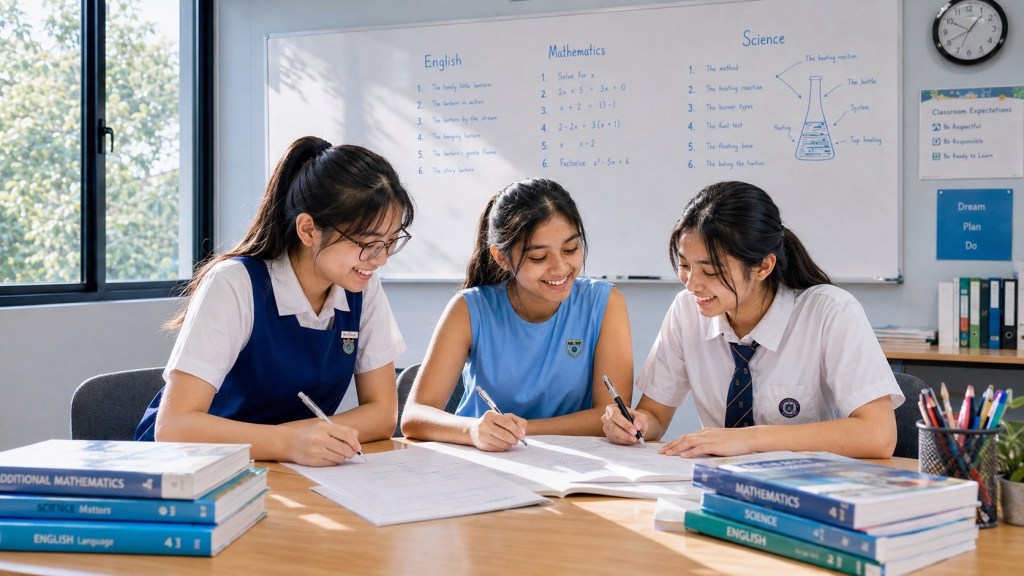
Did you know? Preparing for G1 Mobile Robotics starts long before a student builds a robot. Primary English helps them follow a task, Mathematics helps them measure and compare, and Science helps them distinguish a prediction from a result. To study effectively today, choose one teacher-approved diagram or simulation, explain what each part does, predict one outcome, then check and record what actually happened.
From Primary 1–2, practise ordered instructions and position language; from Primary 3–4, add measurements and simple explanations; from Primary 5–6 and PSLE, connect diagrams, evidence and calculations. In secondary school, turn these foundations into a repeatable routine: understand the requirement, plan a test, perform permitted work, inspect the result and explain the next change. Early preparation means building learning habits, not teaching the upper-secondary examination to young children.
Check the qualification before choosing a revision plan. SEAB’s 2027 G1 directory lists Mobile Robotics, code K130, for approved schools, but the syllabus explicitly identifies joint MOE–ITE Applied Subject Certification, not Singapore–Cambridge SEC certification. PG1, PG2 and PG3 are posting groups, not a guarantee of this elective. Ask your school about availability and your cohort’s syllabus; use this guide for learning, not as a promise of entry or an unsupervised construction manual.
Find your next learning step
Understand the subject · Build the primary foundations · Try a worked learning example · Check the qualification · Check your progress
Choose your question: article contents
- What should a student learn before touching the robot?
- How do Primary 1–2 habits become a robotics foundation?
- What should change in Primary 3–4?
- How do P5–6 and PSLE skills help at secondary level?
- How do you learn by testing rather than guessing?
- What does the 2027 assessment route mean for revision?
- What is a manageable weekly study routine?
- How can you tell whether learning is improving?
A moving machine is exciting, but the first useful question is wonderfully ordinary: what must it do? Write the requirement in a sentence that can be checked. ‘Works well’ is vague. ‘In this classroom simulation, move to the marked position and stop’ gives the learner an observable finish. Keep the teacher’s actual task conditions alongside this sentence so that the student does not solve a different problem.
Split an approved system diagram into input, decision and output. An input supplies information, a decision determines the response, and an output performs an action. The labels are a learning scaffold, not a substitute for the course’s precise terminology. Ask the student to explain one connection aloud. If the explanation stops at ‘this wire goes there’, return to the purpose of the connection before proceeding.
Use paper arrows, a drawn grid or a classroom-approved screen activity. Let a child give three instructions to move a counter from one square to another. Then change the starting square and ask whether the same instructions still work. That small surprise teaches a valuable idea: instructions depend on starting conditions. No electronic equipment is needed to make the reasoning visible.
Read the directions together, then let the child repeat them in their own words. If ‘turn right’ becomes ‘move right’, compare the actions gently. Praise the corrected explanation rather than only a successful finish. These activities support ordinary primary language and reasoning; they are optional connections, not official P1–2 Mobile Robotics syllabus requirements.
Bring measurement into the conversation. A paper route can have a length, a direction and a stopping point. Ask the learner to label units consistently and compare a prediction with an observed result. If a drawn route is 20 cm long, an answer of ‘20’ is incomplete until the student can explain what was measured and which unit describes it.
Use a simple record: prediction, observation and possible reason for a difference. Keep ‘possible’ in the sentence when the cause has not been tested. A child who learns to say ‘I suspect the starting position changed’ is building better reasoning than one who announces a cause without evidence. This transfers to Science investigations and Maths checking as well as later technical work.
PSLE preparation can strengthen the habits that technical learning needs: read a diagram carefully, identify relevant information, show calculations and justify a conclusion. After an ordinary school question, ask what changed, what stayed the same and what evidence supports the answer. The aim is to connect established primary learning, not to add a second examination timetable.
Once the student enters secondary school, use the actual subject materials to extend those habits. Make a vocabulary page with a term, a diagram label and an explanation of its role. Keep everyday descriptions beside the correct technical words until the meaning is secure. Knowing a label is helpful; being able to explain its function in an unfamiliar approved diagram is a stronger check.
Imagine an illustrative simulation in which a robot should stop at a marker but travels beyond it. Record the overshoot first. Do not immediately declare that a sensor has failed. The observed result could have several explanations, and the exercise is to narrow them using the permitted evidence. Review the initial conditions and the instruction sequence before choosing one teacher-approved test.
Keep a fault log with four short entries: expected result, actual result, suspected cause and next permitted check. Change one condition at a time where the task allows it, and record whether the outcome changes. A log also makes a teacher’s feedback more useful: ‘It failed’ becomes ‘This result differed from this prediction under these conditions.’ Physical troubleshooting belongs in supervised lessons with approved equipment.
The K130 syllabus includes a written paper and two practical papers. These cover conceptual understanding alongside interpreting a control-circuit diagram and integrating and testing a mobile robot. The practical emphasis means that reading notes alone is an incomplete preparation method. Students need their school’s authorised practical lessons as well as recall, diagram interpretation and explanation practice.
Do not confuse an extracurricular robotics competition, a Computing course and this applied-subject certification. They may share interests without sharing assessment rules. Use the linked official syllabus and the teacher’s guidance to identify the work expected of your cohort. For assessed tasks, follow the rules on independent work, permitted assistance and resources; a revision guide does not override examination instructions.
Choose one concept and one approved task rather than a large collection of disconnected videos. Start with a brief explanation from memory, check it against the lesson, then interpret a new diagram or simulation example. End by writing the most useful correction in one sentence. Repeat the concept later in the week using a slightly changed example, not simply the identical picture.
Parents can ask, ‘What was the machine supposed to do, and what evidence showed whether it did that?’ The student should own the explanation and the log. Do not complete assessed work, buy equipment on the assumption that it is required, or encourage experiments with unfamiliar power sources. Ask the school what practice is appropriate before arranging physical activities outside class.
Look for three changes: clearer explanations of system functions, more accurate interpretation of diagrams, and more disciplined testing. A successful run is useful, but it does not prove the student understands why it worked. Ask the learner to predict what would happen if one stated condition changed in a paper example, then give a reason before looking at the answer.
If progress stalls, identify the smallest obstacle. Is it the wording of the requirement, a measurement, a technical term, or the sequence of checks? Bring one example to the teacher rather than a general complaint that robotics is difficult. The next useful step is usually a precise correction followed by another attempt—not a new label for the student’s ability.
Continue with the next useful guide
Computing: digital skills and independent problem-solving
Design and Technology: learning through projects
Official syllabus and scope
Checked on 10 October 2026. The learning routines and invented examples above are teaching suggestions, not official assessment questions or guarantees of subject access. Confirm your school’s offering, examination year and instructions. The linked G1 applied-subject syllabus specifies joint MOE–ITE certification, not SEC certification.
SEAB: 2027 G1 school-candidate directory
Explore the applied-subject learning routes. Mobile Robotics, Smart Electrical Technology and Retail Operations use the 2027 G1 joint MOE–ITE certification syllabuses, not SEC certification; Biotechnology K375 is a SEC G3 applied subject. All four require an approved school offering.
How Do Primary Learning Skills Prepare Students for G1 Mobile Robotics?
How Do You Study G1 Smart Electrical Technology Safely and Effectively?
How Do Primary English and Maths Skills Prepare Students for G1 Retail Operations?
How Do Primary Science Skills Prepare Students for SEC Biotechnology?
