
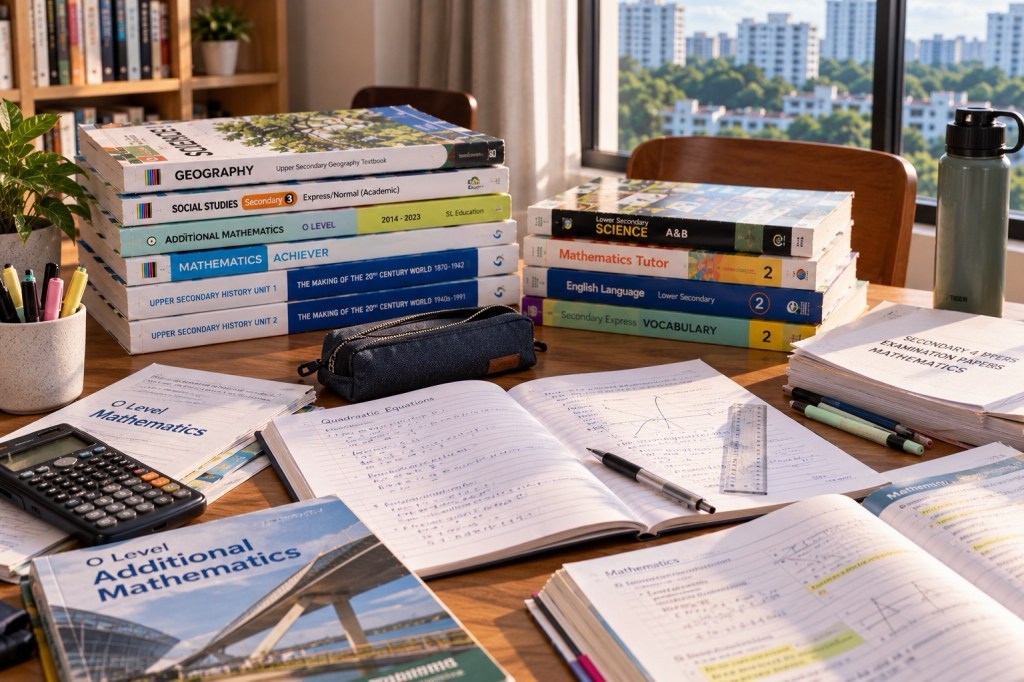
Learning G2 Mathematics with a Jurong West tutor should make mathematical structure visible. The student should learn to identify what a question is made of before trying to remember which formula appears in the textbook.
For 2027 SEC school candidates, SEAB lists G2 Mathematics as K210. The subject requires standard technique, but it also rewards problem solving, reasoning and mathematical communication.
For Jurong West families around Jurong West Central, Lakeside, Boon Lay and Pioneer, a nearby tutor may make the schedule easier. The learning advantage, however, comes from diagnosis. A wrong answer may begin with a misread condition, unstable fractions, weak algebra, a graph error, an incorrect unit or a missing check.
eduKate Sengkang teaches Secondary Mathematics in groups of up to three students. The tutor can therefore inspect the student’s working rather than only the final number.
G2 Mathematics tuition may be useful for students who need to:
- repair number-sense gaps;
- strengthen fractions, decimals, percentages and ratio;
- improve algebraic manipulation;
- connect equations and graphs;
- develop geometry and trigonometric reasoning;
- interpret statistics and probability more accurately;
- show essential working clearly;
- reduce calculator and sign errors;
- improve mixed-topic retrieval; or
- prepare systematically for K210.
Read: G1, G2 and G3 Mathematics Explained for Parents
Check the official 2027 SEC G2 syllabus list at SEAB
Mathematics Improves When the Representation Improves
A student may understand the numbers but not know how to represent the situation.
We teach learners to move between words, diagrams, tables, equations and graphs. The representation chosen often determines whether the problem feels easy or impossible.
Before asking, “Which formula?” ask, “What is the relationship?”
Number Sense
Secondary Mathematics still depends on reliable arithmetic.
Students strengthen directed numbers, fractions, decimals, percentages, powers and estimation. Calculator use is trained as a tool, not as a replacement for mathematical judgement.
An estimate made first gives the student a way to reject impossible results.
Ratio, Rate and Proportion
These ideas appear in scale, speed, similarity, finance and real-world questions.
Students learn to distinguish additive change from multiplicative change and to identify which quantity forms the reference base.
Algebra
Algebra is treated as a language for relationships.
Students learn to simplify, expand, factorise, substitute and solve while preserving equality.
We pay close attention to signs, brackets and fractions because small algebraic errors become expensive in longer problems.
Graphs
Graphs are taught as visual descriptions of relationships.
Students check axes, units, scale and coordinates, then connect the graph to equations and context.
The learner should be able to move both ways: equation to graph and graph back to meaning.
Geometry and Trigonometry
Students annotate diagrams rather than guess from appearance.
We identify what is given, what can be deduced and which relationship applies.
The final result is checked against the geometry and units.
Statistics and Probability
Students learn to interpret data before calculating from it.
Probability is approached through structured outcomes and relationships.
The aim is to make the answer evidence-based rather than intuitive.
The eduKate G2 Mathematics Runtime
1. Diagnose
We identify the first repeated weakness.
2. Rebuild
Older dependencies are repaired before the current chapter is pushed harder.
3. Model
The tutor demonstrates why the method applies.
4. Vary
One condition changes so the student sees what actually changes the mathematics.
5. Remove support
The learner completes a fresh problem independently.
6. Interleave
Earlier topics return in mixed practice.
7. Transfer
The student solves unfamiliar problems without a topic label.
Three G2 Mathematics Pathways
Repair
For a learner with gaps, we rebuild the earliest unstable dependency.
Stabilise
For a learner whose marks fluctuate, we train retrieval, checking, timing and mixed-topic recognition.
Extend
For a strong learner, we increase unfamiliarity, explanation and multi-step reasoning.
Why Working Matters
Good working is part of mathematical control.
- state the relationship;
- substitute clearly;
- show significant transformations;
- keep units visible;
- avoid premature rounding;
- label important quantities;
- check the final result.
When Should a Jurong West Student Begin G2 Mathematics Tuition?
- when fractions, percentages or ratio remain weak;
- when algebra is slow or error-prone;
- when the student can copy examples but cannot start alone;
- when graphs or diagrams are frequently misread;
- when calculator use replaces estimation;
- when topical work is strong but mixed papers are weak;
- when earlier topics are forgotten quickly;
- when K210 preparation needs more structure.
Jurong West Convenience and the Actual Classroom Location
A Jurong West Mathematics tutor may reduce weekly travel for west-side families.
Parents should still ask whether the tutor diagnoses the mechanism behind mistakes, inspects working and revisits corrected skills later.
eduKate Sengkang is not located in Jurong West. Our Sengkang/Punggol classroom is at 83 Punggol Central, Singapore 828761, by appointment.
Class Details
- Class size: up to 3 students
- Subject: G2 Mathematics
- SEC route: K210 for 2027 school candidates
- Duration: 1.5 hours
- Focus: number, algebra, graphs, geometry, trigonometry, statistics, probability and problem solving
- Method: diagnose → rebuild → model → independent practice → retrieval → transfer
- Location: 83 Punggol Central, Singapore 828761
Learning G2 Mathematics with a Jurong West Tutor
Good G2 Mathematics tuition should make the subject more understandable, not merely more intensive.
The learner should become better at seeing the structure, choosing a method, carrying out the working and checking the result.
For students who are behind, we rebuild. For students who are inconsistent, we stabilise. For students who are ready, we extend.
Task recognition
In G2 Mathematics, this part of the learning system is trained through number sense. The student is asked to do more than recognise a correct answer after it is shown. The learner must identify what the task requires, decide which knowledge or representation is useful, make an independent attempt and then inspect the result for signs that something has gone wrong. The tutor watches the decision process as carefully as the final answer because the same score can be produced by very different causes.
This matters for a student travelling from Jurong West because tuition time has to produce something that survives the journey back into school. A correction that only works inside the lesson is not enough. The idea should return later, appear in a changed form and eventually sit beside other topics so the learner has to choose it without being told. That sequence—understand, attempt, correct, retrieve, mix and transfer—is what turns a short-term success into a usable capability.
As the capability becomes more stable, support is reduced. The tutor stops supplying the first move, waits longer before intervening and asks the student to explain why the chosen route belongs. This can feel slower than simply showing the answer, but it builds a learner who can continue when the task is unfamiliar. The standard is therefore not perfect performance during tuition; it is increasingly organised performance when the tutor is silent.
Building a reliable first move
In G2 Mathematics, this part of the learning system is trained through algebra. The student is asked to do more than recognise a correct answer after it is shown. The learner must identify what the task requires, decide which knowledge or representation is useful, make an independent attempt and then inspect the result for signs that something has gone wrong. The tutor watches the decision process as carefully as the final answer because the same score can be produced by very different causes.
This matters for a student travelling from Jurong West because tuition time has to produce something that survives the journey back into school. A correction that only works inside the lesson is not enough. The idea should return later, appear in a changed form and eventually sit beside other topics so the learner has to choose it without being told. That sequence—understand, attempt, correct, retrieve, mix and transfer—is what turns a short-term success into a usable capability.
As the capability becomes more stable, support is reduced. The tutor stops supplying the first move, waits longer before intervening and asks the student to explain why the chosen route belongs. This can feel slower than simply showing the answer, but it builds a learner who can continue when the task is unfamiliar. The standard is therefore not perfect performance during tuition; it is increasingly organised performance when the tutor is silent.
Correction that changes future work
In G2 Mathematics, this part of the learning system is trained through graphs. The student is asked to do more than recognise a correct answer after it is shown. The learner must identify what the task requires, decide which knowledge or representation is useful, make an independent attempt and then inspect the result for signs that something has gone wrong. The tutor watches the decision process as carefully as the final answer because the same score can be produced by very different causes.
This matters for a student travelling from Jurong West because tuition time has to produce something that survives the journey back into school. A correction that only works inside the lesson is not enough. The idea should return later, appear in a changed form and eventually sit beside other topics so the learner has to choose it without being told. That sequence—understand, attempt, correct, retrieve, mix and transfer—is what turns a short-term success into a usable capability.
As the capability becomes more stable, support is reduced. The tutor stops supplying the first move, waits longer before intervening and asks the student to explain why the chosen route belongs. This can feel slower than simply showing the answer, but it builds a learner who can continue when the task is unfamiliar. The standard is therefore not perfect performance during tuition; it is increasingly organised performance when the tutor is silent.
Retrieval after delay
In G2 Mathematics, this part of the learning system is trained through ratio and rate. The student is asked to do more than recognise a correct answer after it is shown. The learner must identify what the task requires, decide which knowledge or representation is useful, make an independent attempt and then inspect the result for signs that something has gone wrong. The tutor watches the decision process as carefully as the final answer because the same score can be produced by very different causes.
This matters for a student travelling from Jurong West because tuition time has to produce something that survives the journey back into school. A correction that only works inside the lesson is not enough. The idea should return later, appear in a changed form and eventually sit beside other topics so the learner has to choose it without being told. That sequence—understand, attempt, correct, retrieve, mix and transfer—is what turns a short-term success into a usable capability.
As the capability becomes more stable, support is reduced. The tutor stops supplying the first move, waits longer before intervening and asks the student to explain why the chosen route belongs. This can feel slower than simply showing the answer, but it builds a learner who can continue when the task is unfamiliar. The standard is therefore not perfect performance during tuition; it is increasingly organised performance when the tutor is silent.
Choosing between methods
In G2 Mathematics, this part of the learning system is trained through geometry. The student is asked to do more than recognise a correct answer after it is shown. The learner must identify what the task requires, decide which knowledge or representation is useful, make an independent attempt and then inspect the result for signs that something has gone wrong. The tutor watches the decision process as carefully as the final answer because the same score can be produced by very different causes.
This matters for a student travelling from Jurong West because tuition time has to produce something that survives the journey back into school. A correction that only works inside the lesson is not enough. The idea should return later, appear in a changed form and eventually sit beside other topics so the learner has to choose it without being told. That sequence—understand, attempt, correct, retrieve, mix and transfer—is what turns a short-term success into a usable capability.
As the capability becomes more stable, support is reduced. The tutor stops supplying the first move, waits longer before intervening and asks the student to explain why the chosen route belongs. This can feel slower than simply showing the answer, but it builds a learner who can continue when the task is unfamiliar. The standard is therefore not perfect performance during tuition; it is increasingly organised performance when the tutor is silent.
Working under mixed conditions
In G2 Mathematics, this part of the learning system is trained through trigonometry. The student is asked to do more than recognise a correct answer after it is shown. The learner must identify what the task requires, decide which knowledge or representation is useful, make an independent attempt and then inspect the result for signs that something has gone wrong. The tutor watches the decision process as carefully as the final answer because the same score can be produced by very different causes.
This matters for a student travelling from Jurong West because tuition time has to produce something that survives the journey back into school. A correction that only works inside the lesson is not enough. The idea should return later, appear in a changed form and eventually sit beside other topics so the learner has to choose it without being told. That sequence—understand, attempt, correct, retrieve, mix and transfer—is what turns a short-term success into a usable capability.
As the capability becomes more stable, support is reduced. The tutor stops supplying the first move, waits longer before intervening and asks the student to explain why the chosen route belongs. This can feel slower than simply showing the answer, but it builds a learner who can continue when the task is unfamiliar. The standard is therefore not perfect performance during tuition; it is increasingly organised performance when the tutor is silent.
Checking before submission
In G2 Mathematics, this part of the learning system is trained through statistics. The student is asked to do more than recognise a correct answer after it is shown. The learner must identify what the task requires, decide which knowledge or representation is useful, make an independent attempt and then inspect the result for signs that something has gone wrong. The tutor watches the decision process as carefully as the final answer because the same score can be produced by very different causes.
This matters for a student travelling from Jurong West because tuition time has to produce something that survives the journey back into school. A correction that only works inside the lesson is not enough. The idea should return later, appear in a changed form and eventually sit beside other topics so the learner has to choose it without being told. That sequence—understand, attempt, correct, retrieve, mix and transfer—is what turns a short-term success into a usable capability.
As the capability becomes more stable, support is reduced. The tutor stops supplying the first move, waits longer before intervening and asks the student to explain why the chosen route belongs. This can feel slower than simply showing the answer, but it builds a learner who can continue when the task is unfamiliar. The standard is therefore not perfect performance during tuition; it is increasingly organised performance when the tutor is silent.
Explaining the reasoning
In G2 Mathematics, this part of the learning system is trained through probability. The student is asked to do more than recognise a correct answer after it is shown. The learner must identify what the task requires, decide which knowledge or representation is useful, make an independent attempt and then inspect the result for signs that something has gone wrong. The tutor watches the decision process as carefully as the final answer because the same score can be produced by very different causes.
This matters for a student travelling from Jurong West because tuition time has to produce something that survives the journey back into school. A correction that only works inside the lesson is not enough. The idea should return later, appear in a changed form and eventually sit beside other topics so the learner has to choose it without being told. That sequence—understand, attempt, correct, retrieve, mix and transfer—is what turns a short-term success into a usable capability.
As the capability becomes more stable, support is reduced. The tutor stops supplying the first move, waits longer before intervening and asks the student to explain why the chosen route belongs. This can feel slower than simply showing the answer, but it builds a learner who can continue when the task is unfamiliar. The standard is therefore not perfect performance during tuition; it is increasingly organised performance when the tutor is silent.
The G2 Mathematics question comes before the calculation
Students sometimes ask for the formula before they have decided what a problem means. That can work on a drill sheet with the chapter title already supplied, but mixed G2 Mathematics tasks are less forgiving. An unfamiliar question may need a number-line picture, ratio table, algebraic expression, labelled diagram or graph. Choosing the appropriate representation is part of the Mathematics itself.
For the 2027 Singapore-Cambridge Secondary Education Certificate, G2 Mathematics is K210. For a younger student, the immediate task is to learn the topics in the school’s programme, correct missing foundations and build habits that will remain useful later. The SEC examination is not a test taken simply because a child begins Secondary 1. Under Full Subject-Based Banding, G2 refers to the level of a subject, not to an unchanging label for the entire student.
Jurong West families may be comparing lessons from the Lakeside, Boon Lay, Pioneer and Jurong West Central areas. The key educational question is which tutor can show why a wrong answer appeared. If a graph answer is wrong because the scale was misread, more equation practice is not the repair. If a word problem fails because the learner cannot form a relationship, the issue may be representation rather than calculation speed.
Worked Clinic 1: signed numbers with a reason for each step
Evaluate -8 – (-3) + 5. The first subtraction removes a negative three and is equivalent to adding three. The expression becomes -8 + 3 + 5 = 0. A student who writes -8 – 3 + 5 = -6 may know ordinary subtraction but has not recognised what it means to subtract a negative amount.
The tutor can draw a number line, show the equivalent operations and ask the learner to state whether each step moves the value up or down. Next, change the expression to -8 + (-3) + 5 and ask what the difference is. Changing the numbers prevents a student from reproducing only the answer pattern. The teaching aim is to connect symbols to a relationship and keep that understanding available under time pressure.
For delayed retrieval, introduce a signed-number calculation inside an equation or a measurement change several days later. The student should recognise the negative quantity without being told that the task is a “signs question”. This transfer matters because small sign errors can spoil longer algebraic solutions while concealing where the first mistake occurred.
Worked Clinic 2: reverse percentages and the reference quantity
A school item is sold after a 20% discount for $72. What was its price before the reduction? The sale price is 80% of the original, so 0.8 × original price = 72. Dividing by 0.8 gives an original price of $90. A check confirms that 20% of $90 is $18 and that $90 – $18 = $72.
A tempting wrong route is to add 20% of $72 to the sale price. This calculates a percentage of the wrong reference amount. The tutor can draw a bar with 100% divided into 80% remaining and 20% removed, and ask the student to say which bar the given $72 represents. The method then becomes a relationship rather than an unmemorised shortcut.
On the next task, reverse an increase instead of a discount. If an amount grows by 10% to $55, the original is $55 divided by 1.10, which is $50. The student should recognise why adding or subtracting a percentage of the final amount is not generally valid. Practice must vary the direction and language of change.
Worked Clinic 3: ratio tables and conservation of proportion
Four notebooks cost $18 at a consistent unit price. If the same price applies, how much would ten notebooks cost? A clear route calculates $18 / 4 = $4.50 per notebook and then $4.50 × 10 = $45. Another route scales from four to ten by a factor of 2.5. Both preserve the same proportional relationship.
We can compare those approaches with a false additive method: adding six notebooks and six dollars to the original pair. That would give ten notebooks costing $24, a result inconsistent with the unit price. Ask the learner why multiplying both corresponding quantities by the same factor works, while adding the same amount does not.
To deepen understanding, introduce a fixed delivery charge. The total cost is no longer directly proportional to the quantity even if the per-item price is unchanged. The student learns to identify the condition under which a method works instead of applying cross-multiplication to any two pairs of numbers.
Worked Clinic 4: build an equation from words
A student buys three identical exercise books and pays a separate $2 fee. The total is $17. Let the cost of one exercise book be x dollars. Then 3x + 2 = 17, so 3x = 15 and x = 5. The essential reasoning occurs before the arithmetic: the fee is added once to the total, rather than three times to the individual book price.
If a student writes 3(x + 2) = 17, ask what that equation would mean in the real situation. It describes a $2 addition for every book, a different arrangement. Substituting x = 5 makes the difference obvious. Connecting algebraic symbols to the intended story gives the learner a way to diagnose a wrong equation independently.
For a follow-up, change the problem to three books each costing $2 more than a fixed base price. Now 3(x + 2) is appropriate. The pupil should be able to articulate the distinction. Teaching the difference between a fee per transaction and an addition per unit is a transferable mathematical habit.
Worked Clinic 5: solve and verify instead of moving symbols blindly
Consider the equation 4x – 7 = 17. Add seven to both sides to get 4x = 24, then divide both sides by four to get x = 6. Substituting six gives 24 – 7 = 17. The balance principle explains the transformation and works even when equations become more complicated.
Some learners memorise “move seven to the other side” but become confused when fractions, brackets or more unknowns appear. The tutor should ask which inverse operation is being applied and why it affects both sides. A written check in the original equation protects against solutions that are algebraically tidy but incorrect.
Variation might introduce 4(x – 2) = 16. A student can divide by four first or expand the bracket before solving. Comparing two valid routes helps the learner choose methods based on structure rather than blindly following the tutor’s preferred sequence. Unprompted method choice is a sign of developing confidence.
Worked Clinic 6: connect tables, graphs and linear relationships
Suppose a service charges $3 to begin and $2 per unit of use. For zero, one, two and three units, the totals are $3, $5, $7 and $9. This table can be represented by y = 2x + 3, where x is the number of units and y is the total cost in dollars. On a graph, the vertical-axis intercept shows the starting charge, while the change of two dollars per extra unit is reflected in the gradient.
A student who interprets the intercept as the price of one unit has misunderstood the story. Ask the learner to return to the table: what would the customer pay even if no units were used? The answer is three dollars. If the starting charge changes, the whole table changes even when the per-unit amount stays the same.
Now compare a plan with no starting charge but a larger unit price. Which plan is cheaper depends on the number of units, not a quick guess from one coefficient. The student learns to move among words, tables, equations and graphs while keeping the meaning of each quantity intact.
Worked Clinic 7: geometry is a justification, not a picture guess
A triangle has angles of 38 degrees and 72 degrees. The third angle is 180 – 38 – 72 = 70 degrees because the interior angles of a triangle sum to 180 degrees. If the diagram appears to suggest a different angle, the properties and given information take precedence over the sketch, especially when it is not drawn to scale.
Ask the student to label the diagram, name the property and write a concise step. Later, change the problem so the relevant angle is on a straight line or within parallel-line relationships. The pupil must select the correct geometric reason rather than use the same 180-degree calculation everywhere.
Good geometry working makes each deduction visible. When the answer is wrong, the tutor can distinguish a mistaken property from an arithmetic slip. A later mixed question should test whether the student still recognises the relevant shape and relationships after the chapter label is removed.
Worked Clinic 8: trigonometric reasoning begins with a diagram
In a right-angled triangle, suppose the side opposite a 30-degree angle is 5 cm and the hypotenuse is 10 cm. The ratio opposite / hypotenuse is 5/10 = 0.5, consistent with sin 30 degrees = 0.5. Students should label the angle, the relevant sides and the selected trigonometric ratio before touching the calculator.
A common error is to use a side labelled “adjacent” to one angle as though it remained adjacent to every other angle. The relationship is relative to the chosen angle. Ask the learner to mark a second acute angle and identify which side is opposite and adjacent now. This makes trigonometry a spatial relationship, not merely three memorised letter combinations.
After calculation, the student checks whether the length is reasonable, whether the answer requires units and whether the calculator mode is appropriate. A numerical result that contradicts the triangle’s geometry should trigger another look at the diagram or selected ratio.
Worked Clinic 9: statistics must not claim more than the data shows
Consider five scores: 4, 6, 6, 7 and 17. Their mean is 8, but their median is 6. The unusually high score pulls the mean upward, so the two summaries answer subtly different questions about a typical result. A student who simply calculates both values without interpretation has missed an important part of statistical thinking.
Ask which measure might better describe a typical score and why. Then change the unusually high value to 8 and repeat the calculation. The learner observes how sensitive the mean is to an extreme value. From there the tutor can discuss when a graph, table or average supports a claim and when the student is guessing beyond the available evidence.
Clear data interpretation begins with labels, sample size, quantities and the question being asked. Precision matters more than writing an elaborate conclusion. A response should explain what the data supports, not offer a confident story that the numbers do not justify.
Worked Clinic 10: check units, magnitude and the meaning of the answer
A rectangular noticeboard measures 1.2 m by 0.8 m. Its area is 0.96 square metres, whereas its perimeter is 4 m. Neither answer is interchangeable. If a task asks how much border material is needed, the perimeter matters. If it asks how much paper covers the board, the area matters. The calculations are simple; selecting the correct quantity is the real thinking task.
Students can estimate before computing and attach units to the answer. If a calculated area is written as 960 metres, the magnitude and unit together indicate that something has gone wrong. A tutor should ask where the first interpretation error occurred, rather than simply replace the number with the answer key.
This approach also applies to speeds, rates, capacity and graphical scales. The student should eventually check three things without a prompt: does the answer address the question, is its size plausible and are the units appropriate? That checking habit reduces a broad family of preventable mistakes.
A six-week G2 Mathematics plan for Jurong West students
- Week 1 — establish the actual weak link. Use a compact mixed set of arithmetic, word problems, algebra, geometry and graphs. Identify whether the error comes from knowledge, recognition, calculation or checking.
- Week 2 — rebuild a prerequisite. Repair the most consequential gap, such as fractions, signed numbers or equation balance, using an understandable representation and a short independent application.
- Week 3 — remove the chapter label. Mix two types of questions and ask students to select an approach. Avoid a sequence of identical exercises that can be completed by copying the first example.
- Week 4 — return after a delay. Revisit a previously corrected error using unfamiliar values. Compare the learner’s first move with the original attempt and adjust teaching if the same failure appears.
- Week 5 — integrate assessment conditions. Introduce appropriate timing, concise working, reliable calculator habits and a final reasonableness check, without making speed the sole goal.
- Week 6 — independent transfer. Set fresh mixed tasks and a practical application question. Decide the next target using visible evidence rather than an unsupported promise of a certain grade.
A six-week sequence is a planning example, not a universal grade-improvement timeline. Students vary in their foundations, school curriculum sequence, confidence and available attention. The most useful plan is the one that responds to what each new attempt reveals.
Home revision that does not become another full tuition lesson
Parents can help by asking a student to explain the relationship before the calculation. A simple question such as “What does the unknown represent?” or “Which quantity would make your answer sensible?” invites reasoning without supplying a solution. When the child is stuck, ask which information is given and what must be found, then leave the specific calculation method for the learner to choose if possible.
A short error ledger can record the first incorrect move, the repaired idea and a later question completed independently. Entries should be specific: “I used the sale price as the percentage base” is more useful than “I was careless.” If the same error repeats, bring the example to the tutor so that the underlying idea is taught directly.
High-achieving learners also benefit from this approach. Extension can involve comparing two valid solution paths, identifying assumptions or testing whether a result must always hold. Strong Mathematics is not merely a race to harder notation; it is the ability to use familiar concepts flexibly and explain why a method is appropriate.
Jurong West location, family time and tuition fit
Jurong West stretches across a varied residential district. Families may be coming from Jurong West Central, the Boon Lay area, Lakeside or Pioneer, with different school dismissal times and travel demands. A local option may be easier to attend, but the more important academic comparison is whether a programme can diagnose errors, individualise corrections and test progress without constant prompting.
eduKate Sengkang’s teaching location is 83 Punggol Central, Singapore 828761, not Jurong West. This is a guide for Jurong West families considering that teaching system, not a claim of a Jurong West classroom. Parents should check current availability, the journey and lesson details before choosing a routine. Extra travel is only sensible when it fits the student’s school obligations and energy.
Useful Mathematics practice can involve everyday west-side routines, such as reading a schedule, comparing unit prices, interpreting simple journey times or estimating the cost of items. These are examples, not claims about local examination questions. What transfers is the reasoning: define the quantities, form the relationship, calculate and check whether the result makes sense.
Frequently asked questions about G2 Mathematics tutoring
Is G2 Mathematics the student’s complete school identity?
No. Under Full Subject-Based Banding, G1, G2 and G3 are subject levels, and a learner can study different subjects at different levels according to school arrangements. Teaching should follow the student’s actual Mathematics level and current school guidance.
Should the tutor begin with full test papers?
A short mixed diagnostic can expose weaknesses, but repeated full papers may simply reproduce an unresolved fraction, ratio or algebra problem. Repair the first unstable prerequisite and then use fresh questions to test whether the repair has transferred.
Why does a student know the formula but still lose marks?
The question may require recognising a different relationship, selecting a suitable representation or checking a unit. A tutor should inspect the first incorrect move rather than concluding that every mistake requires more formula memorisation.
What about so-called careless mistakes?
Classify them. Copying a number incorrectly, changing an algebraic sign, misreading a scale and failing to check a result have different causes. Targeted habits work better than an instruction to “be more careful”.
Does showing working matter?
Yes, when it reveals the mathematical relationship and significant steps. The detail required changes with the question, but transparent working makes errors easier to correct and reasoning easier to verify.
How much should students practise at home?
The right amount is enough to retrieve a skill after a delay and complete a fresh example without excessive prompting. A short task chosen for a specific weakness may be more productive than a large unreviewed worksheet.
Can a learner extend beyond routine G2 questions?
Yes. Variation, practical constraints, comparing representations and explaining why an approach works can increase depth while respecting school subject-level requirements. Extension should build on secure prerequisites.
What proves that a concept has been learned?
A fresh problem solved after a gap, with a valid method, sensible answer, appropriate units and reduced dependence on hints. Correcting an old page is useful but weaker evidence than independent transfer.
Related G2 Jurong West tuition guides
Continue through G2 English, G2 Additional Mathematics and G2 Science for the same locality. The wider Mathematics Tuition hub explains the foundation-to-secondary learning system and additional support.
For another locality in the west, compare G2 Mathematics with Jurong East Tutor. Use the official 2027 G2 syllabus listing when checking the SEC K210 subject code.
Arrange a parent–student consultation
Visit eduKate Sengkang for current class information, fees and contact details. Bring recent school Mathematics work and discuss the first weak link, the correction sequence and whether travel from Jurong West is sustainable.
