
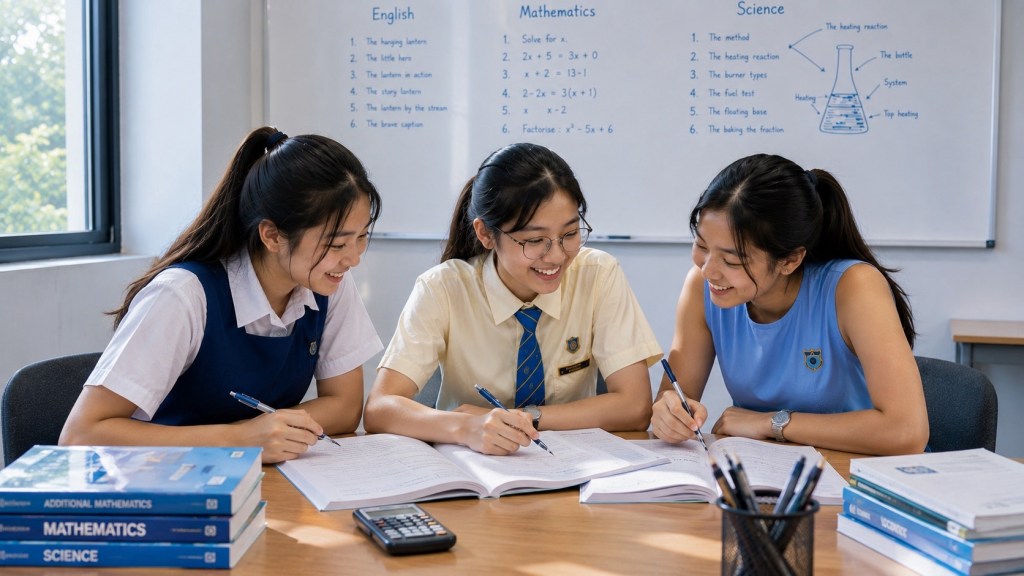
PG1 for Secondary Schools means Posting Group 1, one of the admission groupings used to facilitate entry into Secondary 1 under Singapore’s Full Subject-Based Banding system. By Secondary 4, PG1 is admission history. It is not a Science subject level and should not be used as shorthand for the learner’s current examination syllabus.
For Secondary 4 Science, the useful question is: what Science level and subject combination is the learner actually taking now, and how reliably can the learner perform under those examination conditions? A learner who entered through Posting Group 1 may now take Science at G1, G2 or another level according to the actual school pathway.
Secondary 4 is the examination-year stretch. Scientific knowledge, evidence, quantitative reasoning, experimental design, graphs, command words and checking now have to work together. The current Science programme matters far more than the original admission route.
The Short Answer: What Does PG1 Mean in Secondary 4?
PG1 stands for Posting Group 1. Posting Groups were used to facilitate admission into Secondary 1. Science itself is taken at G1, G2 or G3.
- PG1: Secondary 1 admission route.
- G1/G2/G3 Science: current subject level.
- Secondary 4 programme: the learner’s actual Science combination and school syllabus.
- SEC: Science is assessed at the actual subject level and syllabus taken, not at a Posting Group level.
PG1 Is Not G1 Science
Posting Group 1 describes admission. G1 Science describes curriculum and assessment level. They often appear together, but they are not interchangeable.
By Secondary 4, the learner may be taking G1 Science or a more demanding Science level according to the learner’s actual school pathway. Revision and tuition should follow that current Science programme.
There Is No PG1 Science Examination
What Science level and combination is my child actually sitting, and which scientific process is least reliable under time pressure?
Use the Current Science Level to Plan Revision
If the Learner Is Taking G1 Science
Follow the G1 Science syllabus and current school assessment requirements. Read: What is G1 for Secondary Schools | Sec 4 Science.
If the Learner Is Taking G2 or G3 Science
Follow the actual G2 or G3 syllabus and exact school Science combination. The original PG1 label does not lower the examination demands of the subject being sat.
Five Diagnostic Questions After Every Science Paper
- What scientific idea did the learner not know?
- Where did evidence or data interpretation break down?
- Was the experimental reasoning valid?
- Did Mathematics, units or graph reading cause the loss?
- Which correctable error survived because timing or checking was weak?
Build a Personal Science Error Ledger
- Content: concept missing.
- Vocabulary: idea known but expressed imprecisely.
- Evidence: answer not tied to data.
- Mechanism: causal chain incomplete.
- Experiment: variables, controls or limitations misunderstood.
- Mathematics: units, graphs, ratio or rate fail.
- Timing: execution too slow.
- Checking: labels, units or command words not reviewed.
A Better Examination-Year Science Cycle
- Attempt a focused section or timed paper.
- Classify each lost mark by cause.
- Repair the smallest missing capability.
- Retrieve the repair after a delay.
- Interleave it with other topics.
- Transfer it into a new context.
- Retest under examination conditions.
- Update the error ledger.
Our First-Principles Secondary 4 Science Method
- Confirm the current Science level and combination.
- Find the first divergence.
- Fence the target skill.
- Make evidence visible.
- Explain mechanisms.
- Retrieve after delay.
- Interleave topics and task types.
- Transfer into unfamiliar contexts.
- Retest under time.
PG1 and the SEC
Posting Group is not an SEC subject level. For 2027 reference, G1 Science is K123; G2 paired Science combinations are K223, K224 and K225; G3 lists paired Science K326, K327 and K328 as well as pure Physics K323, Chemistry K324 and Biology K325. The learner sits the actual Science syllabus taken.
Official reference: SEAB Singapore-Cambridge Secondary Education Certificate.
What Progress Looks Like
- reads command words accurately;
- finds relevant evidence faster;
- uses scientific vocabulary precisely;
- handles units and numerical data reliably;
- identifies variables and controls;
- explains mechanisms clearly;
- recognises limitations;
- keeps time more evenly;
- checks units, labels and command words;
- converts feedback from one paper into better performance on the next.
PG1 and Secondary 4 Science: The Current Syllabus Is the Teaching Job
PG1 is useful historical context. It is not the examination syllabus. By Secondary 4, the learner’s current Science level, subject combination, actual work and personal error ledger should drive revision.
Previous step: PG1 Secondary 3 Science.
Contact eduKate Sengkang if you want help building a focused Secondary 4 Science plan.
