
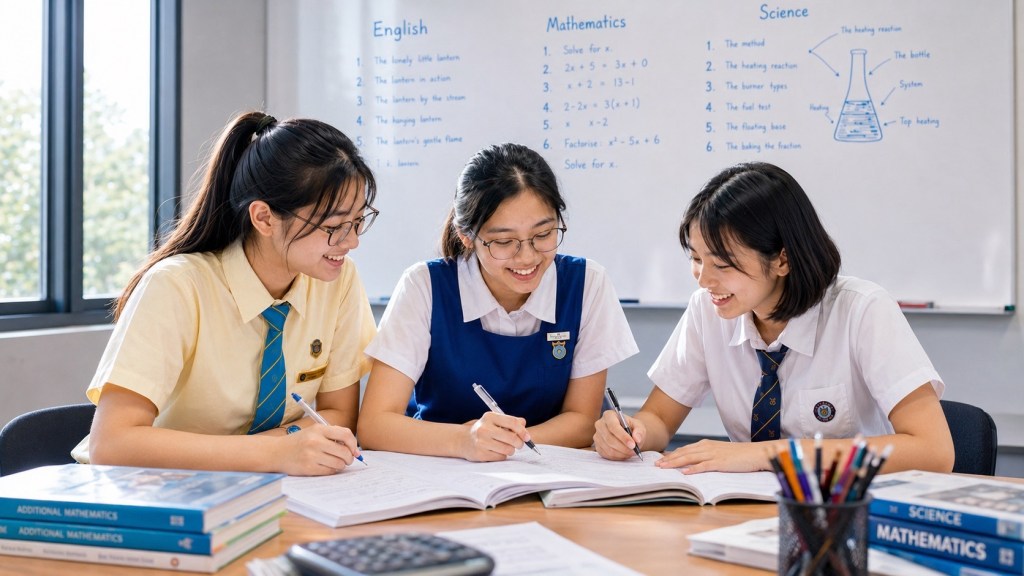
G1 for Secondary Schools is one of the Science subject levels used under Singapore’s Full Subject-Based Banding system. For a Secondary 4 learner taking Science at G1, the label describes the level at which Science is taught and assessed. It does not define the learner’s intelligence, worth or level in every other subject.
Secondary 4 is the examination-year stretch. Scientific knowledge now has to work together with evidence, experiments, quantitative reasoning, graphs, models, command words, timing and checking. The learner cannot rely only on memorised notes. The examination asks whether scientific ideas can be used in unfamiliar contexts.
This guide explains what Secondary 4 G1 Science means, how the current K123 SEC reference fits the examination pathway, how to use past papers diagnostically, how to repair recurring scientific weaknesses, and how parents can recognise whether a low mark came from missing content, poor evidence use, weak Mathematics, experimental reasoning or examination execution.
The Short Answer: What Is Secondary 4 G1 Science?
G1 is an individual Science subject level under Full Subject-Based Banding. A learner may take Science at G1 while taking English, Mathematics or another subject at a different level.
- G1 Science is a subject level, not a Posting Group.
- Secondary 4 is the final preparation and performance year for the relevant cohort.
- Scientific knowledge matters, but it must be applied through evidence and reasoning.
- Past papers should reveal specific weaknesses that can then be repaired.
- Revision should become increasingly selective as the examination approaches.
The 2027 SEC G1 Science Reference
For 2027 school candidates, SEAB lists G1 Science as K123. This is a single G1 Science syllabus.
Students should always use the official syllabus for their own examination year. Official reference: SEAB 2027 G1 Syllabuses for School Candidates.
Secondary 4 Changes the Science Job
Earlier years focus strongly on building scientific concepts and practices. In Secondary 4, the learner also has to access those capabilities under time pressure and across mixed topics.
- Knowledge gap: the scientific principle is not understood.
- Vocabulary gap: the learner knows the idea but cannot express it using the required scientific language.
- Evidence gap: the learner states a conclusion without using the data or observation.
- Experimental gap: variables, controls, measurement or limitations are misunderstood.
- Quantitative gap: graph reading, ratio, percentage, units or arithmetic breaks down.
- Execution gap: the learner knows the content but misreads the command word, rushes or fails to check.
The final answer may look equally wrong in all six cases. The repair is different.
Knowledge Is Necessary but Not Sufficient
A learner can memorise definitions and still struggle because examination questions change the context. The more transferable form of knowledge includes the concept, the mechanism, the evidence that would support it and the situations in which it applies.
- state the principle;
- recognise the principle inside a new context;
- identify which evidence matters;
- explain the mechanism;
- apply the idea quantitatively where needed;
- limit the conclusion to what the evidence supports.
Experimental Design: Can the Method Support the Conclusion?
Secondary 4 learners should be able to evaluate experiments, not merely name variables.
- identify the independent and dependent variables;
- control relevant factors;
- choose suitable apparatus and measurement methods;
- decide whether repeats are needed;
- identify anomalies cautiously;
- spot confounding factors;
- judge whether the method can answer the stated question.
A neat experiment is not automatically a valid experiment. The comparison has to be interpretable.
Graphs and Quantitative Science
Science frequently depends on mathematical literacy. A learner can know the Science and still lose marks through weak graph reading, unit conversion, ratio, percentage or rate.
- read axes and scales accurately;
- identify the variables being compared;
- describe trends precisely;
- compare rates or percentage changes where appropriate;
- recognise anomalous points;
- keep units visible;
- connect the numerical pattern to a scientific mechanism.
Scientific Explanation: Cause, Mechanism, Effect
Model answers often look like keyword lists after they are memorised. The underlying reasoning is more useful.
- Cause: identify the relevant change or condition.
- Principle: state the scientific idea that applies.
- Mechanism: explain what happens within the system.
- Effect: connect the mechanism to the observed result.
- Evidence: use data or observations where the question requires them.
This structure helps the learner adapt when the surface context changes.
Command Words Matter
- State: give the required fact or result directly.
- Describe: report what is observed or shown.
- Explain: connect cause, principle and effect.
- Compare: use a common basis to identify similarities and differences.
- Suggest: propose a scientifically reasonable answer supported by context.
- Calculate: show the mathematical relationship, working and units.
- Evaluate: judge evidence, method, limitation or reliability.
Answering the topic instead of the command word is a common way to know the Science but lose the mark.
Use Past Papers Diagnostically
After every paper or section, the learner should classify lost marks.
- Content: the scientific idea was not known.
- Vocabulary: the idea was known but expressed imprecisely.
- Evidence: the answer was not tied to the graph, table or experiment.
- Mechanism: the causal chain was incomplete.
- Mathematics: the numerical relationship failed.
- Experimental reasoning: variables or limitations were misread.
- Timing: the learner knew the answer but ran out of time.
- Checking: units, labels or command words were not reviewed.
Build a Personal Science Error Ledger
A good error ledger is not a notebook full of corrections. It is a ranked map of recurring weaknesses.
- Error type.
- Trigger.
- First divergence.
- Repair.
- Retest.
If the same error survives through multiple papers, the correction has not transferred yet.
A Better Examination-Year Science Cycle
- Attempt: complete a focused section or timed paper.
- Classify: label each lost mark by cause.
- Repair: isolate the smallest missing scientific capability.
- Retrieve: test the repair after a delay.
- Interleave: mix the repaired idea with other topics.
- Transfer: apply it in a new scientific context.
- Retest under time: return it to examination conditions.
- Update: promote the next highest-cost weakness.
Our First-Principles Examination-Year Science Method
- Find the first divergence. Trace the answer to the earliest point where reasoning stops matching the evidence.
- Fence the target skill. Repair it outside the full paper first.
- Make evidence visible. Identify which observation, measurement or graph supports each claim.
- Explain mechanisms. Connect cause, principle and effect.
- Retrieve after delay. Test whether the scientific idea remains accessible.
- Interleave. Mix topics and task types.
- Transfer. Change the context while preserving the underlying principle.
- Retest under time. Return the repaired capability to examination conditions.
A 90-Minute Small-Group Secondary 4 Science Lesson
- 10 minutes: retrieval from the personal error ledger.
- 15 minutes: repair of one high-leverage concept or scientific practice.
- 15 minutes: graph, experiment or data interpretation.
- 20 minutes: targeted examination-format practice.
- 15 minutes: independent timed application.
- 10 minutes: marking and first-divergence analysis.
- 5 minutes: focused continuation plan.
In a three-student class, the same broad Science topic can remain coherent while the tutor diagnoses different error chains: one learner may need vocabulary precision, another graph interpretation, another experimental reasoning.
G1 Science Is Not the Same as a Posting Group
Posting Groups were used to facilitate Secondary 1 admission. Science subject levels describe the curriculum and examination level. By Secondary 4, the learner’s actual Science level, combination and recent performance evidence are what matter.
What Progress Looks Like in the Examination Year
- reads command words accurately;
- identifies relevant evidence faster;
- uses scientific vocabulary more precisely;
- handles units and numerical data reliably;
- identifies variables and controls;
- explains mechanisms rather than listing keywords;
- recognises experimental limitations;
- keeps time more evenly;
- checks units, labels and command words;
- converts feedback from one paper into better performance on the next.
Frequently Asked Questions
What does G1 Science mean in Secondary 4?
It means Science is being taken at G1, with the learner preparing for and performing within that subject-level syllabus.
Should Secondary 4 Science tuition be mostly full papers?
Not necessarily. Full papers are useful for diagnosis and performance rehearsal, but targeted repair is more efficient when one recurring weakness keeps appearing across topics.
How do I know whether the problem is Science or Mathematics?
Trace the error. If the scientific principle is understood but the learner misreads a graph, ratio, percentage, rate or unit conversion, the bottleneck may be mathematical literacy rather than Science content.
When should timed practice increase?
Timed practice should increase as the learner’s underlying scientific process becomes stable. Timing a broken process can make the learner practise the same mistake faster.
Secondary 4 G1 Science: Turn Knowledge Into Defensible Performance
The examination year is not the time to stop teaching and merely mark papers. It is the time to make teaching more selective. Every paper should reveal the next useful repair.
At eduKate Sengkang, we use the learner’s actual evidence to decide what deserves the next hour of Science. The goal is controlled performance: accurate reading, precise vocabulary, valid experimental reasoning, reliable quantitative work, clear mechanisms and defensible conclusions.
Continue from Secondary 3: What is G1 for Secondary Schools | Sec 3 Science.
Contact eduKate Sengkang if you want help interpreting your child’s Secondary 4 Science performance and building a focused examination-year plan.
