
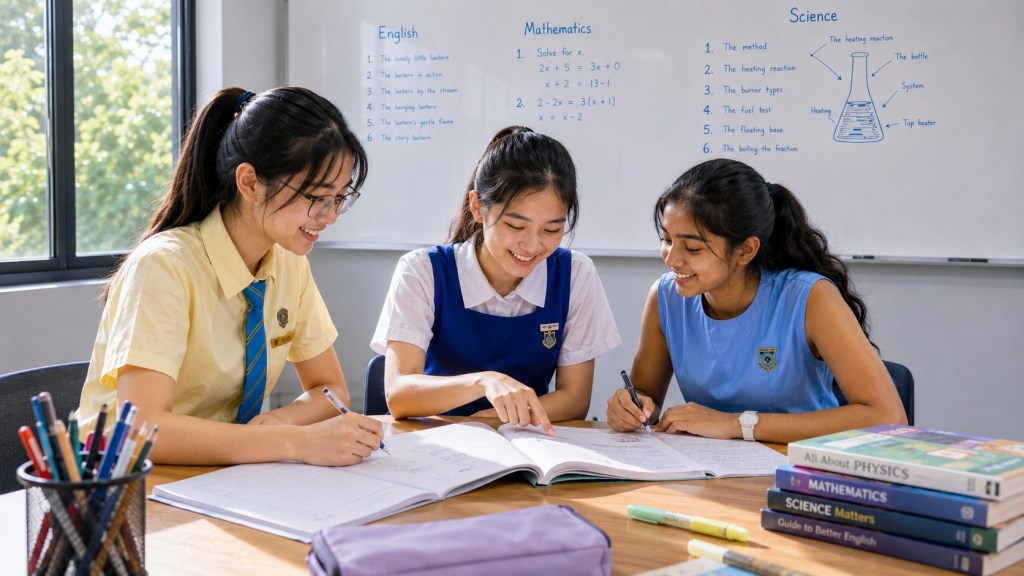
PG3 for Secondary Schools means Posting Group 3, one of the admission groupings used to facilitate entry into Secondary 1 under Singapore’s Full Subject-Based Banding system. By Secondary 3, PG3 is best understood as admission history. It is not a Mathematics subject level and should not be used as a permanent shorthand for the learner’s current mathematical capability.
For Secondary 3 Mathematics, the useful question is: what level of Mathematics is the learner actually taking now, and how reliably can the learner perform at that level? A learner who entered through PG3 may be taking Mathematics at G3, may be taking it at G2, or may have a different subject-level profile according to the school’s arrangements and progress.
Secondary 3 is an upper-secondary performance year. Algebra, representation, geometry, data, working and checking now need to become reliable under mixed and timed conditions. This guide separates the original posting route from the current Mathematics level and shows parents what useful progress actually looks like.
The Short Answer: What Does PG3 Mean in Secondary 3?
PG3 stands for Posting Group 3. Posting Groups are used to facilitate Secondary 1 admission. Under Full Subject-Based Banding, students take individual subjects at G1, G2 or G3, so the current subject-level profile matters more educationally as the learner moves through secondary school.
- PG3: Secondary 1 admission route.
- G3 Mathematics: one possible current Mathematics level.
- G2 Mathematics: another possible current Mathematics level where the learner’s pathway supports it.
- Secondary 3 evidence: actual school performance, teacher feedback and mathematical independence.
- SEC: Mathematics is eventually sat at the actual G1, G2 or G3 subject level, not at a Posting Group level.
PG3 Is Not G3 Mathematics
PG3 explains how the learner entered Secondary 1. G3 Mathematics explains an individual subject level. They may often appear together, but they are not synonyms. By Secondary 3, parents should speak in current subject-level language rather than treat the original posting route as a permanent mathematical identity.
There Is No “PG3 Mathematics” Syllabus
Mathematics is organised at G1, G2 and G3 subject levels. PG3 is not a fourth Mathematics curriculum. The practical parent question is:
What Mathematics level is my child taking now, and where does the mathematical process first become unreliable?
What Can Mathematics Look Like for a PG3 Learner by Secondary 3?
Mathematics at G3
This can be the learner’s current route. Secondary 3 G3 Mathematics should build reliable algebra, representation, geometry, data interpretation, working and checking at that subject level.
Read the current subject-level guide: G3 Secondary 3 Mathematics.
Mathematics at G2
If Mathematics is a relative strength or the learner’s pathway has changed, the current subject level may be G2. Teaching should match the actual syllabus demand rather than the original PG3 label.
Why Secondary 3 Is an Important Mathematics Review Year
By Secondary 3, enough evidence has accumulated to see whether the learner’s mathematical processes are stable under upper-secondary pressure.
- Can the learner interpret algebraic notation accurately?
- Can an equation be formed from a worded relationship?
- Can the learner choose a representation without prompting?
- Are signs, brackets and units controlled?
- Are geometry properties used rather than guessed from appearance?
- Can graphs and tables be interpreted?
- Can earlier methods be retrieved after a delay?
- Does the learner verify answers independently?
These behaviours describe mathematical readiness far more precisely than the original Posting Group.
Three Common PG3 Secondary 3 Mathematics Profiles
Stable at the Current Level
The learner is appropriately placed and now needs consistency. The teaching job is to stabilise algebra, representation, working, checking and performance under time pressure.
Mathematics Has Become a Clear Strength
The learner may have entered through PG3 but now shows sustained strong Mathematics performance. The current level and future pathway can be discussed with the school using evidence rather than label prestige.
The Current Level Is Fragile
The learner may have hidden gaps in fractions, ratio, negative numbers, algebraic meaning, graph interpretation or working discipline. The correct response is diagnosis rather than indiscriminate paper repetition.
Our First-Principles Method for PG3 Secondary 3 Mathematics
- Confirm the current Mathematics level. Admission history is not curriculum.
- Find the first divergence. Trace the working to the earliest wrong assumption, representation or transformation.
- Fence the target skill. Reduce unrelated complexity while one idea is rebuilt.
- Expose structure. Show the relationship underneath the procedure.
- Require explanation. Ask why each step is valid.
- Retrieve after delay. Bring earlier methods back later.
- Interleave. Mix problem types so method selection becomes part of the work.
- Transfer. Change the surface while preserving the underlying structure.
- Verify. Use estimation, substitution, reverse operation, graph behaviour or units.
A 90-Minute Small-Group Mathematics Lesson
- Retrieval of prerequisites.
- Concept instruction.
- Worked reasoning with visible representation.
- Guided practice.
- Independent application.
- Error analysis.
- Mixed or timed transfer work.
- Focused continuation practice.
A three-student group allows the tutor to see whether the learner’s error begins in interpretation, representation, algebra, arithmetic, notation or checking. This makes the teaching target precise.
PG3 and the SEC
Posting Group is not an SEC subject level. Students sit Mathematics at G1, G2 or G3. Current 2027 reference codes include K110 for G1 Mathematics, K210 for G2 Mathematics and K310 for G3 Mathematics. A learner who entered through PG3 therefore sits Mathematics at the actual subject level taken, not a “PG3 Mathematics” examination.
Official reference: SEAB Singapore-Cambridge Secondary Education Certificate.
What Progress Looks Like
- starts by identifying the target;
- chooses representations deliberately;
- uses algebraic notation accurately;
- shows logically connected working;
- recognises structure in unfamiliar wording;
- controls signs and units;
- retrieves earlier methods after a delay;
- checks answers independently;
- remains more stable under time pressure;
- needs less tutor rescue.
Frequently Asked Questions
Does PG3 still determine Mathematics in Secondary 3?
No. PG3 describes the admission route. The learner’s current Mathematics subject level is what matters for curriculum and assessment.
Is PG3 the same as G3 Mathematics?
No. PG3 is an admission grouping. G3 Mathematics is an individual subject level.
What should I tell a Mathematics tutor?
Tell the tutor the learner’s current Mathematics level, recent school topics, assessments and repeated error patterns. PG3 alone is not enough to identify the teaching job.
PG3 and Secondary 3 Mathematics: Current Capability Is the Teaching Job
PG3 is useful background information. It is not the Mathematics curriculum. By Secondary 3, the learner’s current level, actual working and degree of independence should drive teaching.
At eduKate Sengkang, we confirm the level, diagnose the first weak link, stabilise reliable mathematical processes and deepen the work when the evidence shows readiness. Contact eduKate Sengkang if you want help interpreting your child’s Secondary 3 Mathematics profile.
