
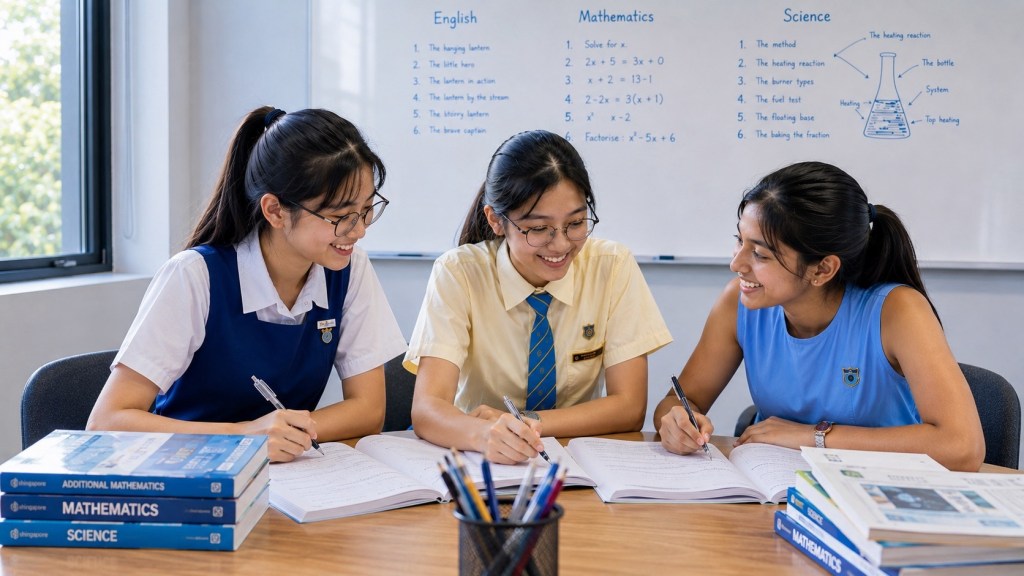
G2 for Secondary Schools is a subject level under Singapore’s Full Subject-Based Banding system. For a Secondary 2 learner taking English at G2, the label describes the degree of language complexity and independence expected in that subject. It is not a permanent stream identity and does not determine the level of every other subject.
Secondary 2 G2 English is a consolidation year. Secondary 1 introduces the new environment; Secondary 2 should turn useful habits into a stable system. Students need to read more precisely, infer from evidence, write with clearer purpose and organisation, retrieve vocabulary more independently, control grammar under longer writing demands, listen selectively and develop spoken responses in real time.
This guide explains what Secondary 2 G2 English means, what should become more secure by the end of the year, how it differs from G1 and G3, how it relates to Posting Groups, and how parents can recognise whether the learner is repairing, stabilising or ready for greater challenge.
The Short Answer: What Is Secondary 2 G2 English?
G2 means General 2. Under Full Subject-Based Banding, G1, G2 and G3 are subject levels that can differ across a learner’s timetable. A student may therefore take English at G2 while taking Mathematics, Science or another subject at a different level.
By Secondary 2, a useful G2 learner should be moving from “I know how to do this when I see an example” toward “I can recognise the job and choose the process myself.”
What Secondary 2 Adds to the G2 English Job
- Longer texts require stronger attention control.
- Inference requires evidence rather than imagination.
- Vocabulary needs greater contextual precision.
- Writing needs clearer audience, purpose and paragraph structure.
- Grammar has to survive longer pieces of writing.
- Listening requires better note selection.
- Oral responses need development and flexibility.
- Students need more reliable checking under time pressure.
The student is not simply doing “more English”. The student is becoming more independent inside the same language system.
Reading: Evidence Before Interpretation
At Secondary 2 G2, comprehension improves when the learner separates three layers:
- Literal: what the text states directly.
- Inferential: what can reasonably be concluded from the evidence.
- Interpretive: how wording, structure or context shapes meaning.
Many wrong answers come from skipping the first layer and jumping straight to an attractive interpretation. Stronger students build an evidence chain first.
Writing: Purpose, Audience, Development
Secondary 2 G2 writing should become more deliberate. Before writing, the learner should know:
- what the task requires;
- who the reader is;
- what information must be included;
- what tone is suitable;
- what order makes the response easy to follow;
- which details deserve development.
This prevents a common problem: grammatically fluent writing that does not actually fulfil the task.
Vocabulary: Depth Over Decoration
G2 learners benefit from a larger vocabulary, but difficult words are not automatically better words. The goal is precision.
- meaning;
- word family;
- collocation;
- register;
- synonym differences;
- contextual meaning;
- retrieval in writing and speech.
A student who knows when reluctant, hesitant and unwilling differ has more useful vocabulary than a student who memorises all three as interchangeable.
Grammar: Accuracy Under Load
Secondary 2 students often know grammar rules but lose control while writing quickly. That means the problem is no longer only rule knowledge. It is transfer under load.
- tense sequence;
- subject–verb agreement;
- pronoun reference;
- sentence boundaries;
- conjunctions and logical relationships;
- articles and determiners;
- prepositions;
- word forms;
- punctuation for clarity.
The learner should gradually become able to edit for recurring patterns without waiting for the tutor to mark every line.
Listening and Oral: Real-Time Language Control
Listening and oral communication reveal whether language knowledge is accessible quickly enough for real-time use.
- predict the information category before listening;
- listen for contrast and correction;
- record only useful information;
- answer the oral question directly;
- give a reason;
- add an example;
- explain the example;
- adapt to a follow-up question.
A prepared speech can sound fluent while hiding weak interaction. Secondary 2 should build both structure and flexibility.
How G2 English Differs From G1 and G3
- G1: dependable functional language control and growing independence.
- G2: stronger inference, development, contextual vocabulary and independent task control.
- G3: greater nuance, evaluative reading, rhetorical control and sustained language precision.
These are levels of subject demand, not rankings of students.
G2 English Is Not Posting Group 2
Posting Group 2 is used to facilitate entry into Secondary 1. G2 English is an individual subject level. By Secondary 2, the learner’s actual subject profile should be the focus.
A learner who entered through PG2 may be taking English at G2 or another level according to the school’s subject-level arrangements, earlier eligibility and subsequent progress.
The Future SEC Endpoint
As a current reference point, SEAB’s 2027 Singapore-Cambridge Secondary Education Certificate lists G2 English Language as K200. Students should always use the syllabus for their own examination year.
Secondary 2 should build the capabilities that make the later endpoint manageable: accurate reading, evidence use, vocabulary depth, paragraph organisation, grammar under load, listening, oral interaction and checking.
Official reference: SEAB 2027 G2 Syllabuses for School Candidates.
Three Secondary 2 G2 English Pathways
Repair
The student is at G2 but an older gap is blocking current work. The cause may be slow reading, weak vocabulary, sentence-boundary errors, poor paraphrase or misunderstanding question demands.
Stabilisation
The learner can perform at G2 but not reliably. One test is strong; the next collapses under time pressure. The job is to make useful routines repeatable.
Extension
The learner is secure and needs deeper challenge. Extension should increase text complexity, inference, vocabulary precision, writing development and transfer rather than merely increase worksheet volume.
Our First-Principles Method for Secondary 2 G2 English
- Diagnose the first divergence. Find the earliest point where the learner’s process stops matching the task.
- Fence the skill. Reduce unrelated complexity while the target capability is being built.
- Model the decision. Show why one answer, sentence or paragraph choice is stronger.
- Require explanation. Make the learner verbalise evidence and reasoning.
- Retrieve after delay. Revisit words, grammar and reading strategies later.
- Interleave. Mix problem types so the learner must select the right skill.
- Transfer. Change genre, topic and task format.
- Check. Build task fulfilment, grammar and clarity into the process.
What Progress Looks Like
- reads the entire question before answering;
- uses evidence to support inference;
- paraphrases without changing meaning;
- plans writing before drafting;
- uses vocabulary with greater precision;
- makes fewer repeated grammar errors;
- listens for relationships rather than isolated keywords;
- develops oral answers with reasons and examples;
- checks task fulfilment independently;
- remains more stable with unfamiliar material.
Frequently Asked Questions
What does G2 English mean in Secondary 2?
It means English is being taken at General 2, with greater demand for independent reading, inference, writing development, listening and oral communication than at G1.
Is G2 English the same as Posting Group 2?
No. Posting Group 2 is an admission grouping. G2 English is a subject level.
Can a Secondary 2 learner move to G3 English?
Subject levels can be reviewed according to school guidance and sustained evidence of readiness. Added demand should improve learning rather than simply increase pressure.
What is the current 2027 SEC reference code for G2 English?
SEAB lists G2 English Language as K200 for 2027 school candidates. Always use the syllabus for the learner’s actual examination year.
Helpful Reading
- What is G2 for Secondary Schools | Sec 1 English
- PSLE to SEC G1, G2 and G3 English: A Parent Roadmap
- G2 SEC English: Control the Task Before You Write
- SEAB 2027 G2 Syllabuses
Secondary 2 G2 English: Turn Good Lessons Into Independent Performance
The central Secondary 2 job is consistency. The learner should need fewer prompts to read carefully, find evidence, organise writing, retrieve vocabulary, control grammar, develop spoken ideas and check the final response.
At eduKate Sengkang, we diagnose the first divergence, rebuild what is missing, stabilise what works and extend what is ready. The aim is a language system that travels into unfamiliar tasks.
Contact eduKate Sengkang if you want help reading your child’s Secondary 2 G2 English work and identifying the next useful step.
