
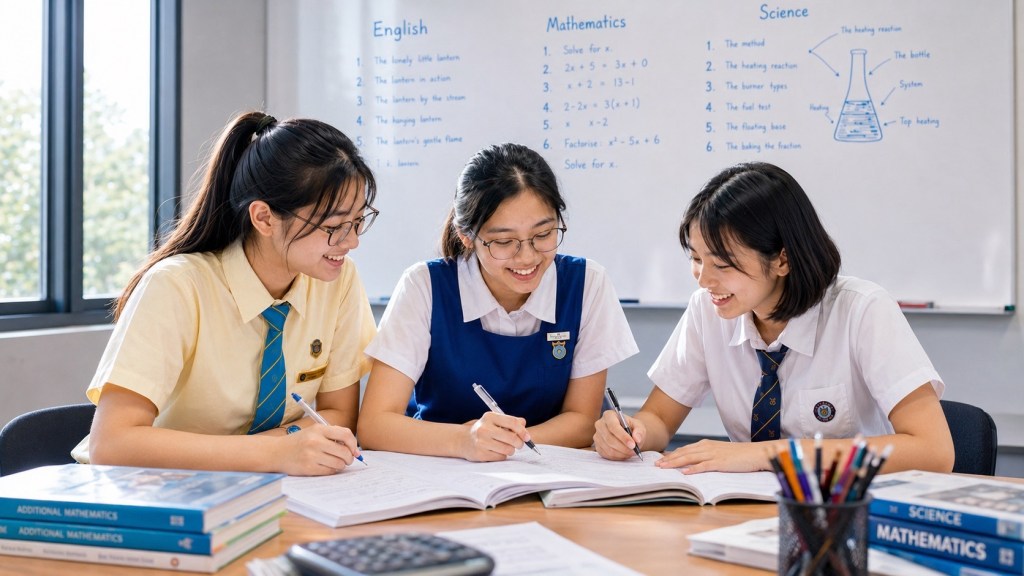
G1 for Secondary Schools is a subject level under Singapore’s Full Subject-Based Banding system. For a Secondary 2 learner taking English at G1, the label describes the level at which English is being learnt and assessed. It does not describe the learner’s intelligence, potential, whole-school identity or the level of every other subject.
Secondary 2 G1 English has a different job from Secondary 1. The first year of secondary school is largely about transition. By Secondary 2, the learner should be consolidating a repeatable language system: read the task accurately, understand the text, retrieve useful vocabulary, write complete and organised responses, listen for the right information, speak with development and check work independently.
This guide explains what Secondary 2 G1 English means, what should become more secure during the year, how it differs from G2 and G3 English, how it relates to Posting Groups, and how parents can distinguish real progress from simple familiarity with school worksheets.
The Short Answer: What Is Secondary 2 G1 English?
G1 means General 1. Under Full Subject-Based Banding, G1, G2 and G3 are subject levels. A student can therefore take English at G1 while taking another subject at G2 or G3.
By Secondary 2, the important question is not only whether the learner can complete English work. It is whether the learner can complete familiar tasks with increasing independence and remain reasonably stable when the topic, passage or question changes.
- G1 English is an individual subject level.
- It is not the same thing as Posting Group 1.
- It does not fix every subject at the same level.
- It should be read together with actual school performance and teacher feedback.
- It can be reviewed as the learner’s readiness changes.
What Changes From Secondary 1 to Secondary 2?
Secondary 1 introduces the new language environment. Secondary 2 should make the learner more stable inside it.
- Reading becomes less dependent on teacher prompting.
- Comprehension answers should become more evidence-based.
- Writing should show clearer paragraph purpose and sequence.
- Grammar errors should become less repetitive.
- Vocabulary should be retrieved from memory rather than recognised only on a list.
- Listening should become more selective and organised.
- Oral responses should move beyond one-line answers.
- Checking should become part of the learner’s own routine.
The learner is no longer just adapting to secondary school. The learner is building a system that must eventually carry greater upper-secondary demand.
Reading: From Finding Information to Controlling Meaning
At Secondary 2 G1, reading should become more deliberate. Students need to identify what the question is asking before searching the text.
- identify the main idea;
- locate relevant details;
- track pronoun and reference words;
- follow sequence, cause and consequence;
- recognise simple inference from evidence;
- understand familiar vocabulary in context;
- separate the writer’s words from the learner’s own assumptions.
A useful reading habit is: question → evidence → answer. The learner should be able to explain where the answer comes from instead of relying on topic familiarity or guessing.
Writing: Build Paragraphs That Have Jobs
Secondary 2 writing becomes more reliable when the learner stops seeing a composition as one long block of sentences. Each paragraph should perform a recognisable function.
- introduce a situation or central idea;
- develop one point or event;
- add relevant detail;
- show consequence or response;
- connect to the next stage of the piece;
- close without simply repeating the introduction.
For situational or functional writing, purpose and audience matter just as much. A response can be grammatically correct yet fail because it does not provide the information, tone or action the task requires.
Grammar: Stop Repairing the Same Error Every Week
The Secondary 2 goal is not to memorise a larger grammar rulebook. It is to reduce repeated error patterns inside real writing.
- subject–verb agreement;
- verb tense and time sequence;
- articles and determiners;
- pronoun reference;
- prepositions;
- sentence boundaries;
- conjunctions;
- word forms;
- punctuation for clarity.
When an error appears, the useful question is: what clue should help me notice this next time? That changes correction into learning.
Vocabulary: Move From Recognition to Retrieval
A learner may recognise a word in a vocabulary list but fail to use it in writing or oral communication. Secondary 2 should close that gap.
- meaning;
- part of speech;
- common collocations;
- word family;
- register;
- example sentence;
- retrieval after a delay;
- use in a new context.
A smaller vocabulary that is retrievable and accurate is more powerful than a larger vocabulary that exists only in a notebook.
Listening and Oral: Make Thinking Audible
Listening requires the learner to process information while it disappears. Oral communication requires the learner to organise ideas while speaking. Both improve when the student has a simple internal structure.
- answer directly;
- give a reason;
- add a relevant example;
- explain why the example matters;
- respond to a follow-up question;
- stay on the original topic.
Fluency does not mean speaking quickly. It means keeping meaning stable while communicating.
How Secondary 2 G1 English Differs From G2 and G3
The broad language domains are shared across the subject levels, but complexity, independence and precision increase.
- G1: builds dependable functional language control and increasing independence.
- G2: increases text complexity, inference, development and task control.
- G3: increases nuance, evaluation, sustained development and precision further.
The correct level is the one where the learner can be challenged and still build stable capability. A more demanding label is useful only when the learner can learn well there.
G1 English Is Not Posting Group 1
Posting Group 1 is used for Secondary 1 admission. G1 English is a subject level. By Secondary 2, the learner’s actual subject profile matters far more than the admission shorthand.
- Posting Group describes how the learner entered secondary school.
- G1 English describes the current English level.
- School progress provides evidence about future subject-level fit.
The Future SEC Endpoint
As a current reference point, SEAB’s 2027 Singapore-Cambridge Secondary Education Certificate lists G1 English Language as K100. Students should always use the syllabus for their own examination year, because details can change.
Secondary 2 should not be reduced to premature examination drilling. The better preparation is to strengthen the language system that later examination work depends on: reading accuracy, vocabulary retrieval, sentence control, paragraph organisation, listening, oral development and independent checking.
Official reference: SEAB 2027 G1 Syllabuses for School Candidates.
Three Secondary 2 G1 English Pathways
Repair
The learner still carries a Primary 6 or Secondary 1 gap that now interferes with several tasks. The first weak link may be reading fluency, vocabulary, sentence formation or question interpretation.
The goal is targeted repair, not restarting all of English.
Stabilisation
The learner can perform at G1 but not consistently. We build repeatable routines for reading questions, planning, paragraphing, grammar checks and oral development.
Extension
The learner is secure and ready for greater complexity. Extension should deepen comprehension, vocabulary precision, writing development and independence. Where sustained school evidence supports it, the family can discuss whether a more demanding subject level is appropriate.
Our First-Principles Method for Secondary 2 G1 English
- Diagnose: identify the first weak link rather than call the learner “weak in English”.
- Fence: reduce unrelated difficulty while one skill is being built.
- Model: make the invisible reading or writing decision visible.
- Explain: require the learner to state why an answer works.
- Retrieve: return to vocabulary and grammar after a delay.
- Interleave: mix old and new skills so the learner must select the right tool.
- Transfer: use the skill in a different text or task.
- Check: build a repeatable self-checking routine.
What Progress Looks Like
- reads the complete question before answering;
- uses evidence rather than guessing;
- writes more complete and controlled sentences;
- organises paragraphs more clearly;
- retrieves useful vocabulary without constant prompting;
- makes fewer repeated grammar errors;
- develops oral responses beyond one sentence;
- checks work independently;
- needs less adult rescue;
- remains more stable when the topic changes.
Frequently Asked Questions
What does G1 English mean in Secondary 2?
It means English is being taken at General 1. The learner is expected to build increasingly independent control of reading, writing, listening and oral communication at that subject level.
Is G1 English the same as PG1?
No. PG1 is an admission grouping. G1 English is an individual subject level.
Can a Secondary 2 learner change English level?
Subject levels can be reviewed according to school guidance, progress and readiness. Parents should discuss the learner’s actual evidence with the school.
What is the current 2027 SEC reference code for G1 English?
SEAB lists G1 English Language as K100 for 2027 school candidates. Always use the syllabus for the learner’s own examination year.
Helpful Reading
- What is G1 for Secondary Schools | Sec 1 English
- PSLE to SEC G1, G2 and G3 English: A Parent Roadmap
- SEC G1, G2 and G3 English: Fast Revision for Reading, Writing and Language Use
- SEAB 2027 G1 Syllabuses
Secondary 2 G1 English: Make the System Repeatable
Secondary 2 G1 English is not about collecting more worksheets. It is about making useful language behaviour repeatable: read accurately, retrieve words, organise ideas, control sentences, speak with development and check before submitting.
At eduKate Sengkang, we diagnose the first weak link, rebuild what is missing, stabilise what is inconsistent and extend what is ready. The goal is increasing independence.
Contact eduKate Sengkang if you want help reading your child’s Secondary 2 G1 English work and identifying the next useful step.
