
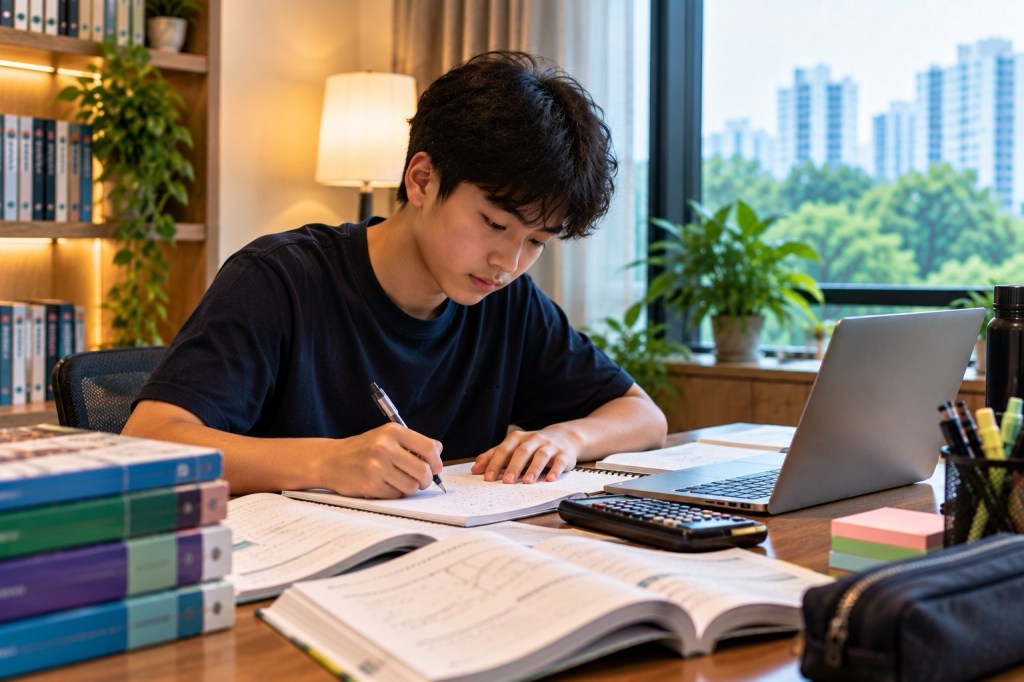
University open-book examination preparation is not a lighter version of revision. It is a different performance system. The learner still needs knowledge in memory, but must also know which permitted source to use, how to reach it quickly, how to apply it to an unfamiliar question, how to verify a detail without surrendering minutes to searching, and how to finish the paper under the real rules of the module. This casebook is for students looking for open-book exam techniques, a workable revision plan, and a way to study effectively when books, notes, PDFs or selected digital resources are allowed.
The search terms matter because they describe the real problem. A student can build a beautiful study timetable, practise active recall and complete past papers, yet still perform poorly in an open-book university exam if every question triggers an uncontrolled search through lecture slides. Another student can own the subject conceptually but lose time because references are badly named, evidence is difficult to locate or the final answer becomes a collage of copied material. The useful target is not “having resources”. It is independent learning that can retrieve, locate, apply, verify and finish under time.
This page is a supporting assessment casebook in the eduKateSengkang learner-runtime estate. The broad examination architecture remains with How to Prepare for an Open-Book Exam | Retrieval First, Resources Second. For the contrast condition, use How to Prepare for a Closed-Book University Examination. For learning before assessment, use How to Learn From Lectures and Tutorials and How to Read Academic Papers as a Student. This casebook owns the worked university layer: how the learner turns those ideas into timed decisions.
The quiet answer: the book should become a tool, not a place to hide
Open-book assessments are often misunderstood in opposite directions. One student treats them as easy because “everything is available”. Another reacts by preparing an enormous archive, as though the safest strategy were to carry the whole semester into the examination. Both approaches confuse availability with usefulness.
A permitted resource helps only when four conditions are true. First, the learner can recognise that the resource is relevant. Second, the learner can locate the required part fast enough that the search is worth its cost. Third, the learner can interpret the material correctly in the context of the question. Fourth, the learner can integrate it into an answer rather than merely reproduce it. If any one of those conditions fails, the open resource becomes friction.
Open-book performance is a division of labour between what the learner can already think with and what the learner can efficiently verify.
Internal knowledge provides orientation. External resources provide precision, detail, evidence, low-frequency information and authorised reference. The examination tests the quality of the partnership.
What this casebook owns
- The permitted-materials audit: turning module instructions into a usable rules card.
- The internal-versus-external knowledge decision: deciding what must be retrievable and what may sensibly remain in references.
- The question-to-source drill: reading the task before opening anything.
- The lookup-cost audit: measuring how long resource navigation actually takes.
- The application case: moving from source material to reasoning rather than copying.
- The verification pass: checking a narrow uncertainty without reopening the whole course.
- The timed rehearsal: practising with the same resource environment and constraints.
- The independent-performance check: proving that resources support thinking rather than replace it.
This page does not own your institution’s rules. The module handbook, assessment brief, learning platform, authorised announcements and formal academic-integrity guidance always take priority. A university may permit a printed text but prohibit internet access. Another may permit local digital files but not generative AI. A take-home assessment may have different collaboration and citation rules from a timed online paper. Never infer permission from the words “open book”.
The five-part operating loop
For most timed open-book university work, a useful operating loop is Read → Retrieve → Locate → Apply → Verify. Read first so the learner knows the job. Retrieve next so prior knowledge generates an initial model. Locate only the information that is missing. Apply it inside the answer. Verify only the claims or calculations whose uncertainty matters.
A sixth verb sits over the entire loop: Finish. Students sometimes optimise the quality of one answer until the rest of the paper becomes impossible. The examination is a portfolio of marks, not a competition to produce the most perfect first response. Any lookup, quotation, calculation or cross-check must be judged against its opportunity cost.
Build the rules card before the revision system
Before content revision, write one page containing the operational facts that change strategy: assessment format, duration, start and submission time, permitted books, printed notes, digital files, internet access, calculator or software rules, citation expectations, collaboration restrictions, AI permissions, platform requirements and the formal contingency procedure. The purpose is not bureaucracy. It is to remove uncertainty from the environment.
Do not compress ambiguous wording into assumptions. “Notes allowed” may not mean all digital notes. “Open book” may not mean open internet. “Take home” may not mean collaboration. “Calculator permitted” may name a class of devices rather than any device. When official instructions are unclear, use the institution’s authorised clarification route before the assessment. Strategy begins after the rules are known, not before.
Build the internal course map before the external index
An external index is useful only when the learner has some idea of what to look for. The internal course map is a compact model of the subject: major concepts, relationships, recurring problem families, methods, evidence types, exceptions and common confusions. It should be reconstructible from memory at a useful level.
A learner who cannot sketch the course architecture may have difficulty interpreting even a perfect folder system. Search engines return matching strings; they do not guarantee conceptual relevance. A question may use one phrase while the notes use another. Internal understanding supplies synonyms, relationships and likely locations.
Test the map by closing resources and drawing the module from memory. Then compare it with the syllabus, lecture sequence and assessment outcomes. Missing branches are learning gaps. Excessive detail may indicate that the map has become another set of notes rather than an orientation device.
Use a two-layer resource system
A useful open-book note system often has two layers. Layer one is fast: a compact index, decision cards, formula relationships, recurring comparisons, high-value definitions and direct pointers to deeper material. Layer two is deep: the full notes, readings, cases, tables and longer explanations.
The first layer should answer “Where should I go?” The second should answer “What exactly does the source say or show?” If both layers are equally large, the learner still has to search through the search system. Keep archive separate from examination surface. A semester may contain hundreds of documents worth preserving. That does not mean hundreds of documents should sit in the primary exam workspace.
Case 1 — The beautifully organised folder that nobody can use
Alicia prepares by creating twenty-six folders. Each topic has lecture slides, tutorial notes, readings, summaries, screenshots, generated flashcards and three versions of her own notes. The structure feels thorough. During a timed practice, however, a question asks her to compare two mechanisms taught in different weeks. Alicia knows both ideas, but cannot remember which folder contains the most useful comparison table. She searches a broad keyword, finds eleven documents and starts opening them.
The problem is not lack of notes. The resource architecture was designed around how material entered the course, not around how questions ask the learner to use it. Alicia rebuilds the primary layer around recurring examination functions: definitions, core models, comparisons, formulae, evidence, examples, exceptions and common errors. The original weekly folders remain as archive, but the examination layer becomes shallow and predictable.
On the next practice, she reads the question and retrieves the comparison from memory. She then opens one comparison index to verify a boundary condition. The resource visit is short because she knew the purpose before she opened the file. The improvement did not come from deleting knowledge. It came from reducing navigation entropy.
Case 2 — The student who searches before answering
Beatrice reads an essay prompt, recognises one keyword and immediately searches her notes for that word. The search returns dozens of passages. She starts reading them, hoping the answer will emerge. Ten minutes later she has more information but no argument.
The repair is a question-first rule. Before opening a source, Beatrice writes a three-line skeleton: the command, the central judgement she currently thinks is defensible, and the exact information she is missing. That missing information becomes the search target. Instead of “search sustainability”, the target becomes “find the condition under which this framework treats substitution as insufficient”. The resource operation is now bounded.
This method protects reasoning. The question creates the structure; the source fills a defined gap. When students reverse that order, the resource starts dictating the answer. Open-book work becomes stronger when search follows a hypothesis instead of replacing one.
Case 3 — The formula sheet that saves no time
Ciara has an authorised formula sheet for a quantitative module. She decides that learning formula relationships is unnecessary. In practice, a problem requires choosing between two related equations. Both are on the sheet. Ciara can read them but does not immediately know which assumptions distinguish them. She spends several minutes rereading surrounding notes.
The solution is not to memorise every symbol mechanically. It is to internalise the selection logic. Ciara builds a decision card for each major method: use when, do not use when, required inputs, output meaning, common unit error and one quick reasonableness check. During practice she first chooses the method from the problem representation, then consults the formula sheet for exact notation.
The formula sheet now serves precision. Her memory serves choice. This is a recurring open-book distinction: external storage works best for exactness when internal knowledge still owns recognition and judgement.
Case 4 — The problem where every source looks relevant
Denise faces a case question with several facts, exceptions and competing principles. Her materials include primary sources, lecture commentary and her own notes. The danger is not lack of sources. It is overcollection. If every potentially relevant authority is opened, the answer becomes a research session rather than an examination response.
Denise marks the issue sequence first. For each issue she writes: governing principle, fact that activates it, likely exception, authority needed to verify wording and provisional conclusion. She then consults only the authority required for that step. If exact language matters, she verifies it. If she already knows the general rule well enough to apply it, she does not reopen five summaries simply to feel safer.
The case illustrates a general principle across disciplines. Resource richness increases the need for a stopping rule. The student should know what sufficient support looks like before the search begins.
Case 5 — The open-book data paper
Emily’s assessment provides datasets, tables and permitted reference material. She assumes that because the information is visible, the main challenge will be calculation. Practice reveals something else: the hardest step is deciding what each variable and table can legitimately support.
She builds a data-reading routine: identify the question, identify the unit of analysis, identify the relevant variables, check scale and denominator, inspect missingness or obvious limits, choose the operation, compute, then interpret in words. References are used to verify definitions or method conditions. They are not allowed to replace the initial reading of the data.
On a later task, a percentage looks dramatic. Emily resists the urge to write the conclusion immediately. She checks what the percentage is a percentage of, whether groups are comparable and whether the question asks description or explanation. The open material provides evidence; disciplined reading controls the claim.
The question-to-source drill
Take a bank of unfamiliar or changed questions. For each, do not answer immediately. First write the likely concept family, the likely resource and the exact information that would justify opening it. Then check whether the prediction is right. This drill trains resource routing.
A question asking for evaluation may require a framework plus evidence and limitations. A calculation may require a condition check rather than a formula lookup. A case question may require one authoritative definition and one contrasting example. The point is to learn that questions activate different information operations.
After ten or twenty drills, patterns become visible. Those patterns should shape the primary index. If the same comparison is repeatedly needed, make it easier to reach. If a resource is never useful, remove it from the first layer.
Measure lookup cost instead of guessing
Students commonly say a resource is “easy to find” without measuring it. During timed practice, record a few lookup times. The purpose is not to worship speed. It is to see whether navigation cost is large enough to change strategy.
If a common detail repeatedly takes several minutes to locate, either the index is weak, the resource is poorly designed or the detail should be learned more deeply. If a low-frequency fact takes longer but appears once in a long paper, that may be acceptable. Cost must be read against frequency, consequence and mark value.
The useful measure is not raw seconds. It is time per meaningful gain in answer quality. A lookup that corrects a central assumption may be worth more than five quick searches that add decorative detail.
Use a search-stop rule
Open-book students need an explicit way to stop looking. The rule can be qualitative: stop when the missing condition is verified; stop when one authoritative example is found; stop when the method requirement is clear; stop when the answer has enough evidence to support the planned argument. The exact rule varies by task.
Without a stop rule, searching expands because each source generates another possible question. Under assessment conditions, curiosity needs a boundary. The learner can note the unresolved point for later learning without sacrificing the whole paper.
The application triangle
Strong open-book answers often connect three elements: concept, case evidence and reasoning. The concept provides the model or rule. The evidence comes from the question, dataset, text or permitted source. The reasoning explains why that concept changes the interpretation of that evidence.
A copied definition supplies only one corner. A list of case facts supplies another. The mark-bearing work often lives in the connection. Train by highlighting each corner in practice answers. If the reasoning sentence is missing, add it. If a concept is present without relevant evidence, remove or redirect it.
This triangle also protects the learner’s voice. Source material is integrated for a defined purpose rather than used as a substitute answer.
Case 6 — The take-home examination that turns into endless research
Faith receives a take-home assessment with a generous window. The absence of a short timer creates a new failure mode: the answer expands until the deadline consumes the whole week. She keeps finding another paper, another example, another qualification. The work becomes better in parts but less finishable as a whole.
She divides the window into gates. Gate one is interpretation: decide what each question requires. Gate two is evidence sufficiency: identify the minimum credible source set needed to support the planned argument. Gate three is production: draft the complete answer before optional expansion. Gate four is verification: check accuracy, citation, relevance and submission requirements. A search can reopen only when the draft reveals a real evidential gap.
A longer assessment window should permit deeper judgement, not infinite browsing. The discipline is to know when more information changes the answer and when it merely delays completion.
Case 7 — The student with three versions of the same table
Alicia has a tutorial table, her own revised table and a screenshot from a later lecture. Two use slightly different labels. Under time she opens the old screenshot first and worries that her memory is wrong. The repair is simple: one source-of-truth version in the primary folder, with the older copy archived. She adds the date and source of the authoritative update.
The lesson is larger than file hygiene. Confidence under assessment depends partly on knowing which representation governs. Multiple near-duplicates increase verification work at the worst possible moment. Version control is therefore a learning operation whenever the student relies on external memory.
Case 8 — The student who uses resources to avoid committing
Beatrice knows enough to answer but feels uncomfortable making a judgement. She keeps searching for one more source that will remove uncertainty. The search is psychological as well as informational. Because no real-world evidence can make every conclusion certain, the answer never feels ready.
She adopts a calibrated decision rule: state the current judgement, give the strongest evidence, name the material limitation, then move. A new lookup is justified only if it could realistically change the conclusion or correct an important factual uncertainty. This separates productive verification from reassurance-seeking.
Open-book performance still requires intellectual commitment. Resources can inform judgement; they cannot eliminate the need to make it.
Case 9 — The model answer becomes a script
Ciara uses a model answer while revising and begins to associate a familiar question stem with the model’s paragraph sequence. On a changed task, she reproduces the same structure even though one section is no longer relevant. Her resource has become a script.
The repair is decomposition. She annotates the model by function: define, distinguish, apply, test alternative, qualify, conclude. Then she practises recombining those functions for different prompts. The model is no longer an answer to remember. It is evidence about useful moves.
This is transfer of learning: the student can carry the underlying structure into a new problem without dragging the old surface with it. The open book is useful because it exposes examples, but the learner still needs to abstract the principle.
Case 10 — The quantitative student who verifies everything
Denise calculates correctly but checks every arithmetic step against worked examples. The habit feels careful. Under time it becomes expensive. The real need is a hierarchy of checks. She should verify high-risk decisions and perform fast internal reasonableness checks on routine steps.
She builds three check levels. Level one: mental sanity check for sign, scale, unit and direction. Level two: short calculation verification for steps known to be error-prone. Level three: source consultation when a condition, constant or interpretation is genuinely uncertain. The level is chosen by risk, not anxiety.
Verification becomes targeted quality control rather than a second full solution.
Case 11 — The essay student with too many quotations
Emily’s notes contain excellent quotations. In practice she keeps searching for the perfect line, then tries to build the argument around it. The answer becomes source-led. She reverses the sequence: write the claim, specify the evidence function, then locate a quotation only if exact language improves the analysis.
Often the stronger answer uses fewer quotations because the student is doing more of the explanatory work. The source supports the argument; it does not become the argument. Where citation is required, she follows the module’s exact convention rather than importing a style from another assessment.
Case 12 — The student who never practises the actual interface
Faith’s open-book examination is online. Her notes are digital. She practises with files open but does not simulate the real answer platform. On a trial run she discovers that screen space, scrolling, window switching and equation entry slow her more than expected.
She now rehearses the full environment where possible and permitted. The purpose is not to game a platform. It is to make ordinary operations unsurprising. She learns which documents can reasonably remain open, whether split screen helps or distracts, how files are named and how much submission buffer she needs.
The technology is part of the performance channel. If it changes the route from question to answer, it belongs in rehearsal.
Active recall still belongs in open-book study
The education keyword cloud keeps active recall beside study tips and exam techniques because retrieval remains useful even when resources are permitted. The purpose changes slightly. The learner is not trying to internalise every low-frequency detail. The learner is building fast access to the concepts and decision rules that make external information usable.
Useful retrieval prompts include: What are the three conditions for this method? What distinguishes model A from model B? Which assumption would invalidate this conclusion? What evidence would change the judgement? Which formula family applies to this representation? What are the recurring limitations of this design?
If the answer can only be produced while looking at notes, the learner may still have familiarity rather than working control. Close the source, answer, then reopen it to verify. That sequence makes the boundary visible.
Spacing and delayed return expose false fluency
Do not build the entire open-book system the night before. Return to the course map, decision cards and resource index across days. Spacing exposes what the learner forgot and what the index fails to cue. A note system that feels obvious immediately after construction may be confusing a week later.
A delayed test is especially useful: take a fresh question several days after a revision block and see whether you can choose the right resource without rebuilding the context from scratch. That is closer to examination reality. The delayed attempt also separates memory for yesterday’s explanation from capability that survived.
Interleaving exposes routing weakness
When practice is grouped by chapter, the learner already knows which topic applies. Open-book examination questions may remove that label. Mix question families so the first job becomes recognition. Interleaving can feel harder because it adds a method-selection problem. That difficulty is useful when the assessment also requires selection.
Keep the mix controlled. The aim is not randomness for its own sake. Combine question types that could plausibly be confused, then inspect why one route fits and another does not. If the learner repeatedly opens the wrong resource first, the error may be conceptual rather than navigational.
The reference-sheet paradox
A reference sheet can become so comprehensive that it stops functioning as a reference. The cure is not arbitrary minimalism. It is hierarchy. Put high-frequency decision cues where the eye reaches them first. Place low-frequency details deeper. Use labels that reflect the question the learner will ask under time.
“Chapter 7” is useful only if the learner thinks in chapter numbers. “When the sample is paired”, “assumptions before model B” or “exceptions to rule C” may be better retrieval cues. Design the sheet around decisions, not the order in which notes were originally taught.
Build a contradiction and version check
Large note collections often contain old and new versions, simplified explanations, tutor annotations and lecture corrections. Before the exam, identify places where sources disagree. Decide which source is authoritative for the module. Remove obsolete duplicates from the primary workspace or mark them clearly.
During an examination, contradictory materials create expensive hesitation. The learner may spend time deciding which note is right instead of answering the question. Version control is therefore part of study design, not an administrative afterthought.
Past papers are resource-navigation laboratories
Past papers, sample assessments and instructor-provided practice are valuable because they reveal what the resource system must do. Use them not only to test content but to test the complete open-book workflow. Keep the same files, notes, tabs, printed materials and calculator configuration you plan to use where rules permit.
After each paper, audit resource behaviour. Which source was opened most? Which lookup was unnecessary? Which important detail was impossible to find? Where did a search begin before the question had been understood? Which file created duplicate or contradictory information? Then modify the system and run another changed task.
This creates a revision loop: perform, observe friction, repair, retest. The resource architecture matures through evidence rather than aesthetics.
Build a resource hierarchy
A practical hierarchy can be thought of as four levels. Tier zero is memory: the concept map, core relationships and method-selection cues. Tier one is the fast layer: one-page indexes, concise formula conditions, decision cards and recurring comparisons. Tier two is the main reference set: full notes, textbook sections, readings and approved reference documents. Tier three is reserve material: information that is legitimate but rarely useful under time.
The aim is to keep most operations in tiers zero and one. Tier two should be entered for defined reasons. Tier three should be rare. If every question requires deep-tier searching, either the fast layer is weak or the learner does not yet own enough structure.
The bounded-search protocol
Before opening a resource, finish the sentence: “I am looking for ___ because it will let me ___.” If the student cannot complete that sentence, the search target is probably too vague. Once the information is found, return to the answer. Do not continue browsing merely because adjacent material looks useful.
During rehearsal, note searches that exceeded their value. Ask whether the problem was poor indexing, weak vocabulary, uncertainty about the concept, or a source that should never have been in the primary set. Each cause has a different repair.
The evidence-to-answer conversion
Finding the correct page is not the same as answering. After each lookup, force a conversion step. State what the information means for this question. Which claim does it support? Which assumption does it change? Which calculation does it permit? Which alternative does it rule out? Which limitation does it introduce?
This step prevents the “resource dump”: several accurate facts placed beside one another without a line of reasoning. The answer should remain organised by the question, not by the sequence in which sources were opened.
Open-book writing should still sound like the learner
University work often asks for synthesis. A learner who moves sentence by sentence between sources can lose ownership of the argument. Plan the paragraph in your own words first. Then insert evidence, definitions or exact language where it performs a clear function. Where quotation or citation is required, follow the actual course rules.
A useful self-test is oral. Close the source and explain the paragraph’s reasoning aloud. If the learner cannot explain why each source is present, the writing may be assembled rather than understood.
Design a personal lookup budget
There is no universal “ninety-second rule” that fits every discipline. Instead, estimate a reasonable lookup budget from the exam length, mark allocation and task type. A twenty-mark case may justify a longer source check than a two-mark factual item. A central condition that could reverse the method may justify more time than a decorative example.
Practise with a timer long enough to make cost visible but not so rigid that it creates artificial panic. The goal is judgement. Students should know when a lookup is worth continuing and when the rational move is to answer from what they know, flag the point if the format allows, and continue.
When the answer is uncertain
Open-book access can tempt students to treat every uncertainty as a solvable search problem. Some questions are uncertain because the evidence itself is incomplete or competing. In those cases, better performance may mean qualifying the claim rather than searching indefinitely for certainty.
Use calibrated language. Distinguish “the evidence establishes” from “the evidence suggests”, and distinguish “this condition is required” from “this condition is commonly associated”. Precision is not only about finding more sources. It is also about making a claim no larger than the evidence permits.
When the resource is wrong
If a practice session reveals that a note is inaccurate, outdated or misleading, do not merely remember the correction. Fix the source-of-truth layer. Mark the change and remove the defective version from the primary workspace. A resource system should improve after contact with error.
If the issue concerns official rules, use the current institutional source. A tutor summary, peer message or old cohort document should never outrank the authoritative instruction for the actual assessment.
When the learner is too dependent on worked examples
Worked examples can reveal structure, but they can also create a matching habit. Introduce completion problems first, then changed problems, then unlabeled mixed problems. Delay access to the worked example until the learner has selected a method and made an attempt.
The goal is not to ban examples. It is to move support to the correct point in the learning loop. Guidance comes after the learner has exposed what they can currently do.
When the resource set is too large
Run a subtraction audit. Remove one low-value source from the primary set and complete a timed question. If performance is unchanged or improves, the source was not earning its place. Repeat carefully. A lean resource surface often increases confidence because the learner knows what each remaining item is for.
Keep removed material in archive if it remains academically useful. The examination surface and the knowledge archive do not need to be identical.
Four discipline lenses: the same open-book principle, different examination work
Open-book technique should not be flattened into one universal routine. The operating logic remains stable—understand the task, retrieve what you can, consult resources deliberately, apply rather than copy, verify what matters, finish—but different disciplines create different bottlenecks. A useful revision plan therefore keeps the shared architecture while changing the practice surface.
Essay, humanities and theory-heavy modules
The main risk is source abundance. Students often collect definitions, quotations and examples faster than they build an argument. Start each practice response from the prompt. Identify the command word, the object of judgement and the likely tension. Draft the provisional thesis before opening notes. Then ask which concepts and evidence can actually move that thesis forward.
For each major concept, keep a short comparison card: what the idea claims, what problem it addresses, what it explains well, what it does not explain, one useful contrast and one evidence route. This prevents the exam from becoming a memory contest over isolated quotations. The learner should be able to move between theories because the question demands it, not because the notes are arranged that way.
Practise counterargument deliberately. Open-book conditions can make one-sided answers look more sophisticated simply because they contain more references. A stronger response shows that the learner can locate the strongest alternative, explain its relevance and then state why the final judgement remains qualified or changes. Resource access should deepen reasoning, not merely decorate it.
Quantitative, mathematical and computational modules
The main risk is confusing formula access with method selection. A reference sheet can tell a learner the exact equation, but it cannot guarantee that the equation is appropriate. Build method-selection drills in which the formula sheet remains closed until the learner has named the model, assumptions, required inputs and expected output. Then open the reference to verify notation or constants.
Keep worked examples by problem family, not by lecture date. Under each family, record one canonical example, one common trap, one changed variant and one quick reasonableness check. Practise with mixed questions so the chapter label disappears. If the learner needs to browse examples before recognising the family, that is a learning gap rather than an indexing problem.
Where software or calculators are permitted, rehearse the complete chain from representation to interpretation. The fact that a tool returns a number does not establish that the model was correct. Ask what the output means in the units and context of the problem, whether the magnitude is plausible, and which assumption would make the result misleading.
Case-based professional modules
The main risk is overcollection. The student can find many relevant rules, cases, standards or frameworks, yet fail to organise them around the actual decision. Practise issue spotting first. Turn the prompt into a sequence of decisions, then assign each decision a source need. This creates a bounded route through the material.
When the course depends on professional, legal, ethical, clinical or institutional rules, use the current authoritative sources specified by the module. A generic study guide cannot determine which standard governs your assessment. The open-book system should make the relevant authority easier to locate, but should never invent or silently substitute rules.
Practise limits and exceptions. A student who remembers only the general principle may search widely when the problem actually turns on one exception. Build contrast cards around conditions: rule, trigger, exception, consequence, evidence needed. Then rehearse changed cases in which the surface facts vary but the decision structure remains.
Data, evidence and research-methods modules
The main risk is treating visible numbers as self-explanatory. Keep a reading sequence: question, unit of analysis, variable meaning, scale, denominator, comparison, uncertainty, method condition, interpretation. If the assessment includes tables or figures, practise reading them before consulting explanatory notes. The resource should clarify a term or method, not replace engagement with the evidence.
For statistical or empirical material, build “what this does not prove” notes beside common outputs. A correlation is not automatically causation. A small p-value is not automatically practical importance. A model fit statistic does not eliminate the need to inspect assumptions. These boundaries are especially valuable in open-book settings because exact terminology can be verified while interpretation remains the learner’s job.
A useful final check is claim size. After writing an inference, ask whether the evidence supports the exact verb used: shows, suggests, predicts, is associated with, causes, estimates, is consistent with. The difference between these words can be more important than another lookup.
Printed-book architecture
Some assessments permit only printed resources. In that environment, navigation is physical. Tabs, a front index, margin cues and consistent annotation can reduce friction. The same design principle applies: make high-frequency decisions easy to reach and keep low-frequency detail deeper.
Do not tab every page. If the entire edge of a book becomes a wall of identical markers, the signal disappears. Use a small vocabulary of tab purposes. For example: models, formulae, evidence, exceptions, worked examples. The exact categories should follow the module’s recurring assessment work.
Practise turning to the correct section from a question, not from a chapter name. The learner should know the conceptual neighbourhood before touching the book. If every search begins by scanning the contents page from the beginning, the internal map is too weak.
PDF and digital-note architecture
Digital resources create fast search but also invite broad search. File naming matters. A useful file name answers what the document is and why it matters. “Week7_final2.pdf” tells the future exam taker almost nothing. “Model-selection-assumptions-week7.pdf” is easier to route.
Build one examination index with direct links or exact filenames where the rules permit. Keep old versions in an archive folder, not beside current files. Use search inside a document only after deciding which document should contain the answer. Whole-computer search is powerful but can produce too many weak matches.
Test the setup offline if the assessment may run without internet. A resource that exists only in cloud storage is not a usable resource if the authorised exam environment cannot reach it. Technical rehearsal belongs in the plan because access is part of performance.
Hybrid architecture: one sheet, one folder, one memory map
Many students work best with a hybrid system: one small printed or digital fast sheet, one orderly reference folder and one course map held internally. The sheet handles routing. The folder handles depth. Memory handles recognition and judgement. Each layer should have a clear role.
If the same information is copied into all three layers, maintenance becomes difficult. Prefer pointers over duplication. A fast sheet might say “paired designs → assumptions card P3” rather than reproduce a full page of explanation. The learner gets speed without creating another version-control problem.
Timed rehearsal should grow in stages
A full three-hour mock is not always the best first rehearsal. Early on, it can hide the source of failure because too many skills break at once. Build realism in stages. Start with short route drills, then timed sections, then full-length papers or assessment simulations.
Stage 1 — ten-minute routing drills
Take one unfamiliar question. Give yourself a short window to identify the command, write an initial answer skeleton, name the resource needed and locate the relevant information. Stop before writing the full answer. The objective is to test recognition and navigation.
Record the first wrong turn. Did you misread the command? Choose the wrong concept? Open the right document but search the wrong term? Find the information but fail to understand it? The first wrong turn is often more useful than the final time.
Stage 2 — twenty-five percent paper
Complete a quarter-paper or equivalent task set under real resource conditions. This length is long enough for time pressure to appear while still leaving capacity for detailed review afterwards. Mark not only answer quality but how the resource system behaved.
Create a friction log with five columns: trigger, action, time cost, effect on answer, repair. A line might read: “uncertain definition → opened four lecture decks → four minutes → no change → build one definitions index.” This transforms vague frustration into a design decision.
Stage 3 — fifty percent paper
At half length, stamina and sequencing begin to matter. Test whether the learner can abandon a low-value search, move to the next question and return later if the format permits. Check whether early overinvestment creates late incompleteness.
This is the right stage to test a time budget by mark value. The learner does not need a mechanical minutes-per-mark rule if the course does not suit one, but they do need a sense of when one answer is consuming the opportunity to score elsewhere.
Stage 4 — full rehearsal
A full rehearsal should reproduce the actual conditions as far as legitimate and practical: permitted resources, platform, calculator, timing, break rules, writing medium, submission steps and the same limits on communication or internet access. The purpose is to discover system-level friction before the real assessment.
Afterwards, do not immediately run another full paper. Repair. Consolidate the evidence. Change the index if needed, learn the missing concepts, practise the weak method-selection family, then use a fresh full or substantial rehearsal to see whether the repair survives.
A fourteen-day open-book examination runway
Days 14–13: define the assessment. Confirm the official rules, learning outcomes, format and weighting. Gather the authorised source set. Remove obsolete versions. Run one representative diagnostic without trying to optimise the score. The purpose is to expose content gaps and resource friction.
Days 12–11: rebuild the course map. Close the notes and reconstruct the module from memory. Mark concepts as stable, fragile or unclear for this task, not as labels about yourself. Compare the map with the syllabus and learning outcomes. Repair the highest-leverage missing branches first.
Days 10–9: build the fast layer. Create the shallow index, decision cards, formula-condition notes, recurring comparisons and source pointers. Avoid full rewriting. Every new resource item should answer a real retrieval problem observed in practice.
Days 8–7: run routing drills. Use mixed unfamiliar questions. Predict the concept and source before opening anything. Measure repeated slow lookups. Strengthen memory where lookup is too frequent and improve indexing where navigation is the real problem.
Days 6–5: timed sections. Complete substantial sections under the true resource configuration. Track search behaviour, method selection, unfinished answers and checking. Repair the largest recurring bottleneck.
Days 4–3: full integration. Run a realistic long rehearsal. Treat technology and submission as part of the system. Review with the five-column friction log. Make only changes justified by evidence.
Day 2: changed retest. Use fresh questions that resemble the assessment demands but are not copies of the material just reviewed. This checks whether the learner can transfer the operating method rather than replay a familiar paper.
Day 1: stabilise. Reactivate the course map, high-frequency decision cues and known error checks. Confirm logistics. Do not redesign the entire note system because one page looks untidy. Stability now has value.
A seven-day recovery plan
When only one week remains, compression matters more than comprehensiveness. Day one: confirm rules and run a diagnostic. Day two: repair the largest conceptual gaps and build the course map. Day three: construct the fast resource layer. Day four: mixed question-to-source drills. Day five: timed substantial section. Day six: repair plus changed retest. Day seven: light activation, logistics and rest.
The main choice is what not to do. Rewriting every lecture note is usually a poor use of the final week unless the existing notes are genuinely unusable and the assessment specifically rewards exact reference work. Use the evidence from the diagnostic to decide what earns time.
A forty-eight-hour rescue
Two days is not enough to rebuild an entire semester. Triage. Confirm what is permitted. Identify the highest-frequency concepts and methods. Build one shallow index. Practise representative questions. Locate the most dangerous knowledge gaps. Run one timed block. Fix the clearest bottleneck. Protect sleep and the submission environment.
A rescue plan should reduce uncertainty, not pretend to create mastery overnight. The objective is to make the knowledge that does exist easier to deploy while avoiding preventable navigation and rules errors.
Design the study timetable around cognitive jobs
A useful study timetable schedules jobs, not vague subject hours. “Study Module X for three hours” hides the work. “Reconstruct course map; solve six mixed selection questions; repair two gaps; run one thirty-minute open-book section; audit lookup times” makes the work inspectable.
Balance three modes: learning, resource design and performance practice. Too much resource design produces beautiful infrastructure without tested capability. Too much timed practice without repair repeats the same friction. The timetable should alternate attempt, evidence, repair and changed attempt.
Protect return time. If a learner corrects a mistake on Monday, schedule a fresh related task on Thursday or Friday. The delayed return tests whether the correction became usable knowledge rather than remaining a memory of the worked solution.
AI and the open-book boundary
Do not assume that because an examination is open book, generative AI is permitted. The institution, module and assessment instructions govern. Even during preparation, use AI in ways that preserve the learner’s thinking: generate changed practice questions, critique an answer after an attempt, ask for alternative examples, or simulate follow-up questions. Verify important claims against authoritative material.
Avoid building a resource system that depends on AI producing the answer during the assessment unless that exact use is explicitly authorised. Preparation should leave the learner more capable, not more dependent on a tool whose permission, availability or output quality may change.
If AI helped produce study material, verify the material before it enters the primary exam layer. A confidently written error placed into a trusted reference sheet can be more dangerous than an obviously missing fact.
The independent-performance test
A strong resource system should survive a fresh task. Give the learner a question that is not in the notes. Observe whether they can identify the concept, form an initial answer, choose a resource deliberately, find a relevant detail, integrate it, check the result and stop searching. Record the amount of prompting required.
Then repeat with a changed question after a delay. If the learner can only perform immediately after a walkthrough, the evidence remains fragile. If they can carry the process into a new surface with less support, transfer is becoming visible.
This is why the eduKate learning runtime separates activity from capability. A completed worksheet, a polished note set or one successful mock is useful evidence. It is not the whole conclusion.
A practice-review rubric that does not turn learning into one fake score
After a timed task, review five dimensions separately. Question reading: did the learner identify the command, scope and output? Internal retrieval: did a usable initial model appear before search? Resource routing: was the source selected deliberately and reached efficiently? Application: did the information change reasoning rather than merely enlarge the answer? Completion: did the learner allocate enough time to finish and check the high-risk points?
Use descriptive evidence instead of compressing the whole performance into a number. “Opened four files before identifying the actual rule” is actionable. “Resource skill 6/10” is less useful unless the scale is defined and validated. The purpose of the rubric is to select the next repair.
The same learner can be strong in one dimension and fragile in another. Good retrieval with poor stopping control needs a different intervention from weak concept knowledge with excellent file navigation. Diagnosis should stay granular enough to change what the learner does next.
The examination-day operating sequence
Before the paper begins, the resource system should already be settled. Confirm the permitted materials and technology. Open only what the rules and platform permit. Keep the primary index visible or immediately reachable if appropriate. Avoid last-minute file creation.
When a question appears, read the entire task before touching the resources. Mark the command, scope, data and constraints. Retrieve the first model from memory. Decide whether a lookup is needed. If it is, name the target. Locate. Return to the answer. Keep the resource visit subordinate to the task.
If a search stalls, use a recovery rule. Stop, write what you can justify, mark the uncertainty mentally or on permitted planning space, and move if the cost is becoming disproportionate. A stalled search should not silently consume the next question’s time.
Reserve checking for high-value risks: unanswered parts, wrong units, misread commands, unsupported claims, transcription errors, contradictory conclusions, missing uploads or submission steps. Rechecking every sentence from the beginning may be impossible. Use the error patterns learned in practice to decide what deserves attention.
What to do when you blank
Blanking in an open-book paper can be deceptive because the resource is physically present. The learner may start searching immediately, which can make the blank feel larger. Instead, rebuild a minimal frame. What subject area is this? What is the question asking me to produce? What facts are given? What relationships do I remember? What would a plausible first step look like?
Only then open a source. The purpose of the source is to restore a missing component, not to replace the entire thinking process. Even a partial internal frame improves search quality because it supplies better terms and a reason for choosing one document over another.
What to do when two sources disagree
First ask whether the disagreement is genuine. One source may be simplified, older, describing a different condition or using a different definition. Return to the authoritative course source where possible. If the assessment expects engagement with disagreement, state the difference explicitly rather than pretending it does not exist.
Do not spend excessive time resolving a conflict that the question does not depend on. If the difference cannot affect the answer, record the governing source and proceed. If it can reverse the conclusion, the conflict is high value and deserves verification.
What to do when the paper is harder than practice
Do not respond by opening more resources indiscriminately. Harder questions often increase the importance of structure. Identify what remains familiar: the concept family, the data type, the command, the method conditions or the reasoning pattern. Use those anchors to build a route.
A changed surface is also a transfer test. If the learner can only perform when the question resembles the revision example, the issue is not open-book technique alone. It is conceptual flexibility. Make the best justified attempt, then use the post-exam review to identify which representation or method-selection skill failed.
What to do after the examination
Do not judge the strategy only from the eventual grade. As soon as practical, record what the resource system actually did. Which materials were used? Which were dead weight? Which searches were slow? Which concepts had to be reconstructed under pressure? Which questions exposed a gap that practice missed?
When formal feedback or marks arrive, connect them to that process record. A lower score can come from content, interpretation, time, incomplete answers, weak application or resource friction. A higher score does not automatically prove the preparation system is optimal. Look for repeatable causes.
Archive the final primary index separately from the evolving course notes. If the module feeds a later course, extract durable concepts and method rules rather than carrying the entire exam workspace forward.
Frequently asked questions
Is an open-book examination easier than a closed-book examination?
Not necessarily. Open-book conditions change where information can be stored, but the assessment may place more weight on application, synthesis, evaluation, data interpretation or exact use of permitted references. Read the actual learning outcomes, rubric, question style and time limit. The useful question is not whether the format is easier in general; it is which capabilities this particular assessment requires and which resources genuinely reduce friction without replacing understanding.
Should I memorise anything if my notes are allowed?
Yes. Core concepts, relationships, vocabulary and method-selection cues should usually be retrievable enough to orient you quickly. The resource is most useful for exact wording, detailed evidence, constants, formulas, exceptions or low-frequency information. If every question requires searching for the basic meaning of the topic, the learner spends examination time rebuilding context. Memory and resources are partners rather than substitutes.
How many pages of notes should I take in?
There is no universal ideal number. Use the smallest set that reliably supports the real assessment. Test the set during timed practice and measure whether additional pages improve answers or merely increase search friction. A compact fast layer plus deeper references often works better than one undifferentiated bundle. Always stay within the institution’s explicit material rules.
Should I make a full index?
Make an index only if it reduces a real navigation problem. A useful index maps examination decisions to sources: definitions, models, comparisons, formula conditions, evidence, exceptions and common errors. A long index that reproduces the table of contents may add little. Build it from the questions you actually practise, then refine it when a lookup is slow or misrouted.
Is Ctrl+F enough for digital notes?
It is powerful but incomplete. Search works only when you know the right document and terms. A question may use different language from the notes, and broad search may return many weak matches. Conceptual knowledge still helps you choose synonyms and likely locations. Practise deciding where to search before typing a term. Keep filenames and versions clear so the search surface remains trustworthy.
Should I use active recall for an open-book paper?
Yes, especially for the structure that makes external information usable. Retrieve definitions, relationships, assumptions, decision rules and common contrasts without looking. Then open the source to verify. Active recall can expose what you only recognise when reading. The goal is not to memorise every line; it is to make the high-frequency thinking available fast enough that the resource can do a narrower job.
How should I use past papers?
Use authorised past or sample papers as performance laboratories. Practise with the same permitted resource configuration you expect to use. Track not only correct answers but navigation, search time, method selection, unfinished sections and checking. After the paper, repair the biggest recurring bottleneck and use a changed paper or task later. Do not memorise old answers as predictions of future questions.
What if I cannot find something in my notes?
First decide whether the missing detail is central enough to justify continued search. If it could reverse the method or conclusion, use the authoritative source and a bounded search. If it is low value, answer from what you can justify and continue. After practice, repair the index or learn the concept more deeply so the same failure does not recur.
How do I stop overchecking?
Use a risk hierarchy. Check decisions whose failure has large consequences: method selection, conditions, units, transcription, key definitions, unsupported claims and submission steps. Use quick internal checks for routine work. During rehearsal, notice when verification changes nothing. The goal is not to become careless; it is to direct checking toward the errors that matter most.
Can I prepare a model answer bank?
You can use model answers for learning where authorised, but do not let them become scripts. Annotate what each part does: define, compare, apply, justify, challenge, qualify, conclude. Then practise changed prompts that require a different combination of those moves. If the student reproduces the old surface whenever the keyword appears, the model has become a dependency rather than a learning tool.
How should I prepare for an online open-book examination?
Rehearse the actual permitted interface as closely as possible. Know how files are named, what can be opened, whether internet or cloud access is allowed, how answers are entered and how submission works. Keep the digital workspace lean. Test important files locally where appropriate. Technology should become predictable enough that it does not compete with the academic task.
How should I prepare for a take-home open-book assessment?
Use gates. Interpret every question, decide what evidence is sufficient, draft the complete response, then verify and refine. Without gates, the long window can become endless research. Follow the institution’s rules for collaboration, citation and AI. A take-home format may allow deeper source use, but it still requires stopping rules and an honest account of what you produced.
What if the course gives a formula sheet?
Learn the meaning and selection logic behind the formulas. Know when each relationship applies, which inputs it requires, what the output means and how to check reasonableness. Use the sheet for exact notation and low-frequency detail. During mixed practice, choose the method before looking at the sheet. This tests whether the learner can recognise the problem family independently.
How do I know if my resource system is too large?
Run a subtraction test. Remove one low-value source from the primary set and complete a realistic task. If performance is unchanged or improves, the source was not earning its place. Also inspect how often each item is opened. Archive material can remain academically useful without sitting on the examination surface.
What if I keep running out of time?
Separate the time leak. Is it reading, planning, searching, writing, calculation, verification or switching between tools? Many students blame writing speed when uncontrolled lookup is the larger cost. Measure several practice questions, find the recurring bottleneck and repair that layer first. Full-paper timing should improve only after local friction is understood.
Can I use generative AI during an open-book exam?
Only if the institution and the exact assessment explicitly allow that use. “Open book” does not imply “open AI”. During preparation, AI can support practice, feedback and question generation while you preserve your own attempt and verify important claims. During the assessment, follow the formal rules precisely. When in doubt, use the authorised clarification route rather than assuming.
What should I do the night before?
Keep the system stable. Confirm permitted materials, the primary index, technology, calculator, timing and submission requirements. Reactivate the course map and a few high-frequency decision cues. Avoid rewriting the whole semester or adding untested resources. Protect enough sleep to preserve attention, working memory and decision quality.
What does independent open-book performance look like?
The learner can read a fresh question, identify the relevant concept, form an initial answer, choose a source for a specific reason, locate the needed information, integrate it into reasoning, verify what matters, stop searching and finish within the relevant constraints without rescue. A delayed changed task provides stronger evidence than immediate repetition after coaching.
What if my practice score falls after I start using mixed questions?
That can happen because mixed practice removes the chapter label and adds a recognition problem. Compare error types before assuming learning has declined. If method selection is now the weak point, practise contrasts between similar problem families. Keep some blocked practice for building a new skill, then return to mixed practice to test whether the skill can be selected without cues.
Where should this casebook lead next?
Use the global open-book examination guide for the canonical theory layer, the Sengkang closed-book university guide for the contrast condition, the lectures-and-tutorials guide for learning before assessment, and the academic-paper guide for source judgement. Return to the Learning Atlas when the problem is not only exam format but a wider learner-state question.
Where to go next
For the broad open-book examination architecture, continue to How to Prepare for an Open-Book Exam | Retrieval First, Resources Second. For the closed-book contrast, use How to Prepare for a Closed-Book University Examination. For the lecture-to-learning pipeline, use How to Learn From Lectures and Tutorials. For source judgement, use How to Read Academic Papers as a Student. For the wider learner runtime, return to eduKateSengkang Learning Atlas V2.0.
Final principle
An open book changes where knowledge can live. It does not remove the need to know. Build enough internal structure to recognise the problem. Keep external resources narrow enough to navigate. Read before searching. Retrieve before locating. Locate only what is missing. Apply the information inside your own reasoning. Verify the points that can change the answer. Stop when the search has done its job. Finish the paper.
The best open-book system becomes almost quiet on exam day. The learner knows the course. The index is predictable. The source is found. The evidence is used. The answer remains theirs.
A final resource stress test before publication of your own plan
Before trusting an open-book preparation system, deliberately stress it. Choose a fresh question from a topic that was not revised that day. Put away the explanatory walkthroughs. Start with the exact resource configuration you intend to use. Ask the learner to narrate only the decisions that matter: what the question asks, what is already known, what remains uncertain, which source is worth opening and why. The purpose is not to create an artificial think-aloud performance. It is to expose whether the route from question to resource is genuinely owned.
Introduce one controlled complication. Rename a surface feature, change a value, reverse a comparison, provide an unfamiliar example or move the key information into a different representation. A student who understands the underlying method should adapt. A student who has memorised a route may search for the old wording. That difference is the reason transfer practice matters.
Then remove one support. Hide the fast sheet for a single question, or delay access to the worked example until an initial method has been chosen. Do not remove accommodations or legitimate access arrangements that the learner is entitled to use. The aim is to reduce instructional prompting, not to make the assessment artificially inaccessible. Observe what the learner can still reconstruct independently.
Finally, restore the normal permitted resources and run one timed question. Compare the two performances. The first stress task shows what is internal. The second shows whether the external system adds efficient precision. If the learner collapses without the index but performs perfectly with it, that may be acceptable for low-frequency detail but risky for core concepts. If the learner knows the ideas yet wastes time inside the index, the resource architecture still needs repair.
How to decide what belongs in memory and what belongs in the book
A useful decision can be made with four questions. How frequently is the information needed? How central is it to method selection? How exact must it be? How expensive is it to retrieve externally? High-frequency, high-centrality ideas usually deserve stronger internal retrieval. Rare, exact, easily located details are good candidates for external reference. Information that is both rare and hard to find may need a better index or a deliberate memory cue.
Do not treat this as a rigid matrix. Disciplines differ. A legal phrase may require exact reference even when familiar. A mathematical identity may be worth internalising because it unlocks many decisions. A scientific constant may sensibly remain on an authorised sheet. The learner should be able to explain why an item lives where it does.
This allocation is one of the quiet skills behind effective open-book work. Memory becomes selective rather than overloaded. Resources become purposeful rather than encyclopedic. Study time is directed toward the knowledge that changes decisions, while the reference system carries detail without becoming a maze.
The whole system in one page
Before revision: confirm the rules. During learning: build conceptual structure, retrieval and worked understanding. During resource design: create one shallow fast layer and a trustworthy deep layer. During practice: read first, retrieve second, locate third, apply fourth, verify fifth. During review: identify the first wrong turn and repair it. After delay: use a changed task. On exam day: keep the system stable, search for a reason, stop when the reason is satisfied and finish the whole paper.
That sequence is deliberately simple. The sophistication belongs inside the decisions, not in the number of folders. A strong open-book learner does not look busy. They look oriented. The question controls the resource, the resource sharpens the answer, and the learner remains responsible for the reasoning.
