
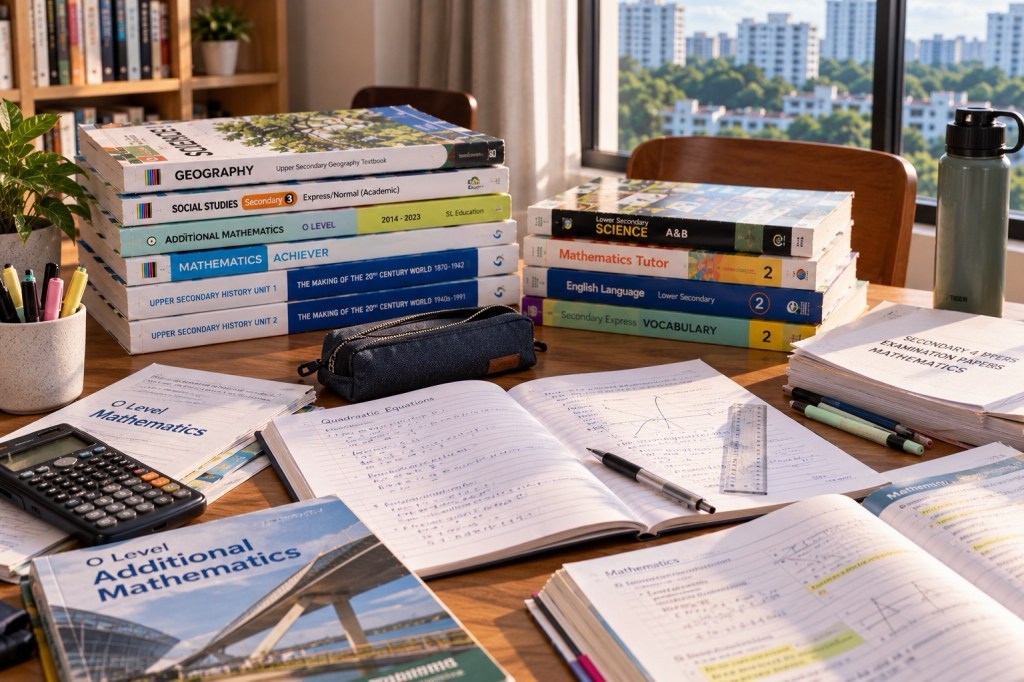
Learning G2 Mathematics with a Hougang tutor should make mathematical structure visible. The student should learn to identify what a question is made of before trying to remember which formula appears in the textbook.
For 2027 SEC school candidates, SEAB lists G2 Mathematics as K210. The subject requires standard technique, but it also rewards problem solving, reasoning and mathematical communication.
For Hougang families, a nearby tutor may make the schedule easier. The learning advantage, however, comes from diagnosis. A wrong answer may begin with a misread condition, unstable fractions, weak algebra, a graph error, an incorrect unit or a missing check.
eduKate Sengkang teaches Secondary Mathematics in groups of up to three students. The tutor can therefore inspect the student’s working rather than only the final number.
G2 Mathematics tuition may be useful for students who need to:
- repair number-sense gaps;
- strengthen fractions, decimals, percentages and ratio;
- improve algebraic manipulation;
- connect equations and graphs;
- develop geometry and trigonometric reasoning;
- interpret statistics and probability more accurately;
- show essential working clearly;
- reduce calculator and sign errors;
- improve mixed-topic retrieval; or
- prepare systematically for K210.
Read: G1, G2 and G3 Mathematics Explained for Parents
Check the official 2027 SEC G2 syllabus list at SEAB
Mathematics Improves When the Representation Improves
A student may understand the numbers but not know how to represent the situation.
We teach learners to move between words, diagrams, tables, equations and graphs. The representation chosen often determines whether the problem feels easy or impossible.
Before asking, “Which formula?” ask, “What is the relationship?”
Number Sense
Secondary Mathematics still depends on reliable arithmetic.
Students strengthen directed numbers, fractions, decimals, percentages, powers and estimation. Calculator use is trained as a tool, not as a replacement for mathematical judgement.
An estimate made first gives the student a way to reject impossible results.
Ratio, Rate and Proportion
These ideas appear in scale, speed, similarity, finance and real-world questions.
Students learn to distinguish additive change from multiplicative change and to identify which quantity forms the reference base.
Algebra
Algebra is treated as a language for relationships.
Students learn to simplify, expand, factorise, substitute and solve while preserving equality.
We pay close attention to signs, brackets and fractions because small algebraic errors become expensive in longer problems.
Graphs
Graphs are taught as visual descriptions of relationships.
Students check axes, units, scale and coordinates, then connect the graph to equations and context.
The learner should be able to move both ways: equation to graph and graph back to meaning.
Geometry and Trigonometry
Students annotate diagrams rather than guess from appearance.
We identify what is given, what can be deduced and which relationship applies.
The final result is checked against the geometry and units.
Statistics and Probability
Students learn to interpret data before calculating from it.
Probability is approached through structured outcomes and relationships.
The aim is to make the answer evidence-based rather than intuitive.
The eduKate G2 Mathematics Runtime
1. Diagnose
We identify the first repeated weakness.
2. Rebuild
Older dependencies are repaired before the current chapter is pushed harder.
3. Model
The tutor demonstrates why the method applies.
4. Vary
One condition changes so the student sees what actually changes the mathematics.
5. Remove support
The learner completes a fresh problem independently.
6. Interleave
Earlier topics return in mixed practice.
7. Transfer
The student solves unfamiliar problems without a topic label.
Three G2 Mathematics Pathways
Repair
For a learner with gaps, we rebuild the earliest unstable dependency.
Stabilise
For a learner whose marks fluctuate, we train retrieval, checking, timing and mixed-topic recognition.
Extend
For a strong learner, we increase unfamiliarity, explanation and multi-step reasoning.
Why Working Matters
Good working is part of mathematical control.
- state the relationship;
- substitute clearly;
- show significant transformations;
- keep units visible;
- avoid premature rounding;
- label important quantities;
- check the final result.
When Should an Hougang Student Begin G2 Mathematics Tuition?
- when fractions, percentages or ratio remain weak;
- when algebra is slow or error-prone;
- when the student can copy examples but cannot start alone;
- when graphs or diagrams are frequently misread;
- when calculator use replaces estimation;
- when topical work is strong but mixed papers are weak;
- when earlier topics are forgotten quickly;
- when K210 preparation needs more structure.
Hougang Convenience and the Actual Classroom Location
An Hougang Mathematics tutor may reduce weekly travel for north-east families.
Parents should still ask whether the tutor diagnoses the mechanism behind mistakes, inspects working and revisits corrected skills later.
eduKate Sengkang is not located in Hougang. Our Sengkang/Punggol classroom is at 83 Punggol Central, Singapore 828761, by appointment.
Class Details
- Class size: up to 3 students
- Subject: G2 Mathematics
- SEC route: K210 for 2027 school candidates
- Duration: 1.5 hours
- Focus: number, algebra, graphs, geometry, trigonometry, statistics, probability and problem solving
- Method: diagnose → rebuild → model → independent practice → retrieval → transfer
- Location: 83 Punggol Central, Singapore 828761
Learning G2 Mathematics with an Hougang Tutor
Good G2 Mathematics tuition should make the subject more understandable, not merely more intensive.
The learner should become better at seeing the structure, choosing a method, carrying out the working and checking the result.
For students who are behind, we rebuild. For students who are inconsistent, we stabilise. For students who are ready, we extend.
Task recognition
In G2 Mathematics, this part of the learning system is trained through number sense. The student is asked to do more than recognise a correct answer after it is shown. The learner must identify what the task requires, decide which knowledge or representation is useful, make an independent attempt and then inspect the result for signs that something has gone wrong. The tutor watches the decision process as carefully as the final answer because the same score can be produced by very different causes.
This matters for a student travelling from Hougang because tuition time has to produce something that survives the journey back into school. A correction that only works inside the lesson is not enough. The idea should return later, appear in a changed form and eventually sit beside other topics so the learner has to choose it without being told. That sequence—understand, attempt, correct, retrieve, mix and transfer—is what turns a short-term success into a usable capability.
As the capability becomes more stable, support is reduced. The tutor stops supplying the first move, waits longer before intervening and asks the student to explain why the chosen route belongs. This can feel slower than simply showing the answer, but it builds a learner who can continue when the task is unfamiliar. The standard is therefore not perfect performance during tuition; it is increasingly organised performance when the tutor is silent.
Building a reliable first move
In G2 Mathematics, this part of the learning system is trained through algebra. The student is asked to do more than recognise a correct answer after it is shown. The learner must identify what the task requires, decide which knowledge or representation is useful, make an independent attempt and then inspect the result for signs that something has gone wrong. The tutor watches the decision process as carefully as the final answer because the same score can be produced by very different causes.
This matters for a student travelling from Hougang because tuition time has to produce something that survives the journey back into school. A correction that only works inside the lesson is not enough. The idea should return later, appear in a changed form and eventually sit beside other topics so the learner has to choose it without being told. That sequence—understand, attempt, correct, retrieve, mix and transfer—is what turns a short-term success into a usable capability.
As the capability becomes more stable, support is reduced. The tutor stops supplying the first move, waits longer before intervening and asks the student to explain why the chosen route belongs. This can feel slower than simply showing the answer, but it builds a learner who can continue when the task is unfamiliar. The standard is therefore not perfect performance during tuition; it is increasingly organised performance when the tutor is silent.
Correction that changes future work
In G2 Mathematics, this part of the learning system is trained through graphs. The student is asked to do more than recognise a correct answer after it is shown. The learner must identify what the task requires, decide which knowledge or representation is useful, make an independent attempt and then inspect the result for signs that something has gone wrong. The tutor watches the decision process as carefully as the final answer because the same score can be produced by very different causes.
This matters for a student travelling from Hougang because tuition time has to produce something that survives the journey back into school. A correction that only works inside the lesson is not enough. The idea should return later, appear in a changed form and eventually sit beside other topics so the learner has to choose it without being told. That sequence—understand, attempt, correct, retrieve, mix and transfer—is what turns a short-term success into a usable capability.
As the capability becomes more stable, support is reduced. The tutor stops supplying the first move, waits longer before intervening and asks the student to explain why the chosen route belongs. This can feel slower than simply showing the answer, but it builds a learner who can continue when the task is unfamiliar. The standard is therefore not perfect performance during tuition; it is increasingly organised performance when the tutor is silent.
Retrieval after delay
In G2 Mathematics, this part of the learning system is trained through ratio and rate. The student is asked to do more than recognise a correct answer after it is shown. The learner must identify what the task requires, decide which knowledge or representation is useful, make an independent attempt and then inspect the result for signs that something has gone wrong. The tutor watches the decision process as carefully as the final answer because the same score can be produced by very different causes.
This matters for a student travelling from Hougang because tuition time has to produce something that survives the journey back into school. A correction that only works inside the lesson is not enough. The idea should return later, appear in a changed form and eventually sit beside other topics so the learner has to choose it without being told. That sequence—understand, attempt, correct, retrieve, mix and transfer—is what turns a short-term success into a usable capability.
As the capability becomes more stable, support is reduced. The tutor stops supplying the first move, waits longer before intervening and asks the student to explain why the chosen route belongs. This can feel slower than simply showing the answer, but it builds a learner who can continue when the task is unfamiliar. The standard is therefore not perfect performance during tuition; it is increasingly organised performance when the tutor is silent.
Choosing between methods
In G2 Mathematics, this part of the learning system is trained through geometry. The student is asked to do more than recognise a correct answer after it is shown. The learner must identify what the task requires, decide which knowledge or representation is useful, make an independent attempt and then inspect the result for signs that something has gone wrong. The tutor watches the decision process as carefully as the final answer because the same score can be produced by very different causes.
This matters for a student travelling from Hougang because tuition time has to produce something that survives the journey back into school. A correction that only works inside the lesson is not enough. The idea should return later, appear in a changed form and eventually sit beside other topics so the learner has to choose it without being told. That sequence—understand, attempt, correct, retrieve, mix and transfer—is what turns a short-term success into a usable capability.
As the capability becomes more stable, support is reduced. The tutor stops supplying the first move, waits longer before intervening and asks the student to explain why the chosen route belongs. This can feel slower than simply showing the answer, but it builds a learner who can continue when the task is unfamiliar. The standard is therefore not perfect performance during tuition; it is increasingly organised performance when the tutor is silent.
Working under mixed conditions
In G2 Mathematics, this part of the learning system is trained through trigonometry. The student is asked to do more than recognise a correct answer after it is shown. The learner must identify what the task requires, decide which knowledge or representation is useful, make an independent attempt and then inspect the result for signs that something has gone wrong. The tutor watches the decision process as carefully as the final answer because the same score can be produced by very different causes.
This matters for a student travelling from Hougang because tuition time has to produce something that survives the journey back into school. A correction that only works inside the lesson is not enough. The idea should return later, appear in a changed form and eventually sit beside other topics so the learner has to choose it without being told. That sequence—understand, attempt, correct, retrieve, mix and transfer—is what turns a short-term success into a usable capability.
As the capability becomes more stable, support is reduced. The tutor stops supplying the first move, waits longer before intervening and asks the student to explain why the chosen route belongs. This can feel slower than simply showing the answer, but it builds a learner who can continue when the task is unfamiliar. The standard is therefore not perfect performance during tuition; it is increasingly organised performance when the tutor is silent.
Checking before submission
In G2 Mathematics, this part of the learning system is trained through statistics. The student is asked to do more than recognise a correct answer after it is shown. The learner must identify what the task requires, decide which knowledge or representation is useful, make an independent attempt and then inspect the result for signs that something has gone wrong. The tutor watches the decision process as carefully as the final answer because the same score can be produced by very different causes.
This matters for a student travelling from Hougang because tuition time has to produce something that survives the journey back into school. A correction that only works inside the lesson is not enough. The idea should return later, appear in a changed form and eventually sit beside other topics so the learner has to choose it without being told. That sequence—understand, attempt, correct, retrieve, mix and transfer—is what turns a short-term success into a usable capability.
As the capability becomes more stable, support is reduced. The tutor stops supplying the first move, waits longer before intervening and asks the student to explain why the chosen route belongs. This can feel slower than simply showing the answer, but it builds a learner who can continue when the task is unfamiliar. The standard is therefore not perfect performance during tuition; it is increasingly organised performance when the tutor is silent.
Explaining the reasoning
In G2 Mathematics, this part of the learning system is trained through probability. The student is asked to do more than recognise a correct answer after it is shown. The learner must identify what the task requires, decide which knowledge or representation is useful, make an independent attempt and then inspect the result for signs that something has gone wrong. The tutor watches the decision process as carefully as the final answer because the same score can be produced by very different causes.
This matters for a student travelling from Hougang because tuition time has to produce something that survives the journey back into school. A correction that only works inside the lesson is not enough. The idea should return later, appear in a changed form and eventually sit beside other topics so the learner has to choose it without being told. That sequence—understand, attempt, correct, retrieve, mix and transfer—is what turns a short-term success into a usable capability.
As the capability becomes more stable, support is reduced. The tutor stops supplying the first move, waits longer before intervening and asks the student to explain why the chosen route belongs. This can feel slower than simply showing the answer, but it builds a learner who can continue when the task is unfamiliar. The standard is therefore not perfect performance during tuition; it is increasingly organised performance when the tutor is silent.
Using school feedback
In G2 Mathematics, this part of the learning system is trained through working presentation. The student is asked to do more than recognise a correct answer after it is shown. The learner must identify what the task requires, decide which knowledge or representation is useful, make an independent attempt and then inspect the result for signs that something has gone wrong. The tutor watches the decision process as carefully as the final answer because the same score can be produced by very different causes.
This matters for a student travelling from Hougang because tuition time has to produce something that survives the journey back into school. A correction that only works inside the lesson is not enough. The idea should return later, appear in a changed form and eventually sit beside other topics so the learner has to choose it without being told. That sequence—understand, attempt, correct, retrieve, mix and transfer—is what turns a short-term success into a usable capability.
As the capability becomes more stable, support is reduced. The tutor stops supplying the first move, waits longer before intervening and asks the student to explain why the chosen route belongs. This can feel slower than simply showing the answer, but it builds a learner who can continue when the task is unfamiliar. The standard is therefore not perfect performance during tuition; it is increasingly organised performance when the tutor is silent.
Managing assessment time
In G2 Mathematics, this part of the learning system is trained through estimation. The student is asked to do more than recognise a correct answer after it is shown. The learner must identify what the task requires, decide which knowledge or representation is useful, make an independent attempt and then inspect the result for signs that something has gone wrong. The tutor watches the decision process as carefully as the final answer because the same score can be produced by very different causes.
This matters for a student travelling from Hougang because tuition time has to produce something that survives the journey back into school. A correction that only works inside the lesson is not enough. The idea should return later, appear in a changed form and eventually sit beside other topics so the learner has to choose it without being told. That sequence—understand, attempt, correct, retrieve, mix and transfer—is what turns a short-term success into a usable capability.
As the capability becomes more stable, support is reduced. The tutor stops supplying the first move, waits longer before intervening and asks the student to explain why the chosen route belongs. This can feel slower than simply showing the answer, but it builds a learner who can continue when the task is unfamiliar. The standard is therefore not perfect performance during tuition; it is increasingly organised performance when the tutor is silent.
Recovering after uncertainty
In G2 Mathematics, this part of the learning system is trained through number sense. The student is asked to do more than recognise a correct answer after it is shown. The learner must identify what the task requires, decide which knowledge or representation is useful, make an independent attempt and then inspect the result for signs that something has gone wrong. The tutor watches the decision process as carefully as the final answer because the same score can be produced by very different causes.
This matters for a student travelling from Hougang because tuition time has to produce something that survives the journey back into school. A correction that only works inside the lesson is not enough. The idea should return later, appear in a changed form and eventually sit beside other topics so the learner has to choose it without being told. That sequence—understand, attempt, correct, retrieve, mix and transfer—is what turns a short-term success into a usable capability.
As the capability becomes more stable, support is reduced. The tutor stops supplying the first move, waits longer before intervening and asks the student to explain why the chosen route belongs. This can feel slower than simply showing the answer, but it builds a learner who can continue when the task is unfamiliar. The standard is therefore not perfect performance during tuition; it is increasingly organised performance when the tutor is silent.
Strengthening home practice
In G2 Mathematics, this part of the learning system is trained through algebra. The student is asked to do more than recognise a correct answer after it is shown. The learner must identify what the task requires, decide which knowledge or representation is useful, make an independent attempt and then inspect the result for signs that something has gone wrong. The tutor watches the decision process as carefully as the final answer because the same score can be produced by very different causes.
This matters for a student travelling from Hougang because tuition time has to produce something that survives the journey back into school. A correction that only works inside the lesson is not enough. The idea should return later, appear in a changed form and eventually sit beside other topics so the learner has to choose it without being told. That sequence—understand, attempt, correct, retrieve, mix and transfer—is what turns a short-term success into a usable capability.
As the capability becomes more stable, support is reduced. The tutor stops supplying the first move, waits longer before intervening and asks the student to explain why the chosen route belongs. This can feel slower than simply showing the answer, but it builds a learner who can continue when the task is unfamiliar. The standard is therefore not perfect performance during tuition; it is increasingly organised performance when the tutor is silent.
Keeping earlier learning available
In G2 Mathematics, this part of the learning system is trained through graphs. The student is asked to do more than recognise a correct answer after it is shown. The learner must identify what the task requires, decide which knowledge or representation is useful, make an independent attempt and then inspect the result for signs that something has gone wrong. The tutor watches the decision process as carefully as the final answer because the same score can be produced by very different causes.
This matters for a student travelling from Hougang because tuition time has to produce something that survives the journey back into school. A correction that only works inside the lesson is not enough. The idea should return later, appear in a changed form and eventually sit beside other topics so the learner has to choose it without being told. That sequence—understand, attempt, correct, retrieve, mix and transfer—is what turns a short-term success into a usable capability.
As the capability becomes more stable, support is reduced. The tutor stops supplying the first move, waits longer before intervening and asks the student to explain why the chosen route belongs. This can feel slower than simply showing the answer, but it builds a learner who can continue when the task is unfamiliar. The standard is therefore not perfect performance during tuition; it is increasingly organised performance when the tutor is silent.
Connecting one topic to another
In G2 Mathematics, this part of the learning system is trained through ratio and rate. The student is asked to do more than recognise a correct answer after it is shown. The learner must identify what the task requires, decide which knowledge or representation is useful, make an independent attempt and then inspect the result for signs that something has gone wrong. The tutor watches the decision process as carefully as the final answer because the same score can be produced by very different causes.
This matters for a student travelling from Hougang because tuition time has to produce something that survives the journey back into school. A correction that only works inside the lesson is not enough. The idea should return later, appear in a changed form and eventually sit beside other topics so the learner has to choose it without being told. That sequence—understand, attempt, correct, retrieve, mix and transfer—is what turns a short-term success into a usable capability.
As the capability becomes more stable, support is reduced. The tutor stops supplying the first move, waits longer before intervening and asks the student to explain why the chosen route belongs. This can feel slower than simply showing the answer, but it builds a learner who can continue when the task is unfamiliar. The standard is therefore not perfect performance during tuition; it is increasingly organised performance when the tutor is silent.
Learning from repeated errors
In G2 Mathematics, this part of the learning system is trained through geometry. The student is asked to do more than recognise a correct answer after it is shown. The learner must identify what the task requires, decide which knowledge or representation is useful, make an independent attempt and then inspect the result for signs that something has gone wrong. The tutor watches the decision process as carefully as the final answer because the same score can be produced by very different causes.
This matters for a student travelling from Hougang because tuition time has to produce something that survives the journey back into school. A correction that only works inside the lesson is not enough. The idea should return later, appear in a changed form and eventually sit beside other topics so the learner has to choose it without being told. That sequence—understand, attempt, correct, retrieve, mix and transfer—is what turns a short-term success into a usable capability.
As the capability becomes more stable, support is reduced. The tutor stops supplying the first move, waits longer before intervening and asks the student to explain why the chosen route belongs. This can feel slower than simply showing the answer, but it builds a learner who can continue when the task is unfamiliar. The standard is therefore not perfect performance during tuition; it is increasingly organised performance when the tutor is silent.
Extending a strong learner
In G2 Mathematics, this part of the learning system is trained through trigonometry. The student is asked to do more than recognise a correct answer after it is shown. The learner must identify what the task requires, decide which knowledge or representation is useful, make an independent attempt and then inspect the result for signs that something has gone wrong. The tutor watches the decision process as carefully as the final answer because the same score can be produced by very different causes.
This matters for a student travelling from Hougang because tuition time has to produce something that survives the journey back into school. A correction that only works inside the lesson is not enough. The idea should return later, appear in a changed form and eventually sit beside other topics so the learner has to choose it without being told. That sequence—understand, attempt, correct, retrieve, mix and transfer—is what turns a short-term success into a usable capability.
As the capability becomes more stable, support is reduced. The tutor stops supplying the first move, waits longer before intervening and asks the student to explain why the chosen route belongs. This can feel slower than simply showing the answer, but it builds a learner who can continue when the task is unfamiliar. The standard is therefore not perfect performance during tuition; it is increasingly organised performance when the tutor is silent.
Arrange a Parent–Student Consultation
Visit eduKate Sengkang for current class information, fees and contact details.
Continue learning: Mathematics Hub · Complete Mathematics Index.
