
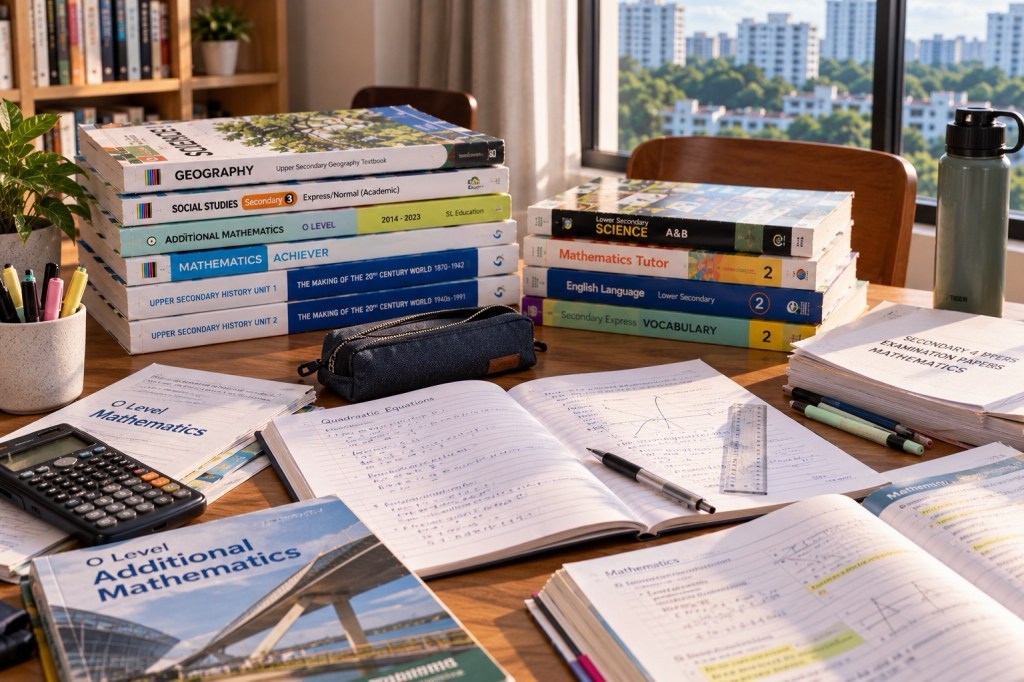
Learning G2 Mathematics with an Ang Mo Kio tutor should make mathematical structure visible. The useful tutor does more than demonstrate a procedure, assign twenty similar questions and mark the final answers. The tutor helps the student see what the problem is made of, why a method applies, where the reasoning changes direction and how to check whether the result makes sense.
For 2027 SEC school candidates, SEAB lists G2 Mathematics as syllabus K210, with 4045 shown as the earlier reference code. The official assessment gives substantial weight to standard techniques, but it also tests problem solving, reasoning and mathematical communication. That means a student needs both fluency and judgement.
For Ang Mo Kio families, a nearby tutor may make the weekly routine easier. But Mathematics improves when the tutor can diagnose the precise weak link: number control, ratio, algebraic language, graph interpretation, geometry, trigonometry, data, probability, problem formulation, working presentation or examination timing.
This guide uses the same small-group structure as eduKate’s established Secondary Mathematics pages: diagnose the starting point, rebuild the first unstable dependency, increase complexity deliberately, mix topics, test transfer and move towards independent performance.
G2 Mathematics support may be useful for students who need to:
- repair gaps carried from Primary Mathematics;
- strengthen algebra and symbolic control;
- improve ratio, percentage, rate and proportional reasoning;
- interpret graphs, equations and real-world information more accurately;
- show essential working clearly;
- reduce sign, substitution and calculator errors;
- connect geometry, trigonometry and mensuration;
- build stronger statistics and probability reasoning;
- prepare for mixed-topic SEC questions; or
- move from routine success to reliable problem solving.
eduKate Sengkang teaches Secondary Mathematics in groups of up to three students. Lessons are 1.5 hours, with the class kept small enough for the tutor to inspect working rather than only mark answers.
Check the official 2027 SEC G2 syllabus list at SEAB
A More Important Mathematical Transition Than It First Appears
Many students enter Secondary Mathematics believing that progress means learning more formulas. The deeper transition is different. Mathematics becomes more symbolic, more connected and less forgiving of hidden gaps.
A Primary-school weakness with fractions may reappear inside algebra. A weak understanding of ratio may reappear in rate, similarity or scale. Poor number sense may turn a straightforward equation into a chain of calculator checks. Weak reading may cause a student to select the wrong quantity even when the mathematical technique is known.
The student therefore needs to learn not only how to execute a method, but how to choose it.
- Numbers become general relationships.
- Words become algebraic statements.
- Tables and diagrams become mathematical evidence.
- Graphs become representations of changing quantities.
- Geometry becomes a network of properties and deductions.
- Statistics becomes interpretation rather than only calculation.
- Working becomes part of communication and part of the mark.
The strongest G2 Mathematics student is not the one who remembers the most steps. It is the one who can identify the structure, select the method and recover when the first route fails.
Why Ang Mo Kio Parents May Prefer a Small-Group G2 Mathematics Tutor
Mathematics errors are highly diagnostic. A wrong answer contains a history. The student may have chosen the wrong formula, copied a value incorrectly, misread a negative sign, expanded one term but not the other, rounded too early, mistaken a diameter for a radius or reached for a calculator before deciding what the equation means.
A small group makes that history easier to see. The tutor can watch how the student begins, what is written first, which representation is chosen and where hesitation appears.
Three students also create useful comparison. They may solve the same question through different routes. One may use algebra, another a diagram, another a numerical check. The tutor can ask which route is most efficient, which is most general and which is easiest to verify.
The aim is not to create dependency on immediate correction. The aim is to turn correction into a student-owned checking habit.
G2 Mathematics Under Full Subject-Based Banding
Under Full Subject-Based Banding, G1, G2 and G3 are subject levels. They are not identical to Posting Groups. A student can take Mathematics at G2 while taking another subject at a different level, depending on school arrangements and readiness.
For the 2027 SEC, G2 Mathematics is K210. The official assessment objectives are approximately AO1 60% for standard techniques, AO2 30% for solving problems in varied contexts and AO3 10% for reasoning and mathematical communication.
The examination has two papers of 2 hours each, 70 marks each and 50% weighting each. Paper 1 contains about 23 short-answer questions. Paper 2 contains a longer Section A, including a final question focused on applying Mathematics to a real-world scenario, and a Section B choice involving selected Geometry and Measurement or Statistics and Probability content.
This tells us something important about preparation. Routine fluency remains essential, but routine fluency alone is incomplete. A student must also interpret, connect, formulate, justify and communicate.
What We Teach in G2 Mathematics Tuition
Number sense and numerical control
We protect the arithmetic engine first. Students work on directed numbers, fractions, decimals, percentages, powers, roots, approximation, estimation and calculator judgement. These may look like earlier skills, but they continue to support nearly every later topic.
The tutor checks whether the learner can estimate the likely size and sign of an answer before pressing keys. A calculator should confirm mathematical thinking, not replace it.
Ratio, rate, proportion and percentage
Students learn to recognise multiplicative relationships, distinguish additive from proportional change, move between representations and interpret rate in context. This supports later work in scale, similarity, speed, finance, data and real-world modelling.
Algebraic language and manipulation
Algebra is treated as a language. Students need to understand variables, terms, coefficients, expressions, equations, identities and functions before procedures become dependable.
We train simplification, substitution, expansion, factorisation, equation solving and the interpretation of algebraic relationships. Every manipulation should preserve meaning.
Graphs and relationships
Graphs are not drawings to be copied. Students learn what axes represent, how scale changes perception, how coordinates encode information, how equations connect to graphs and how to interpret change from visual information.
The goal is translation: words to symbols, symbols to graphs, graphs back to meaning.
Geometry, measurement and trigonometry
Students strengthen angle reasoning, properties of shapes, congruence and similarity where relevant, mensuration, coordinate reasoning and trigonometric ideas according to the school sequence.
We teach students to annotate diagrams, mark known information, identify relationships and avoid assuming facts that have not been given or proved.
Statistics and probability
Students learn to read and compare data, choose appropriate summaries, interpret representations and reason about uncertainty. Probability is trained as structured counting and relationship, not guesswork.
Problem solving and mathematical communication
Students practise extracting information, defining unknowns, choosing a representation, making connections across topics and explaining steps. Essential working is protected because the official syllabus warns that omitting it can result in loss of marks.
Our First-Principles G2 Mathematics Teaching Method
1. Diagnose the exact weakness
“Weak in algebra” may actually mean weak negative-number control, weak fractions, unclear notation, poor substitution, misunderstanding of equality or insufficient practice retrieving earlier procedures. The surface label is not enough.
2. Rebuild the earliest dependency
If the current topic depends on an older skill, we repair the older skill first. This often produces faster improvement than pushing harder on the newest chapter.
A student who cannot simplify fractions reliably will struggle with algebraic fractions. A student who does not understand ratio deeply may struggle with similarity. A student who cannot read a graph carefully will remain fragile in later coordinate and function work.
3. Use controlled variation
We change one feature at a time so the student can see what actually changes the method. A clean example may become negative. Then fractional. Then the unknown appears on both sides. Then the context is written rather than symbolic.
This creates boundaries around the method before complexity is added.
4. Move from worked example to independent attempt
The tutor may model a first question, complete part of the second with the student, then remove the scaffold. The next question should require the learner to reconstruct the method rather than copy the page above.
5. Retrieve and interleave
Topics are revisited after delay and mixed with other topics. This trains method selection, which is what examinations require. A paper does not announce, “Use simultaneous equations now.” The student has to recognise that structure.
6. Check and recover
We teach estimation, substitution, reverse operations, unit checks, diagram checks and reasonableness checks. Recovery is a mathematical skill. Strong students still make mistakes; they simply detect and repair more of them.
Three G2 Mathematics Student Pathways
The repair pathway
This student has visible gaps. Homework takes too long, algebra feels confusing, test scores are falling or the learner cannot start without an example. We stop the drift by finding the earliest unstable dependency and reconnecting it to the present school topic.
The stabilisation pathway
This student understands most lessons but produces inconsistent results. One paper is strong and the next is weak. The problem may be retrieval, checking, mixed-topic recognition, timing or working presentation. We train repeatability.
The extension pathway
This student is already secure. Extension means deeper structure, not racing through chapters. We use unfamiliar contexts, multiple methods, stronger explanation, harder transfer and questions that require the learner to decide what information matters.
Why Algebra Receives Special Attention
Algebra gradually becomes the operating language of Secondary Mathematics. It connects equations, graphs, geometry, formulae, rates, functions, trigonometry, statistics and later Additional Mathematics.
Early algebra weakness therefore behaves like a system weakness. The student may continue passing individual topics while paying a hidden cost every time symbols appear.
A strong G2 tutor does not allow algebra to become a collection of magic moves. Students should know what a term is, what equality means, why an operation is valid and how to check whether the transformed expression or equation still represents the same relationship.
Once that language becomes familiar, many later topics feel less like separate chapters and more like variations of the same mathematical system.
When Should a Ang Mo Kio Student Begin G2 Mathematics Tuition?
Support may be useful when a student:
- struggled with fractions, ratio or percentage before secondary school;
- loses negative signs or makes repeated arithmetic errors;
- can follow examples but cannot start unfamiliar questions;
- writes very little working and cannot explain how the answer was obtained;
- depends heavily on answer keys;
- takes too long on routine questions;
- performs well in topical practice but poorly in mixed tests;
- misreads graphs, diagrams or real-world information;
- is moving towards upper-secondary G2 Mathematics and needs stronger foundations;
- wants to prepare for G2 Additional Mathematics; or
- is already strong and needs greater transfer and depth.
Early support can be more efficient than waiting for several chapters to pile onto the same missing foundation.
Ang Mo Kio Convenience, Teaching Fit and the Actual Classroom Location
A tutor in Ang Mo Kio can reduce travel and make weekly attendance easier. That is a real advantage, especially during busy school terms.
Parents should still compare teaching fit. Ask how the tutor diagnoses errors, whether the class checks working line by line, how mixed-topic practice is introduced, whether mistakes are revisited later and how the student is trained to become independent.
eduKate Sengkang is not located in Ang Mo Kio. Our Sengkang/Punggol classroom is at 83 Punggol Central, Singapore 828761. Ang Mo Kio families considering eduKate should compare commute time with the value of the three-student format and the specific learning fit. Families preferring a tutor physically in Ang Mo Kio can use the criteria in this guide to evaluate local choices.
Class Details at eduKate Sengkang
- Format: small groups of up to 3 students
- Subject: Secondary Mathematics
- Levels: G1, G2 and G3 according to the learner’s actual school route
- Duration: 1.5 hours per lesson
- Focus: foundations, algebra, graphs, geometry, trigonometry, data, probability, problem solving and examination control
- Method: diagnose → rebuild → guided practice → independent attempt → mixed retrieval → transfer
- Location: 83 Punggol Central, Singapore 828761
- Attendance: by appointment
The school’s sequence matters. We support the student’s live curriculum while protecting prerequisite knowledge. Pre-teaching is used when the learner is ready and when earlier exposure will make the school lesson more useful, not simply to claim faster chapter coverage.
What Parents Can Bring to a Consultation
- recent Mathematics test papers;
- marked worksheets;
- school homework showing repeated errors;
- the current textbook or topic list;
- teacher comments;
- examples of questions the student cannot start;
- calculator model, if calculator use is part of the issue;
- upcoming assessment dates; and
- the student’s own description of what feels confusing.
We look beyond the mark. Two students with 60% may need completely different programmes. One may understand the concepts but lose marks through carelessness and weak checking. Another may be compensating for a deep algebra gap through memorised procedures. The score is the output; the diagnostic work looks for the mechanism.
Helpful Reading for G2 Mathematics Families
- G1, G2 and G3 Mathematics Explained for Secondary School Parents
- Technical Specification of Secondary 2 G2 Mathematics
- SEAB 2027 SEC G2 Syllabuses for School Candidates
Learning G2 Mathematics with a Ang Mo Kio Tutor
Good G2 Mathematics tuition should make school Mathematics feel more intelligible, not merely more intensive.
The learner should gradually understand what the question is asking, identify the mathematical structure, choose a method, show enough working, check the result and recover from mistakes with less adult intervention.
For students who are behind, we rebuild. For students who are inconsistent, we stabilise. For students who are ready, we extend.
The end goal is not a student who can complete a familiar worksheet beside the tutor. It is a student who can meet an unfamiliar G2 Mathematics problem, decide what to do and carry the method through independently.
A Deeper G2 Mathematics Learning Blueprint
The strongest G2 Mathematics tuition programme is built around dependency and representation. A student does not merely need more questions. The learner needs to recognise what the problem is made of, which earlier skill it depends on and which representation makes the relationship easiest to see. That may be an equation, a graph, a diagram, a table or a carefully labelled list of quantities.
The dependency map
When a student is weak in a current chapter, we trace backwards. Algebra may be failing because fractions are slow. Geometry may be failing because ratio is unstable. A statistics question may be failing because the learner is misreading scale. This dependency map prevents the common mistake of repeatedly drilling the visible topic while leaving the earlier cause untouched. Repair is faster when it begins at the first unstable link.
Representation before calculation
We repeatedly ask the student to represent the problem before calculating. What are the known quantities? What is unknown? What relationship connects them? Can the situation be drawn? Can it be written algebraically? Can a rough estimate predict the size or sign of the result? These habits reduce blind substitution and make unfamiliar questions less intimidating because the student has a method for entering them.
Algebra as mathematical language
Algebra is trained as a language rather than a bag of moves. Equality, equivalence, variable, coefficient, factor and function are treated as ideas with meaning. Students learn why an operation is valid before they are expected to perform it quickly. This is especially important for G2, because later topics reuse the same algebra under greater pressure. Fluency matters, but fluent misunderstanding only makes errors faster.
Working as an external memory
Clear working reduces cognitive load. A well-organised solution lets the student see what has already been established, where a sign changed, which quantity was substituted and whether a unit remains attached. We teach enough working to preserve reasoning without filling the page with commentary. The goal is an inspectable mathematical argument that can be checked by the student as well as by the marker.
Mixed practice and method selection
Topical practice builds a method. Mixed practice builds selection. Once a method is understood, we place it beside other topics so the learner must decide which tool belongs. That is closer to examination reality. A paper will not say, “Use simultaneous equations now.” Recognition must come from the structure of the question. This transition from execution to selection is one of the central goals of G2 Mathematics.
Why Three Students Changes the Teaching
A three-student tutorial is not simply a smaller lecture. Its value comes from visibility. The tutor can see how each learner starts, how long a decision takes, what is written before an error appears and whether a correction survives the next question. With three students there is also enough variation to compare approaches. One learner may notice something another misses. The tutor can use that contrast deliberately without losing individual attention.
The class remains active because every student can be questioned frequently. Silence is harder to hide behind. At the same time, the group still provides peer momentum: students see another method, hear another explanation and realise that difficulty is something to work through rather than something to conceal. The design works only when independent attempts remain central. Three students should not become three spectators.
What a 1.5-Hour Lesson Is Trying to Achieve
A useful 1.5-hour lesson has an internal shape. The first part checks retrieval and identifies whether earlier learning is still available. The middle develops the main concept or repair target through explanation and guided practice. The later part removes support, mixes the skill with other material and records what must continue after class. The exact timings change with the student, but the logic remains stable: recall, understand, practise, perform, check and continue.
This structure prevents a lesson from becoming ninety minutes of explanation. The student needs sufficient time doing the intellectual work. The tutor may speak less as the lesson progresses. That is deliberate. The goal is not for the learner to leave saying, “The tutor made it look easy.” The goal is for the learner to demonstrate, before leaving, that the method can be carried without the tutor doing the difficult part.
How School Papers Become Diagnostic Evidence
Recent school papers are valuable because they show performance under the conditions that matter. We do not only record the total score. Errors are sorted into categories: task reading, missing knowledge, retrieval failure, method selection, execution, language or notation, checking and time control. A cluster of mistakes in one category often reveals a more useful intervention than another full paper would.
Corrections are then converted into future practice. If the learner lost marks because the concept was missing, we reteach. If the concept was known but not retrieved, we use spaced recall. If the method was selected incorrectly, we use contrastive problems. If the execution was careless, we redesign working and checking. If timing caused the loss, we practise decision speed and paper order. The correction has to match the mechanism.
The Difference Between Practice and Repetition
Repetition can make a page familiar without making a skill transferable. Practice becomes useful when the learner has to retrieve, choose and adapt. Early work may be tightly controlled so the student understands one method clearly. Later work changes the numbers, wording, representation, context and neighbouring topics. Eventually the learner must identify the method without being told which chapter the question belongs to.
We therefore use a progression from blocked practice to mixed practice. Blocked practice answers the question, “Can you perform this method?” Mixed practice answers the harder question, “Can you recognise when this method belongs?” The second question is closer to real school assessment and to the independence parents actually want.
Pre-Teaching, Repair and School Alignment
Tuition has to balance three competing needs: keep pace with school, repair earlier gaps and sometimes teach slightly ahead. The balance changes from student to student. A learner with a major prerequisite gap gains little from racing forward. A secure learner may benefit from a calm first encounter with an upcoming topic so the school lesson becomes consolidation rather than surprise.
We therefore treat pre-teaching as a readiness decision, not a prestige claim. The purpose is to reduce cognitive shock and give the student useful prior structure. Repair is equally deliberate: we return only to the earlier knowledge that is blocking current work. We do not restart an entire primary or lower-secondary syllabus when two specific dependencies are responsible for the difficulty.
What Independent Home Practice Should Look Like
Home practice should be small enough to complete well and specific enough to tell us something. The student may receive retrieval questions, one short correction set, a mixed problem set or a focused writing or explanation task depending on the subject. The purpose is continuation, not exhaustion. A huge packet that remains unfinished teaches less than a carefully chosen set that reveals whether the student can reproduce the lesson independently.
We encourage students to mark uncertainty rather than hide it. A question that required a hint should be identified. A correction that still feels unclear should return to class. This creates a more accurate learning record. Over time the learner begins to recognise personal error patterns and needs fewer external reminders to start checking them.
How We Measure Progress Beyond One Score
Marks matter, but they are a delayed and noisy indicator. Earlier signs of improvement often appear in behaviour: the student starts work sooner, asks a more precise question, shows clearer working, chooses evidence more carefully, checks units or grammar without being prompted, and can explain why a correction is needed. These changes show that the internal system is becoming more organised.
We also look for stability. A skill that appears once after heavy guidance is not yet secure. Progress becomes more convincing when the learner retrieves it after a delay, uses it in a mixed task and carries it into a school paper. The aim is not a single impressive worksheet. It is a pattern of increasingly reliable performance.
Preparing for K210: From Topic Knowledge to Paper Control
As assessment approaches, the learning task changes. The student still needs subject knowledge, but now must manage sequence, time, checking and recovery. We use timed sections and mixed papers only after enough underlying knowledge is stable. Otherwise timed practice merely measures the same weakness repeatedly.
Paper control includes knowing when to move on, how much working or explanation is enough, which questions deserve a second check and how to recover after a difficult item. A student who loses five minutes emotionally replaying one mistake can damage the rest of the paper. We teach recovery as a performance skill: mark the uncertainty, move, regain rhythm and return with a calmer mind if time permits.
A Parent’s Guide to Useful Support at Home
Parents can help without becoming the second tutor. The most useful questions are often simple: What are you learning this week? Which part is still unclear? Show me one correction you now understand. What are you going to practise first? These questions ask the student to retrieve and organise learning without requiring the parent to know every detail of the syllabus.
It is also useful to protect routine. A regular place, a realistic start time and a clear definition of what “finished” means can remove unnecessary friction. When a student is struggling, more pressure is not always the answer. Better diagnosis, smaller tasks and visible completion can restore momentum. When a student is strong, the challenge should come from deeper thinking rather than from indiscriminate volume.
What Progress Can Look Like for a G2 Mathematics Student
- starts unfamiliar work with less hesitation;
- can explain the method or reasoning instead of only showing an answer;
- recognises recurring personal error patterns;
- retrieves earlier learning after a delay;
- handles mixed tasks with less dependence on topic labels;
- uses checking deliberately rather than as an afterthought;
- asks more precise questions when genuinely stuck;
- shows greater stability across school assessments;
- can recover after one difficult question without losing the rest of the paper;
- needs progressively less prompting from the tutor.
These changes are deliberately broader than a single grade. A grade can improve because the paper happened to suit the learner, and a grade can fall because several small execution errors appeared at once. The deeper target is a system that makes stronger performance more likely across different papers and different weeks.
Local Fit for Ang Mo Kio Families
Families searching for an Ang Mo Kio tutor are usually balancing learning quality with travel, school schedules, CCAs, family commitments and the student’s energy. Convenience has real educational value because a programme that is difficult to attend consistently cannot work well. At the same time, proximity should not be confused with teaching fit. The right question is whether the programme can identify and change the learner’s actual performance mechanism.
eduKate Sengkang’s classroom is at 83 Punggol Central, Singapore 828761, by appointment. Families from Ang Mo Kio can compare the commute with the value of a three-student format, close correction and the subject system described in this guide. Families who prefer a tutor physically in Ang Mo Kio can use the same standards when comparing alternatives: diagnostic clarity, visible independent work, retrieval after correction and evidence that the learner is becoming less dependent.
What Parents Can Bring to a Consultation
- recent school papers and weighted assessments;
- marked homework or compositions;
- teacher comments;
- the current school topic sequence;
- examples of questions the student cannot start independently;
- examples of work the student can complete confidently;
- upcoming assessment dates;
- the student’s own description of what feels difficult;
- any recent change in subject level or school programme.
We are not only looking for weakness. We are looking for the boundary between what the learner can already do independently and what still requires support. That boundary helps us decide whether the immediate job is repair, stabilisation or extension.
Frequently Asked Questions
Is Mathematics tuition necessary for every G2 student?
No. A student who is learning confidently, completing school work independently and producing stable results may not need tuition. Support becomes useful when the learner has a persistent gap, school pace is creating instability, examination performance is inconsistent or the family wants structured extension that cannot be achieved reliably through self-study alone.
How quickly should improvement appear?
Some improvements appear early as better organisation, clearer working, stronger questions or less resistance to starting. Larger conceptual gaps take longer. The rate depends on the starting point, attendance, practice between lessons and how close the next assessment is. Responsible tuition should make the process visible without promising an instant grade.
Do you follow the school’s topic order?
We take the school sequence seriously because tuition has to support the learner’s real week. However, we may temporarily step backward to repair a prerequisite or slightly forward to pre-teach an upcoming idea. The sequence is therefore coordinated rather than copied mechanically.
Do you teach ahead?
Yes, when the learner is ready. Pre-teaching is useful when it gives the student a calm first encounter with new language and structure. We do not push ahead merely to claim faster coverage when the foundation is still unstable.
What happens after a mistake is corrected?
A correction is not considered secure simply because the student understands the explanation. The learner must complete a changed problem or task, retrieve the skill later and eventually use it in mixed work. This is how we separate recognition from independent learning.
What if my child is already strong?
Strong students do not need endless repetition. They need greater precision, unfamiliar contexts, multiple representations, stronger explanation and tasks that require method selection. Extension should deepen the system rather than merely accelerate through pages.
Can a student join during the school term?
Yes, subject to a suitable three-student placement and timetable. Recent school work helps us decide whether the current group pace and the learner’s needs are compatible.
How do parents know whether tuition is working?
Look for reduced dependence as well as marks. The student should increasingly start work independently, explain corrections, retrieve earlier learning, recognise errors and manage unfamiliar tasks with a clearer plan. These behaviours usually precede more stable assessment performance.
Helpful Reading Across the eduKate System
- eduKate Sengkang
- G1, G2 and G3 Mathematics Explained for Parents
- Singapore Examinations and Assessment Board
Further Learning Notes
Difficulty Calibration
Good practice sits just beyond automatic success. If every task is easy, the learner rehearses comfort. If every task is overwhelming, the learner rehearses failure. We adjust difficulty by changing one dimension at a time: amount of information, number of steps, unfamiliarity of representation, time available or degree of guidance. This lets the student feel exactly which additional demand created the difficulty and learn how to manage it.
Further Learning Notes
Correction Quality
A correction should contain a reason, not only a replacement answer. The student should be able to state what was wrong, what rule or principle applies, and what sign will help recognise the same situation next time. We often ask the learner to write a brief correction note in their own words. That note becomes useful material for later retrieval because it records the error pattern rather than only the finished solution.
Further Learning Notes
Retrieval Strength
Knowledge that can only be recognised when the notes are open is not yet dependable. We therefore close the reference, wait, and ask for the idea again. Retrieval may feel harder than rereading, but that difficulty is useful. It exposes whether the memory is actually available. Over time, spaced retrieval turns a recently explained method into something the student can call upon during a mixed school paper.
Further Learning Notes
Transfer
Transfer is the reason we change context. The student may meet different numbers, a different passage, a different diagram, a new experiment or a differently worded prompt. The surface changes while the underlying structure remains. We want the learner to say, in effect, “This looks different, but I know what kind of thinking belongs here.” That is a stronger sign of learning than success on a page that resembles the example.
Further Learning Notes
Pace
Pace should increase only after clarity. Speed built on fragile understanding creates fast errors. Once the method is stable, we shorten decision time, combine steps that are genuinely automatic and practise under modest time constraints. The student learns where speed is safe and where a slower check is valuable. Examination efficiency is therefore trained as controlled judgement rather than as rushing.
Further Learning Notes
Confidence
Confidence is most useful when it is evidence-based. We do not try to persuade a learner that difficult work is easy. Instead, we create repeated experiences of understanding, attempting, correcting and succeeding independently. The student begins to trust a process: read, represent, choose, execute, check. That kind of confidence is more durable because it survives a difficult question.
Further Learning Notes
Independent Starts
One important measure is how the student begins. Weak learners often wait for a hint even when they possess enough knowledge to start. We train a first-minute routine: identify the task, write what is known, choose a representation and make the smallest sensible first move. Starting well reduces helplessness and gives the tutor clearer evidence about what the learner can truly do without support.
Ang Mo Kio Learning Context
A local tuition page should reflect the conditions in which learning actually happens. Ang Mo Kio families are balancing school schedules, CCAs, travel, family routines and the student’s available attention. A strong programme therefore needs to be academically precise and logistically sustainable.
For Ang Mo Kio Mathematics students, a compact weekly rhythm helps protect algebra, graph work and mixed problem solving alongside school commitments. One retrieval set, one correction task and one mixed problem often reveal more than a large untargeted worksheet. The key is to know what mathematical dependency is being trained and what evidence will show whether it is becoming reliable.
Students around Ang Mo Kio, Yio Chu Kang and Mayflower often balance Mathematics with several demanding subjects and activities. A sustainable continuation routine keeps high-value skills available across the week so the next lesson can deepen rather than restart.
A practical weekly rhythm
A useful rhythm is one focused tuition lesson, one short retrieval session, one school-linked correction task and one brief check of upcoming assessment demands. The precise pattern changes by student, but the principle is consistency. Learning becomes more reliable when the student repeatedly returns to high-value ideas instead of waiting for a large revision block immediately before a test.
Travel versus teaching fit
A tutor physically located in Ang Mo Kio may offer the shortest commute. eduKate Sengkang is at 83 Punggol Central, Singapore 828761, so families should compare travel time honestly against the value of the three-student format and the teaching system described here. The correct choice is the one the student can attend consistently and benefit from academically.
What makes the page genuinely local
The area name is not enough. The article should help an Ang Mo Kio family think about actual scheduling, travel, school workload and the kind of independent practice that can fit between lessons. That local layer sits on top of a subject-accurate teaching system; it does not replace it.
Arrange a Parent–Student Consultation
Visit eduKate Sengkang to review current class information, fees and contact details. Share the student’s Secondary level, G2 Mathematics route, recent results, recurring error patterns and upcoming assessments so that the support can begin at the correct point.
Continue learning: Mathematics Hub · Complete Mathematics Index.
