
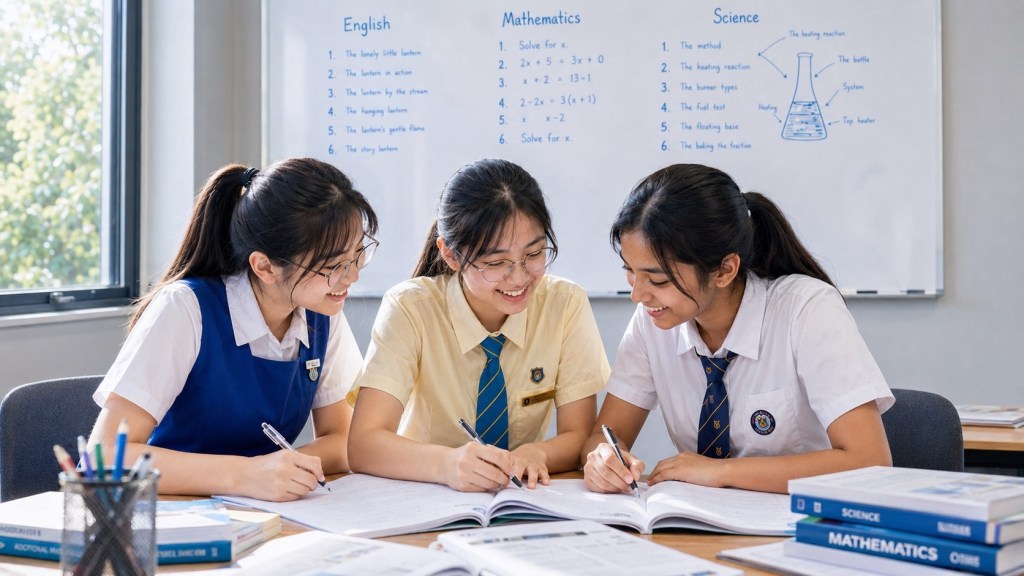
G2 SEC answer repair becomes more efficient when a correction follows the dependency structure of the work. A changed value, referent, assumption or scientific interpretation does not automatically invalidate everything around it. The learner needs to know what truly depends on the error and what can be preserved.
This eightieth Learner’s Guide develops dependency-aware repair across K200 English, K210 Mathematics and K223–K225 Science. It extends Vol 0076 Uncertainty Quarantine and Vol 0070 Dependency Graphs. The rule is: repair from the first broken node, propagate only through real dependencies, and preserve independent work.
The repair protocol
- Locate the earliest broken assumption, source, value or relation.
- Identify every answer element that genuinely depends on it.
- Preserve independent evidence and working.
- Propagate the correction only through dependent branches.
- Verify the repaired branch by a different route, then close it.
1. English referent repair
Repair event: A pronoun is reassigned to a different antecedent.
Dependency-aware move: Update only answers whose evidence chain uses that pronoun; do not reopen unrelated vocabulary or summary points.
For practice, deliberately plant this error in an otherwise sound answer. Ask the learner to mark what must change and what must remain untouched. Full rewriting should count as inefficient unless the error sits at a high-level dependency such as the model, source interpretation or governing assumption.
2. English source repair
Repair event: A quotation is found to belong to Text 2 rather than Text 1.
Dependency-aware move: Repair attribution and any comparison built on it, while preserving the meaning of the quotation if unchanged.
For practice, deliberately plant this error in an otherwise sound answer. Ask the learner to mark what must change and what must remain untouched. Full rewriting should count as inefficient unless the error sits at a high-level dependency such as the model, source interpretation or governing assumption.
3. English chronology repair
Repair event: A motive is discovered to rely on information the character learned later.
Dependency-aware move: Remove that causal explanation and revisit only inferences depending on the impossible chronology.
For practice, deliberately plant this error in an otherwise sound answer. Ask the learner to mark what must change and what must remain untouched. Full rewriting should count as inefficient unless the error sits at a high-level dependency such as the model, source interpretation or governing assumption.
4. English certainty repair
Repair event: A source says may rather than will.
Dependency-aware move: Reduce certainty in paraphrases and conclusions using that claim; other factual details remain intact.
For practice, deliberately plant this error in an otherwise sound answer. Ask the learner to mark what must change and what must remain untouched. Full rewriting should count as inefficient unless the error sits at a high-level dependency such as the model, source interpretation or governing assumption.
5. English scope repair
Repair event: A statement applies to some participants rather than all.
Dependency-aware move: Narrow only the answers that generalised the population.
For practice, deliberately plant this error in an otherwise sound answer. Ask the learner to mark what must change and what must remain untouched. Full rewriting should count as inefficient unless the error sits at a high-level dependency such as the model, source interpretation or governing assumption.
6. English contrast repair
Repair event: A however-clause changes the writer’s final stance.
Dependency-aware move: Update attitude or purpose answers that depended on the earlier one-sided reading.
For practice, deliberately plant this error in an otherwise sound answer. Ask the learner to mark what must change and what must remain untouched. Full rewriting should count as inefficient unless the error sits at a high-level dependency such as the model, source interpretation or governing assumption.
7. English summary repair
Repair event: Two selected points are discovered to duplicate one idea.
Dependency-aware move: Fuse or remove the duplicate without rebuilding the entire summary point bank.
For practice, deliberately plant this error in an otherwise sound answer. Ask the learner to mark what must change and what must remain untouched. Full rewriting should count as inefficient unless the error sits at a high-level dependency such as the model, source interpretation or governing assumption.
8. English task repair
Repair event: One situational-writing requirement was omitted.
Dependency-aware move: Insert the missing content where it fits; do not rewrite paragraphs already fulfilling their tasks.
For practice, deliberately plant this error in an otherwise sound answer. Ask the learner to mark what must change and what must remain untouched. Full rewriting should count as inefficient unless the error sits at a high-level dependency such as the model, source interpretation or governing assumption.
9. English tone repair
Repair event: One phrase is too informal for the audience.
Dependency-aware move: Replace the phrase locally while preserving content and structure.
For practice, deliberately plant this error in an otherwise sound answer. Ask the learner to mark what must change and what must remain untouched. Full rewriting should count as inefficient unless the error sits at a high-level dependency such as the model, source interpretation or governing assumption.
10. English grammar repair
Repair event: A subject–verb error is found in one sentence.
Dependency-aware move: Correct the local agreement without reopening the paragraph’s ideas.
For practice, deliberately plant this error in an otherwise sound answer. Ask the learner to mark what must change and what must remain untouched. Full rewriting should count as inefficient unless the error sits at a high-level dependency such as the model, source interpretation or governing assumption.
11. Mathematics copied-value repair
Repair event: A value copied from the stem is wrong.
Dependency-aware move: Update only calculations that inherit that input; preserve independent subparts.
For practice, deliberately plant this error in an otherwise sound answer. Ask the learner to mark what must change and what must remain untouched. Full rewriting should count as inefficient unless the error sits at a high-level dependency such as the model, source interpretation or governing assumption.
12. Mathematics sign repair
Repair event: One negative sign was lost.
Dependency-aware move: Trace descendants of that expression and recalculate only affected values.
For practice, deliberately plant this error in an otherwise sound answer. Ask the learner to mark what must change and what must remain untouched. Full rewriting should count as inefficient unless the error sits at a high-level dependency such as the model, source interpretation or governing assumption.
13. Mathematics denominator repair
Repair event: A percentage used the wrong base.
Dependency-aware move: Repair the rate and any conclusions that depend on it, not unrelated arithmetic.
For practice, deliberately plant this error in an otherwise sound answer. Ask the learner to mark what must change and what must remain untouched. Full rewriting should count as inefficient unless the error sits at a high-level dependency such as the model, source interpretation or governing assumption.
14. Mathematics unit repair
Repair event: A conversion factor was reversed.
Dependency-aware move: Correct converted values and their descendants while preserving the formula model.
For practice, deliberately plant this error in an otherwise sound answer. Ask the learner to mark what must change and what must remain untouched. Full rewriting should count as inefficient unless the error sits at a high-level dependency such as the model, source interpretation or governing assumption.
15. Mathematics equation-model repair
Repair event: The initial equation represents the story incorrectly.
Dependency-aware move: This is a high-level dependency: rebuild downstream algebra because every later value inherits the wrong model.
For practice, deliberately plant this error in an otherwise sound answer. Ask the learner to mark what must change and what must remain untouched. Full rewriting should count as inefficient unless the error sits at a high-level dependency such as the model, source interpretation or governing assumption.
16. Mathematics arithmetic repair
Repair event: One multiplication is wrong inside an otherwise valid method.
Dependency-aware move: Correct that line and propagate the new value only through dependent steps.
For practice, deliberately plant this error in an otherwise sound answer. Ask the learner to mark what must change and what must remain untouched. Full rewriting should count as inefficient unless the error sits at a high-level dependency such as the model, source interpretation or governing assumption.
17. Mathematics rounding repair
Repair event: A value was rounded too early.
Dependency-aware move: Restore a fuller value from the earliest available point and update only calculations affected by accumulated rounding.
For practice, deliberately plant this error in an otherwise sound answer. Ask the learner to mark what must change and what must remain untouched. Full rewriting should count as inefficient unless the error sits at a high-level dependency such as the model, source interpretation or governing assumption.
18. Mathematics graph-scale repair
Repair event: One coordinate was read using the wrong interval.
Dependency-aware move: Correct graph-derived quantities while preserving unrelated algebra.
For practice, deliberately plant this error in an otherwise sound answer. Ask the learner to mark what must change and what must remain untouched. Full rewriting should count as inefficient unless the error sits at a high-level dependency such as the model, source interpretation or governing assumption.
19. Mathematics choice repair
Repair event: The selected Paper 2 option is found genuinely non-viable early enough to switch.
Dependency-aware move: Close the abandoned option cleanly; do not carry its working assumptions into the new choice.
For practice, deliberately plant this error in an otherwise sound answer. Ask the learner to mark what must change and what must remain untouched. Full rewriting should count as inefficient unless the error sits at a high-level dependency such as the model, source interpretation or governing assumption.
20. Mathematics constraint repair
Repair event: A numerical solution violates an integer or capacity condition.
Dependency-aware move: Keep the algebraic result as an intermediate value and repair only the contextual final decision.
For practice, deliberately plant this error in an otherwise sound answer. Ask the learner to mark what must change and what must remain untouched. Full rewriting should count as inefficient unless the error sits at a high-level dependency such as the model, source interpretation or governing assumption.
21. Science data-ownership repair
Repair event: A measurement is attached to the wrong condition.
Dependency-aware move: Relabel the data and update only comparisons or conclusions using that value.
For practice, deliberately plant this error in an otherwise sound answer. Ask the learner to mark what must change and what must remain untouched. Full rewriting should count as inefficient unless the error sits at a high-level dependency such as the model, source interpretation or governing assumption.
22. Science variable-role repair
Repair event: Independent and controlled variables were confused.
Dependency-aware move: Repair the experimental logic and causal claims that depend on the roles.
For practice, deliberately plant this error in an otherwise sound answer. Ask the learner to mark what must change and what must remain untouched. Full rewriting should count as inefficient unless the error sits at a high-level dependency such as the model, source interpretation or governing assumption.
23. Science trend repair
Repair event: A graph trend was described in the wrong direction.
Dependency-aware move: Correct the trend statement and any mechanism or prediction built from it.
For practice, deliberately plant this error in an otherwise sound answer. Ask the learner to mark what must change and what must remain untouched. Full rewriting should count as inefficient unless the error sits at a high-level dependency such as the model, source interpretation or governing assumption.
24. Science anomaly repair
Repair event: A point thought to be ordinary is recognised as anomalous.
Dependency-aware move: Update repeatability or evaluation comments without deleting the rest of the dataset.
For practice, deliberately plant this error in an otherwise sound answer. Ask the learner to mark what must change and what must remain untouched. Full rewriting should count as inefficient unless the error sits at a high-level dependency such as the model, source interpretation or governing assumption.
25. Science causal repair
Repair event: The evidence supports association, not causation.
Dependency-aware move: Downgrade causal wording and mechanism claims while preserving the observed relationship.
For practice, deliberately plant this error in an otherwise sound answer. Ask the learner to mark what must change and what must remain untouched. Full rewriting should count as inefficient unless the error sits at a high-level dependency such as the model, source interpretation or governing assumption.
26. Science mechanism repair
Repair event: One causal link is scientifically wrong.
Dependency-aware move: Replace that link and check only conclusions downstream of it.
For practice, deliberately plant this error in an otherwise sound answer. Ask the learner to mark what must change and what must remain untouched. Full rewriting should count as inefficient unless the error sits at a high-level dependency such as the model, source interpretation or governing assumption.
27. Science unit repair
Repair event: A quantitative Science answer uses the wrong unit conversion.
Dependency-aware move: Correct the numerical branch while preserving the scientific relation.
For practice, deliberately plant this error in an otherwise sound answer. Ask the learner to mark what must change and what must remain untouched. Full rewriting should count as inefficient unless the error sits at a high-level dependency such as the model, source interpretation or governing assumption.
28. Science model repair
Repair event: A model assumption is found not to hold under the tested conditions.
Dependency-aware move: Narrow the model’s range and update predictions that relied on the assumption.
For practice, deliberately plant this error in an otherwise sound answer. Ask the learner to mark what must change and what must remain untouched. Full rewriting should count as inefficient unless the error sits at a high-level dependency such as the model, source interpretation or governing assumption.
29. Science negative-evidence repair
Repair event: A missing result was overinterpreted as proof of absence.
Dependency-aware move: Rewrite the conclusion as no detected effect under tested conditions if that is what the method supports.
For practice, deliberately plant this error in an otherwise sound answer. Ask the learner to mark what must change and what must remain untouched. Full rewriting should count as inefficient unless the error sits at a high-level dependency such as the model, source interpretation or governing assumption.
30. Science control repair
Repair event: A supposed control group was exposed to the treatment.
Dependency-aware move: Downgrade causal confidence and revisit only claims relying on clean control comparison.
For practice, deliberately plant this error in an otherwise sound answer. Ask the learner to mark what must change and what must remain untouched. Full rewriting should count as inefficient unless the error sits at a high-level dependency such as the model, source interpretation or governing assumption.
31. Answer-number repair
Repair event: A correct response is written under the wrong question number.
Dependency-aware move: Move or relabel the response without altering its content.
For practice, deliberately plant this error in an otherwise sound answer. Ask the learner to mark what must change and what must remain untouched. Full rewriting should count as inefficient unless the error sits at a high-level dependency such as the model, source interpretation or governing assumption.
32. Option-label repair
Repair event: A chosen option is not clearly identified.
Dependency-aware move: Fix the option label before doing conceptual rechecking.
For practice, deliberately plant this error in an otherwise sound answer. Ask the learner to mark what must change and what must remain untouched. Full rewriting should count as inefficient unless the error sits at a high-level dependency such as the model, source interpretation or governing assumption.
33. Skipped-state repair
Repair event: A return marker says only ‘?’ and no longer restores the problem.
Dependency-aware move: Reconstruct the smallest known/blocked/next state before spending more time on the question.
For practice, deliberately plant this error in an otherwise sound answer. Ask the learner to mark what must change and what must remain untouched. Full rewriting should count as inefficient unless the error sits at a high-level dependency such as the model, source interpretation or governing assumption.
34. Timing-plan repair
Repair event: One question used too much time.
Dependency-aware move: Adjust the next checkpoint or return order, not the depth of every remaining answer.
For practice, deliberately plant this error in an otherwise sound answer. Ask the learner to mark what must change and what must remain untouched. Full rewriting should count as inefficient unless the error sits at a high-level dependency such as the model, source interpretation or governing assumption.
35. Confidence repair
Repair event: A high-confidence answer fails an independent check.
Dependency-aware move: Downgrade that item and the specific error family, not global confidence across the paper.
For practice, deliberately plant this error in an otherwise sound answer. Ask the learner to mark what must change and what must remain untouched. Full rewriting should count as inefficient unless the error sits at a high-level dependency such as the model, source interpretation or governing assumption.
36. Instruction repair
Repair event: A general instruction was overlooked.
Dependency-aware move: Map exactly which responses it affects and revise those only.
For practice, deliberately plant this error in an otherwise sound answer. Ask the learner to mark what must change and what must remain untouched. Full rewriting should count as inefficient unless the error sits at a high-level dependency such as the model, source interpretation or governing assumption.
37. Definition repair
Repair event: A locally defined term was interpreted using a familiar but different meaning.
Dependency-aware move: Repair answers using that term while preserving unrelated topic knowledge.
For practice, deliberately plant this error in an otherwise sound answer. Ask the learner to mark what must change and what must remain untouched. Full rewriting should count as inefficient unless the error sits at a high-level dependency such as the model, source interpretation or governing assumption.
38. Assumption repair
Repair event: An unstated assumption is identified as invented.
Dependency-aware move: Remove or replace only the branch that depends on it.
For practice, deliberately plant this error in an otherwise sound answer. Ask the learner to mark what must change and what must remain untouched. Full rewriting should count as inefficient unless the error sits at a high-level dependency such as the model, source interpretation or governing assumption.
39. Dependency-map repair
Repair event: A changed intermediate value appears in several later lines.
Dependency-aware move: Draw or mentally trace arrows to determine which lines truly inherit it before editing.
For practice, deliberately plant this error in an otherwise sound answer. Ask the learner to mark what must change and what must remain untouched. Full rewriting should count as inefficient unless the error sits at a high-level dependency such as the model, source interpretation or governing assumption.
40. Independent-branch preservation
Repair event: A later subpart uses a different method and does not depend on the corrected earlier value.
Dependency-aware move: Leave it untouched even if it appears in the same question.
For practice, deliberately plant this error in an otherwise sound answer. Ask the learner to mark what must change and what must remain untouched. Full rewriting should count as inefficient unless the error sits at a high-level dependency such as the model, source interpretation or governing assumption.
41. Shared-source repair
Repair event: Several English answers use the same misread paragraph.
Dependency-aware move: Update the small cluster sharing that source instead of rereading the whole paper.
For practice, deliberately plant this error in an otherwise sound answer. Ask the learner to mark what must change and what must remain untouched. Full rewriting should count as inefficient unless the error sits at a high-level dependency such as the model, source interpretation or governing assumption.
42. Shared-formula repair
Repair event: Several Mathematics answers use the same incorrectly remembered formula.
Dependency-aware move: This repeated dependency justifies a broader repair across all affected items.
For practice, deliberately plant this error in an otherwise sound answer. Ask the learner to mark what must change and what must remain untouched. Full rewriting should count as inefficient unless the error sits at a high-level dependency such as the model, source interpretation or governing assumption.
43. Shared-concept repair
Repair event: Several Science responses use the same wrong mechanism.
Dependency-aware move: Promote the issue from local correction to a concept-level repair across the affected set.
For practice, deliberately plant this error in an otherwise sound answer. Ask the learner to mark what must change and what must remain untouched. Full rewriting should count as inefficient unless the error sits at a high-level dependency such as the model, source interpretation or governing assumption.
44. One-off slip containment
Repair event: A mistake appears once and does not recur in similar work.
Dependency-aware move: Correct it locally and monitor rather than rebuilding the topic.
For practice, deliberately plant this error in an otherwise sound answer. Ask the learner to mark what must change and what must remain untouched. Full rewriting should count as inefficient unless the error sits at a high-level dependency such as the model, source interpretation or governing assumption.
45. Repeated slip escalation
Repair event: The same sign, source or unit error appears repeatedly.
Dependency-aware move: Treat recurrence as evidence of a system-level weakness and widen the repair scope.
For practice, deliberately plant this error in an otherwise sound answer. Ask the learner to mark what must change and what must remain untouched. Full rewriting should count as inefficient unless the error sits at a high-level dependency such as the model, source interpretation or governing assumption.
46. Late review repair
Repair event: A local error is found with two minutes left.
Dependency-aware move: Choose repairs with clear dependency and high recoverability rather than reopening opaque questions.
For practice, deliberately plant this error in an otherwise sound answer. Ask the learner to mark what must change and what must remain untouched. Full rewriting should count as inefficient unless the error sits at a high-level dependency such as the model, source interpretation or governing assumption.
47. One-minute repair
Repair event: Time is nearly over.
Dependency-aware move: Prioritise numbering, units, blanks and one-step corrections; avoid deep rewrites without evidence.
For practice, deliberately plant this error in an otherwise sound answer. Ask the learner to mark what must change and what must remain untouched. Full rewriting should count as inefficient unless the error sits at a high-level dependency such as the model, source interpretation or governing assumption.
48. Post-practice repair
Repair event: After marking, one answer is wrong.
Dependency-aware move: Identify first broken transition rather than copying the full model answer.
For practice, deliberately plant this error in an otherwise sound answer. Ask the learner to mark what must change and what must remain untouched. Full rewriting should count as inefficient unless the error sits at a high-level dependency such as the model, source interpretation or governing assumption.
49. Transfer repair
Repair event: A repaired skill works only on the original question.
Dependency-aware move: Retest on a changed surface; if it fails, the repair was too local or memorised.
For practice, deliberately plant this error in an otherwise sound answer. Ask the learner to mark what must change and what must remain untouched. Full rewriting should count as inefficient unless the error sits at a high-level dependency such as the model, source interpretation or governing assumption.
50. Stable repair
Repair event: The skill survives several fresh transfer tasks.
Dependency-aware move: Reduce repair frequency and return study time to weaker areas.
For practice, deliberately plant this error in an otherwise sound answer. Ask the learner to mark what must change and what must remain untouched. Full rewriting should count as inefficient unless the error sits at a high-level dependency such as the model, source interpretation or governing assumption.
51. Repair without overcorrection
Repair event: One rule has an exception.
Dependency-aware move: Do not replace the old overgeneralisation with the opposite overgeneralisation; learn the boundary.
For practice, deliberately plant this error in an otherwise sound answer. Ask the learner to mark what must change and what must remain untouched. Full rewriting should count as inefficient unless the error sits at a high-level dependency such as the model, source interpretation or governing assumption.
52. Repair with evidence preservation
Repair event: Most of an answer is correct.
Dependency-aware move: Keep sound evidence and wording while replacing only the unsupported link.
For practice, deliberately plant this error in an otherwise sound answer. Ask the learner to mark what must change and what must remain untouched. Full rewriting should count as inefficient unless the error sits at a high-level dependency such as the model, source interpretation or governing assumption.
53. Repair with source preservation
Repair event: A conclusion changes but the source data remain valid.
Dependency-aware move: Do not discard measurements merely because interpretation changed.
For practice, deliberately plant this error in an otherwise sound answer. Ask the learner to mark what must change and what must remain untouched. Full rewriting should count as inefficient unless the error sits at a high-level dependency such as the model, source interpretation or governing assumption.
54. Repair with model preservation
Repair event: A numerical execution fails but the equation model is correct.
Dependency-aware move: Keep the model and redo execution only.
For practice, deliberately plant this error in an otherwise sound answer. Ask the learner to mark what must change and what must remain untouched. Full rewriting should count as inefficient unless the error sits at a high-level dependency such as the model, source interpretation or governing assumption.
55. Repair with execution preservation
Repair event: Arithmetic is correct but the model is wrong.
Dependency-aware move: Do not let correct calculation make the model seem valid; rebuild from representation.
For practice, deliberately plant this error in an otherwise sound answer. Ask the learner to mark what must change and what must remain untouched. Full rewriting should count as inefficient unless the error sits at a high-level dependency such as the model, source interpretation or governing assumption.
56. Repair after new clue
Repair event: A later question reveals a missing principle.
Dependency-aware move: Use the clue to repair earlier dependent work at a safe transition rather than interrupting productive current work.
For practice, deliberately plant this error in an otherwise sound answer. Ask the learner to mark what must change and what must remain untouched. Full rewriting should count as inefficient unless the error sits at a high-level dependency such as the model, source interpretation or governing assumption.
57. Repair after contradiction
Repair event: Two answers cannot both be true.
Dependency-aware move: Find the shared source, assumption or variable and repair at the earliest common dependency.
For practice, deliberately plant this error in an otherwise sound answer. Ask the learner to mark what must change and what must remain untouched. Full rewriting should count as inefficient unless the error sits at a high-level dependency such as the model, source interpretation or governing assumption.
58. Repair after impossible unit
Repair event: A result has the wrong quantity type.
Dependency-aware move: Trace back to formula orientation, power or conversion before changing the final number.
For practice, deliberately plant this error in an otherwise sound answer. Ask the learner to mark what must change and what must remain untouched. Full rewriting should count as inefficient unless the error sits at a high-level dependency such as the model, source interpretation or governing assumption.
59. Repair after impossible range
Repair event: A probability exceeds one or a mean lies outside the data range.
Dependency-aware move: Use the impossible output to locate denominator, counting or data-entry errors.
For practice, deliberately plant this error in an otherwise sound answer. Ask the learner to mark what must change and what must remain untouched. Full rewriting should count as inefficient unless the error sits at a high-level dependency such as the model, source interpretation or governing assumption.
60. Repair after counterexample
Repair event: A universal claim fails on one legitimate case.
Dependency-aware move: Narrow the claim’s scope rather than abandoning every related principle.
For practice, deliberately plant this error in an otherwise sound answer. Ask the learner to mark what must change and what must remain untouched. Full rewriting should count as inefficient unless the error sits at a high-level dependency such as the model, source interpretation or governing assumption.
61. Repair after negative evidence
Repair event: A predicted Science result repeatedly fails to appear in a valid test.
Dependency-aware move: Revise the hypothesis or range rather than repeatedly asserting the same mechanism.
For practice, deliberately plant this error in an otherwise sound answer. Ask the learner to mark what must change and what must remain untouched. Full rewriting should count as inefficient unless the error sits at a high-level dependency such as the model, source interpretation or governing assumption.
62. Repair after contrast signal
Repair event: A later clause qualifies an earlier English statement.
Dependency-aware move: Preserve the earlier fact but revise the final stance to include the qualification.
For practice, deliberately plant this error in an otherwise sound answer. Ask the learner to mark what must change and what must remain untouched. Full rewriting should count as inefficient unless the error sits at a high-level dependency such as the model, source interpretation or governing assumption.
63. Repair after referent resolution
Repair event: A pronoun is finally resolved.
Dependency-aware move: Update only the inference chain using that pronoun and close the uncertainty marker.
For practice, deliberately plant this error in an otherwise sound answer. Ask the learner to mark what must change and what must remain untouched. Full rewriting should count as inefficient unless the error sits at a high-level dependency such as the model, source interpretation or governing assumption.
64. Repair after denominator naming
Repair event: The correct base becomes clear.
Dependency-aware move: Recalculate the rate and downstream comparison while leaving unrelated totals unchanged.
For practice, deliberately plant this error in an otherwise sound answer. Ask the learner to mark what must change and what must remain untouched. Full rewriting should count as inefficient unless the error sits at a high-level dependency such as the model, source interpretation or governing assumption.
65. Repair after unit alignment
Repair event: Two quantities are converted to common units.
Dependency-aware move: Recompare them; do not redo reasoning that never depended on the unit mismatch.
For practice, deliberately plant this error in an otherwise sound answer. Ask the learner to mark what must change and what must remain untouched. Full rewriting should count as inefficient unless the error sits at a high-level dependency such as the model, source interpretation or governing assumption.
66. Repair after control discovery
Repair event: A confounding variable is identified.
Dependency-aware move: Reduce causal certainty and suggest a targeted control without rewriting descriptive data.
For practice, deliberately plant this error in an otherwise sound answer. Ask the learner to mark what must change and what must remain untouched. Full rewriting should count as inefficient unless the error sits at a high-level dependency such as the model, source interpretation or governing assumption.
67. Repair after sample-scope discovery
Repair event: The evidence covers a narrower population than first thought.
Dependency-aware move: Narrow the conclusion rather than changing the observed result.
For practice, deliberately plant this error in an otherwise sound answer. Ask the learner to mark what must change and what must remain untouched. Full rewriting should count as inefficient unless the error sits at a high-level dependency such as the model, source interpretation or governing assumption.
68. Repair after time-range discovery
Repair event: The graph question asks only a specific interval.
Dependency-aware move: Replace whole-graph claims with interval-specific ones while preserving correctly read data.
For practice, deliberately plant this error in an otherwise sound answer. Ask the learner to mark what must change and what must remain untouched. Full rewriting should count as inefficient unless the error sits at a high-level dependency such as the model, source interpretation or governing assumption.
69. Repair after option elimination
Repair event: A previously considered MCQ option is ruled out.
Dependency-aware move: Do not reopen it later unless new evidence directly challenges the elimination reason.
For practice, deliberately plant this error in an otherwise sound answer. Ask the learner to mark what must change and what must remain untouched. Full rewriting should count as inefficient unless the error sits at a high-level dependency such as the model, source interpretation or governing assumption.
70. Repair closure
Repair event: A question has been corrected and independently checked.
Dependency-aware move: Clear the marker and stop spending attention on it.
For practice, deliberately plant this error in an otherwise sound answer. Ask the learner to mark what must change and what must remain untouched. Full rewriting should count as inefficient unless the error sits at a high-level dependency such as the model, source interpretation or governing assumption.
Repair scope: local, branch or system
A local repair changes one step. A branch repair changes several descendants of one earlier node. A system repair is justified only when repeated evidence shows the same rule, formula, source habit or mechanism is wrong across questions. This three-level distinction prevents both under-correction and destructive over-correction.
Links
Use the Examination Craft hub for review and recovery, Vol 0072 Verification Asymmetry for post-repair checking, the relevant English, Mathematics and Science hubs for capability repair, and the PSLE Learner’s Guide for earlier foundations.
Official-source discipline
Use the current SEAB 2027 G2 school-candidate syllabus directory and linked subject syllabuses for official assessment requirements. Dependency-aware repair is an eduKateSengkang training method, not an SEAB instruction.
Final rule
Do not punish correct work for being near an error. Find the first broken node, follow its true dependencies, repair only what inherits the problem and verify the new branch. Precision in correction is part of examination performance.
G2 SEC Learner’s Guide: open the Vol 0001–0131 index · continue to Vol 0132–0175.
G2 SEC Learner’s Guide navigation: Master Index · Cross-subject lane · Examination Craft
