
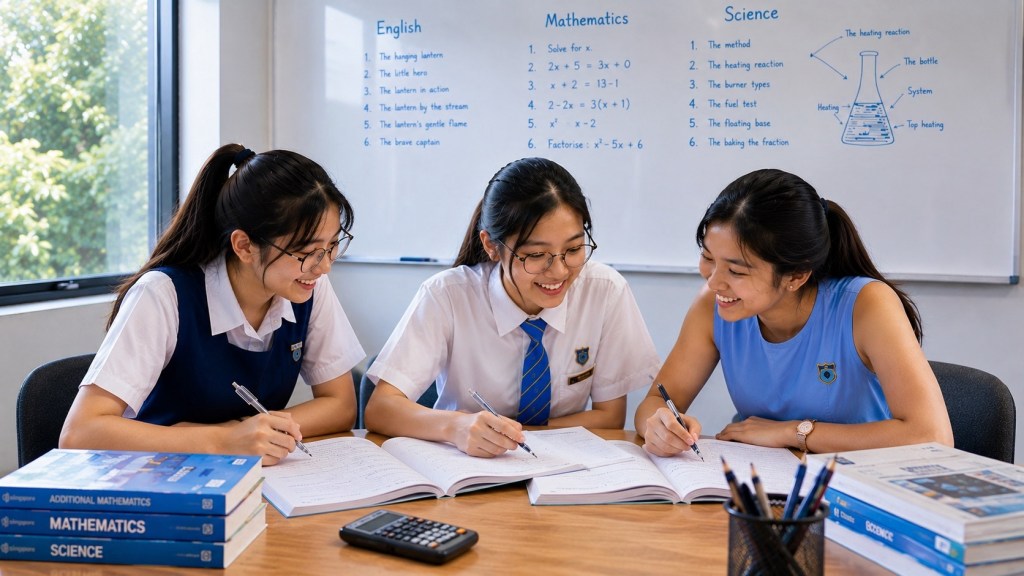
Why Students Struggle With Additional Mathematics Even When E-Math Is Strong is the cross-diagnostic owner for a common upper-secondary pattern: a student performs well in Elementary Mathematics, yet Additional Mathematics feels unexpectedly fragile, slow or abstract.
The existing Additional Mathematics Tuition Sengkang page remains the broad A-Math owner, while the Additional Mathematics Learning Hub and its topic guides remain the specialist estate.
This page explains the mismatch itself: why strength in E-Math does not automatically transfer, which hidden dependencies A-Math exposes, how to diagnose the first failure, and how to repair A-Math without treating a capable Mathematics student as though all earlier learning has disappeared.
A-Math often feels like a new subject not because the student forgot Mathematics, but because familiar Mathematics is now compressed into denser symbolic structures that demand faster recognition, stronger algebra and more independent method selection.
1. E-Math strength and A-Math strength overlap, but they are not identical
A student can be accurate with arithmetic, routine algebra, geometry and standard problem solving while still finding A-Math difficult. The subjects share foundations, but A-Math places much more weight on symbolic manipulation, functional thinking, exact forms, transformation of expressions and longer chains of algebraic reasoning.
The overlap matters because strong E-Math is an asset.
The difference matters because that asset may not yet be organised for A-Math.
2. The first difference is symbolic density
A-Math compresses more meaning into fewer symbols. One line can contain functions, powers, brackets, fractions, logarithms or trigonometric expressions whose structure must be parsed before any method is chosen.
Students who relied on visual familiarity in E-Math can feel as though the page suddenly became less readable.
The first bottleneck may be symbolic parsing rather than mathematical intelligence.
3. The second difference is transformation depth
E-Math often rewards applying a known method to a visible structure. A-Math more often requires the learner to transform an expression into a form where the method becomes possible.
Expansion, factorisation, completing the square, identity work and algebraic rearrangement can all be intermediate moves.
The student has to control the representation before reaching the target.
4. The third difference is dependency length
A longer A-Math solution may contain several correct subgoals that depend on earlier symbolic decisions. One sign error, domain oversight or poor factorisation can contaminate the whole chain.
The subject therefore punishes small upstream fragility more strongly.
Working has to preserve the route, not only the answer.
5. The fourth difference is exactness
A-Math frequently works with exact algebraic, surd, trigonometric or logarithmic forms. Approximate decimal thinking is sometimes insufficient.
Students who are comfortable only when a calculator gives a numerical answer can feel less secure.
Exact form requires confidence in symbolic objects as legitimate answers.
6. The fifth difference is method selection
A question may admit more than one valid route, but some are shorter, safer or easier to verify. Students must choose among algebraic manipulation, identities, substitution, graph reasoning, differentiation, integration or other topic-specific methods.
Knowing methods separately is not enough.
A-Math performance depends on routing.
7. Strong E-Math arithmetic can hide weak algebraic structure
A learner may calculate accurately while treating algebra as a sequence of local moves. E-Math can sometimes allow this to survive because many tasks have shorter symbolic chains.
A-Math exposes whether terms, factors, functions and equations are represented structurally.
The hidden gap becomes visible under density.
8. Strong E-Math marks can hide fraction avoidance
A student may succeed in E-Math while still disliking algebraic fractions, fractional coefficients or exact rational manipulation. A-Math makes these forms harder to avoid.
Fraction structure is not a Primary-school relic.
It becomes part of symbolic control.
9. Strong E-Math marks can hide sign fragility
Negative values, subtraction, negative coefficients and bracketed expressions can interact repeatedly in A-Math.
A learner who knows sign rules only as slogans may accumulate errors across long solutions.
Sign roles need structural interpretation.
10. Strong E-Math marks can hide weak factor recognition
Factorisation in A-Math is not only a chapter. It becomes a route into equations, simplification, partial fractions and other transformations.
Students need to recognise product structure quickly.
A factorisation weakness can therefore appear across several topics.
11. Strong E-Math marks can hide weak function thinking
A-Math asks the learner to treat functions as objects with inputs, outputs, domains, transformations and inverses, not simply as formulae to substitute into.
This is a conceptual shift.
Students who see a formula as a calculation instruction may struggle with functions as mappings.
12. Strong E-Math marks can hide graph–algebra disconnection
A student may plot graphs correctly and manipulate equations correctly while failing to connect the two representations. A-Math increasingly rewards seeing algebraic structure through graphical behaviour and vice versa.
Cross-representation fluency becomes important.
The graph and equation should describe one mathematical object.
13. Strong E-Math marks can hide weak equation meaning
If solving an equation means moving terms and changing signs, A-Math’s denser equations can expose the fragility. The learner needs equality, inverse operations and admissible solutions.
Procedure should rest on invariants.
That makes unfamiliar forms reconstructible.
14. Strong E-Math marks can hide weak domain awareness
A-Math introduces more situations where expressions are not defined for every value or where only certain solutions are admissible.
A learner who sees algebra as unrestricted symbol movement may produce mathematically invalid answers.
Constraints are part of the representation.
15. Strong E-Math marks can hide weak notation reading
Function notation, indices, logarithms, trigonometric symbols and calculus notation each compress relationships.
Students need to read notation before using rules.
Misreading the object creates errors that look procedural later.
16. Strong E-Math marks can hide calculator dependence
A calculator can support numerical work but cannot decide which algebraic transformation, identity or exact form is required.
A-Math often asks the student to preserve structure that the calculator does not supply.
Tool fluency and algebraic fluency are different.
17. Strong E-Math marks can hide slow retrieval
A student may know algebraic facts, identities or formulas but retrieve them too slowly for longer A-Math chains.
Working memory becomes occupied by recall that should be cheaper.
Retrieval speed can become a performance bottleneck without being a conceptual gap.
18. Strong E-Math marks can hide weak reverse reasoning
A-Math frequently asks the learner to rearrange, invert, factor, substitute back or reconstruct an earlier condition. Students who only know forward routines can feel stuck.
Inverse and reversible transformations should be explicit.
Many advanced procedures are easier when their reverse is also understood.
19. Strong E-Math marks can hide weak abstraction
A-Math often removes the concrete story that helped make E-Math intuitive. The learner must operate on general forms and symbols without an immediate real-world anchor.
This is not meaningless abstraction.
It is Mathematics asking the student to reason about structure itself.
20. The visible struggle may begin with one hidden prerequisite
A learner who appears weak across several A-Math topics may have one recurring problem: factorisation, fractions, sign control, equation structure or function notation.
Diagnose the earliest repeated failure.
One precise repair can unlock several chapters.
21. Readiness is not the same as an E-Math grade
A strong E-Math result is useful evidence, but it compresses many abilities into one score. A-Math readiness depends more specifically on algebraic fluency, fraction control, exactness, symbolic reading, function thinking and willingness to work through longer transformations.
The learner may be mathematically strong overall while one of these dependencies is underdeveloped.
Readiness should therefore be profiled, not inferred from one headline mark.
22. A readiness profile should include algebraic fluency
Can the student expand, factorise, simplify, solve and rearrange accurately enough that these operations do not consume all working memory?
If every line requires deliberate reconstruction, A-Math questions become cognitively expensive.
The issue may be fluency rather than understanding.
23. A readiness profile should include fraction control
Can the learner manipulate fractional coefficients, algebraic fractions and rational expressions without avoiding them?
Many A-Math topics place fractions inside larger symbolic structures.
A student who is comfortable only with integer coefficients may experience repeated friction.
24. A readiness profile should include sign control
Can the learner distinguish subtraction, a negative number, a negative coefficient and the negation of a bracketed expression under mixed conditions?
A-Math chains amplify sign mistakes.
Sign control should be tested inside real algebra, not only in isolated drills.
25. A readiness profile should include factor recognition
Can the student see common factors, quadratic structure and product forms without being told that the chapter is factorisation?
A-Math often requires factorisation as an intermediate move rather than the final answer.
Recognition matters as much as execution.
26. A readiness profile should include equality and equation structure
Does the learner understand why transformations preserve equality, or rely on moving terms across the equals sign by habit?
The latter can survive routine E-Math equations and become brittle in fractional, logarithmic or trigonometric equations.
A-Math needs relational equality.
27. A readiness profile should include graph–algebra translation
Can the student connect an equation to a graph, interpret roots, turning points or transformations and move back from visual behaviour to symbolic structure?
A-Math functions are rarely only one representation.
Cross-form fluency lowers topic difficulty.
28. A readiness profile should include exact-form comfort
Surds, logarithms, trigonometric values and algebraic expressions may remain exact throughout a solution. The learner should not feel that an answer is unfinished simply because it is not a decimal.
Exactness is a legitimate mathematical representation.
Confidence in exact form is part of A-Math maturity.
29. A readiness profile should include self-checking
Can the student substitute back, compare equivalent forms, inspect signs, use graph behaviour or test domain restrictions?
Long A-Math chains benefit from local verification before errors propagate.
Checking should become structural, not only final-answer rereading.
30. A readiness profile should include method selection
Can the learner choose between factorisation, formula, graph reasoning, identities, substitution or a calculus route when several methods are available?
A-Math increasingly tests navigation among methods.
Selection is distinct from knowing each method.
31. Diagnostic category: concept not built
The student may genuinely not understand what a function, logarithm, derivative or identity represents. In that case, direct teaching is necessary.
More practice cannot retrieve a concept that was never constructed.
The first intervention should make the mathematical object meaningful.
32. Diagnostic category: concept built, notation weak
The learner can explain the relationship verbally or graphically but misreads symbolic notation. Function notation, powers or trigonometric symbols may be the barrier.
Translation practice is appropriate.
The concept does not need to be rebuilt from zero.
33. Diagnostic category: method known, trigger weak
The student can execute a method after being told to use it but does not recognise when the method applies.
This is a routing gap.
Mixed and near-miss problems should train the trigger conditions.
34. Diagnostic category: method selected, execution weak
The route is correct but algebraic manipulation, signs or arithmetic produce errors.
Procedure and fluency need targeted work.
Protect the successful method-selection layer.
35. Diagnostic category: execution strong, checking weak
The learner produces long correct work most of the time but loses marks to local sign, exactness or domain errors that remain undetected.
Build a small verification system.
The issue is not topic coverage.
36. Diagnostic category: untimed strong, timed fragile
The student understands and solves accurately but takes too long under assessment conditions.
This is a conversion problem.
Fluency, method economy and selective working matter more than broad reteaching.
37. Diagnostic category: topical strong, mixed weak
The learner performs well when the chapter title announces the method and struggles when several topics are interleaved.
The missing skill is recognition and route selection.
Mixed practice should replace some blocked practice.
38. Diagnostic category: familiar strong, fresh weak
Repeated tuition formats may create high performance through surface recognition. A changed context, variable name or expression form causes collapse.
This is a transfer gap.
Controlled variation and fresh tasks are the repair.
39. Diagnostic category: working correct, confidence low
The learner repeatedly seeks reassurance, rewrites correct answers or avoids unfamiliar questions despite sound mathematics.
Use independent checks and evidence of fresh success.
Confidence should grow from verified control.
40. Diagnostic category: confidence high, calibration weak
Another student moves quickly through long algebra and accepts impossible or non-admissible answers because the method felt familiar.
Use domain, sign, graph and substitution checks.
Confidence should be proportional to evidence.
41. Factorisation is a frequent hidden bottleneck
Weak factor recognition can affect quadratics, algebraic fractions, partial fractions and other transformations. The student may experience several chapters as separate difficulties even though one structural skill is recurring.
Track repeated dependence on product structure.
This is a high-leverage repair candidate.
42. Fractions are another frequent hidden bottleneck
A-Math often embeds fractions inside equations, coefficients, rational expressions and calculus working. A student who avoids fractions spends extra working memory on basic representation.
Fluency here can unlock several topics.
Fraction confidence should be treated as algebra infrastructure.
43. Sign control is another frequent hidden bottleneck
Long transformations create many opportunities for negative signs to change role or be lost. If sign errors recur across unrelated topics, diagnose the sign system rather than each chapter separately.
Common causes include weak grouping, poor line structure and rushed rewriting.
The intervention should match the cause.
44. Functions are a frequent conceptual bottleneck
Functions require students to think about mappings, inputs, outputs, transformations and inverse relationships. Learners who see every formula only as a calculation instruction may struggle even when their algebra is strong.
Functions need their own conceptual model.
This is not simply more equation practice.
45. Graph reasoning is a frequent representation bottleneck
Students may plot accurately but fail to connect features with algebraic meaning. Others can manipulate equations but do not predict how transformations change graphs.
Cross-representation practice is needed.
The graph should become another form of the function.
46. Exact forms are a frequent confidence bottleneck
A learner may repeatedly convert exact values to decimals because an expression such as √3 or a logarithmic form feels incomplete. This can lose structure and make later manipulation harder.
Teach what exactness preserves.
A-Math uses exact representation deliberately.
47. Trigonometric identities are a frequent method-selection bottleneck
The student may know several identities but not know which transformation simplifies the current expression or equation.
The issue is not identity memory alone.
Practice should compare trigger features and desired target forms.
48. Calculus can expose weak algebra rather than weak calculus
Differentiation or integration rules may be understood, yet algebraic simplification before or after the calculus step creates the error.
Diagnose the exact line where the solution diverges.
Protect the calculus concept if it is correct.
49. Coordinate geometry can expose weak representation
A student may know distance, midpoint or gradient formulae but misidentify points, axes or the relationship represented by the line.
Diagram-to-symbol translation remains essential.
Formula recall cannot repair a wrong spatial model.
50. Logarithms can expose weak inverse-function thinking
Logarithms and exponentials are linked inverse structures. Students who memorise laws without the inverse relationship may struggle with equations and graphs.
The conceptual bridge matters.
Laws then become easier to reconstruct and verify.
51. A-Math should be taught as a network of reusable structures
Factorisation, substitution, inverse operations, function transformations, exactness and constraints recur across many chapters.
Students should recognise these shared structures.
The subject becomes smaller when repeated mathematical jobs are visible.
52. Chapter boundaries can hide those shared structures
When every worksheet is labelled by topic, students may associate a method with the chapter heading rather than the mathematical trigger.
Later mixed papers remove that cue.
Interleaving should gradually replace chapter-dependent recognition.
53. Strong E-Math students may need slower A-Math teaching initially
Fast E-Math performance can create an expectation that A-Math should also feel immediate. Slower concept-building at the start is not evidence of low ability.
The new symbolic system needs time to organise.
Depth early can create speed later.
54. Strong E-Math students may resist showing working
A learner accustomed to short solutions may attempt too much A-Math mentally. Longer algebraic chains then become difficult to check.
Working should externalise important transformations.
It is a reasoning tool, not punishment.
55. Strong E-Math students may overuse familiar E-Math methods
A bar model, numerical trial or calculator approach may feel safer even when A-Math algebra offers a shorter route.
The old method is not wrong merely because it is old.
The learner needs to compare cost, generality and verification.
56. Strong E-Math students may underuse estimation
A-Math feels symbolic, so some learners stop asking whether an answer’s sign or magnitude makes sense.
This removes a valuable safety layer.
Number sense should continue supervising symbolic work.
57. Strong E-Math students may expect one obvious method
A-Math often permits several routes, and the shortest route may not be visually obvious at first. This can feel less secure than routine E-Math questions.
Method comparison should be taught explicitly.
Choice is part of expertise.
58. Strong E-Math students may interpret early struggle as identity failure
A learner who has long seen themselves as good at Mathematics can be unsettled when A-Math demands slower thinking.
The useful response is technical: identify the new dependency.
A difficult transition does not erase previous mathematical strength.
59. The tutor should explain why the subject feels different
Naming symbolic density, exactness, transformation depth and method selection helps the learner understand the change in demand.
This reduces vague frustration.
The student can then target the new skills instead of simply working longer.
60. The tutor should not use E-Math success as a reason to skip diagnosis
A strong E-Math grade can create false confidence that all algebra prerequisites are secure.
Test the specific A-Math dependencies.
Good prior performance should inform the profile, not end the investigation.
61. Repair should begin with the earliest recurring failure
If a student misses factorisation across quadratics, algebraic fractions and calculus simplification, the shared factorisation dependency deserves priority. If signs fail across functions and trigonometry, sign control may be upstream.
Look across topics for the repeated structure.
Repair should follow dependency, not chapter order.
62. Use the learner’s strong E-Math as scaffolding
A strong E-Math student already has useful assets: number sense, proportional reasoning, geometry, algebraic familiarity or calculator fluency. Connect A-Math structures to those strengths.
The bridge should feel like extension, not total restart.
Existing competence is working capital.
63. Rebuild equality before advanced equation techniques
If equation solving relies on transposition slogans, use balance reasoning and inverse operations briefly. Then return to A-Math equations.
The repair can be concise.
A strong invariant makes later symbolic work safer.
64. Rebuild factorisation as product recognition
Ask what multiplication structure would reconstruct the expression rather than only which pattern the chapter suggests. Compare expanded and factorised forms.
Use common-factor, quadratic and other syllabus-appropriate examples.
The target is seeing products inside sums.
65. Rebuild fractions as algebraic structure
Treat numerator and denominator as grouped expressions, identify common factors and preserve restrictions. Avoid visual cancellation across addition.
The fraction bar should be read as division plus grouping.
This makes rational manipulation more reliable.
66. Rebuild sign control through role classification
Before applying sign rules, identify whether a minus symbol represents subtraction, a negative value, a negative coefficient or negation of a bracketed expression.
The role determines the valid transformation.
Classification reduces automatic sign errors.
67. Rebuild functions as mappings
Use inputs, outputs, tables and graphs to show that a function describes a relationship between quantities. Function notation then becomes a compact way to refer to that mapping.
This model supports inverse functions and transformations.
The symbol f is not merely another variable.
68. Rebuild inverse functions through reversibility
An inverse should undo the original mapping under the appropriate conditions. This connects directly to inverse operations and reversible transformations.
Students should ask whether the function is one-to-one where required.
Inverse notation should inherit the structural idea.
69. Rebuild exact forms through equivalence
An exact surd, logarithmic or trigonometric value can be equivalent to a decimal approximation without losing precision. Students should learn why the exact representation may be preferable.
Exactness preserves structure for later work.
It is not unfinished arithmetic.
70. Rebuild logarithms through inverse exponentials
Instead of memorising laws first, connect logarithms to the question: what exponent produces this value? The laws then describe how exponential structure behaves under multiplication, division and powers.
Inverse-function meaning supports retrieval.
The topic becomes less arbitrary.
71. Rebuild trigonometric identities through equivalence
An identity states that two expressions are equal wherever both are defined. The goal is to transform one form into another without changing value.
Students should distinguish proving an identity from solving an equation.
The representation task is different.
72. Rebuild calculus through rate and accumulation
Differentiation should connect to rate of change and gradient; integration to accumulation and area-related ideas where appropriate. Rules still matter, but concept gives them a place.
A-Math calculus is more reliable when symbols remain interpretable.
Then algebra can support rather than obscure the calculus.
73. Use worked examples that reveal decisions
A strong worked example should show why a method was chosen, what intermediate form is being sought and how the answer will be checked.
Students need the hidden route, not only the visible steps.
This reduces imitation without understanding.
74. Fade worked examples deliberately
After one complete example, remove a step, then a cue, then the entire scaffold on a fresh problem. The learner should increasingly reconstruct the route.
Support fading should follow evidence.
A permanent worked solution beside the exercise can create false fluency.
75. Use self-explanation selectively
Ask why factorisation helps here, why this substitution is valid or what the derivative represents. A brief explanation can expose shallow symbolic knowledge.
The goal is not long prose.
The goal is structural visibility.
76. Use controlled variation
Change one feature at a time: coefficient, sign, variable, domain, graph orientation or requested form. Observe whether the learner updates the method correctly.
This reveals the cues the student was using.
Controlled variation is excellent A-Math diagnostics.
77. Use near-miss questions
Two expressions may look similar while one factors and the other does not, or two trigonometric equations may require different identities. Compare them side by side.
The student should identify the feature that changes the route.
Discrimination is a core method-selection skill.
78. Use reverse tasks
Expand after factorising, differentiate and compare with the original function, substitute a solution back, or reconstruct a function from a graph where appropriate.
Reverse work creates verification and deeper structure.
One-way procedures are less robust.
79. Use fresh examples after every repair
The original corrected problem is no longer clean evidence. Change coefficients, context or representation.
The learner should still find the method.
Fresh transfer is the acceptance condition.
80. Use delayed fresh examples
Return later without announcing the target. If the method can be reconstructed after time, the repair is more durable.
A-Math chains depend heavily on long-term access.
Spaced retrieval protects the network.
81. Use mixed-topic sets after local stability
Once individual methods are secure, remove chapter labels and combine functions, algebra, trigonometry or calculus at the appropriate level.
The learner must choose.
This converts topic knowledge into examination navigation.
82. Use full papers only when the diagnostic question is paper-level
Full-paper work is useful for timing, switching, stamina and integrated selection. It is inefficient for one local factorisation misconception.
Match practice scale to problem scale.
A-Math paper volume should follow diagnosis.
83. Strong E-Math students may benefit from fewer but deeper A-Math problems
A smaller set that demands method comparison, explanation and fresh transfer can reveal more than many repetitive routine questions.
Volume is useful when fluency is the target.
Depth is useful when structure is the target.
84. Strong students should compare solution routes
A quadratic question might be solved by factorisation, formula or completing the square depending on form and purpose. The learner should compare efficiency and information gained.
Method comparison builds judgement.
A-Math expertise is not one favourite technique.
85. Strong students should track exactness deliberately
Know when an exact expression should be preserved and when a decimal approximation is appropriate. This affects later substitution and verification.
Premature approximation can compound error.
Representation precision is part of method choice.
86. Strong students should practise constraints
Domain restrictions, admissible roots and contextual conditions can invalidate an otherwise correct symbolic result.
Ask what values are allowed before and after transformation.
A-Math answers live inside mathematical boundaries.
87. Strong students should practise concise working
As fluency grows, routine transformations can be compressed while key equivalence changes, substitutions and restrictions remain visible.
The shortest safe route is better than the shortest possible route.
Working should protect both marks and self-checking.
88. Strong students should practise error containment
A local sign or arithmetic slip should be found and repaired without causing a full-solution restart whenever possible.
Trace dependencies.
Recovery is part of high-level examination performance.
89. Catch-up students need an active prerequisite map
List only the small number of upstream structures causing repeated failures: perhaps factorisation, fractions, signs or functions.
Do not label the whole subject weak.
A compact map makes intervention manageable.
90. Catch-up students need age-appropriate simplified examples
Reduce algebraic density while preserving the A-Math relationship. Avoid sending a Secondary 3 or 4 student back to childish materials unnecessarily.
Access can be simplified without lowering dignity.
Then restore normal load.
91. Catch-up students need current-topic re-entry
After repairing factorisation, use it immediately inside the quadratic or algebraic-fraction problem that exposed the gap.
The learner should feel the purpose of remediation.
Repair should move forward.
92. Catch-up students need a smaller paper dose
When the system is fragile, repeated full papers can generate many errors but little learning. Use targeted teaching and fresh mixed sets first.
Paper practice can increase as the network stabilises.
The aim is interpretable evidence.
93. Catch-up students need visible evidence of progress
Show that one previously recurring error now survives fresh work with less support.
This is more credible than vague encouragement.
Confidence grows from owned capability.
94. Catch-up students need stable routines
Use a consistent process: parse structure, choose method, show key working, verify. Do not introduce new shortcuts every week.
A stable operating system reduces cognitive noise.
Novelty should serve learning, not excitement alone.
95. A-Math homework should have a learning job
One set may build retrieval, another method selection, another transfer or paper conversion. Homework volume without a defined job can become mechanical.
Students should know why they are doing the set.
Purpose improves feedback.
96. Retrieval practice should focus on high-dependency knowledge
Identities, formulas, factor patterns and algebraic transformations that support many topics deserve regular access practice.
Low-dependency details can receive lighter review.
Memory allocation should follow mathematical leverage.
97. Spaced practice should protect older chapters
A-Math topics can feel secure immediately after teaching and fade when the class moves on. Small returns keep the methods available.
The subject is cumulative.
Later calculus or functions can reuse earlier algebra unexpectedly.
98. Interleaving should train route selection
Mixed questions remove the chapter heading that announces the method. The learner must recognise structure from the expression or task.
This is essential before examination conditions.
Interleaving should follow basic method understanding.
99. Error logs should record mechanisms
Write factorisation trigger missed, domain restriction ignored or sign lost after expansion rather than copying whole questions into a notebook.
The log should reveal repeatable patterns.
A smaller mechanism map is easier to act on.
100. Solved errors should leave the active log
When a pattern survives fresh, delayed and mixed work, move it to maintenance or archive.
The active queue should shrink.
Progress should simplify the learner’s attention.
101. A-Math working should preserve exact transformations
Each line should make the significant symbolic change traceable. Skipping too many steps can hide a sign, factor or equivalence break.
Working is an external memory system.
It should support correction.
102. A-Math working should preserve restrictions
When an expression has domain constraints or an equation creates possible extraneous solutions, record the relevant condition.
The final answer must satisfy the original mathematical object.
Restrictions are not optional annotations.
103. A-Math working should preserve definitions
If a variable or function is introduced, its meaning should remain stable. In modelling questions, units should travel with quantities.
A symbol that changes meaning silently corrupts the chain.
Notation discipline protects reasoning.
104. A-Math working should preserve exactness until approximation is justified
Premature decimal conversion can lose structure and accuracy. Keep exact forms when the method or question requires them.
Approximate deliberately.
Representation choice affects precision.
105. A-Math checking should use substitution where appropriate
Candidate solutions can often be returned to the original equation or condition. This is particularly useful after long manipulations.
The check should target the source expression.
A transformed equation can sometimes introduce or hide invalid values.
106. A-Math checking should use inverse transformations
Factorisation can be checked by expansion; differentiation can sometimes be checked against structural expectations; function inverses can be composed where appropriate.
The reverse route provides independent evidence.
Checking should not simply repeat the same work.
107. A-Math checking should use graph behaviour
Roots, turning points, signs or transformation direction can provide useful plausibility checks on algebraic results.
Graphical evidence can reveal impossible symbolic outcomes.
Cross-representation verification is powerful.
108. A-Math checking should use domains and signs
Ask whether the final result is allowed, whether a logarithm argument is valid, whether a length is positive or whether a trigonometric solution lies in the required interval.
Context and domain constrain algebra.
A neat expression can still be invalid.
109. A-Math checking should use method-specific expectations
A derivative should reflect increasing or decreasing behaviour; a quadratic discriminant should align with the number of real roots; a transformed function should shift or scale as expected.
These checks rely on concept.
They turn understanding into verification.
110. The goal is not to make A-Math look like E-Math
A-Math has genuinely different symbolic and structural demands. The goal is to use the student’s E-Math strengths as a foundation while building the new capabilities explicitly.
The learner should become comfortable with abstraction rather than avoid it.
Difference does not imply disconnection.
111. Parents should not read A-Math struggle as proof that E-Math strength was false
The earlier E-Math result can be genuine while A-Math exposes a different capability boundary. A learner can be strong at routine algebra, geometry and number work yet still need explicit development in functions, exact forms and symbolic transformation.
Both statements can be true.
A new demand does not invalidate old competence.
112. Parents should ask which A-Math dependency is failing
Instead of asking why the child suddenly became bad at Maths, ask whether the recurring issue is factorisation, signs, functions, fractions, notation, exactness, route selection or working control.
A precise question creates a repairable problem.
Broad worry creates broad practice.
113. Parents should ask whether the problem is learning or conversion
A student who cannot solve a topic untimed needs teaching. A student who solves it accurately but too slowly needs fluency or examination conversion.
These interventions are different.
More teaching is not always the answer.
114. Parents should ask whether the learner can explain the method trigger
Knowing how to complete the square is different from recognising when it is useful. Knowing identities is different from choosing one under mixed conditions.
Ask why this method fits.
Selection is a major A-Math capability.
115. Parents should ask whether the child can recover after forgetting
A student does not need perfect memory if they can reconstruct from structure. Factorisation, inverse relationships and function models provide recovery routes.
Recoverability is a strong readiness signal.
Brittle recall is less durable.
116. Parents should ask whether tuition support is shrinking
If the tutor still selects every method, flags every sign risk and supplies every formula trigger, the polished work may overstate independence.
Look for fresh problems with fewer cues.
Support fading is part of progress.
117. Parents should avoid comparing A-Math speed with E-Math speed too early
A-Math initially requires more symbolic parsing and method selection. The learner may need deliberate time while the new structures are becoming chunks.
Speed should grow after the route is stable.
Premature pressure can encourage shallow shortcuts.
118. Parents should avoid assuming more tuition hours solve the problem
If the method is wrong, more repetitions can strengthen the wrong model. If the student is exhausted, more sessions can reduce capacity.
Diagnose before increasing dosage.
The right intervention is more valuable than more intervention.
119. Parents should avoid changing tutors solely because A-Math feels harder
The subject is supposed to introduce new abstraction and may create a temporary learning dip. Evaluate whether the tutor can diagnose, explain and reduce support.
Change support when evidence shows a mismatch.
Difficulty alone is not proof of poor teaching.
120. Parents should look for transfer to school work
A-Math tuition should improve classwork, tests and fresh homework without the tutor present.
Tuition-only success is partial evidence.
Transfer back to the school environment is the practical endpoint.
121. Tutors should begin from a capability profile
Record algebraic fluency, fractions, signs, factorisation, functions, exactness, method selection, working and checking.
The profile should identify stable assets as well as gaps.
One broad A-Math label is not enough.
122. Tutors should distinguish content coverage from capability
A chapter can be taught and still not be usable. Conversely, a student may have independently mastered material not recently revised.
Coverage tells what appeared in lessons.
Capability tells what the learner can carry.
123. Tutors should identify the first wrong line
In a long A-Math solution, the final wrong answer may be several steps after the decisive error. Trace backwards to the first invalid representation or transformation.
Repair there.
Downstream corrections should follow automatically.
124. Tutors should preserve successful working
If the student chose the correct method and maintained structure until one arithmetic slip, keep that route. Do not reteach the whole topic.
Specificity protects confidence and time.
Local errors deserve local interventions.
125. Tutors should teach method triggers explicitly
For each major method, identify the structural features that make it useful and the features that suggest another route.
Use contrasts and near misses.
This builds route selection rather than chapter memory.
126. Tutors should teach verification alongside methods
A solution technique should arrive with at least one plausible check: substitution, inverse transformation, graph behaviour, domain or exact-form comparison.
Verification should be part of the method family.
Students should know how failure would look.
127. Tutors should teach restrictions before they become marks lost
Domains, admissible solutions and exact-answer conditions should be part of the mathematical object from the start.
Do not leave them as final exam warnings.
Constraint awareness is a conceptual habit.
128. Tutors should use the A-Math Learning Hub as a specialist estate
The Additional Mathematics Learning Hub already contains deep topic, diagnostic and examination guides.
This cross-diagnostic owner should route to those pages rather than duplicate them.
One owner per job keeps the estate navigable.
129. The study guide should remain the syllabus-level map
Use the Additional Mathematics Study Guide for topic coverage and worked-example navigation.
Use this page when the question is why E-Math strength did not automatically become A-Math strength.
The intents are different.
130. The tuition owner should remain the broad local route
The Additional Mathematics Tuition Sengkang page remains the main Sengkang A-Math tuition owner.
This diagnostic article supports it without competing for the commercial head term.
Editorial architecture should mirror learning architecture.
131. E-Math strength is most useful when it can be translated
Strong number sense can support exactness; strong ratio can support functions; strong geometry can support coordinate methods; strong equation skills can support calculus setup.
The tutor should make these transfers explicit.
A-Math becomes less alien when familiar structures are recognised.
132. E-Math strength is less useful when it remains context-bound
A learner may know ratio only through bar models or equations only in one familiar format. A-Math requires the relationship to survive new notation and abstraction.
Variation reveals whether the earlier knowledge is portable.
Transfer is the conversion step.
133. E-Math speed is useful only when the route is valid
Rapid arithmetic can accelerate a correct A-Math method. It can also accelerate a wrong representation or sign pattern.
Speed multiplies the method already chosen.
Selection and checking must supervise fluency.
134. E-Math confidence is useful when it supports productive struggle
A strong Mathematics identity can help the learner persist through harder abstraction if struggle is interpreted technically rather than personally.
Use evidence of earlier success as a resource.
Then identify the new capability being built.
135. E-Math habits may need to evolve
Mental calculation, short working and rapid pattern recognition may have served well before. A-Math may require more explicit symbolic lines, restrictions and method comparison.
The goal is not to discard efficient habits.
It is to adapt them to a denser subject.
136. A-Math readiness should be retested after the first term
Initial impressions can change once students experience real chapter load and school assessments.
Update the capability profile with fresh evidence.
Readiness is not a one-time label.
137. Early A-Math struggle can be temporary adaptation
A student may need time to become fluent with notation and longer chains even when the underlying concepts are sound.
Look for decreasing support and faster recognition.
A learning curve is not automatically a deficit.
138. Persistent A-Math struggle requires mechanism diagnosis
If the same error families remain after several cycles of practice, the learner may be rehearsing around a misconception or dependency gap.
Stop broad repetition.
Test the upstream structure.
139. Sudden A-Math collapse can follow cumulative load
Several individually manageable topics may become difficult when mixed and timed. The student can know each method and still fail route selection or stamina.
Use mixed sets and paper-level observation.
The cause may be coordination, not knowledge.
140. A-Math marks can improve before independence
Structured tuition can quickly raise performance through cues and well-sequenced practice. That improvement is useful but should not be mistaken for complete transfer.
Gradually remove prompts.
Independent fresh work should confirm the next stage.
141. Independence can improve before marks
A student may begin choosing methods and checking accurately while still losing marks to slower algebra or unfamiliar school papers.
The system can be improving before the headline score catches up.
Track mechanism-level progress.
142. A-Math examination training should follow capability
Full papers are valuable when the student needs timing, selection, stamina and integration. They are less useful when a basic factorisation or function model remains broken.
Repair first, integrate second.
Simulation should test a working system.
143. Timed topic sets can bridge into papers
A student who is accurate untimed but slow can practise short representative sets before full papers.
This converts individual methods under moderate pressure.
Timing can be layered.
144. Mixed-topic sets can bridge into papers
Interleaving functions, algebra, trigonometry and calculus removes chapter cues and trains method selection without full-paper fatigue.
The learner should explain the route after each problem.
Mixed sets are efficient routing practice.
145. Full papers reveal integration costs
They show where topic switching, late-paper accuracy, model choice and checking break under sustained load.
Analyse the paper by error family.
The score is only the compressed output.
146. Mock papers should be reviewed for first failure
For every significant error, ask where the solution first stopped being valid: method selection, representation, transformation, arithmetic or checking.
This produces actionable evidence.
Do not copy full solutions without diagnosis.
147. Past-paper familiarity should be labelled
Repeated exposure can improve scores because the wording and route are remembered.
This still has retrieval value.
Use fresh or changed problems to test transfer.
148. Method economy matters more as the examination approaches
A correct ten-line route may be inferior to a robust five-line route if time and error opportunities are higher. Students should compare solution cost.
The shortest safe method is often ideal.
Economy should preserve checkability.
149. Verification budgeting matters under time
Not every line can be checked equally. Students should allocate verification to high-risk transformations, domain-sensitive steps, exactness and final interpretation.
Checking should be selective.
A-Math verification is a resource allocation problem.
150. Final-stage method switching should reduce
Close to an examination, newly discovered shortcuts can destabilise a learner who already has reliable methods.
Introduce new methods only when expected value is clear.
Stability has increasing value near performance.
151. Strong students should not chase difficulty for its own sake
A very hard problem is useful when it develops transfer, structural recognition or method selection. Difficulty alone is not a learning objective.
Choose challenge with a job.
Advanced work should deepen the system.
152. Catch-up students should not be buried in elementary review
Only the specific prerequisite should be simplified. Keep the presentation mature and reconnect quickly to A-Math.
A learner’s age and current curriculum matter.
Remediation should not become an identity.
153. A-Math study should protect rest and cognitive capacity
Long symbolic chains require sustained working memory and attention. Exhausted practice can increase sign errors and shallow pattern matching.
Reduce low-value repetition before extending study time.
Capacity is part of performance.
154. A-Math study should protect confidence calibration
Students should neither assume every hard question proves weakness nor assume every familiar method will work.
Use checks and fresh evidence.
Calibrated confidence supports better decisions.
155. A-Math study should protect curiosity
Functions, transformations, calculus and exact algebra become more meaningful when students can ask why the structures work.
Exam training need not erase mathematical interest.
Understanding can coexist with performance preparation.
156. A-Math study should protect method authorship
The learner should increasingly decide what to try, what to rewrite and how to verify. Tutor-provided route selection should reduce.
A-Math becomes independent when the student owns the next move.
This is the real release condition.
157. A-Math study should preserve E-Math
Taking Additional Mathematics should not cause neglect of Elementary Mathematics. The two subjects share foundations and both matter within the student’s programme.
Avoid creating a false competition.
Strong algebra should support rather than cannibalise E-Math.
158. E-Math and A-Math should be reviewed as one mathematical profile
Some skills, such as algebraic manipulation, graphs and geometry, interact across both subjects. Others are more specialised.
A combined profile can reveal shared dependencies.
Intervention can then avoid duplicated practice.
159. One tutor or programme should keep the methods coherent
If school and tuition use different routes, the learner should understand how they relate rather than memorise conflicting procedures.
Method diversity is useful when comparison is explicit.
Unexplained conflict adds cognitive load.
160. The goal is a learner who can explain why A-Math needs a different operating system
By the time the transition stabilises, the student should recognise that A-Math demands denser symbolic reading, stronger transformation control, more exactness and more method selection.
Naming the demands makes them trainable.
The subject stops feeling mysteriously difficult.
161. Worked case: strong E-Math algebra, weak A-Math factorisation
The learner solves linear equations comfortably and expands brackets accurately but cannot recognise when a quadratic expression should be factorised as an intermediate step.
The visible difficulty appears in several A-Math chapters.
The repair is factor recognition under mixed conditions, not broad algebra reteaching.
162. Worked case: strong E-Math graphs, weak function structure
The student plots coordinates neatly and reads axes well but treats f(x) as an equation label rather than a mapping. Inverse functions and transformations then feel arbitrary.
The graph skill is real.
The missing layer is function meaning.
163. Worked case: strong arithmetic, weak exact forms
The learner reaches correct decimal approximations quickly but converts surds or trigonometric values prematurely and loses exact relationships needed later.
Calculator confidence is not the problem.
Exact-form judgement needs explicit training.
164. Worked case: strong routine equations, weak restrictions
The student manipulates an algebraic fraction correctly but accepts a value that makes an original denominator zero.
Procedure succeeded; admissibility failed.
The repair is domain awareness.
165. Worked case: strong topical work, weak mixed paper
The learner scores highly on isolated functions, logarithms and trigonometry but loses time deciding which method applies when topics are mixed.
The knowledge is present.
Routing and paper conversion are the active bottlenecks.
166. Worked case: strong method choice, weak signs
The student selects the correct differentiation or identity route and loses marks through negative coefficients or bracket expansion.
The topic reasoning is strong.
Target sign and algebraic fluency without dismantling the method-selection strength.
167. Worked case: strong understanding, slow working
Every transformation is explained correctly but the learner writes excessive lines and rechecks repeatedly. Under time, later questions are unfinished.
The next frontier is method economy and verification budgeting.
More conceptual explanation is not the main need.
168. Worked case: fast working, weak calibration
A confident student moves quickly through algebra and accepts an impossible or non-admissible solution because the chain looked familiar.
Add local checks at high-risk steps.
Speed should be supervised by structure.
169. Worked case: strong E-Math marks, weak fraction coefficients
The student succeeded in E-Math by converting awkward fractions to decimals where possible. A-Math now embeds fractional coefficients in exact algebra.
The earlier avoidance strategy no longer scales.
Fraction fluency becomes an upstream repair.
170. Worked case: strong geometry, weak coordinate algebra
The learner understands geometric properties visually but struggles when lines, gradients and coordinates turn the geometry into equations.
Spatial reasoning is an asset.
The missing bridge is geometry-to-algebra translation.
171. Frequently asked question: Does strong E-Math mean A-Math should be easy?
No. Strong E-Math provides valuable foundations, but A-Math adds symbolic density, transformation depth, functions, exact forms and more independent method selection.
The transition can still require explicit learning.
The two subjects overlap without being identical.
172. Frequently asked question: Does struggling with A-Math mean the student is weak at Mathematics?
Not necessarily. A learner can have strong quantitative reasoning while one A-Math dependency is underdeveloped.
Profile the specific mechanism.
A-Math difficulty should be diagnosed rather than globalised.
173. Frequently asked question: Should the student drop A-Math immediately if marks are low?
A course decision should consider school guidance, subject pathway, current syllabus level, sustained evidence and the learner’s wider goals. One early low score does not by itself identify the cause.
First distinguish missing prerequisites from adaptation and paper conversion.
Decisions should follow the student’s actual context.
174. Frequently asked question: How long should the transition take?
There is no universal timeline. Some learners adapt quickly; others need explicit work on algebraic fluency, functions or exactness before performance stabilises.
Track decreasing support and fresh transfer rather than a fixed calendar.
Evidence is more useful than an arbitrary deadline.
175. Frequently asked question: Should we revise E-Math first?
Only where an E-Math dependency is actually causing the A-Math failure. A full E-Math restart is usually inefficient for a student whose broad E-Math performance is already strong.
Repair the upstream skill precisely.
Then return to A-Math.
176. Frequently asked question: Should A-Math tuition teach ahead?
Teaching ahead can help when it creates more time for concept-building, retrieval and mixed practice, but only if current prerequisites are secure.
Acceleration without structural readiness can create a larger future repair.
Sequence should serve understanding.
177. Frequently asked question: Should students memorise identities and formulas?
Yes, important identities and formulas need accessible memory, but they should remain tied to meaning, conditions and method triggers.
Memory makes reasoning cheaper.
It should not become blind substitution.
178. Frequently asked question: Should A-Math students use AI solution tools?
Where school rules and household choices permit, tools can check steps, generate variants and surface alternate methods. The learner should still form the route independently and verify tool output.
A copied solution does not build method selection.
Tool use should strengthen judgement.
179. Frequently asked question: Should students use graphing tools?
Graphing tools can help visualise functions and check behaviour where appropriate, but they should not outsource the algebraic reasoning the learner is expected to perform.
Use them as a representation and verification aid.
The underlying function model should remain internal.
180. Frequently asked question: Why does my child forget A-Math after each chapter?
The subject is cumulative, and blocked chapter practice can create temporary fluency that fades without retrieval. Older algebra, identities and functions should return in spaced mixed work.
Continuity needs planned retrieval.
Understanding once is not the same as accessible knowledge later.
181. Frequently asked question: Why do full papers feel much harder than topical worksheets?
Full papers remove chapter cues and add switching, timing, stamina and method-selection demands.
The student may know the topics separately.
Mixed integration is the missing layer.
182. Frequently asked question: How do I know A-Math tuition is working?
Look for better fresh-task transfer, fewer prompts, smaller recurring error families, more efficient route selection, stronger school performance and better checking.
Completed tuition work is only part of the evidence.
Independence is the stronger measure.
183. Frequently asked question: Why do marks improve and then fall?
Recent practice can lift familiar-topic performance, while delayed retrieval or mixed-paper conditions reveal unresolved fragility.
Compare the error families across both periods.
Regression should be diagnosed before restarting the programme.
184. Frequently asked question: Should a strong student do harder questions or more papers?
Choose the task according to the bottleneck. Harder questions develop structural transfer; full papers develop timing and integration.
Neither is automatically superior.
Practice should have a job.
185. Frequently asked question: How much working should be shown?
Enough to preserve key transformations, substitutions, restrictions and the route to the result. Routine steps can become more concise with mastery.
The working must remain checkable.
The existing A-Math method-economy and working specialists provide deeper guidance.
186. Frequently asked question: What if the student hates A-Math but likes E-Math?
The dislike may come from symbolic overload, repeated failure, speed pressure or genuine subject preference. Diagnose the experience before interpreting it as ability.
Improved control can change motivation for some learners.
For others, pathway decisions may still be appropriate with school and family guidance.
187. Frequently asked question: What if the student likes A-Math but scores poorly?
Interest is a useful resource, but performance may still be limited by algebraic fluency, careless transformations, incomplete working or weak paper conversion.
Preserve the curiosity while fixing the mechanism.
Motivation and performance are different dimensions.
188. Frequently asked question: Can A-Math improve E-Math?
Stronger algebra, function thinking and exact manipulation can deepen general Mathematics reasoning, though the subjects retain different syllabus demands.
Transfer is possible when the shared structure is made explicit.
The relationship should be supportive, not assumed.
189. Frequently asked question: Can E-Math practice improve A-Math?
Yes, when the practice targets shared dependencies such as algebra, fractions, graphs or geometry. Routine E-Math volume that does not address the A-Math bottleneck may have little effect.
Transfer depends on overlap.
Choose practice structurally.
190. Frequently asked question: What should parents ask an A-Math tutor?
Ask what the first recurring failure is, what support is still required, how the skill will be retested fresh and how tuition connects to school work.
These questions reveal the learning system.
They are more informative than asking only how many worksheets are completed.
191. Final readiness should include symbolic parsing
Give an unfamiliar expression containing several structural features and ask the learner to identify terms, factors, groups, restrictions or function components before manipulating.
The student should read the object correctly.
Symbol literacy is a foundational A-Math capability.
192. Final readiness should include method selection
Use a mixed set where several learned techniques are plausible. Do not label the chapter.
The learner should choose a mathematically valid and reasonably efficient route.
Selection is stronger evidence than following a heading.
193. Final readiness should include one exact-form task
The learner should preserve an exact answer where appropriate, manipulate it correctly and know when approximation is permitted or requested.
Exactness should no longer feel unfinished.
Representation precision matters.
194. Final readiness should include one function translation
Move among symbolic rule, graph and transformation language. The learner should preserve domain, mapping and structural meaning.
This tests the conceptual centre of A-Math.
Functions should not remain notation alone.
195. Final readiness should include one factorisation-dependent task
Use a problem where factorisation is an intermediate move rather than the named topic.
The learner should recognise the structure independently.
Hidden-method recognition is essential for mixed papers.
196. Final readiness should include one sign-sensitive task
Use negative coefficients, brackets or exact expressions where sign roles matter.
The learner should parse before applying rules.
Recurring sign errors should not survive unnoticed.
197. Final readiness should include one restriction-sensitive task
Use a domain, interval, denominator or contextual constraint that can invalidate a candidate answer.
The learner should identify and apply the restriction.
A-Math solutions live inside admissible sets.
198. Final readiness should include one verification choice
The learner should choose substitution, expansion, graph behaviour, domain, sign or another appropriate check without being told which.
Verification should be targeted.
Independent checking is evidence of control.
199. Final readiness should include delayed mixed work
The student should still retrieve and select A-Math methods after time has passed and topics are interleaved.
This distinguishes a durable network from recent chapter memory.
Continuity is part of readiness.
200. Final readiness should include reduced tutor prompts
Routine reminders to factorise, preserve exact form or check the domain should fade on familiar structures.
Any remaining support should be recorded.
The support footprint is part of the learner model.
201. The final A-Math profile should preserve E-Math strengths
Record strong arithmetic, geometry, graphing or algebra alongside A-Math-specific frontiers.
This keeps the learner model balanced.
Strengths can continue supporting repair.
202. The final A-Math profile should identify one active frontier
Perhaps factorisation, method selection, functions, exactness or examination speed remains the next job.
One clear frontier prevents diffuse revision.
Progress is easier when the next load is named.
203. The final A-Math profile should retire solved dependencies
A historical sign or fraction weakness that no longer appears on fresh mixed work can leave the active queue.
Keep it in light maintenance if necessary.
A smaller problem set is evidence of progress.
204. The final A-Math profile should distinguish learning from exam conversion
Topic mastery, mixed-topic selection, timing, working and checking should be reported separately.
A student can be strong in one and weak in another.
This prevents the wrong intervention.
205. A-Math maturity means symbols no longer feel detached from meaning
Functions, equations, trigonometric expressions and derivatives become mathematical objects the learner can interpret, transform and verify.
The notation may remain demanding.
It should no longer feel arbitrary.
206. A-Math maturity means a forgotten method can often be rebuilt
When memory fails, the learner can return to equality, factors, inverse relationships, function structure or calculus meaning.
This makes the subject resilient.
Recoverability is more durable than perfect recall.
207. A-Math maturity means the learner can choose when E-Math intuition helps
Number sense, estimation, geometry and proportional reasoning remain valuable checks and starting points.
The learner should integrate them with A-Math abstraction.
The subjects become connected rather than competing.
208. A-Math maturity means the learner can choose when symbolic methods are superior
Some problems become far shorter and more general through algebra, functions or calculus than through arithmetic or visual trial.
The student should recognise that advantage.
Method choice is part of mathematical growth.
209. A-Math maturity means working can be checked
The solution should preserve transformations, definitions, restrictions and exactness clearly enough that an error can be located.
This supports both examination marks and self-correction.
Working is part of the reasoning system.
210. A-Math maturity means uncertainty is manageable
A difficult question may not open immediately. The learner can simplify, transform, try a representation, inspect constraints or leave and return under exam conditions.
The subject no longer depends on instant recognition.
Recovery is a high-level capability.
211. Strong E-Math is still an advantage
The learner already possesses mathematical knowledge, fluency and habits that can support Additional Mathematics. The challenge is converting those assets into a more symbolic operating system.
The transition can be demanding without being mysterious.
Diagnosis makes the bridge visible.
212. Weak A-Math performance should not erase the learner’s mathematical history
A temporary A-Math dip is one data point inside a longer capability profile.
Use the existing strengths to repair the new dependencies.
The aim is growth, not relabelling the learner.
213. A-Math tuition should make the subject smaller over time
As shared structures become visible, several chapters begin to reuse the same factorisation, function, inverse, exactness and verification ideas.
The subject becomes more connected.
Good teaching reduces the number of apparently separate tricks.
214. Final acceptance: the learner can face an unfamiliar A-Math surface
Use a fresh problem whose notation or layout differs from recent practice while preserving known syllabus structure.
The learner should parse the object, choose a route, preserve exactness and constraints, and make meaningful progress without a tutor naming the chapter.
This is strong evidence of transfer.
215. Final acceptance: the learner can explain the first failure
After an error, the student should be able to say whether the issue was concept, notation, factorisation, sign, method selection, procedure or checking.
The language can be simple.
Diagnostic ownership speeds future repair.
216. Final acceptance: the learner can verify independently
The student should choose a relevant check—substitution, expansion, graph behaviour, domain, sign, exact-form comparison or another appropriate route.
The check should produce new information.
Verification should not be ritual.
217. Final acceptance: the learner can recover
A wrong turn should not require the tutor to restart the whole problem. The student should be able to backtrack to the last valid line, revise the representation and continue.
This is a crucial examination and learning skill.
Recovery shows the system is becoming internal.
218. Final acceptance: support has a clear boundary
Record which methods are independent and which still need a cue. A student can be ready in many areas while one frontier remains active.
A precise boundary is useful.
It tells the next move.
219. Final compression: E-Math strength → symbolic conversion → A-Math structure
Strong E-Math supplies valuable quantitative foundations. A-Math asks the learner to compress those foundations into denser symbolic structures, transform them over longer chains, select among more methods and preserve exactness and constraints.
Struggle appears when one conversion layer is missing.
Repair that layer, and the earlier mathematical strength can begin compounding again.
220. The real question is not why a strong E-Math student struggles, but which new A-Math capability has not yet stabilised
Once that capability is named, the problem becomes technical rather than mysterious. The learner may need better factor recognition, stronger function thinking, more exact-form confidence, faster retrieval, cleaner working or more independent method selection.
Those are teachable systems.
A-Math becomes manageable when the bridge is diagnosed precisely.
221. Final acceptance should prove independent reconstruction, not just successful recall
Give the learner a fresh Additional Mathematics problem in which the most useful route is not announced by the worksheet heading. The student should identify the symbolic structure, recognise the relevant method family, preserve restrictions and exactness, and show enough working that a sign or transformation error can be located. If a remembered formula or identity temporarily fails, the learner should still be able to reconstruct part of the route from factors, equality, function behaviour, inverse relationships or another valid structural cue.
222. The strongest handoff is a smaller, clearer A-Math problem set
By the time the transition has stabilised, the active problem list should be narrower than it was at the start. Solved fraction, sign or factorisation dependencies move to maintenance. The learner knows which methods are independent, which one or two frontiers remain active, and which verification routes are reliable. Strong E-Math has then been converted into a more abstract mathematical system rather than replaced by it.
That is the useful endpoint: Additional Mathematics no longer feels difficult for one mysterious reason. It becomes a network of identifiable structures, each with a teachable entry point, a checkable method and a clear path toward independence.
The lasting advantage is not that the learner never finds A-Math hard again. It is that difficulty can be decomposed: identify the structure, locate the broken dependency, choose a representation, repair the method, verify the result and retest independently. Once that cycle is available, strong E-Math foundations can keep supporting increasingly abstract Mathematics instead of being treated as irrelevant history.
A-Math confidence becomes durable when the learner can rebuild the route.
