
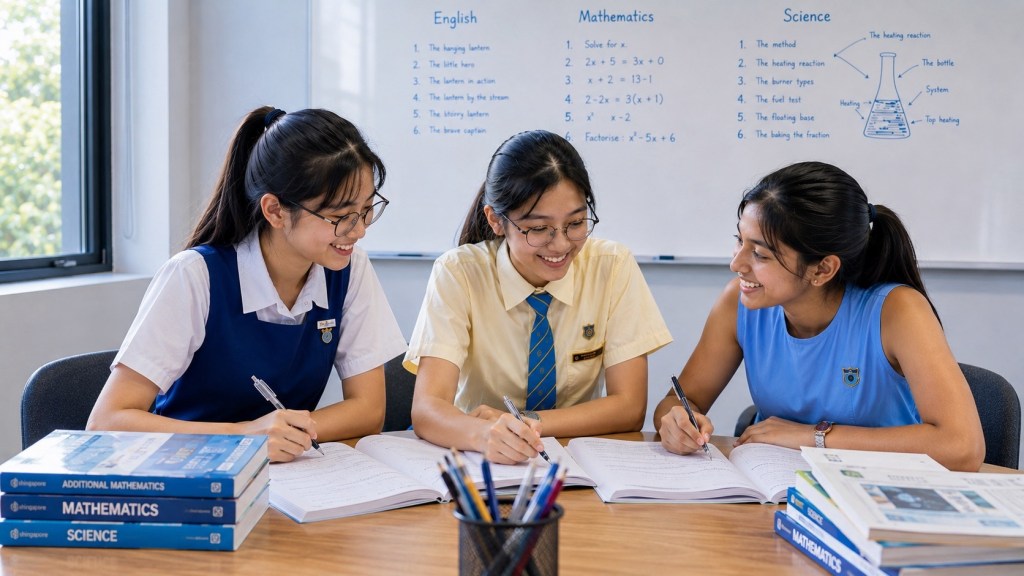
G3 SEC Mathematics rewards more than fast calculation. The 2027 K310 syllabus explicitly emphasises conceptual understanding, skill proficiency, reasoning, communication, application and metacognition. That is a useful description of what a strong learner should build.
For 2027 school candidates, G3 Mathematics is K310. Paper 1 and Paper 2 are each 2 hours 15 minutes, 90 marks and 50% of the assessment. The official scheme is in the 2027 K310 G3 Mathematics syllabus.
Paper 1 contains about 26 short-answer questions. Paper 2 contains 9 to 10 questions of varying length, with the final question specifically focused on applying Mathematics to a real-world scenario. Essential working matters. Both papers allow an approved calculator.
1. The Mathematics Performance Stack
A learner can think of Mathematics as a stack. Each layer depends on the one below it.
- Number control: arithmetic, fractions, negatives, indices, ratios, percentages and units.
- Algebraic language: expressions, equations, inequalities, functions and symbolic manipulation.
- Representation: diagrams, graphs, tables, formulae and coordinate relationships.
- Reasoning: deciding what follows from the information and why.
- Modelling: converting a situation into mathematics and interpreting the answer back in context.
- Control: working, accuracy, timing, checking and recovery.
When a higher layer fails, inspect the layers below. A student struggling with a real-world percentage model may actually have weak ratio sense or algebra. A student losing trigonometry marks may have a diagram-reading or calculator-mode issue rather than a trigonometry-concept issue.
2. The PSLE Handoff
PSLE Mathematics already trains problem interpretation, multi-step reasoning, units and checking. Keep those habits. The PSLE Mathematics question-launch routine remains useful because secondary Mathematics still begins with understanding what the problem is asking.
The new demand is symbolic compression. Secondary Mathematics often expresses relationships using algebra rather than a long verbal or pictorial method. A learner who was strong with bar models must now become comfortable with variables, equations, functions and formal notation.
Do not rush this transition. Algebra is not merely arithmetic with letters. It is a language for general relationships.
3. Build Concept Before Procedure
A procedure is easier to remember when the learner understands what stays true while the symbols change. For equations, the invariant is equality. For ratio, it is proportional relationship. For similar figures, it is scale. For probability, it is the structure of possible outcomes.
When learning a new method, ask three questions: What problem does this method solve? Why is the method valid? How will I recognise when to use it?
If the learner can execute a method but cannot answer those three questions, practice should not yet become harder. The concept needs another pass.
4. The Three Reads of a Mathematics Question
Use three quick reads for demanding questions.
- Situation read: What is happening? What quantities or objects are involved?
- Relationship read: What is connected to what? Which values are fixed, changing, proportional, equal, parallel, similar or dependent?
- Task read: What exactly must be found, shown, proved or interpreted?
This prevents a common error: beginning calculation before the mathematical structure is clear.
On a diagram, mark information deliberately. On a table, identify variables and units. On a word problem, define the unknown. On a graph, inspect scale and axes before reading values.
5. Working Is Part of the Answer
SEAB notes that omission of essential working can result in loss of marks. The purpose of working is not decoration. It makes the mathematical reasoning inspectable.
Good working should preserve the chain from information to conclusion. Each line should have a job. Avoid writing every calculator keystroke, but do not jump across reasoning that carries marks.
A useful standard is this: could another competent learner reconstruct why the next line follows? If not, the working may be too compressed.
Working also protects checking. A final answer with no visible method is difficult to diagnose when wrong.
6. Accuracy Is a System
Do not describe repeated errors as careless until the mechanism is known. Mathematics has predictable accuracy risks.
- sign errors with negatives
- bracket and distribution errors
- incorrect substitution
- premature rounding
- unit mismatch
- calculator mode
- copying a value incorrectly
- misreading a graph scale
- using a formula with the wrong dimension
- giving an answer to the wrong degree of accuracy
- failing to interpret a numerical answer in context
Create a personal high-risk list. During checking, search specifically for those errors. Targeted checking is faster than rereading the whole paper with no question in mind.
7. Use Estimation Before and After Calculation
Estimation gives the learner an expected region for the answer. It is one of the cheapest error detectors available.
Before using a calculator, ask whether the answer should be positive or negative, larger or smaller than a reference value, close to zero or large, and what unit it should carry.
After calculating, compare the output with that expectation. An answer of 4870 metres for the length of a classroom should trigger immediate review even if the calculator arithmetic was entered correctly.
8. Algebra: Protect Meaning
A common secondary-school mistake is manipulating symbols without preserving meaning. Every algebraic operation should be legal for a reason.
When solving equations, teach balance rather than “moving terms”. When factorising, connect the factorised form with multiplication. When simplifying fractions, distinguish common factors from terms. When working with indices, return to the laws rather than pattern guessing.
For each algebra skill, practise reverse checks. Expand the factorised form. Substitute the equation solution. Compare two equivalent expressions numerically. Reversibility builds confidence.
9. Geometry: Read the Diagram as Evidence
A diagram is not proof. Unless information is stated or logically implied, appearance alone is unsafe.
Label known lengths, angles, parallel lines and equal quantities. Write the reason beside key deductions during practice. Examples include alternate angles, angle sum, congruence, similarity, tangent properties or circle theorems.
The habit of naming the reason turns geometry from visual guessing into a chain of justified moves.
10. Graphs and Functions: Connect Four Representations
For a relationship, practise moving between words, table, equation and graph. A strong learner can see that these are different views of the same structure.
Ask: what does the gradient mean here? What does an intercept represent? What does a turning point or intersection tell me? How does a parameter change the graph?
Do not treat graph sketching as art. It is a representation of mathematical properties.
11. Statistics and Probability: Interpret, Do Not Only Calculate
A mean, median, range or probability is useful only in context. The examination may require the learner to interpret data rather than perform a routine calculation.
When comparing distributions, state the feature and what it means. When reading a graph, respect scale. When evaluating an average, consider whether the data contain outliers or whether another measure gives a more useful summary.
Probability should be connected to sample space and structure. Memorised rules without a model are fragile.
12. Paper 2 and Real-World Modelling
The final K310 Paper 2 question focuses specifically on applying Mathematics to a real-world scenario. The syllabus also notes that real-world problems can integrate more than one topic and may involve travel, transport, sports, recipes, floor plans, navigation, finance, utilities, exchange and data.
Use a modelling loop: define the question, identify relevant quantities, make justified assumptions if required, choose a mathematical representation, calculate, then interpret the result in the real context.
The final step matters. A mathematically valid number can still be an unsuitable real-world answer. For example, a calculation may produce 3.2 buses, but the decision requires four buses.
Practise reading long information sources without calculating immediately. First separate relevant, irrelevant and derived information.
13. Calculator Skill Without Calculator Dependence
An approved calculator is allowed in both K310 papers, but a calculator cannot decide the method. The learner must still estimate, choose operations, interpret output and control rounding.
Practise efficient entry, brackets, memory functions and statistical functions relevant to the syllabus, but keep enough number sense to detect impossible output.
For exact forms and algebraic reasoning, know when a calculator result is not the required final form.
14. The Mathematics Error Ledger
Use categories: concept, retrieval, representation, method selection, algebra, arithmetic, calculator, unit, accuracy, interpretation, working and time.
For every repeated error, write a prevention rule. “Check units before substitution.” “Do not round until final line.” “For inverse proportion, test product.” “For similar areas, square the linear scale factor.”
Then re-test the same underlying skill in a different question. A corrected solution is not proof of repair if the student remembers the answer.
15. Topic Practice Must Become Mixed Practice
Topical practice is useful while learning. It becomes dangerous when it lasts too long because the chapter heading tells the learner what method to use.
Once a skill is stable, mix it with neighbouring and older topics. Remove labels. Change the order. Include questions where the first apparent method is not the best one.
The discomfort of deciding is part of the training. The examination asks for selection, not merely execution.
16. From Basic to Advanced
Basic
Stabilise number skills, algebraic notation, units, calculator use and clean working. Be able to solve standard questions correctly.
Developing
Increase retrieval speed, connect representations and solve multi-step questions. Begin mixed sets and short timing.
Proficient
Solve unfamiliar combinations, explain reasoning and interpret answers in context. Practise Paper 1 and Paper 2 sections under realistic time.
Advanced
Control full papers, including the extended real-world problem. Maintain accuracy late in the session. Check high-risk steps efficiently and recover from difficult items without losing the paper.
17. A Weekly Mathematics Engine
- Session A: concept repair and worked-example reconstruction.
- Session B: closed-book standard questions.
- Session C: mixed application and unfamiliar problems.
- Session D: timed section plus error analysis.
- Short retrieval: formulae, definitions, properties and personal error rules across the week.
The proportions change with the learner. A weak foundation needs more Session A. An examination-ready learner needs more Session C and D.
18. A 12-Week Build
Weeks 12–9: repair concepts and algebra. Weeks 8–6: mix strands and strengthen representation. Weeks 5–3: sit timed sections and full papers, including real-world application. Weeks 2–1: revisit personal high-risk errors, formulae, accuracy conventions and checking routines.
Do not use the final week to hunt exotic questions. Stabilise the mathematics you already know.
19. Examination-Day Control
Read before calculating. Show essential working. Keep units visible. Follow the required accuracy. If blocked, write what is known and identify the relationship before abandoning the item.
Use checking time in descending risk: unanswered parts, unit and accuracy errors, algebraic sign mistakes, copied values and implausible answers.
A strong paper is not one with no difficult questions. It is one in which difficult questions do not damage the rest of the performance.
20. Continue the EMS Sequence
Start with Vol. 0001 — Examination Control Foundations, read Vol. 0002 — G3 SEC English, and continue to Vol. 0004 — G3 SEC Science. For a wider subject bridge, see Secondary G1, G2 and G3 Mathematics: Algebra, Problem Solving and the Secondary Reset.
Official Reference
G3 Learner’s Guide navigation: ← Vol 0002 · Master Hub · Vols 0001–0069 · Vol 0004 → · Mathematics route.
