
Secondary Mathematics becomes easier to transfer when students can reverse a finished solution and reconstruct how it was built. Parents searching for E-Math working backwards, reverse engineering Mathematics questions, how to understand model answers or Mathematics tuition in Sengkang often see students who can follow a forward solution but cannot explain how someone knew what to do first.
Reverse engineering changes the direction of attention. Instead of asking only “What is the next step?”, the student asks “What must have been true for this final line to exist?” or “What earlier relationship would produce this answer?” This is especially useful for equations, geometry, graphs, rate problems and extended questions where the completed route hides the original decision points.
At eduKate Sengkang, this Advanced Mathematics Tutorials article owns reverse-engineering intent. It complements the Worked Examples, Multi-Step Questions and test-corrections routes.
Quick answer: what does reverse engineering mean in Mathematics?
Start from a completed answer, condition or solution and work backwards to identify the relationships, decisions and intermediate quantities that must have produced it.
- What does the final answer represent?
- What formula or relationship could produce it?
- What intermediate value must have existed before that?
- Which condition forced the chosen method?
- Could another route produce the same result?
- What changes if one condition is altered?
Reverse engineer a worked solution
Cover the first half of a model answer and reveal only the final lines. Ask the student to reconstruct the missing earlier reasoning. This exposes whether the learner understands the architecture rather than remembers the visible sequence.
Then compare the reconstructed route with the original model. Differences can be useful if the alternative is mathematically valid.
Reverse engineer an equation
If the final solution is x = 7, ask what equation could have produced it. Then add constraints: can the student create a linear equation, a ratio situation or a geometry condition whose solution is 7?
This strengthens the connection between symbolic manipulation and problem construction.
Reverse engineer a geometry result
If a final length is known, students can ask which theorem, ratio or trigonometric relationship would connect that length to the given information. This is useful when the original question hides the route inside a diagram.
Reverse engineering is useful after mistakes
When a correction shows the right final answer, ask which earlier line changed the whole route. This helps the student distinguish a root error from downstream consequences.
The technique therefore links naturally to the Test Corrections owner.
Secondary 1–2: reconstruct short routes
Lower-secondary students can reverse two-step algebra, ratio and graph problems. The goal is to see that methods are connected, not arbitrary teacher moves.
Secondary 3–4: reconstruct extended solutions
Upper-secondary students can reverse longer chains involving trigonometry, coordinate geometry, mensuration, statistics or real-world application. This helps them see subgoals and method dependencies more clearly.
The reverse-engineering ladder
- Level 1: explain the final line.
- Level 2: reconstruct one missing step.
- Level 3: reconstruct several missing steps.
- Level 4: create a new question that would use the same route.
- Level 5: alter one condition and predict how the route changes.
Common reverse-engineering mistakes
- Assumes only one method is possible.
- Copies the visible algebra backwards without explaining meaning.
- Ignores units and context.
- Reconstructs a route that reaches the answer but violates a condition.
- Cannot explain why the original method was efficient.
A three-student tutorial can compare reconstructed routes
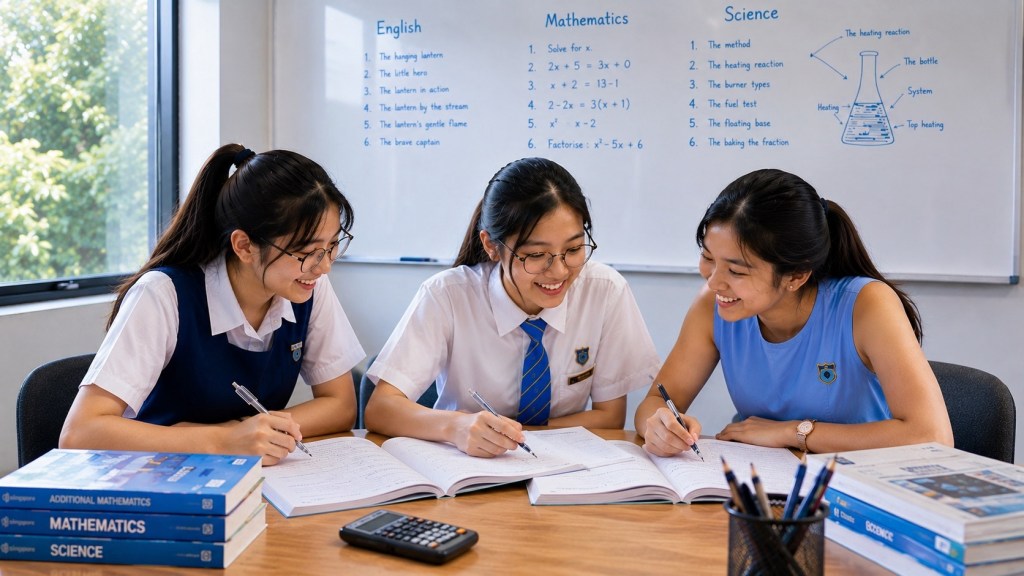
Give all three students the same final answer or completed solution but hide the beginning. Each learner reconstructs a plausible route. The tutor can compare which route is valid, efficient and easiest to verify.
This creates deeper discussion than simply copying one model solution.
Frequently asked questions
Is working backwards only for word problems?
No. It is useful in algebra, geometry, graphs, probability, data and solution analysis.
Can reverse engineering help strong students?
Yes. It deepens structural understanding and makes method comparison more explicit.
Where this reverse-engineering guide sits in the Mathematics estate
Use the Worked Examples guide first, then use reverse engineering to test whether the model has become genuine understanding.
Continue through the Mathematics Learning Hub for routes by concept and level, the Complete Mathematics Index for the wider estate, or Mathematics Tutor Sengkang when the question is specifically about tutoring support.
