
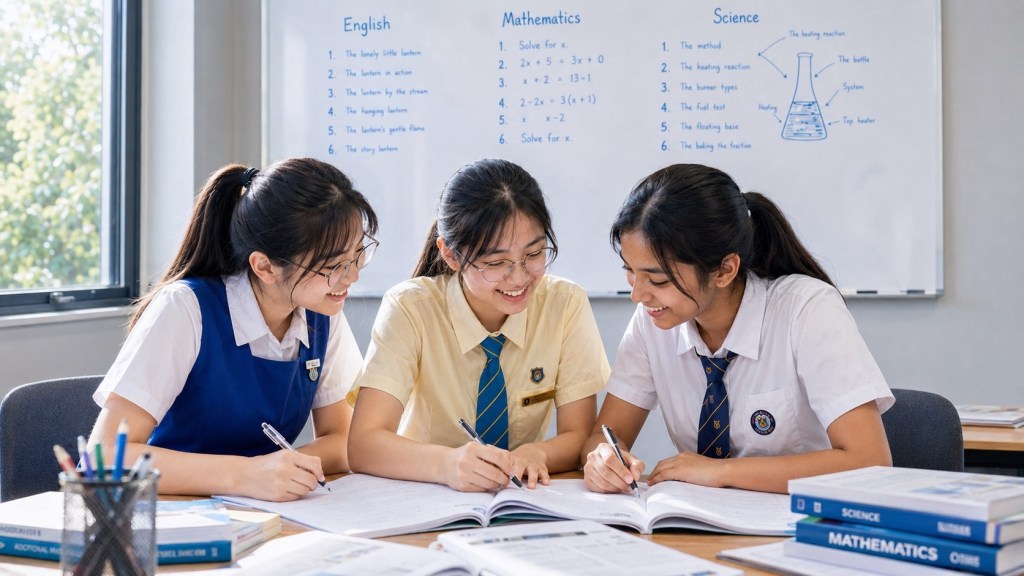
Secondary Mathematics homework can take too long for reasons that have very little to do with laziness. Parents searching for why E-Math homework takes hours, how to make Mathematics homework faster, why a child is always behind on school worksheets or Mathematics tuition in Sengkang often see only the total time. The useful question is where those minutes are actually going.
A student may spend ten minutes trying to remember a method, another ten rereading the same word problem, fifteen more correcting algebra, and then another block checking answers repeatedly. The homework feels like one long task, but it is actually several different bottlenecks stacked together. Telling the student to “work faster” does not identify which one to repair.
At eduKate Sengkang, this Advanced Mathematics Tutorials article owns homework-duration intent. It complements the existing parent homework-support guide, the Speed vs Accuracy owner and the deliberate-practice route.
Quick answer: why does Mathematics homework take so long?
Because “slow homework” is usually a mixture of retrieval delay, method-selection delay, execution delay, checking delay, distraction or support dependence. Diagnose the minutes before choosing the intervention.
- Slow retrieval: the student cannot recall the method quickly.
- Slow selection: the student knows methods but cannot decide which applies.
- Slow algebra: too many transformations require conscious effort.
- Slow reading: wording must be reread repeatedly.
- Slow checking: the student recalculates secure work several times.
- Support dependence: the learner waits for a parent, tutor or model answer.
- Distraction: attention repeatedly leaves the task.
- Perfectionism: the student rewrites or over-polishes low-value work.
Build a homework time map
For one or two assignments, record where the minutes go. Do not change anything yet. The goal is to collect evidence.
- Reading and understanding the question
- Choosing the method
- Doing the Mathematics
- Using the calculator
- Checking
- Waiting for help
- Rewriting
- Off-task time
The map often shows that only one or two categories dominate the total.
Slow retrieval needs retrieval practice, not more homework volume
If the student pauses because formulas, algebraic transformations or earlier topic knowledge are not available, add short closed-note retrieval. A ten-minute retrieval block can save much more time across the week’s assignments.
See Secondary Mathematics Retrieval Practice.
Slow method selection needs mixed classification
Students can be fast on topical worksheets and slow on school homework because the homework mixes several methods. Ask the learner to classify the question before solving: algebraic, graphical, geometric, statistical, proportional or another structure.
The relevant owner is Mixed-Topic Method Selection.
Slow algebra needs bottleneck practice
If the student understands the question but algebra consumes most of the time, isolate the exact bottleneck: sign control, fraction manipulation, expansion, factorisation or rearrangement.
Use deliberate practice on that one step rather than adding an entire extra worksheet.
Slow reading needs representation, not faster eyes
Repeated rereading often means the student has not converted the wording into a useful mathematical form. A quick sketch, table, variable definition or equation can reduce cognitive load.
Slow checking can come from underconfidence
Some students recalculate nearly every answer because they do not trust their own working. Compare confidence with actual accuracy. If the work is usually correct, targeted checking is more efficient than global rechecking.
Use the Confidence Calibration route when this pattern repeats.
Support dependence can hide inside homework completion
A student may appear diligent while spending large amounts of time waiting for the next hint. If every difficult question pauses until a parent or tutor returns, the bottleneck is not simply Mathematics speed.
Reduce support gradually and use the Hints and Scaffolding route.
Secondary 1–2: protect foundations before timing aggressively
Lower-secondary students should not be pushed to rush new algebra, graphs or ratio work. First make the method clear and accurate; then improve fluency.
Secondary 3–4: homework time becomes workload control
Upper-secondary students often carry E-Math, A-Math and heavier subject loads. Homework efficiency matters because one slow subject can consume the week’s revision budget. Diagnose the slow step instead of simply extending study time.
A three-student tutorial can diagnose homework time directly
Ask students to bring one typical homework set with visible working. The tutor can observe where each learner pauses: before the first step, during algebra, at the calculator or during checking. Three students with “slow homework” may have three different causes.
A 30-minute homework-efficiency drill
5 minutes: retrieval warm-up
Test whether key methods are available.
10 minutes: timed ordinary homework
Observe starts, pauses and method choices.
10 minutes: repair the biggest bottleneck
Use one targeted intervention.
5 minutes: retest
Use a similar question and compare time without sacrificing accuracy.
Frequently asked questions
How long should Secondary Mathematics homework take?
There is no universal time. The better question is whether the time is proportional to the amount and difficulty of work, and whether the learner is becoming more efficient over time.
Should parents set a strict timer?
A timer can collect useful data, but it should not force rushing before the method is stable.
What if homework takes long because there is simply too much?
Then volume is part of the problem. Coordinate school, tuition and revision workloads so targeted practice does not become a second full curriculum.
Where this homework-duration guide sits in the Mathematics estate
Use the Deliberate Practice guide once the slowest bottleneck has been identified.
Homework duration should change by Secondary level
Secondary 1: protect method formation
Secondary 1 homework often takes long because the symbolic language is new. Negative numbers, equations and graphs can create pauses that look like slowness but are really method formation. Accuracy should come before aggressive timing.
Secondary 2: diagnose bridge-skill delays
Secondary 2 students may lose time in factorisation, proportion, formula manipulation and graph interpretation. If one of these bridge skills is slow, several chapters can become time-heavy at once.
Secondary 3: control E-Math and A-Math workload
Secondary 3 students taking A-Math can spend so long on one Mathematics subject that the other is squeezed out. A weekly time map helps separate true learning need from inefficient repetition.
Secondary 4: homework time should support paper performance
Final-year homework should increasingly prepare the student for mixed and timed work. Long homework sessions that never improve paper completion are a sign that the practice architecture needs review.
The homework-duration diagnostic matrix
- Long time + high accuracy: fluency or overchecking problem.
- Long time + low accuracy: concept, method or support problem.
- Short time + low accuracy: rushing or weak checking.
- Short time + high accuracy: efficient control; maintain.
- Long pauses before first step: retrieval or method-selection problem.
- Long pauses after each answer: confidence or checking problem.
When homework volume itself is the bottleneck
Sometimes the work is simply too large for the student’s available week. If school, tuition and revision all assign overlapping practice, the learner can spend hours repeating secure material while higher-value gaps remain untouched.
The solution is coordination. Keep the school requirement, then make tuition continuation work selective enough to add a missing function rather than duplicate the whole chapter.
Parent checkpoint: is the child becoming more efficient?
- Does the same type of homework take less time after several weeks?
- Are pauses becoming shorter?
- Is checking becoming more targeted?
- Can the student begin without waiting for help?
- Are long homework sessions improving school-test performance?
Continue through the Mathematics Learning Hub for routes by concept and level, the Complete Mathematics Index for the wider estate, or Mathematics Tutor Sengkang when the question is specifically about tutoring support.
