
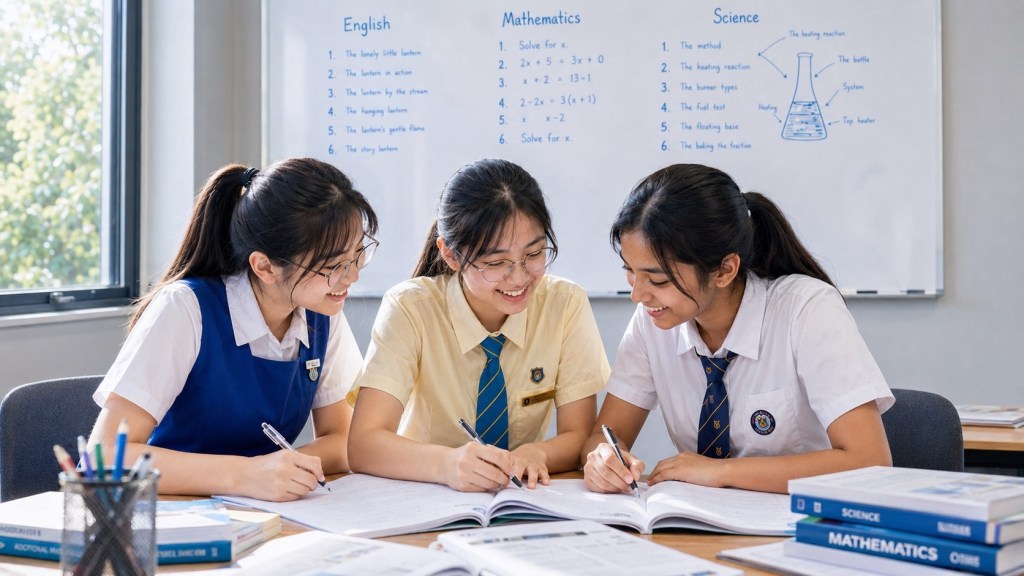
Can a quiet or shy child benefit from small-group Science tuition in Sengkang? Parents searching for small-group Science tuition, shy child tuition, quiet student tutor, personalised Science class or PSLE Science support often worry that a child who does not speak much will disappear in a group. The right question is not whether the learner is naturally talkative. It is whether the teaching format makes the child’s thinking visible in more than one way.
A strong Science lesson does not require constant speaking. Students can reveal reasoning through written answers, diagrams, choices, annotations, comparisons and short explanations. A tutor can gradually increase verbal participation without making confidence itself the academic target. The goal is accurate Science and growing independence, not turning every child into the loudest person in the room.
At eduKate Sengkang, formal Science tuition currently covers Primary 3 to Primary 6, including PSLE Science, in focused classes of up to three students for 1.5-hour lessons. Primary 1–2 Science is educational discovery material rather than a formal lower-primary tuition offer. Secondary G1/G2/G3 Science appears for transition guidance, while the Sengkang Science programme remains Primary 3–6/PSLE. This article owns the parent-fit question for quiet, shy or slow-to-speak learners.
Quiet is not the same as weak
Some quiet students think carefully and prefer to answer after time. Others are uncertain and afraid of being wrong. Another child may understand well but dislike speaking in front of peers. These states look similar from the outside.
A tutor should diagnose the reason for silence rather than treating quietness as a problem to fix.
A small group should provide multiple ways to participate
- Independent written attempts.
- Pointing to evidence in a diagram or table.
- Choosing between two explanations and justifying the choice.
- Annotating a model answer.
- Explaining to the tutor privately during desk-side feedback.
- Short verbal answers before longer explanations.
- Comparing anonymous student responses.
The learner’s reasoning can become visible gradually without forcing immediate public performance.
Why three students can be a useful size
A three-student class is small enough for the tutor to notice when one learner is consistently silent, yet large enough for the child to hear peer reasoning without being the centre of attention all the time.
The tutor can rotate questions, protect thinking time and avoid letting one confident student dominate. The educational value comes from orchestration, not simply the number three.
A quiet child does not need less intellectual demand. The child needs a route into the demand that does not confuse fast speaking with good Science.
Wait time matters
Quiet students are often disadvantaged by tutors who answer their own questions too quickly. A learner may need several seconds to retrieve, formulate and decide. If the tutor jumps in, the child learns that silence will be filled by someone else.
Useful wait time gives the student a chance to act. The tutor can then see whether the learner is thinking productively or genuinely stuck.
The tutor should not reward only speed
Science accuracy and reasoning matter more than being first. A small group can become competitive if the same quick student answers every question. The tutor should sometimes ask everyone to write first before anyone speaks.
This gives quieter learners equal cognitive entry and prevents fast recall from dominating deeper explanation.
Written Science can be the bridge to spoken Science
A child who hesitates verbally may produce a strong written explanation. The tutor can begin there: “Show me where your reasoning is,” then ask the learner to explain one phrase rather than the whole answer.
Over time, the student can move from pointing to short explanation to fuller verbal reasoning. The scaffold should follow the child’s readiness.
Primary 3: protect the first identity as a Science learner
Primary 3 children are new to formal Science. A quiet child may need time before speaking confidently about new concepts. The tutor can use sorting, drawing, labelling and simple comparisons to establish success.
The child should not leave with the idea that Science belongs to students who answer fastest.
Primary 4: use paired comparison instead of cold calling
For more complex relationships, the tutor can show two answers and ask the learner to mark which is stronger before explaining. This lowers the entry barrier while still demanding judgement.
As confidence grows, the tutor can ask the child to justify one decision to the group.
Primary 5: quiet students need open-ended visibility
Primary 5 open-ended questions reveal whether the child can build a complete explanation. A quiet learner may actually be strong in written Science, or may hide confusion behind silence. The tutor needs the written evidence.
A three-student class should include enough individual written work that participation is not measured only by speaking.
Primary 6: quiet learners still need examination independence
PSLE does not require classroom talk; it requires independent paper performance. A quiet student can therefore be extremely capable if retrieval, application and written explanation are strong.
The tutor should focus on the examination capabilities that matter while still helping the learner ask questions when genuinely stuck.
Shyness should not become a permanent accommodation
Support should enable participation, not freeze the learner into a protected role where the tutor never asks for explanation. Over time, the child should be invited to take slightly more ownership.
The progression can be small: write → point → short phrase → one sentence → fuller explanation.
When a quiet child may prefer one-to-one tuition
Some learners are so inhibited in a group that little authentic reasoning becomes visible. A temporary one-to-one format may help establish trust and foundational habits.
The goal should still be independence. One-to-one should not become continuous prompting.
When a quiet child may benefit more from the group
A small group can reduce the intensity of constant adult attention. The child gets time to think while the tutor works with another student and can learn by observing alternative explanations.
For some quiet learners, this is less stressful than being the sole focus of a one-to-one lesson for ninety minutes.
How peer reasoning can help
Hearing another student make a similar mistake normalises correction. The quiet child learns that wrong answers are part of the lesson rather than public failure.
Anonymous answer comparison is especially useful because students can critique reasoning without personal exposure.
The tutor must manage dominant students
A small group fails a quiet child when one learner takes all the airtime. The tutor should structure turns, use written-first tasks and sometimes direct questions to a specific student after giving thinking time.
Good small-group teaching is not a free conversation. It is deliberately orchestrated.
How to tell whether silence is productive
Productive silence often includes writing, rereading, sketching or revising. Unproductive silence may include blank pages, avoidance or waiting for rescue. The tutor should observe what the student does during the quiet interval.
This allows support to be calibrated instead of assuming that all silence means the same thing.
How parents can prepare a quiet child for tuition
Do not tell the child that the tutor will make them speak more. Explain that the tutor will look at how they solve Science and that written work is useful evidence. The child can bring recent questions that were confusing.
Reducing performance pressure makes it easier for authentic reasoning to appear.
How parents should ask about class fit
- How do you make sure every student participates?
- Do students write before answering aloud?
- How do you handle a child who needs more thinking time?
- Can feedback be given individually within the small group?
- How do you prevent one confident student from dominating?
- How do you distinguish quiet confidence from hidden confusion?
Quiet students can still ask excellent questions
The quality of a question matters more than the volume of speaking. A learner who says little but asks, “Does the graph prove cause or only show that both values changed?” is demonstrating strong metacognition.
A tutor should value precise questions and create low-pressure ways for them to emerge.
Online versus in-person for quiet learners
Some quiet students find online chat and digital annotation easier. Others become even more invisible online. In-person small groups can provide stronger presence but also more social pressure.
The companion Online Science Tutor or In-Person Tuition? guide helps families compare the formats.
What progress looks like
- The child starts written tasks without waiting for the tutor.
- The learner asks more precise questions.
- Short explanations become easier.
- Corrections require fewer prompts.
- The student can disagree with an answer and explain why.
- School work shows stronger independence even if classroom talk remains quiet.
What progress does not require
The child does not have to become extroverted. A quiet student can remain quiet and still become an excellent Science learner. The educational goal is visible reasoning, not personality change.
When the group is the wrong fit
If the learner remains unable to expose confusion, receives little tutor attention or is persistently overshadowed, the group may be wrong. Parents can try a different group, tutor or format.
The Is This Tuition Class the Right Fit? guide provides the broader review framework.
After PSLE: quiet independence becomes even more valuable
Secondary Science requires more independent reading, practical reasoning and self-correction. A quiet learner who can manage uncertainty, ask precise questions and work independently is well positioned for the transition.
For the wider bridge, use From PSLE to Secondary Science G1, G2 and G3.
Frequently asked questions
Is small-group tuition suitable for a shy child?
It can be, especially when the tutor uses written-first tasks, wait time and structured turns. Fit depends on the teaching culture, not only class size.
Should a quiet child have one-to-one Science tuition instead?
Sometimes, particularly if group inhibition prevents useful reasoning from appearing. But one-to-one should still build independent work rather than constant prompt dependence.
Will my child be forced to speak?
A good tutor should gradually increase explanation while preserving multiple ways to participate. The academic target is scientific reasoning, not extroversion.
How large are eduKate Sengkang Science classes?
The stated model is up to three students for 1.5-hour lessons.
Final idea: make thinking visible without making personality the problem
Quiet students do not need to be repaired for being quiet. They need a learning environment where reasoning can be seen, feedback can be used and participation can grow at an intellectually honest pace.
For Sengkang and Punggol families, judge the class by what the child can do—not by how much the child talks. If written reasoning becomes stronger, questions become more precise and independence grows, the small group is doing its job.
The tutor should establish a participation baseline
During the first few lessons, note how the child participates naturally. Does the learner write readily, answer when asked directly, volunteer only after seeing peers respond, or avoid exposing unfinished work? This baseline helps the tutor distinguish personality from a change caused by confusion or stress.
Later, progress can be measured against the learner’s own starting point rather than against a louder classmate.
Quiet students often benefit from predictable participation routines
Unpredictable cold calling can make some learners focus more on whether they will be called than on the Science. A predictable routine reduces that cost. For example: everyone writes, then each student explains one part; or the tutor gives thirty seconds of thinking time before asking for a response.
Predictability does not lower the standard. It gives the child a fair route into the same intellectual task.
Use low-risk questions before high-exposure questions
A tutor can begin with a concrete observation—what changed in the diagram—before asking for a full causal explanation. The child experiences success and enters the reasoning sequence gradually.
As confidence and familiarity grow, the tutor can increase the complexity of public responses without making participation feel like a sudden test.
Private correction should not become secret teaching
Desk-side feedback is useful for a quiet student, but the learner should still eventually use the repaired idea in shared or independent work. If all meaningful teaching happens privately, the child may remain dependent on one-to-one moments inside the group.
The tutor can repair quietly, then ask the student to apply the idea independently and, when appropriate, share one part of the reasoning.
A quiet learner can contribute through evaluation
Some students find it easier to evaluate an existing answer than to produce a full answer from nothing. Ask which of two responses is stronger, which evidence is missing or where a causal chain breaks.
Evaluation is genuine scientific thinking. It can become a bridge toward more generative responses later.
A quiet learner should not be assigned a permanent helper
Pairing the child constantly with a more confident peer can look supportive but may create dependence. The stronger student begins speaking for both, and the tutor loses access to the quieter learner’s reasoning.
Peer work should alternate with individual attempts so each student’s capability remains visible.
Group culture should normalise incomplete answers
Students speak more freely when the class treats a first answer as a draft. The tutor can ask, “What is useful here, and what link is missing?” rather than reducing every response to correct or wrong.
This makes scientific explanation a process of refinement and lowers the social cost of attempting.
The tutor should distinguish quiet from disengaged
A quiet student may be fully engaged: eyes on the diagram, writing steadily, revising after feedback. Another learner may be withdrawn and not attempting. The teaching response should differ.
Engagement is visible in action, not only in speech.
The tutor should distinguish shyness from slow retrieval
A child may look shy because answers come slowly. When given more time, the learner may respond confidently. This suggests fluency or retrieval rather than social inhibition.
The tutor can test the same question in writing and compare. If the written response is also slow, the problem is likely cognitive rather than social.
The tutor should distinguish shyness from fear of being wrong
Some high-achieving children become quiet when questions become uncertain because they are accustomed to being correct. The tutor can normalise probabilistic language: “I think this because…,” “The evidence suggests…,” “I am not sure between A and B because…”
This gives the learner a way to speak before certainty is complete.
Parents should not rehearse answers for the group
Trying to help a shy child by practising exactly what to say can increase performance pressure and make the learner dependent on prepared responses. It is better to rehearse a process: take thinking time, identify one piece of evidence, state one sentence and stop.
The child can then generate the actual answer in the lesson.
The tutor can use nonverbal confidence checks
Students can show a confidence rating with fingers, mark an answer privately or choose between options before discussing. This gives the tutor information without requiring immediate public explanation.
The tutor can then invite reasoning from students who are ready and follow up privately where needed.
A quiet learner still needs challenge
Tutors sometimes lower difficulty to protect a shy student. This can become patronising and educationally harmful. The child should receive appropriately demanding Science work with a supported route into participation.
The target difficulty should follow capability, not speaking style.
A quiet high achiever has different needs from a quiet struggling learner
The high achiever may need harder transfer and more opportunities to articulate sophisticated reasoning. The struggling learner may need concept repair and a safer sequence of smaller steps. Both can be quiet, but the teaching plan should be different.
This is another reason class size alone does not create personalisation. The tutor must diagnose the learner beneath the behaviour.
How to use think-pair-share in a three-student class
A simple adaptation is think → write → compare → share. Every learner first works independently. Two students compare one point while the tutor observes the third. Then the group discusses the reasoning.
The quiet learner enters the public conversation after already forming an answer, which reduces the burden of generating and speaking simultaneously.
How to build question-asking confidence
The tutor can explicitly teach question forms: “Which condition matters here?” “Does the data support this?” “I understand the process but not why the result changes.” These stems are not scripts for personality; they are tools for metacognition.
As the child gains experience, the questions become more natural and specific.
How parents can ask about the lesson afterward
Avoid “Did you speak today?” as the main measure. Ask, “What did you figure out?” “What question did you get stuck on?” “What did you change after feedback?”
This signals that learning matters more than performance of confidence.
What the tutor should report to parents
A useful update might say, “Your child wrote strong answers and contributed after thinking time; I am increasing one short verbal explanation per lesson.” This is better than “Very quiet today,” which gives little educational direction.
The report should connect participation to Science capability.
When shyness improves but Science does not
A child may become more talkative without becoming more accurate. Participation is only valuable when it exposes and improves reasoning. The tutor should keep evaluating the Science evidence.
Social comfort supports learning but does not replace subject diagnosis.
When Science improves but shyness remains
That can still be a successful outcome. A child who remains quiet but now writes precise explanations, asks useful questions when necessary and works independently has made meaningful progress.
Parents should not move the goalposts and demand personality change after academic fit has been achieved.
Quiet learners and trial lessons
A single trial can underestimate a quiet child because unfamiliarity suppresses participation. The tutor should rely more heavily on written work and allow the diagnosis to update across several sessions.
The companion First Science Tuition Lesson guide explains why first-session evidence should remain provisional.
Quiet learners and online tuition
Online chat can be an excellent bridge for some students. The learner can type a question or annotate privately before speaking. But cameras, lag and screen fatigue can also make silence harder to interpret.
Parents should trial the modality and compare actual reasoning visibility rather than assuming online is automatically safer for shy children.
Quiet learners and PSLE paper review
Paper review can suit quiet learners because the written evidence is already present. The tutor can point to the response and ask focused questions rather than relying on broad discussion.
Over time, the child can learn to verbalise the diagnostic categories: concept, evidence, mechanism or execution.
A three-student group should not rank personalities
One student may be quick and vocal, another slow and precise, another exploratory and willing to change answers. The tutor should make each strength visible without assigning social roles such as ‘the smart one’ or ‘the quiet one.’
Temporary behaviours should not become identities.
The ultimate participation goal is self-advocacy
The learner should eventually be able to signal when something is unclear, ask for the kind of help needed and explain enough reasoning for the tutor or school teacher to respond effectively.
This is more useful than becoming generally talkative. It is a specific learning capability the child can carry into Secondary school.
Quiet learners need access to the tutor before they need confidence
A child cannot build confidence if questions remain unanswered because the learner never finds a route into the conversation. The tutor can create explicit access points: written questions at the start, a one-minute desk-side check, or a predictable moment near the end when each student can raise one uncertainty.
These structures make help-seeking normal rather than socially expensive.
The group should separate thinking time from speaking time
When a tutor asks a difficult question and immediately expects speech, the task combines retrieval, reasoning, language formulation and social performance. Quiet students may know the Science but lose access under the combined load.
Give thinking time first. Let everyone write one line or mark the diagram. Then ask for explanation. This preserves the Science target while reducing unnecessary performance pressure.
Quiet students can be excellent at error detection
A learner who does not volunteer many original answers may still notice inconsistencies, missing evidence and vague wording in other responses. The tutor can use this strength through comparison tasks and near-miss answers.
As the learner becomes more comfortable, error detection can transition into generating improved answers independently.
The tutor should vary who speaks first
If the most confident child always answers first, everyone else receives a cue. Sometimes ask the quiet student first after private thinking time; sometimes collect all written answers before discussion; sometimes ask the group to vote silently before anyone explains.
Variation prevents a fixed classroom hierarchy from forming.
Quiet students need feedback on reasoning, not on personality
Praise should be specific: “You used the graph evidence accurately,” “Your mechanism is complete,” “You changed your answer after noticing the condition.” Avoid repeatedly praising the child merely for speaking.
Otherwise participation itself becomes a performance target and can increase self-consciousness.
Parents should watch whether the child is exhausted by the social demand
A small group can still be tiring for a highly inhibited learner. If the child spends the entire lesson managing social stress, the academic benefit may be lower than it appears. A temporary one-to-one or online format can reduce load while the learner builds familiarity.
The format can later change. Fit is not a permanent judgment about personality.
Quiet learners may need a slower first month
The tutor should not conclude after one or two lessons that the child lacks understanding because verbal participation is limited. Use written evidence, delayed questions and repeated observations. As familiarity grows, the diagnosis becomes cleaner.
This is especially important for Primary 3 students who are simultaneously adjusting to formal Science and a new tuition environment.
A quiet child should still experience peer challenge
Protection can become isolation if the tutor never asks the child to compare, disagree or justify. Once the learner has a stable route into participation, the group should still provide intellectual challenge.
The aim is safe exposure to reasoning, not permanent exemption from it.
The child can prepare one question before class
For students who find spontaneous help-seeking difficult, a simple routine is to choose one school question or uncertainty before the lesson. The tutor knows there will be a predictable point to discuss it.
Over time, this planned question can evolve into more spontaneous self-advocacy.
Parents should not interpret silence after class as failure
Some children process privately and speak little about tuition on the journey home. Look at school work, homework independence and the child’s ability to explain a correction when asked calmly later.
Evidence of learning can be quiet too.
How to judge a three-student group after six weeks
- Does the tutor know what the quiet learner understands?
- Is the child attempting work before receiving prompts?
- Has the learner found at least one comfortable way to ask questions?
- Are written explanations improving?
- Does the tutor manage dominant peers effectively?
- Is participation growing without becoming the main pressure?
- Do gains transfer to school work?
The strongest outcome is functional confidence
Functional confidence means the child can act when uncertain: make an attempt, ask a precise question, revise after evidence and continue. The learner does not need to feel fearless or become socially outgoing.
This form of confidence is useful because it belongs to learning behaviour rather than personality.
The quiet learner should eventually be able to disagree
One important milestone is the ability to say that an answer, explanation or interpretation does not seem right and to give a reason. This can begin in writing: circle the questionable step, mark the unsupported claim, then explain one sentence.
Disagreement is academically valuable because it shows the learner is evaluating rather than merely following. A quiet child who can challenge evidence respectfully may be demonstrating stronger Science than a talkative child who simply responds quickly.
The tutor can use advance notice strategically
For demanding discussion tasks, the tutor can sometimes tell all three students, “In five minutes each of you will explain one part of this experiment.” Advance notice gives the quiet learner time to organise reasoning without reducing the standard.
Over time, less notice can be needed as participation becomes more automatic. The scaffold fades as functional confidence grows.
Parents should notice the difference between voice and agency
Voice is how much the child speaks. Agency is whether the child makes decisions about learning: choosing an answer, revising after evidence, asking for help and identifying uncertainty. A quiet learner can have strong agency.
Small-group tuition is working when agency increases. The child may still speak less than peers while becoming far more capable of directing their own Science learning.
The final fit test for a quiet child
After several weeks, ask whether the group lets the learner think honestly. Can the child show unfinished work, make a wrong attempt, receive feedback and try again without withdrawing? If yes, the class is creating a useful learning environment.
If the child remains invisible despite thoughtful teaching adjustments, another format may be better. The decision should protect Science learning, not preserve a particular class model.
Quiet students need a way to recover after being interrupted
In group discussion, another student may answer first or the tutor may move on before the quiet learner is ready. A good class gives the child a re-entry route: “You were still thinking—show me what you had,” or “Add one detail to this answer.” This signals that slower timing does not make the reasoning irrelevant.
Repeated re-entry opportunities prevent the student from learning that once the moment passes, participation is over.
Quiet students should see that revision is normal
The tutor can model changing an answer after new evidence. This reduces the social risk of being wrong. Students learn that a first response is not a public identity; it is a hypothesis that can be improved.
For shy learners, this classroom norm can be especially powerful because fear of error often suppresses participation more than lack of knowledge.
The group should include occasional individual conferences
A short one-to-one check within the 1.5-hour lesson can help the tutor hear reasoning that has not yet appeared publicly. The conference should be brief and connected to the shared work, so the learner remains part of the group rather than receiving a separate private lesson.
The tutor can then choose one insight from that conversation to bring back into the student’s independent or group task.
Parents should expect gradual, not theatrical, change
A quiet learner may not suddenly start volunteering ten answers. Progress can be smaller and more meaningful: the child writes before being asked, asks one precise question, explains one sentence without prompting, or disagrees with a peer answer using evidence.
These changes show that agency is increasing. Small-group fit should be judged by this steady functional progress, not by a dramatic personality transformation.
A final small-group rule: the quiet learner must still be knowable
The tutor should be able to answer concrete questions about the child: what concepts are secure, what mistakes recur, what kind of prompt is still needed, how the student uses feedback and whether school work is becoming more independent. If the learner is quiet and the tutor cannot answer those questions, the child may be invisible in the group.
When those questions can be answered accurately, quietness is not a barrier. The tutor is seeing the learner through written work, timing, revisions, questions and selective explanation. The group is then doing what a good small group should do: making individual thinking visible without demanding that every student perform the same personality.
That is the real standard for fit.
Parents can support this by valuing evidence over performance of confidence. Ask what the child understood, what changed after feedback and what question still remains, rather than how many times the learner spoke. A quiet student who increasingly starts work, revises independently and asks one precise question when necessary is developing powerful learning agency. That agency is more durable than surface talkativeness because it travels with the child into school, examinations and Secondary Science. The small group is successful when the learner can remain themselves while becoming more capable.
A quiet child may always prefer thinking before speaking, and that is compatible with excellent Science. The tutor’s responsibility is to make sure silence never becomes invisibility. The learner should receive challenge, feedback, independent attempt time and a reliable way to ask for help. Parents should see that the child’s written reasoning, questions and self-correction are becoming stronger across the term. If those capabilities grow, the small group is not asking the child to become someone else. It is helping the learner use their own style more effectively.
One practical sign is what happens after a mistake. A learner who once went silent may begin to mark the error, listen to feedback, rewrite one sentence and continue. That recovery behaviour matters more than spontaneous classroom chatter. It shows that the child can stay engaged with difficulty without needing to perform confidence. Over time, the tutor can increase the social demand while keeping the Science demand stable, giving the learner a gradual route toward clearer self-advocacy.
Parents should therefore evaluate small-group Science tuition by access, visibility and agency. Can the child get help without fighting for airtime? Can the tutor see the learner’s thinking even when little is said? Can the student act independently, revise after evidence and ask a precise question when necessary? If those conditions are present, a quiet learner can thrive. The child does not need to become louder. The learner needs to become increasingly able to show, test and own the Science.
That is enough. Quiet Science can still be excellent Science, and a well-run three-student class should make that excellence visible without demanding a different personality.
The final measure is not volume of speech. It is whether the learner’s scientific decisions become more accurate, more independent and easier to communicate when communication is genuinely needed. If those capabilities keep growing, the class is respecting both the child and the subject.
That is the fit parents should look for.
Exactly.
Return to Science Tutor Sengkang for the complete small-group Primary Science tutoring route: diagnose the first weak link in observation, concepts, relationships, evidence, explanation and examination execution.
