
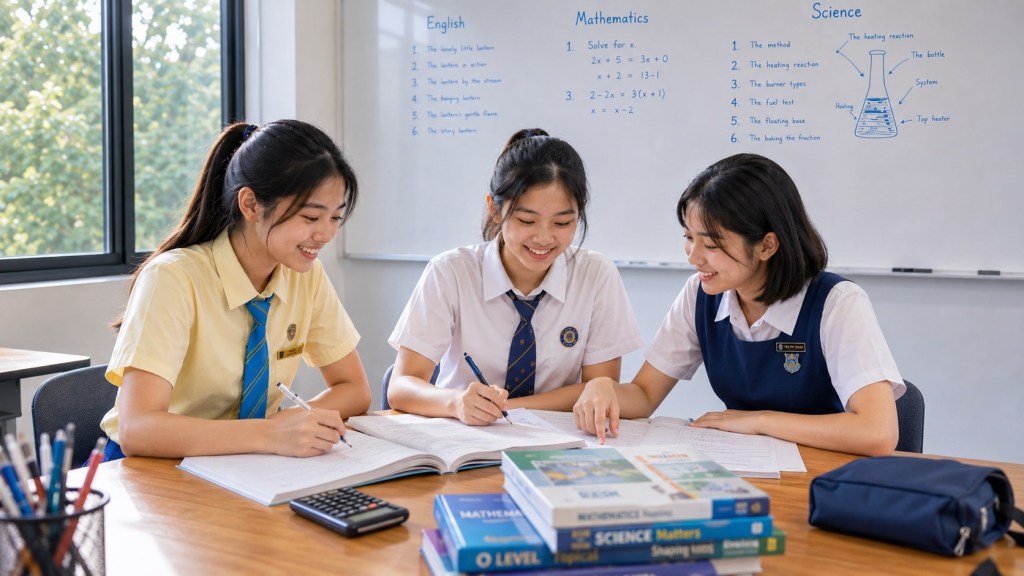
Does my child need a Science tutor in Sengkang, or can we fix this through self-study and home practice? Parents searching for Science tuition versus self-study, Primary Science tuition, PSLE Science tutor, homework help or Science revision at home are often trying to avoid two mistakes: adding tuition when it is unnecessary, or waiting too long when the same weakness keeps returning.
Current Science tutoring pages in Singapore and internationally often present personalised support, homework help, concept reinforcement, test preparation and study skills as reasons to use a tutor. Those are real benefits, but many Primary students can improve without regular tuition when the learning problem is small, recent and understandable. The decision should depend on whether the child can diagnose, repair and maintain the learning independently with ordinary school and family support.
At eduKate Sengkang, formal Science tuition currently covers Primary 3 to Primary 6, including PSLE Science, in focused classes of up to three students for 1.5-hour lessons. Primary 1–2 Science on the site is educational discovery material rather than a formal tuition offer. Secondary G1/G2/G3 Science appears for transition guidance, while the stated Sengkang Science programme remains Primary 3–6/PSLE. This article owns the parent decision between regular tuition and a disciplined self-study route.
Self-study works when the learner can close the loop alone
A useful self-study cycle is simple: identify what is unknown, retrieve or relearn the relevant concept, attempt a question, check the answer, understand the correction, make a second attempt and return later. If the child can do this reliably, tuition may add little.
The problem appears when one part of the loop repeatedly fails. The student may not know which concept is missing, may read corrections without understanding them, may avoid difficult questions or may never return after feedback. Tuition can add value by repairing the part of the learning system the child cannot yet manage alone.
The strongest reason for tuition is not that Science is difficult. It is that the child cannot yet solve the learning problem independently.
When home practice is usually enough
- The weakness is narrow and recently introduced.
- School explanations make sense after one review.
- The child can retrieve old concepts without heavy prompting.
- Corrections lead to successful second attempts.
- The learner can recognise the same concept in a changed question.
- Homework is mostly independent.
- Marks are stable or improving.
- The family can maintain a light, consistent revision routine.
In these conditions, tuition can become duplication. The child may benefit more from keeping time for reading, sleep and independent work.
When self-study starts to break down
Self-study becomes less efficient when the learner cannot diagnose what is wrong. A child may spend two hours rereading notes because the real problem is question interpretation. Another may keep doing full papers when the same experiment reasoning error returns.
A tutor adds value when expert diagnosis prevents repeated ineffective practice.
The difference between support and rescue
Parents can support self-study without becoming the tutor. Ask process questions: What is the question asking? What evidence do you have? Which old idea might connect? What changed after the correction?
Rescue begins when the parent supplies the route, rewrites the answer or sits beside the child until every question is complete. If home practice requires this level of adult involvement every week, the family may be running a hidden tuition system already.
Primary 3: self-study can be very light
Primary 3 students are still learning how Science works as a formal subject. Many children can manage with school teaching, curiosity and short home conversations. Formal tuition is not automatically necessary because Science has appeared on the timetable.
Home practice can focus on classification, observation, vocabulary in context and simple explanations. The child should still have room to enjoy the subject.
Primary 4: test whether the child can move from facts to relationships
By Primary 4, self-study needs to include more than definitions. Ask the learner to explain cause-and-effect, interpret simple experiments and connect evidence to a conclusion.
If the child can do this with school materials and occasional parent questions, regular tuition may not be necessary. If every unfamiliar question creates a complete restart, external support becomes more useful.
Primary 5: self-study needs cumulative retrieval
Primary 5 is where many home-study systems fail because older topics are no longer automatically active. The child may revise only the current chapter and lose access to earlier concepts.
A strong self-study plan includes short returns to old work. The Primary 5 Science Revision System explains how cumulative retrieval can be organised before Primary 6.
Primary 6: self-study must include paper diagnosis
By Primary 6, completing papers is not enough. The learner should be able to classify mistakes and decide what to do next. If the child can review a paper accurately, target repeated weaknesses and improve across changed questions, self-study can remain effective.
If every paper produces a score but no better study decision, tutoring can add diagnostic structure. The PSLE Science Tuition Sengkang route develops this paper-as-evidence approach.
The three tests of a self-study system
1. Delayed retrieval
Can the child still explain the concept several days later without notes? Immediate familiarity is not enough.
2. Changed-context transfer
Can the learner use the same idea when the diagram, object or wording changes? If not, the child may be memorising surface patterns.
3. Independent correction
Can the learner explain why the original answer failed and produce a better second attempt without an adult rewriting it?
If all three are working, the home system is strong.
When parents should not become the Science tutor
Parents may know Science well but still struggle to teach their own child. The relationship changes the interaction. A question intended as guidance can feel like criticism, and homework can become a nightly test of family patience.
If parent-child conflict is becoming part of the learning problem, outsourcing some teaching can be valuable even when the content itself is not extremely difficult.
When parents can help effectively
Parents are most useful as system supporters. They can protect a quiet study time, ask the child to show original work, encourage delayed return and help organise school papers. They do not need to know every answer.
This keeps responsibility with the learner while preserving useful home structure.
What self-study should not become
- Rereading notes for long periods.
- Copying model answers into a correction book.
- Doing one chapter repeatedly because it feels comfortable.
- Avoiding open-ended questions until the tutor or teacher is available.
- Completing papers without classifying errors.
- Watching explanation videos without making a fresh attempt.
- Using answer keys as the first step instead of the final check.
How long should families try self-study before adding tuition?
A defined trial period is useful. Four to six weeks is often enough to see whether a new home routine changes the repeated problem. Choose one or two indicators: fewer incomplete explanations, stronger old-topic retrieval or less adult prompting.
If the pattern improves, continue. If the same weakness remains despite a serious attempt, tuition becomes easier to justify because the family has evidence that ordinary self-study is not enough.
What a four-week self-study trial can look like
- Week 1: identify one repeated error from recent school work.
- Week 2: relearn the relevant concept and make second attempts.
- Week 3: use changed-context questions and retrieve after delay.
- Week 4: complete a short mixed set without parent help.
- End: compare the same error type with the starting evidence.
This is small enough to sustain and clear enough to evaluate.
When tuition should be temporary
A learner may need a short block of expert help to fix one bottleneck, then return to self-study. Tuition does not have to become a permanent weekly identity.
The companion Continue, Change, Reduce or Stop guide explains how support can shrink after the original job is solved.
When self-study is strong but PSLE still justifies a tutor
A highly independent Primary 6 learner may still benefit from occasional external paper review or advanced open-ended feedback. The value comes from expert calibration rather than routine homework support.
This can be a lighter arrangement than full weekly tuition if the child is already managing most of the learning system alone.
When self-study is not the right first answer
If the child has large foundation gaps, cannot begin independently or is becoming increasingly discouraged, asking for more self-discipline may be unrealistic. The learner may need teaching before independent study becomes possible.
The My Child Is Weak in Science guide helps identify which kind of weakness is present.
Compare the cost of tuition with the cost of parent time
Tuition has a financial cost. Intensive parent support has a time and relationship cost. Families should consider both. A lower-cost home route is not really low-cost if it requires nightly conflict and extensive adult rewriting.
Conversely, tuition may not be good value if the child could solve the problem through a simple independent routine.
How a tutor should preserve self-study
Good tuition should strengthen the child’s independent learning system rather than replace it. The tutor can teach the learner how to retrieve, correct, organise papers and identify uncertainty.
As these skills improve, the student should become better at using the days without tuition.
Why self-study is part of tuition success
A child who only learns during the 1.5-hour lesson is not getting the full value of tuition. The days between sessions are where retrieval, transfer and independence are tested.
The companion How Often Should My Child Have Science Tuition? guide explains why the gap between lessons is educationally useful.
The strongest home resource is not another book
Families often respond to low marks by buying new revision books. Sometimes the child already has enough material. The real problem is that existing material is not being used through retrieval, feedback and transfer.
Before buying more, ask whether the learner can explain the current corrections and use them in a new question.
Online resources can support self-study—but still need active use
Videos, digital flashcards and question banks can be useful. The learner should pause, retrieve, solve and compare rather than watch continuously.
The rule is simple: every explanation resource should eventually lead to an independent task.
A parent checklist: self-study or Science tutor?
- Can my child identify what went wrong?
- Can the child relearn the concept without heavy adult help?
- Do corrections lead to successful second attempts?
- Can learning survive several days?
- Can the child solve a changed question?
- Is homework mostly independent?
- Is the home routine sustainable without conflict?
- Are marks or error patterns improving?
- Would a tutor add a capability that the current system cannot provide?
After PSLE: self-study becomes even more important
Secondary Science demands more independent organisation. Even if a learner later uses formal Secondary Science tuition, the ability to retrieve, correct and plan independently becomes increasingly important.
The Primary years should therefore not end with a child who can only learn when a tutor is present. The transition guide at From PSLE to Secondary Science G1, G2 and G3 explains this shift.
Frequently asked questions
Can my child improve Science without tuition?
Yes. Many students improve through strong school teaching, consistent retrieval, careful correction and independent practice. Tuition is most useful when a persistent problem remains despite those supports.
How long should we try self-study first?
A four- to six-week trial with one clearly defined target can provide useful evidence, unless the gap is already large or PSLE timing makes delay costly.
Should parents help with Science homework?
Parents can ask process questions and help organise work, but should avoid supplying the reasoning or rewriting answers.
Does eduKate Sengkang teach Primary 1–2 Science?
The site contains P1–2 discovery Science content, but the formal Science tuition programme is Primary 3–6/PSLE.
Final idea: tuition should solve what self-study cannot yet solve
A Science tutor is most valuable when the learner cannot diagnose or repair the problem efficiently alone. If the child already has a working self-study system, preserve it. If that system repeatedly breaks at the same point, use tuition to repair the missing capability and then return responsibility to the learner.
For Sengkang and Punggol families, the decision becomes clearer when it is framed this way: not “Is tuition good?” but “What is the learning job, and who can currently do it?”
Self-study and tuition are two positions inside the same system
The useful boundary is not tuition versus independence as opposites. The Tutor System treats support as adjustable: bring in human tutoring when the learning job requires it, calibrate the help, then return more planning, practice and checking to the learner as capability grows.
Self-study needs a source hierarchy
Independent learners can waste time because every uncertainty triggers a new Google search, video or worksheet. A strong home system has a source hierarchy. Start with school notes or the official textbook, then use the correction or teacher feedback, then consult one trusted reference if the concept is still unclear.
This prevents the learner from collecting five explanations when the real job is to understand one relationship and test it on a question.
Self-study needs a stopping rule
Students can overwork a topic because they do not know when enough is enough. A practical stopping rule is: can the learner retrieve the core relationship, apply it to a changed question and explain one correction independently? If yes, move on and schedule a later return.
This protects time for the rest of the syllabus and makes revision more balanced.
Self-study should include error classification
After a school test, do not simply count wrong answers. Classify a small sample: concept, retrieval, transfer, evidence, explanation or execution. The category suggests the next task.
A concept error needs reteaching. A transfer error needs unfamiliar application. An execution error may need timing or checking. This simple classification gives self-study some of the diagnostic value a tutor would otherwise provide.
Parents can ask one weekly review question
A parent does not need to mark Science every night. Once a week, ask: “What mistake did you stop repeating this week?” The child can show one correction and explain what changed.
This keeps the home role light while encouraging metacognition.
A self-study plan should use school evidence before commercial materials
School worksheets and tests already show how the learner is performing in the actual curriculum. Use them before buying new question books. A commercial book is useful when it fills a specific practice need, not simply because the family wants more material.
This keeps the study system connected to real performance.
When model answers help self-study
Model answers are useful after the learner has attempted the question. Compare structure: what evidence was used, which mechanism was included and how the response returned to the command word.
Then close the model and answer a changed question. If the child can only reproduce the original wording, the learning has not transferred.
When answer keys hurt self-study
An answer key can become a source of premature help. If the learner checks after the first hesitation, uncertainty never becomes productive thinking. Set a rule: make a complete attempt or mark the exact point of uncertainty before checking.
This teaches the child to generate evidence about what is missing rather than using the key as a shortcut.
The home system should preserve original wrong answers
Do not erase every error once the correction is known. Keep a few representative examples. A month later, the child can compare the old reasoning with a new attempt and see whether the pattern has changed.
This creates a simple progress record without requiring formal tuition reports.
Self-study works better with short distributed practice
Several short Science returns across the week can be more durable than one long Sunday session. A ten-minute retrieval check, a changed application and a correction review each create separate memory events.
The learner also gets repeated chances to discover what can be done without adult help.
Self-study should become more mixed as the learner improves
At first, chapter practice helps stabilise a method. Later, mix topics so the child must choose what applies. If the student only succeeds when the chapter heading announces the concept, knowledge is not yet flexible enough for PSLE.
Increase mixing gradually so difficulty remains diagnostic rather than chaotic.
A family can create an escalation rule
Agree in advance on when self-study is no longer enough. For example: the same error appears across three school tasks, the child cannot explain a correction after two attempts, or marks continue falling across two assessments despite a consistent home routine.
An escalation rule prevents both premature tuition and endless waiting.
The child should know when to ask the school teacher
Independent learning does not mean solving everything alone. A strong student knows when a question has become genuinely unclear and can ask a precise question at school. This is a valuable skill and can reduce the need for external tutoring.
Parents can help the child phrase the question without supplying the answer.
When self-study creates false confidence
A learner may feel strong because familiar chapter exercises are easy. Use occasional unseen or mixed questions to calibrate. Confidence should be tested against variation.
If performance collapses when the surface changes, the home system needs more transfer practice.
When self-study creates unnecessary anxiety
Some families turn independent revision into constant monitoring. The child is tested every evening, every correction is inspected and every score becomes a family event. This can make self-study less independent than tuition.
Use planned review points instead. The learner needs space to make ordinary mistakes without immediate adult intervention.
What a tutor can teach so the child can return to self-study
- How to classify errors.
- How to retrieve without notes.
- How to compare two explanations.
- How to use evidence from graphs and experiments.
- How to make a second attempt after feedback.
- How to plan a weekly return to old topics.
- How to recognise when outside help is genuinely needed.
These are durable skills because they reduce future dependence on the tutor.
A hybrid route can be sensible
The family does not have to choose permanent full tuition or permanent self-study. A child can self-study most weeks and use periodic diagnostic sessions before major assessments. A struggling learner can use regular tuition for a term, then step down after the bottleneck is repaired.
The arrangement should follow the learning need rather than a fixed identity.
How to compare a month of self-study with a month of tuition
Use the same indicators: repeated error frequency, delayed retrieval, changed-context transfer, homework independence and school performance. Avoid comparing only the amount of work completed.
The better route is the one that produces stronger independent capability at an acceptable cost to the family’s time and energy.
Why strong self-study is valuable even when tuition continues
Tuition can never cover every future Science problem. A learner who knows how to study independently can use tutoring more efficiently because the lesson is reserved for the genuinely difficult parts.
This is especially important as the child moves toward Secondary school and the curriculum becomes broader.
The self-study goal is not perfect independence
Children still need teachers, feedback and explanations. The goal is proportionate independence: the learner can begin, attempt, identify uncertainty and use available support intelligently.
Tuition should enter where that system reaches its current limit, then leave more of the work to the learner as the limit moves.
A self-study learner needs a weekly planning ritual
At the start of the week, the child can choose one current school topic, one older topic to retrieve and one correction to revisit. This is enough structure to prevent revision from becoming random without turning the family into a tuition centre.
The plan should remain small. A self-study system fails when planning becomes more elaborate than the actual learning.
Self-study should begin from questions, not from notes
A useful routine is to attempt a few questions before rereading. The errors reveal which part of the notes deserves attention. This makes revision demand-led rather than page-led.
After relearning, the student attempts a changed question to confirm that the repair worked.
Use a traffic-light system carefully
Students can mark topics green, amber or red, but the colour should be based on evidence. Green means the learner can retrieve and apply after delay, not merely that the notes feel familiar. Amber means performance is inconsistent. Red means the concept or process needs active repair.
This prevents overconfidence and helps the child allocate study time intelligently.
The learner should distinguish learning resources from checking resources
A textbook or explanation video is a learning resource. An answer key is a checking resource. Confusing the two encourages answer-first study. The child should use the explanation to rebuild understanding, attempt independently and only then use the answer key to verify.
This small distinction can improve self-study quality dramatically.
Build a two-step help ladder
Before asking an adult, the child can take two steps: first reread the exact condition or diagram; second retrieve the relevant concept without notes. If still stuck, the learner writes one precise question and seeks help.
The help ladder avoids both helpless waiting and endless unproductive struggle.
Parents can limit help by time
Agree that the child works independently for a reasonable period before asking for support. The period should be short enough to prevent frustration and long enough to allow real thinking. Younger students may need less time; older Primary students can tolerate more.
The goal is not to make the child suffer. It is to ensure that adult help arrives after an authentic attempt.
A self-study system should include one no-notes day
At least once a week, the learner can retrieve without notes: explain a process, sketch a system or answer a mixed question. This reveals whether study has produced access rather than familiarity.
The task can be brief. Its value comes from honesty.
A self-study system should include one ‘why wrong?’ review
Choose one corrected answer and explain why the original reasoning failed. This develops error knowledge. The learner becomes better at recognising the same trap in future questions.
Simply copying the correct response does not build this discrimination.
The family should protect a no-help zone
One short block each week should be completely independent. No parent reminders, no answer checking during the task and no tutor messaging. This gives the learner a real sample of current capability.
The work produced in that zone is excellent evidence for deciding whether self-study remains sufficient.
When school support is underused
Before buying more external help, parents can check whether the child uses available school consultations, asks teachers specific questions and reviews school corrections. Many students have support available but do not know how to use it.
Learning to use school support is itself an independence skill.
Self-study after a bad result should be narrow first
A disappointing paper can trigger plans to revise everything. Start with the repeated errors. If most lost marks come from two patterns, repair those before rebuilding the entire syllabus.
This mirrors good tutoring: diagnose before increasing volume.
When self-study should switch from chapter practice to paper practice
Chapter practice is useful while methods are still forming. Once concepts are stable, mixed sections and timed papers become more informative because the learner must select the right idea under realistic conditions.
Move too early and the child guesses; move too late and method selection remains untrained.
Parents should know the difference between monitoring and teaching
Monitoring means checking whether the routine happened, whether the child can explain one correction and whether the workload is sustainable. Teaching means supplying explanations and directing every answer. Parents can usually do the first without needing to do the second.
This keeps family involvement useful but bounded.
Self-study can coexist with one-off expert review
A learner may be independent most of the time but benefit from a specialist review after a school assessment or before PSLE. The tutor diagnoses the paper, identifies a small number of priorities and returns the learner to self-study.
This is a valid alternative to weekly enrolment for students who already have strong learning habits.
The self-study system should survive a busy week
If the routine works only during school holidays, it is too ambitious. Design a minimum version that fits an ordinary term: perhaps two short retrieval blocks and one correction return.
Consistency at a modest level is more useful than an elaborate plan that collapses when school becomes busy.
Self-study should leave the child more independent after each term
The learner should become better at deciding what to revise, when to seek help and how to use errors. If the child needs the same parent management month after month, the system is not maturing.
That may be a reason to introduce a tutor temporarily—not to replace independence, but to teach the missing learning routines.
A parent decision rule
If the child can identify the problem, choose the right resource, make a serious attempt, use feedback and return later, preserve self-study. If one of those steps repeatedly fails and school support has not repaired it, a tutor can add value.
The purpose of tuition is then clear: repair that step and hand the system back.
A self-study plan should include a reset after every school assessment
After each test, the learner can retire topics that are stable, reactivate older material that has faded and identify one new repeated error. This prevents the home routine from continuing unchanged simply because it was written at the start of the term.
The reset can take fifteen minutes. The student looks at the paper, chooses the next priority and updates the weekly plan. This keeps self-study evidence-led.
The child should own the correction file
A correction file is only useful if the learner can navigate it. Organise by error type or key concept rather than by date alone, and keep only representative examples. The child should know why each example is there.
A giant archive of corrected work can feel responsible while becoming practically unusable. Self-study needs a small working memory outside the brain, not a museum of every mistake.
The strongest evidence that self-study is enough
The child begins difficult work without being chased, can explain why an answer failed, returns to old topics before they disappear and knows when to ask a precise question. Marks do not need to be perfect. The learning system needs to be self-correcting.
When that system is present, tuition should have to prove additional value before it is added.
A final self-study test: can the learner recover after getting stuck?
Independent study is not measured by whether the child never needs help. It is measured by what happens before help is requested. Can the learner identify the exact point of uncertainty, try another representation, retrieve the relevant concept and explain what was already attempted?
A student who can do this is using support intelligently. A student who either waits helplessly or struggles for an hour without changing strategy needs a better recovery routine. Tuition can be useful when it teaches that routine and then fades back.
Parents can therefore judge self-study by recovery quality. A robust home learner knows how to begin, how to notice when the current approach is failing and how to ask a precise question without handing the entire task to someone else.
That is the form of independence worth protecting even when regular tuition is available.
Self-study should include a calm restart after failure
When a home revision plan fails for a week, avoid turning the missed routine into evidence that the child cannot self-study. Restart with the minimum version: one retrieval task and one correction return. Systems become durable partly by surviving interruption.
This matters during busy school terms, illness and examination periods. A learner who can restart independently has a stronger study system than one whose plan works only under perfect conditions.
Parents should therefore judge consistency over months rather than demanding flawless daily compliance. Self-study is successful when the learner repeatedly returns to useful habits without needing the entire routine rebuilt by an adult.
A final self-study rule: make the system visible enough to repair
Independent learning becomes fragile when the child cannot describe what they do. A simple visible routine helps: retrieve, attempt, check, explain the correction, return later. If one step repeatedly disappears, the family can repair that step rather than abandoning self-study entirely.
This matters because self-study is not a personality trait. It is a set of learnable behaviours. A student who currently needs a tutor can still become a strong independent learner if the tutor teaches these behaviours explicitly and gradually reduces support.
Parents should therefore avoid asking whether the child is ‘the kind of person who can self-study.’ Ask which part of the cycle is already strong and which part still needs teaching.
A family can keep one final rule: outside help should arrive after the learner has produced evidence of an attempt. That evidence might be a half-finished diagram, a written question, a marked uncertainty or a correction the child cannot explain. This makes help more precise and preserves ownership. Whether the helper is a parent, school teacher or tutor, the learner remains responsible for beginning the work and showing where the route broke. Over time, better attempts lead to better questions, and better questions reduce how much external help is needed.
The self-study route therefore deserves the same seriousness as tuition. It needs evidence, structure, review and the humility to escalate when the learner reaches a real limit. Families do not have to choose between independence and expert help forever. They can protect independence as the default, use targeted tutoring when the system cannot repair itself, and return the work to the child once the missing capability is stable.
The best home system is not one that never needs help. It is one that makes help precise, temporary and increasingly rare.
That balance gives the child both autonomy and a clear route back to expert support when a genuinely difficult Science problem appears.
The child remains responsible for beginning, thinking and returning.
That matters.
Return to Science Tutor Sengkang for the complete small-group Primary Science tutoring route: diagnose the first weak link in observation, concepts, relationships, evidence, explanation and examination execution.
