
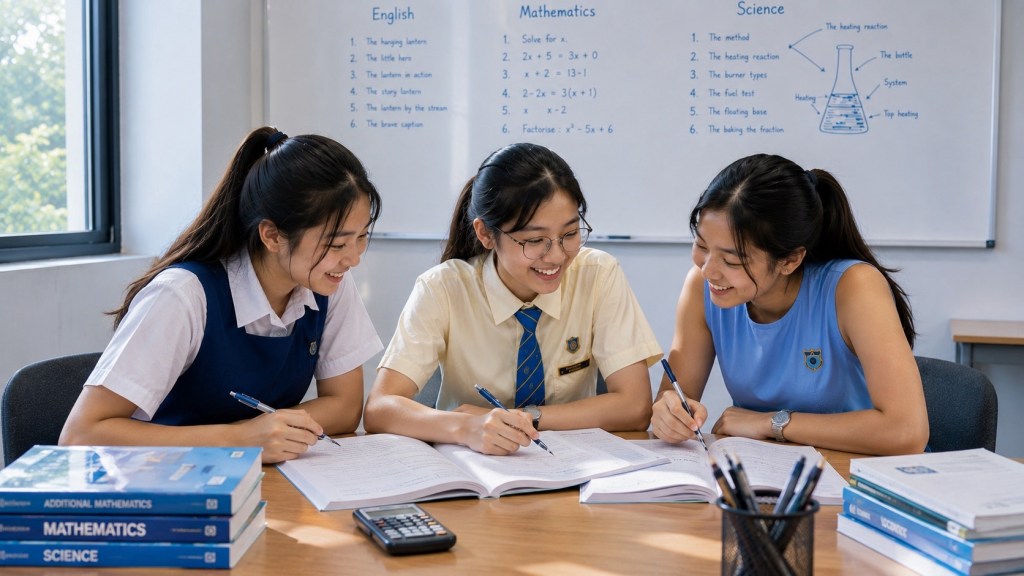
A small Mathematics class is not automatically a good Mathematics class. Parents searching for Primary Mathematics tuition in Sengkang, small-group maths tuition, 3-student tuition, PSLE Mathematics tuition or a Primary Math tutor should ask what the tutor can do with the smaller group that would be difficult in a much larger class.
The answer should be more than ‘give more attention’. A three-student Primary Mathematics tutorial can make each learner’s working visible, allow rapid diagnosis, compare different solution methods, branch practice by need and return feedback before an error becomes a habit.
For Sengkang and nearby Punggol families, the commercial value of a three-student format should therefore come from teaching precision. If all three children receive the same worksheet, the same explanation and the same correction regardless of their actual errors, the small group is being underused.
At eduKate Sengkang, the useful unit is not the worksheet page. It is the learner’s next mathematical decision: what they notice, how they represent the problem, which method they choose, where the route breaks and whether the correction survives independently.
Quick answer: what should a 3-student Mathematics tutorial do?
Keep three learners together for shared mathematical thinking while preserving enough individual visibility to diagnose and teach each learner precisely.
- Inspect each student’s working, not just final answers.
- Diagnose the first weak link.
- Teach the common concept once when appropriate.
- Branch practice when the learners need different repairs.
- Use student explanations to compare methods.
- Keep individual accountability during group discussion.
- Retest corrections using fresh questions.
- Reduce support as independence grows.
Three students should not mean one worksheet times three
Small-group value disappears if the lesson behaves exactly like a large class with fewer chairs.
The tutor should be able to notice that one child misread the fraction, another selected the wrong operation and a third made only an arithmetic slip.
Those errors should not produce identical homework.
The opening diagnostic
A useful lesson begins with a small amount of retrieval or a current-school check.
This reveals whether previous learning survived the gap between lessons and whether current schoolwork contains a new bottleneck.
The diagnostic should be short enough that it does not consume the lesson.
Shared teaching, individual repair
If all three learners need the same concept, teach it together. Shared explanation can be efficient.
Then inspect individual attempts. The tutor may discover that one learner needs a prerequisite repair while the others are ready for transfer.
The group can temporarily branch without losing the common lesson structure.
Why visible working matters
A correct answer does not always prove a stable method. A child may guess, imitate or use an inefficient route.
Visible working lets the tutor see the sequence of decisions.
This is especially important in word problems, fractions, ratio and upper-primary mixed questions.
Student explanations should have a job
Group discussion is useful when it reveals different mathematical structures and strategies.
One learner may use a bar model, another a table and another an equation. The tutor can ask which representation makes the relationship easiest to verify.
Talking is not the goal by itself. The goal is exposing reasoning.
Individual accountability
The strongest learner should not become the unofficial assistant who supplies every first step.
After discussion, each student should complete independent work or explanation.
The tutor needs evidence from each learner.
Primary 1–2 tutorial priorities
Early Primary lessons should emphasise number sense, place value, operations, multiplication/division meaning, language and representation.
Manipulatives and drawings can be useful, but the learner should gradually move toward symbolic independence.
Fluency practice should remain short and accurate.
Primary 3–4 tutorial priorities
The tutorial should add multiplication/division fluency, fractions, decimals, measurement and multi-step problem solving.
Model drawing should be used as a thinking tool rather than a compulsory template.
Mixed questions should appear after concepts are stable.
Primary 5 tutorial priorities
Fractions, decimals, percentage, ratio and multi-step reasoning become the multiplicative spine.
Students should learn to translate between representations and identify reference quantities.
The tutor should begin building PSLE-style mixed selection without turning every lesson into a full paper.
Primary 6 tutorial priorities
The focus shifts toward integration: mixed retrieval, targeted repair, unfamiliar questions, timing and checking.
Full papers become more relevant, but only when they serve a diagnostic or exam-control purpose.
The tutor should know when to stop full papers and return to a narrow repair.
What feedback should look like
Feedback should identify the mechanism and the next action.
‘Careless’ is too vague. ‘You changed the sign when subtracting a negative’ or ‘You found the intermediate quantity but did not return to the final question’ is actionable.
The learner should then use the feedback on a fresh item.
How support should fade
A tutor can create dependency by helping too efficiently. If the tutor always gives the first step, students may never learn to start independently.
Use a hint ladder. Begin with the target, representation or self-questioning prompt before naming the method.
The best long-term sign of tuition success is that the learner needs less tutor intervention.
Homework from a three-student tutorial
Homework does not have to be identical for all three students.
One learner may need fact retrieval, another a fraction repair and another two transfer questions.
The workload should be enough to test and strengthen the lesson, not a punishment for being in tuition.
How parents should evaluate a small-group programme
- Can the tutor describe the child’s recurring mathematical error patterns?
- Does homework reflect those patterns?
- Is the child becoming more independent?
- Are old gaps repaired without losing contact with current schoolwork?
- Does practice move beyond familiar templates?
- Are explanations and checking improving?
- Can the tutor show why the next task was chosen?
What commercial value should look like
Parents pay for instructional decisions, not merely access to more questions.
The value of a three-student tutorial should be diagnostic speed, tailored practice, visible working, fast feedback and better transfer.
If a learner can get the same experience from an answer key and a worksheet pack, the tutoring format is not being used fully.
The eduKate Sengkang route
Use the Mathematics Hub to navigate Primary 1–6, PSLE, Secondary Mathematics and Additional Mathematics.
The year-level pages explain local tuition routes, while the Advanced Mathematics Tutorials lane explains the learning mechanisms parents can use to judge progress.
A recent school paper with the child’s original working remains one of the best starting points for a new diagnostic.
Frequently asked questions
Is three students better than one-to-one?
The formats are different. Three students can create useful comparison and discussion while preserving visibility. One-to-one can provide maximum individual time. The better format depends on the learner and the quality of teaching.
Should all three students be at the same level?
They should be close enough to share meaningful teaching, but identical profiles are neither realistic nor necessary. Good tutoring can branch within a common lesson.
How do I know if the group is too mixed?
If most lesson time is spent running three unrelated curricula, the group may no longer be efficient. Shared mathematical work should remain substantial.
How quickly should marks improve?
Some mechanisms improve before marks do. Look for cleaner working, fewer repeated errors, stronger starts and better mixed-topic performance.
Continue the lane
Pair this article with How to Catch Up in Primary Mathematics Without Restarting the Whole Syllabus and the Primary Mathematics weekly schedule for a complete parent support route.
