
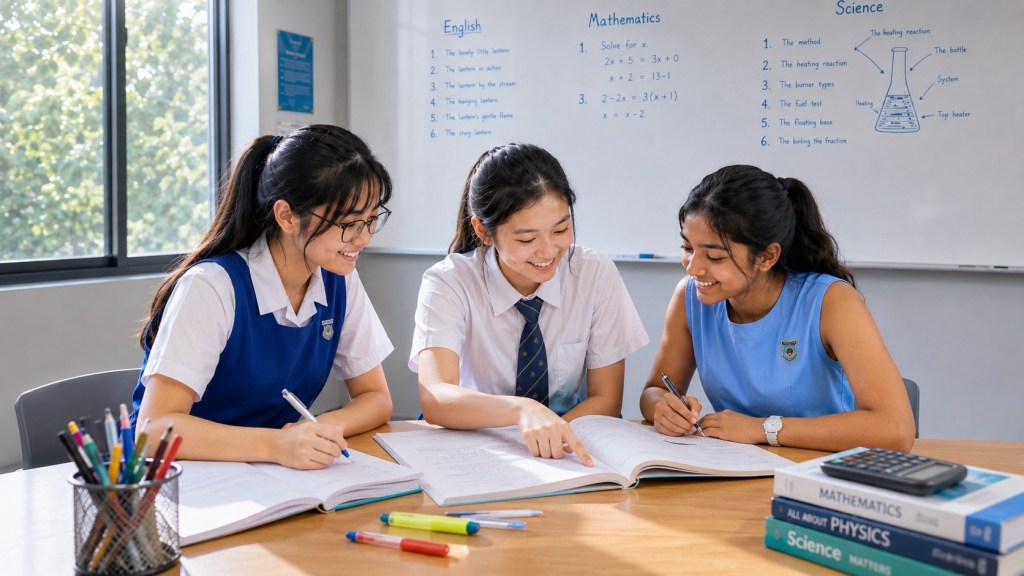
Primary Mathematics families have more resources than ever: school worksheets, textbooks, topical assessment books, online practice, revision books and PSLE past papers. Parents searching for the best maths assessment book, Primary Mathematics worksheets, PSLE maths past papers or Mathematics tuition in Sengkang often assume that the best resource is the hardest or most popular one.
The better question is what job the resource needs to do. A school worksheet may align closely with the current lesson. A textbook can explain structure. A topical assessment book can strengthen execution. A mixed revision book can train method selection. A past paper can test integration, timing and transfer.
For Sengkang and nearby Punggol families, resource choice should therefore follow diagnosis. Buying another book does not solve a fraction misconception, a method-selection gap or a timing problem unless the chosen resource actually targets that problem.
The MOE Primary Mathematics syllabus provides the curriculum frame. Resources should serve that learning system rather than replace it with random difficulty.
Quick answer: which Mathematics resource should parents use?
Use the resource that matches the learning job.
- School worksheet: current-topic alignment.
- Textbook: explanation, examples and concept structure.
- Topical assessment book: consolidation and fluency.
- Mixed revision book: method selection and retrieval.
- Past paper: integration, timing and exam control.
- Error log: personal diagnosis and targeted repair.
School worksheets
School worksheets reveal what the child is currently expected to know. They are often the best first evidence for a parent or tutor.
Do not discard them after marking. Keep representative errors with the child’s original working.
The working shows whether the problem came from concept, method selection, arithmetic or checking.
Textbooks
Textbooks are useful when the learner needs the structure of a topic, worked examples and a coherent progression.
They are especially valuable when a child has forgotten why a method works.
A textbook should be read actively: cover the next line of a worked example and predict the step before revealing it.
Assessment books
Assessment books are useful when a student needs more examples than school provides.
But volume can become misleading. Completing many similar questions can create pattern familiarity without transfer.
Choose books by purpose, not by thickness.
Topical books
Topical books are useful during acquisition and repair. If fractions are weak, a focused set can provide enough variation to rebuild the idea.
The risk is that every question announces the method. The learner may become excellent at fractions only when the chapter says ‘Fractions’.
Move to mixed work after stability improves.
Mixed revision books
Mixed books force the student to identify the topic and method independently.
This makes them valuable for upper-primary learners and PSLE preparation.
They are harder than blocked worksheets because selection is part of the task.
Past papers
Past papers are best used as assessment and integration tools. They reveal switching, timing, checking and transfer.
They are less efficient for first-time learning. A child with a weak ratio concept does not need ten full papers to discover the same ratio error repeatedly.
Use the paper to diagnose, then leave the paper and repair the cause.
How to analyse a past paper
- Mark wrong and blank questions.
- Classify the error cause.
- Look for repeated mechanisms across topics.
- Choose one high-cost error family.
- Repair with targeted practice.
- Retest using a fresh question.
- Return to mixed-paper conditions later.
The danger of answer keys
Answer keys can turn independent practice into confirmation-seeking. Some students check after every line and never learn to tolerate uncertainty.
Use answers after a complete attempt or at planned checkpoints.
When an answer is wrong, compare methods rather than simply copying the solution.
Online videos and AI explanations
Digital explanations can be useful when a concept is unclear, but passive viewing creates familiarity more easily than independent competence.
Pause before the solution and ask the learner to predict the next step.
After watching, close the explanation and solve a fresh question.
How many resources does one child need?
Usually fewer than families imagine. One coherent main resource plus targeted supplementary material is often enough.
The bottleneck is rarely lack of available questions. It is selecting the right questions and learning from the errors.
More books can increase clutter without improving diagnosis.
Primary 1–2 resources
Prioritise clear representations, number sense, place value, operations and simple word problems.
Resources should not overwhelm young learners with dense pages.
Concrete materials and ordinary household quantities can be legitimate mathematical resources.
Primary 3–4 resources
Use materials that support multiplication/division fluency, fractions, measurement, model drawing and multi-step reasoning.
Introduce mixed work gradually after topical competence improves.
Keep diagrams and fraction representations clear.
Primary 5 resources
Look for strong coverage of fractions, decimals, percentage, ratio and multi-step problems.
Mixed problem sets become increasingly important.
Resource difficulty should not jump so sharply that the book becomes an answer-copying exercise.
Primary 6 and PSLE resources
Use targeted revision alongside mixed papers. Past papers should train integration and exam control, not replace diagnosis.
The official SEAB PSLE examination format information should anchor current exam-format understanding.
Commercial resources should support, not redefine, the syllabus.
How tuition should use resources
A tutor should not simply work through a commercial book from page one to the end.
At eduKate Sengkang, the value of a three-student tutorial is that resource selection can branch. One child may need a topical fraction set, another a mixed problem set and another a short timed section.
The resource follows the learner’s bottleneck.
Frequently asked questions
What is the best assessment book?
There is no single best book for every learner. The best resource is the one matched to the current learning need and used with feedback.
Should my child do school papers from other schools?
They can be useful for mixed practice and transfer, especially later in Primary school, but repeated paper completion should not replace targeted repair.
Should we keep old worksheets?
Keep representative errors and important tests. They provide useful evidence of recurring patterns.
Is online practice enough?
It can support fluency and retrieval, but written working, representation and explanation remain important for many Mathematics tasks.
Continue the lane
Pair this article with How Much Mathematics Practice Is Enough?, the weekly schedule article and the Mathematics Hub.
