
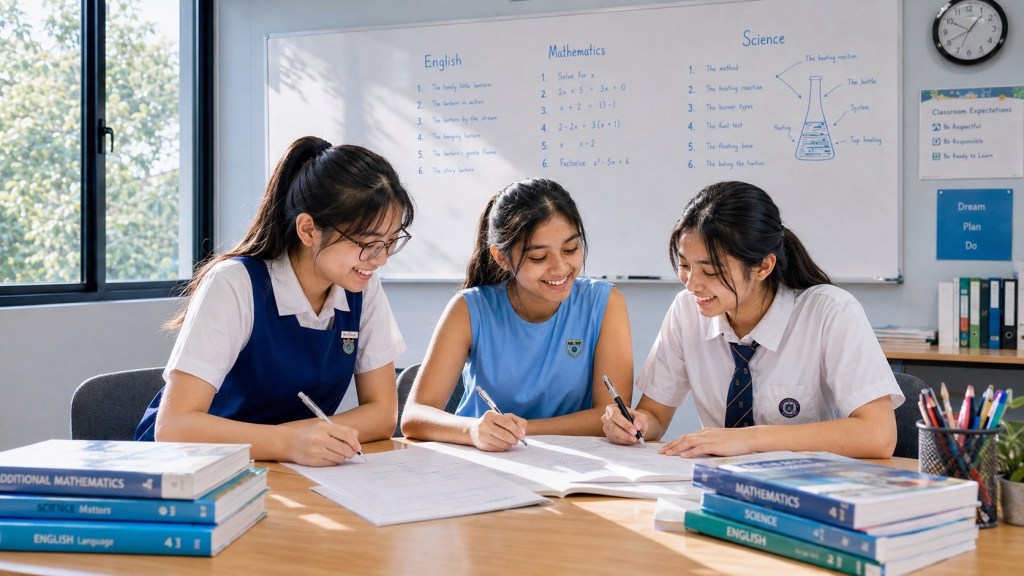
How to improve creative writing, story writing and narrative English is a broad search because students need more than vocabulary to write an engaging story. A Primary 2 learner may need help moving from a picture to a sequence of events. A Primary 5 student may have ideas but weak plot development. A Primary 6 student preparing for PSLE continuous writing needs to select a relevant stimulus, build a coherent narrative, control language and revise under time. At Secondary G1, G2 and G3, creative writing can require stronger characterisation, perspective, pacing, description and stylistic judgement.
Parents in Sengkang and Punggol often hear advice such as “use better words”, “show, don’t tell” or “make the story more exciting”. Those phrases are too vague unless the learner understands the writing mechanism. Strong creative writing depends on choices: what changes, what problem matters, what the character wants, which moment deserves detail, which detail should be omitted, how dialogue changes the scene, and what the ending reveals about consequence or change.
Cambridge English story-writing materials explicitly encourage brainstorming setting, plot, characters and ending before writing, while its broader story resources show how narrative exposes learners to vocabulary and ways of combining words. This Advanced English Tutorials guide turns those principles into a Primary-to-SEC writing system while linking to eduKate Sengkang’s existing composition and continuous-writing owners.
Quick Read
One-sentence answer: improve creative writing by building a clear story problem, choosing a character goal, planning cause-and-effect events, developing the important moments with specific detail, controlling pace and dialogue, and revising the story so every scene contributes to change.
- Primary 1–2: simple sequence, character, setting, complete events and basic description.
- Primary 3–4: problem, motive, reaction, dialogue, paragraphing and cause-and-effect plot.
- Primary 5–6: PSLE continuous writing, stimulus relevance, development, pacing, vocabulary and revision.
- Secondary G1/G2/G3: perspective, voice, conflict, characterisation, structure, imagery, narrative control and timed writing.
- A good story is not a list of dramatic events. It is a chain of meaningful choices and consequences.
1. Start With Change
A story becomes meaningful when something changes: a situation, relationship, belief, decision or consequence.
Ask what is different at the end compared with the beginning. This gives the narrative direction.
2. Primary 1: Beginning, Middle, End
Young writers can organise simple stories into three stages.
The beginning establishes who and where, the middle contains an event, and the ending completes the event.
3. Primary 2: Problem and Solution
Primary 2 students can build stories around a simple problem.
The solution should follow logically from what the character does rather than appear randomly.
4. Primary 3: Character Goal
A character goal gives events a reason to matter.
Ask what the character wants and what makes that difficult.
5. Primary 4: Choice and Consequence
Primary 4 students can strengthen plot by making the character choose between options.
The consequence of the choice creates development rather than a sequence of accidents.
6. Primary 5: Plot Development
Primary 5 learners need stories that escalate rather than repeat the same problem.
Each major event should change the situation and create the next decision.
7. Primary 6 and PSLE
PSLE continuous writing requires stimulus relevance, coherent planning, development and language control under time.
The stimulus should belong naturally in the story rather than be attached to a memorised plot.
8. Secondary 1: Perspective
Secondary 1 writers can explore how first person, third person and limited viewpoint change what the reader knows.
Perspective should be chosen for narrative purpose, not switched accidentally.
9. Secondary 2: Characterisation
Character is built through action, speech, thought, reaction and relationships.
Long descriptions are less effective than details that reveal what the character values or fears.
10. Secondary 3: Pacing
Upper-secondary writers can control how quickly the story moves.
Important moments can be slowed with detail; transitions can compress less important time.
11. Secondary 4 and SEC
By Secondary 4, the writing process should be efficient enough for planning, drafting and revision under time.
The writer needs a reliable method rather than a memorised plot.
12. G1, G2 and G3
The same narrative system operates across subject levels while language complexity and stylistic control differ.
Practice should match the learner’s course and writing readiness.
13. Setting
Setting should influence mood, action or possibility rather than exist as decorative background.
Choose details that matter to what happens next.
14. Character
A believable character has goals, habits, strengths, limits and relationships.
The story does not need a full biography; select what affects the plot.
15. Conflict
Conflict creates pressure between what the character wants and what prevents it.
The obstacle can be another person, circumstance, internal fear or competing responsibility.
16. Stakes
Stakes answer why the outcome matters.
They can be emotional, social, practical or moral rather than always extreme or dangerous.
17. Choice
A story strengthens when the character must choose.
Choices reveal personality and create consequences.
18. Consequence
Events should leave effects.
If nothing changes after a major event, the scene may not be doing enough narrative work.
19. Cause and Effect
Plot should feel connected rather than random.
Ask “because of this, what happens next?” after each major event.
20. Openings
An opening should establish enough context and create forward movement.
Avoid spending too long describing weather or waking up unless it matters to the story.
21. Inciting Event
The inciting event disrupts the ordinary situation and creates the story problem.
It should appear early enough for the main narrative to develop.
22. Rising Action
Each development should increase difficulty, reveal information or force a new choice.
Repeated minor obstacles can feel episodic rather than cumulative.
23. Climax
The climax is the decisive moment where the central conflict reaches its strongest point.
It should grow from earlier events rather than arrive as an unrelated dramatic surprise.
24. Resolution
The resolution shows the consequence of the climax and the new state of the story.
A rushed “and everything was fine” ending wastes the development built earlier.
25. Dialogue
Dialogue should reveal character, conflict or information.
Remove exchanges that merely repeat what the narration already explained.
26. Dialogue Punctuation
Clear punctuation helps readers track speakers and meaning.
Editing dialogue is easier when each spoken line has a purpose.
27. Description
Description should select specific sensory or behavioural details.
A few precise details often create stronger imagery than a long list of adjectives.
28. Show and Tell
“Show, don’t tell” is not an absolute rule.
Tell when information can be compressed; show when the moment deserves reader attention.
29. Sensory Detail
Use sight, sound, touch, smell or taste when the detail contributes to scene or emotion.
Do not force all five senses into every paragraph.
30. Strong Verbs
Precise verbs can carry action and mood efficiently.
Choose “stumbled”, “hesitated” or “snatched” only when the action genuinely fits.
31. Vocabulary
Vocabulary should be precise and natural.
Sophisticated words used incorrectly weaken the story more than simple accurate language.
32. Sentence Rhythm
Sentence length can influence pace and emphasis.
Short sentences may sharpen a decisive moment; longer sentences can carry reflection or layered description.
33. Paragraphing
Paragraphs manage scene, speaker, action and focus.
Breaks should help readers follow changes rather than appear after an arbitrary number of sentences.
34. Flashback
Flashbacks can provide context but can also interrupt momentum.
Use them only when the past information changes how the reader understands the present scene.
35. Foreshadowing
Foreshadowing plants information that gains significance later.
It should be subtle enough not to reveal the entire outcome.
36. Suspense
Suspense comes from uncertainty about an important outcome.
Delaying information can help, but the reader still needs enough clarity to care.
37. Twists
A twist should feel surprising but possible in hindsight.
Random revelations that contradict earlier facts weaken trust.
38. Planning
A compact plan can include setting, character goal, problem, key choice, consequence and ending.
The plan should guide writing rather than consume the available time.
39. Revision
Revision asks whether the story works before editing grammar.
Check relevance, sequence, development, pacing and ending first.
40. Editing
After revision, check tense, reference, dialogue punctuation, sentence boundaries and spelling.
Use the editing tutorial for a fuller self-check system.
41. PSLE Stimulus Use
Choose a stimulus that contributes naturally to the event or meaning.
Do not insert it once merely to satisfy the task and then ignore it.
42. Avoid Memorised Plots
Memorised plots can create mismatches with new prompts.
Learn adaptable story architecture instead: problem, choice, consequence and change.
43. Small-Group Story Work
Three students can propose different plot paths from the same stimulus and compare which choices create stronger consequences.
The tutor can then diagnose individual needs in language, planning or development.
44. When Tuition Adds Value
Tuition may help when ideas remain thin, plots become random, language control collapses or the learner cannot revise independently.
Use the Primary Composition Tutor and Secondary Continuous Writing Tutor pages for focused local support.
45. What Progress Looks Like
Progress appears when stories become more coherent, important moments receive better development and vocabulary feels more natural.
The learner should need fewer prompts to plan and revise.
46. Final Transfer Test
Give an unfamiliar stimulus and a short planning window.
If the learner can build a relevant plot, develop key moments and revise without relying on a memorised story, creative writing is transferring.
Frequently Asked Questions
How can my child get better ideas for stories?
Use problem, goal, choice, consequence and change rather than waiting for a dramatic plot to appear fully formed.
Should children memorise model compositions?
Use models to study structure and language choices, but avoid memorising full plots that may not fit new prompts.
What does “show, don’t tell” really mean?
Use detailed scenes for important moments and concise telling for information that does not need to be expanded.
How can vocabulary improve creative writing?
Precise verbs, nouns and collocations help create clearer images and actions, but accuracy matters more than difficulty.
How do we prepare for PSLE continuous writing?
Practise stimulus selection, planning, development, language control and timed revision on fresh prompts.
Where to Go Next
Use Primary English Composition Tutor Sengkang, Secondary English Continuous Writing Tutor Sengkang and the broader writing skills tutorial.
External reference: Cambridge English | Learn English through stories.
Advanced Creative-Writing Diagnostic Lab
Creative-writing weakness can come from different parts of the process. One student may have no usable story idea. Another may have a good premise but a plot made of unrelated events. Another may plan well but write flat scenes because character reactions are missing. A fourth may create vivid language but lose tense, reference and paragraph control. These are not the same problem, so the first step is to identify where the story stops working.
Use one independent script and mark five layers: relevance to the prompt, plot logic, character motivation, scene development and language control. The layer that fails first often deserves the next teaching block. Correcting every sentence at once can hide the real cause of a weak story.
Premise Before Plot
A premise is the compact idea that gives the story direction: a character wants something, faces an obstacle and must make a consequential choice. Plot is the chain of events that grows from that premise. Students who begin by inventing dramatic events without a premise often produce stories that feel random.
Ask the learner to complete one sentence before planning: “A character wants ___, but ___, so they must decide whether to ___.” This is not a formula for the final story. It is a diagnostic that reveals whether the narrative has a central engine.
Plot Should Be a Chain, Not a List
Strong plots usually have causal movement: because one event happens, the character reacts; that reaction creates a new problem or opportunity; the next choice changes the situation again. When scenes can be rearranged freely without affecting the story, the plot may be episodic rather than cumulative.
After each planned event, ask “because of this, what changes?” If nothing changes, the event may be decorative. This simple question helps Primary writers build coherent narratives and helps Secondary writers create stronger structural momentum.
Stakes Make Choices Matter
Stakes explain why the outcome matters to the character. They do not need to involve danger. Losing trust, disappointing someone, missing an opportunity or confronting a fear can create meaningful pressure. Appropriate stakes help ordinary school or family situations become engaging stories without resorting to implausible disasters.
Ask what the character stands to gain or lose and how that pressure affects the next decision. When the answer is clear, conflict and consequence become easier to develop.
Scene Development: Action, Reaction and Change
A scene becomes vivid when the writer does more than report an event. Show what the character notices, how the character responds and what the moment changes. A useful sequence is action, perception, reaction and choice. This gives the reader access to both the event and its significance.
Use this deeper treatment at moments that deserve attention: a discovery, mistake, important conversation or decision. Less important transitions can be compressed so the story maintains pace and the reader knows which moments matter most.
Dialogue Must Have a Purpose
Dialogue can reveal character, provide necessary information, create tension or change a relationship. If a conversation simply repeats what the narration already told the reader, it may slow the story without adding value. Ask what each spoken line contributes.
Primary writers can begin with clear, purposeful exchanges and accurate punctuation. Secondary writers can add greater subtlety by allowing characters to hesitate, avoid a direct answer or reveal attitude through wording.
Description Should Be Selective
Strong description does not try to describe everything. It selects details that create a particular impression or matter to the action. If a character enters an unfamiliar room, one damaged photograph, a flickering light or a carefully arranged desk may reveal more than a long inventory of furniture.
Ask what the detail does. Does it establish mood, reveal character, prepare a later event or help the reader understand the setting? If it does none of these, the detail may be decorative rather than useful.
Showing and Telling Are Both Useful
“Show, don’t tell” is often misunderstood as a ban on direct explanation. Telling is efficient for transitions, background and less important events. Showing is valuable when the reader should experience a decisive moment through action, sensation, dialogue or thought.
Teach students to choose based on importance. If a five-minute event changes the whole story, slow it down. If a week passes with no major change, compress it. Narrative pacing improves when detail is allocated according to significance.
Stimulus Selection and Story Planning
For stimulus-based writing, the best prompt is not always the one that looks most dramatic. Choose the stimulus that connects naturally to a problem, character goal or meaningful change. Before committing, sketch two possible story routes and ask which one gives the stimulus a real role rather than a brief appearance added only to satisfy the task.
A compact plan can contain six lines: starting situation, character goal, disruption, key decision, consequence and ending change. This provides enough structure to prevent wandering while leaving room for discovery during drafting. If the plan becomes a full page of sentences, it may consume time without improving the story.
PSLE Stimulus Relevance
Primary 6 students should be able to explain why the chosen stimulus matters to the story. If removing the stimulus would leave the plot unchanged, its use may be superficial. A stronger connection makes the stimulus part of the cause, decision, relationship or consequence.
Practise with unfamiliar prompt sets rather than repeatedly polishing one favourite plot. Adaptability is the real examination skill.
Characterisation Through Behaviour
Writers do not need to explain every personality trait directly. Character can emerge from repeated choices, habits, dialogue, priorities and reactions. A student who wants to show that a character is responsible might depict the character noticing a problem, making a difficult choice and accepting the result rather than simply writing that the character is responsible.
Use a character planning chart: what does the character want, what matters to the character, what action reveals this, and how does the character change? This prevents description from becoming a list of adjectives.
Voice and Perspective
First-person narration gives direct access to one character’s perceptions but limits what the narrator can know. Third-person narration can create more distance or follow a character closely. Students should choose perspective deliberately and then keep it stable unless a change is clearly controlled.
Voice also comes from vocabulary, sentence rhythm and what the narrator notices. Different characters can describe the same setting in different ways because their priorities and expectations differ. These choices should grow from character and situation rather than decorative style.
Revision Before Editing
Creative writing should be revised for story logic before grammar is polished. Ask whether the stimulus is relevant, the character’s goal is clear, each major event causes a change, the important scenes receive enough development and the ending follows from what came before. A grammatically perfect sentence cannot repair a missing turning point or an ending that appears without preparation.
After the story architecture works, edit language. Check tense consistency, pronoun reference, sentence boundaries, dialogue punctuation, spelling and repeated vocabulary. Separating revision from editing prevents students from spending time polishing a sentence that may later be removed.
A Four-Week Creative-Writing Repair Cycle
Week one collects an independent story and identifies the first weak layer. Week two isolates that layer—for example plot causality or scene development. Week three returns the skill to a fresh full story. Week four adds timed planning and revision. This creates a diagnosis–practice–transfer cycle rather than asking for full compositions repeatedly without changing the method.
Only one or two active writing targets should dominate each cycle. Students cannot simultaneously rebuild plot, character, vocabulary, dialogue, punctuation and pacing with equal attention. Focus makes progress measurable.
Creative-Writing Case Study: A Simple Event With Strong Development
A strong story does not need an extraordinary premise. Imagine a student loses an important notebook before a group presentation. The narrative can become meaningful because the notebook represents responsibility, the loss creates a practical problem, the character must decide whether to admit the mistake or hide it, and that decision affects the group. The plot grows from choices rather than from increasingly dramatic accidents.
The writer can slow down the moment when the notebook is discovered missing, use dialogue when the group realises what happened, and compress less important movement between places. The ending can show a consequence and a change in how the character handles responsibility. This is enough narrative structure for a compelling school-age story when the scenes are developed precisely.
Creative-Writing Case Study: Revising an Overloaded Plot
A weaker story may contain a missed bus, sudden storm, lost phone, injured friend and surprise competition all in the same piece. The problem is not a lack of ideas; it is too many unrelated events competing for attention. Revision should choose the central problem and remove incidents that do not deepen it.
After trimming, use the available space to develop motive, reaction and consequence. One well-developed difficulty usually produces a stronger narrative than five events rushed through in one or two sentences each.
Parent Creative-Writing Checklist
- Is the story relevant to the prompt or stimulus?
- Does the main character want something clear?
- Does each major event change the situation?
- Are the most important moments developed more fully than transitions?
- Does dialogue reveal character, information or change?
- Does the ending follow from the character’s choices and earlier events?
- Has the learner revised story logic before editing grammar?
Final Creative-Writing Standard
A learner has strong creative-writing control when an unfamiliar prompt does not require a memorised story. The student can generate a relevant premise, build a causal plot, choose meaningful details, control character and pacing, and revise the story independently. Vocabulary and style then sit on top of a working narrative system rather than trying to disguise a weak plot.
Creative-Writing Practice: Vary One Element at a Time
Students often improve faster when one narrative element changes while the others remain stable. Keep the same premise but change the point of view. Keep the same character and setting but change the central choice. Keep the same plot but rewrite one scene with less description and more dialogue. These controlled variations make the effect of each writing decision visible.
This approach is especially useful for Secondary students because it builds stylistic judgement rather than only producing more stories. The learner begins to see how perspective, pacing, detail and sentence rhythm influence the reader even when the underlying event remains similar.
Reading Like a Writer
Creative writing improves when students read stories analytically as well as for enjoyment. After reading a strong scene, ask what changed, which detail was selected, where the writer slowed down and how the paragraph ended. Then ask the learner to borrow the technique for a different situation rather than copying the wording.
This creates a library of narrative moves: opening with action, delaying information, revealing character through behaviour, compressing time, using dialogue to change the scene and ending with consequence. The student gains options instead of memorised phrases.
Creative writing also needs an efficient process when the available writing period is limited. The learner should identify the relevant stimulus, character goal, central difficulty, key choice, consequence and ending before drafting. If a student repeatedly fails to finish, diagnose where the writing process is slowing: an overlong plan, a polished opening that consumes too much time, too many plot events, or a reluctance to move on from one sentence. The repair should target that specific bottleneck. Strong preparation does not mean writing faster at every moment; it means making enough early decisions that the story can move forward without constant replanning.
A strong final revision asks whether the story’s major moments deserve the amount of space they receive. If an unimportant transition occupies a full paragraph while the decisive choice is rushed in one sentence, the pacing is backwards. Students can mark the three moments that matter most and check that those moments contain enough action, reaction and detail for the reader to experience the change.
A useful final creative-writing transfer task uses a completely new stimulus and asks the learner to avoid reusing a recent plot. Give a short planning window and ask for a character goal, central difficulty, key choice, consequence and ending change. If the student can build a coherent story, allocate detail to the important moments and revise without relying on a memorised opening, the narrative system is becoming genuinely adaptable.
Creative-writing progress should also be judged by revision quality. A stronger writer can identify an unnecessary event, expand a decisive moment, clarify a character’s motive and improve an ending without being told exactly where each problem sits. That self-diagnosis matters because examination prompts will be unfamiliar. The learner needs a story-making and story-repair process that works when no memorised model matches the task.
Continue through the English Learning Hub for the wider language map, or use the Complete English Index to find related guides and tutorials.
