
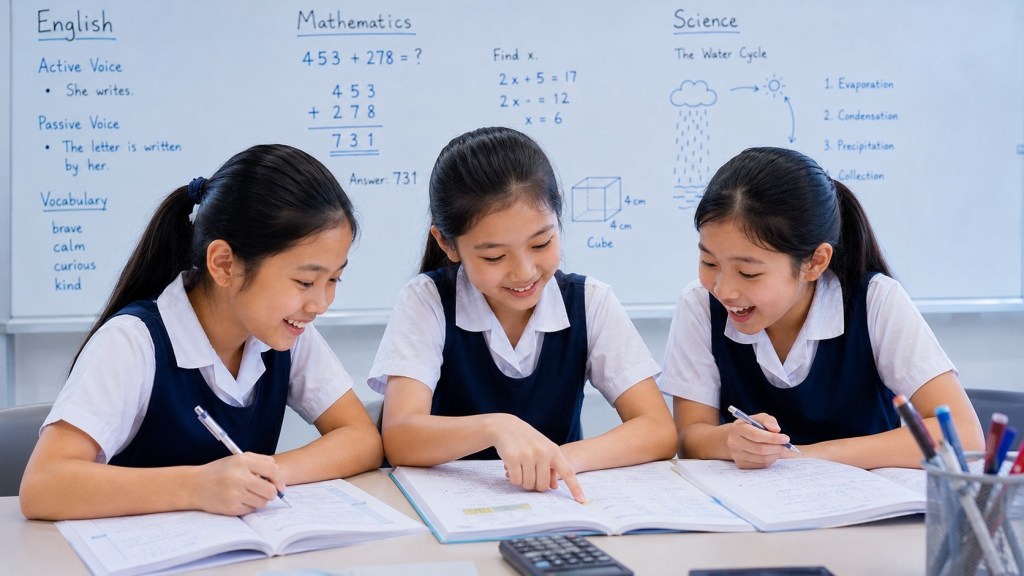
Parents searching for a Primary Science tutor in Sengkang often compare PSLE Science tuition, life cycles, water cycle, plants, ecosystems, food chains, systems, interactions and answering techniques. These topics become difficult when students memorise sequences without understanding what causes each stage to lead to the next.
A strong Primary Science tuition programme in Sengkang should therefore help students understand cycles as repeated processes and systems as connected parts whose interactions produce outcomes. The learner should be able to reconstruct a cycle or system when the diagram, organism or context changes.
At eduKate Sengkang, cycles and systems are taught in small groups of up to three students so the tutor can see whether the first weak link lies in sequence, vocabulary, cause-and-effect, diagram interpretation or transfer.
The One-Sentence Goal
A strong Primary Science learner can identify the parts of a cycle or system, explain how they interact and predict what changes when one part is altered.
Life Cycles: Sequence With Biological Meaning
Life cycles describe how organisms grow, reproduce and produce the next generation. Students should know that different organisms can have different stages while still sharing the broad pattern of continuity across generations.
Memorising “egg → larva → pupa → adult” is useful for an insect with complete metamorphosis, but the student also needs to recognise which stages are specific to that organism.
The Water Cycle
The water cycle links evaporation, condensation, cloud formation and precipitation with collection and movement of water through the environment.
Students should connect each stage causally rather than treat the diagram as arrows to memorise.
Evaporation and Condensation
Evaporation involves liquid water changing into water vapour. Condensation involves water vapour changing back into liquid water under suitable cooling conditions.
These processes connect the water cycle to earlier heat concepts.
Plant Systems
Roots absorb water and mineral salts. Stems support and transport. Leaves capture light and exchange gases. Flowers are involved in reproduction.
Students improve when they connect structure to function instead of memorising plant-part labels separately.
Photosynthesis as a System Process
Plants use light energy, carbon dioxide and water to make food under suitable conditions. The leaves, roots, transport tissues and environment therefore form a connected system.
A change in one condition can affect the whole process.
Food Chains and Food Webs
Food chains show feeding relationships and the transfer of energy from one organism to another. Food webs show that real ecosystems contain multiple connected feeding relationships.
Students should avoid interpreting arrows as “who chases whom”. The arrows represent the direction of energy transfer in the school model.
Interdependence
Organisms depend on both living and non-living parts of their environment. Plants may depend on pollinators; animals may depend on plants for food or shelter; decomposers recycle matter.
A system question may ask what happens when one population changes. Students need to trace likely consequences without assuming every effect is immediate or absolute.
Worked System Example
If a population of insects that feed on a plant decreases sharply, the plant population may experience less feeding pressure under otherwise similar conditions. Predators that rely heavily on those insects may also have less food available.
The key is to trace relationships step by step rather than guess “everything increases” or “everything dies”.
Cycles vs One-Way Flow
Some processes cycle matter; energy flow is not the same kind of cycle. This distinction becomes important as students progress.
Water can circulate through environmental reservoirs. Energy enters ecosystems, is transferred and eventually dissipated into less useful forms.
Diagrams as Models
A cycle diagram is a simplified model. Arrows should represent a process or relationship. Students should be able to explain each arrow in words.
A Practical Systems Sequence
- Identify the system boundary.
- Name the main parts.
- Describe what each part does.
- Trace how one part affects another.
- Change one condition.
- Predict the likely consequence.
- Check the prediction against the evidence given.
Why Three Students Can Work Well
Systems questions generate useful discussion because learners often stop at different points in the causal chain. The tutor can compare explanations while requiring every student to produce a complete independent answer.
What Progress Looks Like
- Life-cycle stages are remembered with their biological roles.
- Water-cycle stages are connected causally.
- Plant structures are linked to functions.
- Food-chain arrows are interpreted correctly.
- Interdependence answers trace more than one step.
- Students distinguish cycles from one-way energy transfer.
- Unfamiliar ecosystem diagrams become easier to reconstruct.
The End Goal Is Systems Thinking
Cycles and systems become easier when students stop memorising diagrams and start explaining how parts, processes and conditions fit together.
Continue through Science Tuition Sengkang, the Primary Science Guide, or the Primary Science Open-Ended route.
