
Students can become better at the hardest questions while their examination score barely moves. The reason is often not mysterious: revision has become a search for difficulty rather than a plan for the whole distribution of marks.
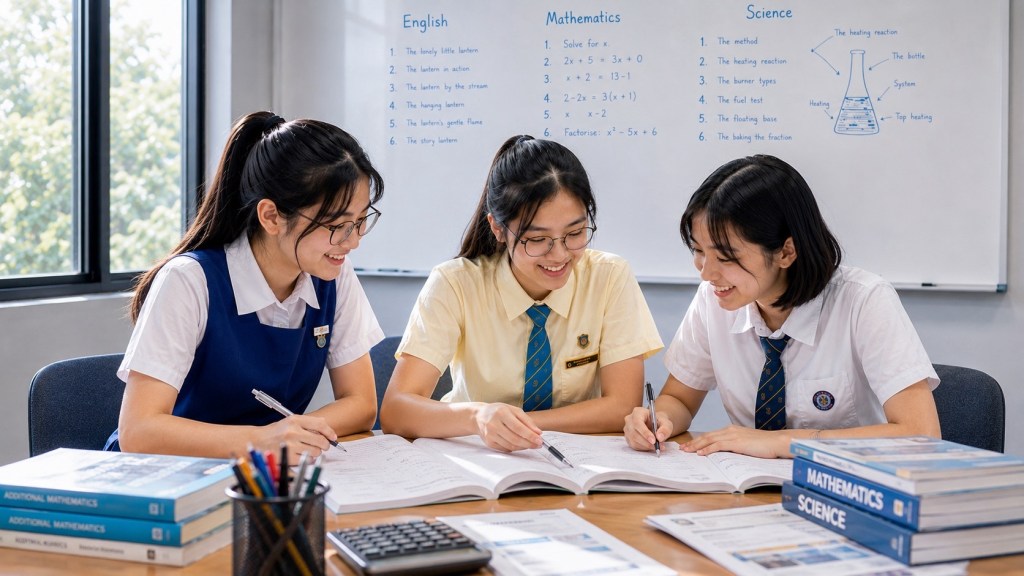
Alicia, Tricia and Kai Kai are fictional eduKate learners used to make the mechanisms visible. This article is world-facing and does not assume one examination board. Difficulty labels, mark allocations and question distributions vary, so the training decisions below should be checked against the learner’s actual syllabus and papers.
The 50-second route
Build a question portfolio, not a difficulty identity. Keep routine marks fluent, spend substantial time on medium questions that require selection and transfer, and use hard questions to stretch specific capabilities. Do not let the hardest item on a worksheet become the definition of useful revision. The practical test is always a fresh, independent question: can the learner perform the relevant operation without the worksheet title, tutor prompt or memory of the model answer? If yes, the practice can move forward. If not, the next task should repair the mechanism rather than merely increase the apparent difficulty. This keeps revision connected to evidence rather than status.
Why hard questions feel productive
Hard questions create visible struggle. They take time, generate pages of working and make revision feel serious. Easy and medium questions can feel beneath a capable learner, especially after a tutor has praised advanced work. Yet an examination score is assembled across the whole paper. A student who can solve one spectacular problem but leaks routine marks has not converted difficulty into reliable performance. The practical test is always a fresh, independent question: can the learner perform the relevant operation without the worksheet title, tutor prompt or memory of the model answer? If yes, the practice can move forward. If not, the next task should repair the mechanism rather than merely increase the apparent difficulty. This keeps revision connected to evidence rather than status.
The ordinary-mark leak
Alicia can solve extension algebra but drops signs in routine equations. Tricia writes sophisticated essays but misses one required content point. Kai Kai tackles the hardest science application while forgetting a basic unit. These fictional learners show the same mechanism: attention follows prestige rather than expected examination value. The practical test is always a fresh, independent question: can the learner perform the relevant operation without the worksheet title, tutor prompt or memory of the model answer? If yes, the practice can move forward. If not, the next task should repair the mechanism rather than merely increase the apparent difficulty. This keeps revision connected to evidence rather than status.
Difficulty is not one dimension
A question can be hard because knowledge is unfamiliar, because several steps must be coordinated, because wording is dense, because time is short or because the representation is unusual. Labeling everything easy, medium or hard hides these causes. Revision should ask what capability the question demands. The practical test is always a fresh, independent question: can the learner perform the relevant operation without the worksheet title, tutor prompt or memory of the model answer? If yes, the practice can move forward. If not, the next task should repair the mechanism rather than merely increase the apparent difficulty. This keeps revision connected to evidence rather than status.
Routine fluency is infrastructure
Routine work should not consume the entire timetable, but it must remain available. Basic algebra, core vocabulary, standard definitions, common graph readings and familiar answer forms reduce cognitive load when they are fluent. If these decay, advanced questions become harder for reasons unrelated to the advanced idea. The practical test is always a fresh, independent question: can the learner perform the relevant operation without the worksheet title, tutor prompt or memory of the model answer? If yes, the practice can move forward. If not, the next task should repair the mechanism rather than merely increase the apparent difficulty. This keeps revision connected to evidence rather than status.
Medium questions often reveal transfer
Medium questions are frequently where the learner must recognise a known method without being told exactly what to use. They can expose whether learning travels beyond the worked example. A student who skips this layer may move from blocked drills straight to exotic challenge and never stabilise independent selection. The practical test is always a fresh, independent question: can the learner perform the relevant operation without the worksheet title, tutor prompt or memory of the model answer? If yes, the practice can move forward. If not, the next task should repair the mechanism rather than merely increase the apparent difficulty. This keeps revision connected to evidence rather than status.
Hard questions should have a job
Before doing a hard question, name the training purpose. Is it unfamiliar application, multi-step planning, proof, synthesis, evaluation or endurance? If the answer is simply “because it is hard,” the task may be prestige practice rather than targeted practice. The practical test is always a fresh, independent question: can the learner perform the relevant operation without the worksheet title, tutor prompt or memory of the model answer? If yes, the practice can move forward. If not, the next task should repair the mechanism rather than merely increase the apparent difficulty. This keeps revision connected to evidence rather than status.
Use marks and syllabus coverage carefully
Past papers and specifications can show what kinds of demands exist, but one paper does not guarantee the next distribution. Do not invent a precise expected return for each topic. Use official assessment information, school guidance and several papers to understand the range, then combine that with the learner’s error pattern. The practical test is always a fresh, independent question: can the learner perform the relevant operation without the worksheet title, tutor prompt or memory of the model answer? If yes, the practice can move forward. If not, the next task should repair the mechanism rather than merely increase the apparent difficulty. This keeps revision connected to evidence rather than status.
Mathematics: protect first moves
A learner can spend an hour on olympiad-style or extension questions while becoming slower at ordinary first moves. Include mixed standard questions where the method is not labelled. Require correct setup, efficient execution and final-answer completion before treating the foundation as maintained. The practical test is always a fresh, independent question: can the learner perform the relevant operation without the worksheet title, tutor prompt or memory of the model answer? If yes, the practice can move forward. If not, the next task should repair the mechanism rather than merely increase the apparent difficulty. This keeps revision connected to evidence rather than status.
Science: protect causal basics
Advanced science application depends on core relationships. A difficult unfamiliar context is useful only if the learner can still identify variables, read data, state relevant principles and connect cause to effect. If those operations are unstable, more exotic contexts may produce noise rather than useful stretch. The practical test is always a fresh, independent question: can the learner perform the relevant operation without the worksheet title, tutor prompt or memory of the model answer? If yes, the practice can move forward. If not, the next task should repair the mechanism rather than merely increase the apparent difficulty. This keeps revision connected to evidence rather than status.
English: protect task fulfilment
A sophisticated vocabulary choice cannot rescue an essay that misses purpose or required content. Advanced interpretation cannot replace accurate evidence selection. Keep high-level writing ambitions, but maintain the ordinary architecture that earns credit: relevance, development, control and completion under the actual criteria. The practical test is always a fresh, independent question: can the learner perform the relevant operation without the worksheet title, tutor prompt or memory of the model answer? If yes, the practice can move forward. If not, the next task should repair the mechanism rather than merely increase the apparent difficulty. This keeps revision connected to evidence rather than status.
The confidence trap
Some strong students avoid ordinary questions because mistakes there feel embarrassing. A hard question offers psychological protection: failure can be blamed on difficulty. A routine error feels like evidence that the student is not as strong as believed. This can quietly bias practice toward impressive tasks and away from diagnostic ones. The practical test is always a fresh, independent question: can the learner perform the relevant operation without the worksheet title, tutor prompt or memory of the model answer? If yes, the practice can move forward. If not, the next task should repair the mechanism rather than merely increase the apparent difficulty. This keeps revision connected to evidence rather than status.
The tutor trap
Tutors can contribute by continually escalating difficulty to demonstrate value. Challenge is useful, but a lesson should not become a performance of how hard the tutor can make the worksheet. The relevant standard is what improves the learner’s independent future performance. The practical test is always a fresh, independent question: can the learner perform the relevant operation without the worksheet title, tutor prompt or memory of the model answer? If yes, the practice can move forward. If not, the next task should repair the mechanism rather than merely increase the apparent difficulty. This keeps revision connected to evidence rather than status.
The parent trap
Parents may equate difficult-looking work with advanced tuition. A page full of dense questions looks valuable. Ask instead what capability the work is training and what evidence shows the learner can still secure ordinary marks independently. The practical test is always a fresh, independent question: can the learner perform the relevant operation without the worksheet title, tutor prompt or memory of the model answer? If yes, the practice can move forward. If not, the next task should repair the mechanism rather than merely increase the apparent difficulty. This keeps revision connected to evidence rather than status.
Build a three-band practice set
Use three practical bands: secure/routine, selection/transfer, and stretch. The proportions should change with the learner and exam runway. There is no universal 20-60-20 formula. The important feature is that no band disappears without evidence. The practical test is always a fresh, independent question: can the learner perform the relevant operation without the worksheet title, tutor prompt or memory of the model answer? If yes, the practice can move forward. If not, the next task should repair the mechanism rather than merely increase the apparent difficulty. This keeps revision connected to evidence rather than status.
Start with a calibration sample
Before allocating the week, use a small mixed sample. If routine accuracy is high and fast, maintenance can remain small. If medium selection fails, increase mixed practice. If both are stable, hard application can occupy more time. Let performance determine the portfolio. The practical test is always a fresh, independent question: can the learner perform the relevant operation without the worksheet title, tutor prompt or memory of the model answer? If yes, the practice can move forward. If not, the next task should repair the mechanism rather than merely increase the apparent difficulty. This keeps revision connected to evidence rather than status.
Do not overtrain easy work
The answer is not to retreat into endless easy questions. Once a routine is reliably fluent, reduce dedicated volume. Keep occasional maintenance and use the released time for selection and stretch. Easy work should protect infrastructure, not become avoidance. The practical test is always a fresh, independent question: can the learner perform the relevant operation without the worksheet title, tutor prompt or memory of the model answer? If yes, the practice can move forward. If not, the next task should repair the mechanism rather than merely increase the apparent difficulty. This keeps revision connected to evidence rather than status.
Do not overtrain hard work
Likewise, a learner should not collect difficult questions without analysing them. After each hard item, identify the decisive move and test it in a changed problem. Otherwise the student may remember one clever solution rather than acquire a reusable capability. The practical test is always a fresh, independent question: can the learner perform the relevant operation without the worksheet title, tutor prompt or memory of the model answer? If yes, the practice can move forward. If not, the next task should repair the mechanism rather than merely increase the apparent difficulty. This keeps revision connected to evidence rather than status.
Question difficulty can be learner-specific
A question that is routine for one student may be difficult for another because prerequisites differ. Use observed performance rather than publisher labels alone. Commercial difficulty ratings can be helpful for browsing but do not replace learner evidence. The practical test is always a fresh, independent question: can the learner perform the relevant operation without the worksheet title, tutor prompt or memory of the model answer? If yes, the practice can move forward. If not, the next task should repair the mechanism rather than merely increase the apparent difficulty. This keeps revision connected to evidence rather than status.
Timed papers reveal the portfolio
A full paper shows whether advanced ability coexists with routine reliability. Inspect where marks disappear. If the student loses ordinary marks early and then solves a hard final question, celebrate the hard success while still repairing the score architecture. The practical test is always a fresh, independent question: can the learner perform the relevant operation without the worksheet title, tutor prompt or memory of the model answer? If yes, the practice can move forward. If not, the next task should repair the mechanism rather than merely increase the apparent difficulty. This keeps revision connected to evidence rather than status.
A weekly architecture
One session can repair a current weak link, another can mix standard and medium transfer, and a short stretch block can target advanced application. Larger paper practice later checks coexistence. This is an example architecture, not a compulsory schedule. The practical test is always a fresh, independent question: can the learner perform the relevant operation without the worksheet title, tutor prompt or memory of the model answer? If yes, the practice can move forward. If not, the next task should repair the mechanism rather than merely increase the apparent difficulty. This keeps revision connected to evidence rather than status.
Use an error budget
After a paper, classify losses into routine execution, method selection, unfamiliar application, answer form and time. If routine losses are large, hard-question volume may not be the next priority. If routine and selection are stable, advanced work becomes more defensible. The practical test is always a fresh, independent question: can the learner perform the relevant operation without the worksheet title, tutor prompt or memory of the model answer? If yes, the practice can move forward. If not, the next task should repair the mechanism rather than merely increase the apparent difficulty. This keeps revision connected to evidence rather than status.
Stop using difficulty as identity
Students should not become “the hard-question child” or “the easy-question child.” Difficulty is a property of a task relative to current capability. As learning changes, the training mix should change. The practical test is always a fresh, independent question: can the learner perform the relevant operation without the worksheet title, tutor prompt or memory of the model answer? If yes, the practice can move forward. If not, the next task should repair the mechanism rather than merely increase the apparent difficulty. This keeps revision connected to evidence rather than status.
Alicia, Tricia and Kai Kai
Alicia keeps extension algebra but adds mixed standard maintenance. Tricia preserves sophisticated writing while checking task fulfilment on ordinary prompts. Kai Kai uses hard science applications only after core data and explanation routines remain stable. Their routes differ because their leaks differ. The practical test is always a fresh, independent question: can the learner perform the relevant operation without the worksheet title, tutor prompt or memory of the model answer? If yes, the practice can move forward. If not, the next task should repair the mechanism rather than merely increase the apparent difficulty. This keeps revision connected to evidence rather than status.
Final distinction
Hard questions are valuable when they stretch a capability the learner is ready to stretch. Ordinary questions are valuable when they protect reliable marks and reveal whether core knowledge remains selectable under exam conditions. The goal is not maximum difficulty. It is maximum useful learning that survives the whole paper. The practical test is always a fresh, independent question: can the learner perform the relevant operation without the worksheet title, tutor prompt or memory of the model answer? If yes, the practice can move forward. If not, the next task should repair the mechanism rather than merely increase the apparent difficulty. This keeps revision connected to evidence rather than status.
Evidence and further reading
Apex exam-preparation resources commonly organise practice by difficulty and encourage learners to review mistakes rather than simply complete questions. That supports using difficulty deliberately, but it does not establish one universal practice ratio. Continue through the Complete Examination Craft Index and Learning Runtime Hub.
The medium-question blind spot
Students often classify medium questions as neither reassuring nor impressive. That makes them easy to neglect. Yet this band frequently requires the exact examination behaviour that topical drills hide: recognising which familiar idea applies, selecting relevant information, coordinating two or three steps and finishing without a tutor cue. Build medium questions from several nearby topics and remove the chapter heading. Ask the learner to name the decisive feature only after they have attempted the item, so the explanation reflects their decision rather than becoming another prompt. If medium accuracy rises while routine accuracy remains stable, the practice mix is doing a different job from simply escalating difficulty.
When hard practice becomes answer collecting
A learner can accumulate difficult worked solutions without accumulating transferable decisions. The page fills with elegant methods, but the next unfamiliar question still feels new. After a hard problem, close the solution and ask three things: what made the problem difficult, what move unlocked it, and what change to the problem would make that move inappropriate? Then return later with a fresh problem sharing the deep structure but not the surface story. This converts a memorable solution into a candidate principle. If the learner can only recognise the method after seeing the original diagram or numbers, more exposure to the same answer is unlikely to be the highest-value next step.
The ordinary-question speed reserve
Routine questions also create a time reserve. When core operations are accurate and reasonably fluent, the student can spend more of the paper on unfamiliar work. If ordinary questions require prolonged reconstruction, the student pays twice: first through direct errors and then through reduced time for harder items. Measure this without glorifying speed. The target is efficient, accurate performance at a pace appropriate to the assessment, not racing. A learner who is slow because they are still reasoning carefully may need fluency practice; a learner who is fast and inaccurate needs a different repair. Time is useful evidence only when read beside correctness and method.
The false ceiling problem
Sometimes students move to very hard material because standard work no longer discriminates among their strengths. That can be appropriate. The danger is assuming that success on advanced work means every lower-level component is permanently secure. Maintenance can be small: a mixed starter, a short retrieval set, or ordinary questions embedded inside a full paper. The point is to detect regression before it becomes expensive. This is especially important when advanced practice uses calculators, reference sheets or scaffolds that ordinary components may not permit. Different task conditions can expose different weaknesses even within the same broad subject.
Difficulty and motivation
Challenge can increase engagement when it is meaningful and attainable, but difficulty can also become theatre. Some students enjoy the identity of tackling the hardest material and resist ordinary practice because it feels less prestigious. Others are demoralised by repeated stretch tasks and need visible evidence of growing competence. Do not prescribe challenge from personality labels. Observe what the work is doing. A good stretch task should create a teachable next move, not merely prove that the tutor owns difficult questions. Motivation matters because a plan that the learner cannot sustain will not deliver enough high-quality practice to reveal whether the underlying design was sound.
The exam-board boundary
Question difficulty is partly constructed by the assessment. Command words, permitted resources, mark schemes, calculator rules and expected depth vary. A problem described as advanced on one commercial platform may not correspond to the learner’s examination. Use official specifications and specimen material to anchor the practice. AQA, for example, publishes subject-specific command-word guidance, illustrating that the required response depends on the command and subject context. The general lesson is not to copy one board’s definitions worldwide; it is to make difficulty subordinate to the actual assessed job.
A four-question calibration drill
Choose four fresh questions: one routine, two requiring selection or transfer, and one genuine stretch item. Do not label the bands for the learner. Record first move, accuracy, independence and time only as needed. If the routine item fails, inspect the foundation. If routine succeeds but selection fails, mixed discrimination is the priority. If both succeed and the stretch item fails, the learner may be ready for advanced teaching without needing to restart earlier material. Four questions cannot certify a whole subject, but they can improve the next decision more than another hour chosen solely by perceived difficulty.
What to do after a hard-question failure
Do not immediately assign five more hard questions. Locate the failure. Was the prerequisite missing? Was the method unknown? Was the method known but not selected? Did the learner fail to coordinate steps? Did the final answer violate a condition? Each cause suggests a different follow-up. A narrow prerequisite repair may be faster than repeating the whole challenge. A selection problem may need contrasting medium questions. A coordination problem may benefit from subgoals before recombination. The hard question is valuable diagnostically when it reveals where the system breaks, not merely because it produces a low score.
What to do after a hard-question success
Success also needs interpretation. Was the question genuinely fresh? Did the learner receive a hint? Was the method recently rehearsed? Can they explain the decisive move and use it again after a delay? A correct answer can be strong evidence without being unlimited evidence. Celebrate it, then decide whether the capability should be maintained, varied or integrated into a full paper. Do not automatically escalate again. Constantly raising difficulty can prevent consolidation and create a curriculum of perpetual novelty in which nothing is allowed to become reliable.
The three-student lesson
In a three-student tutorial, one learner may need routine maintenance, another medium transfer and another stretch on the same broad topic. Keeping the group together does not require identical questions every minute. A common explanation can branch into appropriately demanding practice and return for comparison. The important safeguard is that the fastest learner does not become the default standard for everyone else. Difficulty should be matched to the current learning job. The group can share reasoning without turning one student’s advanced question into evidence that the others are behind.
Parents reading a worksheet
A worksheet’s appearance is weak evidence of educational value. Dense notation, long passages and large numbers can make material look advanced while testing familiar operations. Conversely, a short question can demand difficult discrimination or explanation. Parents should ask what the learner had to decide independently, what was new, what remained stable and what the next fresh check will test. This shifts attention from visual complexity to learning function. It also reduces pressure on tutors to perform difficulty for adults rather than design practice for the child.
The revision-week decision
Near an examination, the practice portfolio should respond to evidence and remaining time. There may be little value in opening a completely new family of exotic problems if ordinary and medium marks are still unstable. Equally, a learner whose core paper is reliable may benefit from selected stretch work that increases flexibility. Protect sleep and sustainable workload. The final week is not a contest to consume the hardest resources available. It is a period for making the capabilities most likely to be needed accessible, accurate and deployable under the actual conditions.
After the examination
Do not judge the practice mix from one headline score alone. Inspect which bands of questions improved, which deteriorated and whether paper difficulty or coverage changed. A flat total can hide gains in stretch questions and losses in routine marks, or the reverse. Use the marked script to update the portfolio. If hard-question success rose while ordinary leakage also rose, preserve the advanced gain and restore maintenance. Improvement does not require choosing one side permanently.
Choose the guide that matches the learning difficulty
This article does not replace the existing guides on interleaving, practice design, revision, maintenance or examination craft. Its focus is narrower: preventing challenge-seeking from distorting the distribution of practice. When the problem is method selection, follow the method-selection route. When the problem is a fading strong topic, use the maintenance article. When the problem is whole-paper pacing, use Examination Craft. Choosing the guide that matches the difficulty makes the next step more useful.
A final planning template
Write three columns: must stay reliable, must become selectable, and ready to stretch. Put capabilities, not chapter prestige, into the columns. Choose fresh tasks that test each job. Review the plan after real evidence rather than after a fixed number of worksheets. A capability can move from stretch to selectable to maintenance as it improves. Another can move backwards if it fades. This simple architecture keeps the learner’s entire examination system visible while still allowing ambitious advanced work.
