
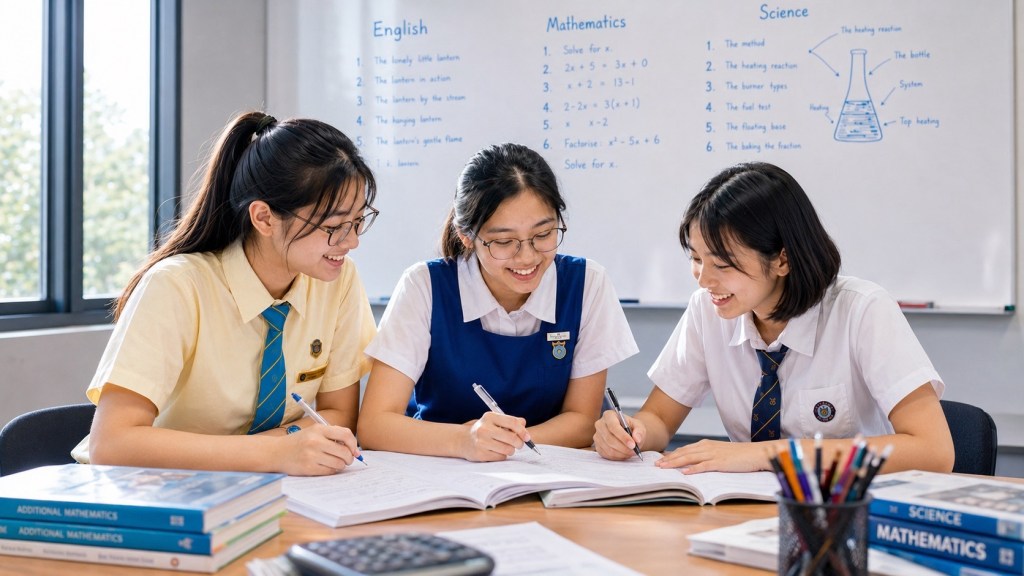
Parents searching for a Secondary English tutor in Sengkang often compare English tuition, comprehension, Paper 2 skills, summary, vocabulary in context, literal and inferential questions, language-use questions and exam technique. Those terms describe the visible components, but they do not identify the first point at which the student’s reading becomes unreliable. A learner may understand the passage generally yet miss an inference, misread tone, choose weak evidence or write an answer that never quite matches the question.
Good Secondary English tuition in Sengkang should make those reading operations visible. Comprehension is not one mysterious talent. It involves building an accurate model of the text, tracking viewpoint, resolving reference, reading vocabulary in context, separating fact from implication, identifying language effects, selecting evidence and expressing the answer with the degree of precision the question requires.
At eduKate Sengkang, Secondary English comprehension is taught in small groups of up to three students. That creates enough discussion for different interpretations to surface while keeping the class small enough for the tutor to inspect each written response closely. One student may infer correctly for the wrong reason. Another may quote relevant evidence but fail to explain it. A third may understand everything orally yet write vague, general answers. The teaching starts with the actual failure rather than the broad label “weak comprehension”.
The One-Sentence Goal
A strong Secondary comprehension learner can determine what a text says, what it implies, how its language shapes meaning, which evidence supports an interpretation and how to express that interpretation precisely.
Why Secondary Comprehension Feels Different From Primary Comprehension
The shift into Secondary English is not simply “longer passages”. Texts become denser, viewpoints less explicit and language choices more consequential. A sentence may do more than report an event; it may position the reader, reveal attitude, create irony, soften criticism or imply something that is never directly stated.
Students must also manage a wider range of text types. Narrative, personal reflection, informational writing, commentary, persuasion and multimodal material can require different reading moves.
This means the learner needs a larger internal toolkit. Retrieval is still important, but retrieval alone no longer covers the whole job.
What “Weak in Comprehension” Can Actually Mean
| Visible problem | Possible first weak link | What we investigate |
|---|---|---|
| Answers retell the passage | Question-type recognition | Does the student know whether the task asks for retrieval, inference, effect or evaluation? |
| Inference answers feel like guesses | Evidence linkage | Can the learner identify the exact clues that justify the conclusion? |
| Vocabulary questions rely on dictionary meaning | Context reading | Can the learner use syntax, nearby clues, contrast and tone? |
| Language-effect answers name a device only | Effect reasoning | Can the student explain what the wording makes the reader understand, imagine or feel? |
| Correct idea but weak mark | Answer precision | Is the response too broad, too vague or missing the relationship requested? |
| Summary lifts too much | Selection and paraphrase | Can the learner identify the required points and compress them without changing meaning? |
| Performance collapses on unfamiliar texts | Transfer | Has the student learned a reading operation or only practised familiar question surfaces? |
Literal Reading Is the Floor, Not the Ceiling
Every strong interpretation begins with accurate literal reading. Students need to know who did what, when, where and under what conditions before they can infer motive or effect.
Problems arise when learners move to interpretation before securing the text. If a student misidentifies the speaker or misses a time shift, even sophisticated reasoning may be built on the wrong event.
We therefore treat literal accuracy as the foundation from which deeper reading grows.
Inference: Conclusion Plus Evidence
Inference is often taught as “read between the lines”. That phrase is memorable but incomplete. A useful inference is a conclusion supported by clues in the text and by ordinary reasoning.
Consider:
When the principal entered, Marcus slid the folded note beneath his workbook and suddenly became interested in the timetable pinned to the wall.
A plausible inference is that Marcus did not want the principal to notice the note. The evidence is behavioural: he hides it and redirects his attention. A much stronger claim—such as “Marcus had cheated”—would go beyond what the sentence supports.
We train students to keep inference proportional to evidence.
A Three-Part Inference Check
- What is directly stated?
- What conclusion follows from those details?
- Which exact words or actions make that conclusion reasonable?
If a student cannot answer the third question, the inference may be guesswork.
Vocabulary in Context: Meaning Is Local
Secondary comprehension frequently asks students to understand a word or phrase according to how it functions in the passage. Dictionary knowledge helps, but context decides.
The word “sharp” can describe a blade, a turn, a pain, a mind, a tone or a sudden change. A student who retrieves only the most familiar definition may miss the intended meaning.
We teach students to use:
- the grammar around the word;
- nearby examples and contrasts;
- cause-and-effect relationships;
- the speaker’s attitude;
- the wider paragraph purpose;
- the emotional or evaluative tone.
The answer should fit the sentence, not merely belong in the same dictionary entry.
Language Effect: Naming the Device Is Not Enough
Students sometimes treat language-effect questions as a hunt for labels: metaphor, simile, personification, repetition. Identifying a device can be useful, but the question usually asks what the wording does.
If a writer says “the corridor swallowed the last of the daylight”, simply writing “personification” does not explain the effect. The learner may need to show that the corridor is presented as dark, enclosing or ominous, making the loss of light feel active rather than neutral.
A practical route is:
Word or image → literal picture created → implied quality or attitude → effect on the reader’s understanding.
Worked Example: Language Effect
Sentence: “The applause limped across the hall and died before reaching the stage.”
A weak answer might say, “This is personification and shows the applause was bad.”
A stronger answer explains the wording. “Limped” suggests the applause was weak and uneven, while “died” suggests it faded quickly. Together, the words make the audience’s response seem reluctant and unenthusiastic.
The improvement comes from unpacking the image, not from adding more literary terminology.
Pronoun and Reference Tracking
Dense passages often rely on pronouns, demonstratives and compressed references: he, she, they, this, that, such a decision, these concerns. Students who lose track of reference can misread whole paragraphs.
We teach a simple habit: replace the pronoun mentally with the noun phrase it refers to. If the sentence stops making sense, re-check the reference.
This sounds elementary, but it becomes especially important when several people, viewpoints or ideas appear close together.
Tone and Attitude: Read the Pattern, Not One Word
Students may be asked to identify a speaker or writer’s attitude. Tone rarely sits inside a single adjective. It is built from a pattern of diction, punctuation, contrast, exaggeration, understatement and selection.
For instance, a writer who repeatedly uses words such as “apparently”, “supposedly” and “conveniently” may be signalling scepticism. The student should not pick “sarcastic” simply because one sentence sounds sharp. The evidence across the passage needs to support the tone label.
Fact, Claim, Evidence and Opinion
Secondary readers increasingly need to distinguish what a text reports from what it argues.
- Fact: a claim presented as verifiable information.
- Opinion: a judgement or belief.
- Evidence: information used to support a claim.
- Inference: a conclusion drawn from information.
- Assertion: a claim stated without necessarily providing support.
These distinctions help students read persuasive and informational texts more critically. A confident sentence is not automatically well supported.
Question Command Words Matter
Comprehension marks are often lost because the student answers a nearby question rather than the one asked.
- Why usually requires a reason or cause.
- How may require a process, method or language effect.
- What suggests points toward evidence and inference.
- In your own words may require paraphrase rather than lifting.
- Compare requires a relationship between at least two items.
- Explain the effect requires more than device identification.
We ask students to paraphrase the question before answering. If they cannot explain the task in simpler words, they may not yet be ready to search the passage.
Answer Precision: Do Not Make the Marker Finish the Thought
A student may have the correct idea but express it too vaguely.
Vague: “It shows he was affected.”
More precise: “His repeated checking of the door suggests he was anxious for someone to arrive.”
The stronger answer names the subject, identifies the evidence and states the specific inference.
Lifting and Paraphrasing
Some questions allow or require students to use words from the passage. Others require the idea to be expressed independently. The learner needs to distinguish these situations rather than follow a blanket rule such as “never lift”.
Paraphrasing is not swapping every word for a synonym. It is reconstructing the meaning in a different form without changing the relationship.
If the original says, “The committee postponed the launch because the safety review remained incomplete,” a good paraphrase preserves cause and sequence. Replacing words individually while losing the causal link is not improvement.
Summary: Selection Before Compression
Summary work exposes whether the student can distinguish central points from supporting detail. Students who begin paraphrasing before deciding what belongs often spend too many words on minor information.
A practical route is:
- Identify the exact summary focus.
- Locate candidate points.
- Remove examples, repetition and decoration unless they are themselves points.
- Combine overlapping ideas.
- Paraphrase carefully.
- Check the required limit and meaning.
Compression comes after selection.
Worked Example: Inference and Evidence
Passage fragment: “Nadia read the message twice. She typed a reply, deleted it, placed the phone face down and joined the others at the table without speaking.”
Question: What does Nadia’s behaviour suggest about her reaction to the message?
A reasonable inference is that the message unsettled her or left her uncertain about how to respond. The evidence lies in the repeated reading, deleted reply, deliberate putting away of the phone and silence. A claim that she was definitely angry would be possible but not strongly established by the fragment alone.
The teaching point is the evidence boundary: interpret, but do not overclaim.
Why Three Students Can Work Well for Comprehension
Comprehension benefits from comparison when the class is small enough for accountability. Three students may reach different interpretations. The tutor can ask each learner to defend the interpretation with textual evidence.
- Every learner can explain an answer aloud.
- Different evidence choices become visible.
- Weak inferences can be challenged respectfully.
- Students hear concise and overlong answer versions.
- The tutor can inspect written phrasing closely.
- Participation is frequent without becoming performance theatre.
- Individual transfer questions can still be assigned.
A Practical Lesson Sequence
- Read: build an accurate literal model of the passage.
- Map: track speaker, viewpoint, reference and paragraph purpose.
- Classify: identify the question type.
- Locate: find the relevant textual evidence.
- Reason: build the inference or language explanation.
- Write: answer with the required level of precision.
- Check: compare the answer against the exact wording of the question.
- Correct: name the error category.
- Transfer: apply the same reading operation to a fresh text.
Correction Categories We Use
- literal misread;
- reference error;
- wrong question type;
- evidence too weak;
- inference too large;
- language effect reduced to device label;
- tone label unsupported;
- dictionary meaning used instead of contextual meaning;
- answer too vague;
- lifting where paraphrase is required;
- summary selection error;
- transfer failure on a new passage.
This is more useful than writing “comprehension weak” at the top of a paper.
What Progress Looks Like
- Students identify the question job before searching.
- Inference answers include stronger evidence.
- Vocabulary meanings fit the local context better.
- Language-effect answers explain the wording rather than name a device only.
- Tone judgements become less impulsive.
- Pronoun and reference mistakes decrease.
- Answers become more precise without becoming longer.
- Summary points are selected before paraphrasing.
- Corrections transfer to unfamiliar texts.
- The learner needs fewer prompts to justify an interpretation.
Secondary 1–4: The Reading Job Evolves
Secondary 1: Reorganise Primary reading
The student learns to handle longer texts, denser vocabulary, clearer paragraph roles and more explicit inference work while adjusting to Secondary English demands.
Secondary 2: Strengthen viewpoint and evidence
Students increasingly distinguish claims from support, recognise perspective and explain how language shapes interpretation.
Secondary 3: Handle denser reasoning
Texts and questions demand greater control over implication, ambiguity, language effect, argument and concise answer formulation.
Secondary 4: Integrate under examination conditions
The student must retrieve reading operations quickly, manage time and switch among question types without losing evidence discipline.
Home Practice: Read Beyond the Worksheet
Comprehension improves through deliberate practice, but wider reading also matters. Students benefit from encountering essays, news features, speeches, narratives, reviews and well-written non-fiction that expose them to different voices and structures.
Parents do not need to turn every article into a test. One useful question is enough: What is the writer trying to make the reader believe, notice or feel here? That keeps reading analytical without making it joyless.
Frequently Asked Questions
Can comprehension really be taught?
Yes. Background knowledge and reading experience matter, but many comprehension operations can be taught explicitly: inference, evidence selection, contextual vocabulary, reference tracking, question interpretation, language effect and summary.
Should students memorise answer frameworks?
Frameworks can remind learners what an answer needs, but they should not override the actual question. We teach flexible reasoning routes rather than fixed sentences.
Why does my child understand the passage but still lose marks?
General understanding may be present while answer precision is weak. The child may need help identifying the specific inference, evidence, language effect or degree of detail the question requests.
Is vocabulary the main solution?
Vocabulary helps enormously, but strong comprehension also depends on syntax, reference, inference, background knowledge, viewpoint and evidence. We treat vocabulary as part of the reading system, not the whole system.
How do you improve language-effect answers?
Students unpack the actual word or image, describe the picture or quality it creates and connect that to the writer’s intended meaning or attitude.
What should parents bring to a consultation?
A recent comprehension paper with the student’s original answers is very useful. It lets us distinguish passage-understanding problems from question-type, evidence or expression problems.
From Reading the Passage to Reading the Writer
Secondary comprehension becomes stronger when the learner stops treating the passage as a container of hidden answers and begins reading it as a constructed piece of communication. Someone selected these words, organised these details, adopted this viewpoint and created these effects.
Our job is to help the student see that construction clearly enough to answer with evidence rather than intuition alone.
Continue through English Tuition Sengkang, the Secondary English Learning Hub, or the Sengkang tuition enquiry process.
