
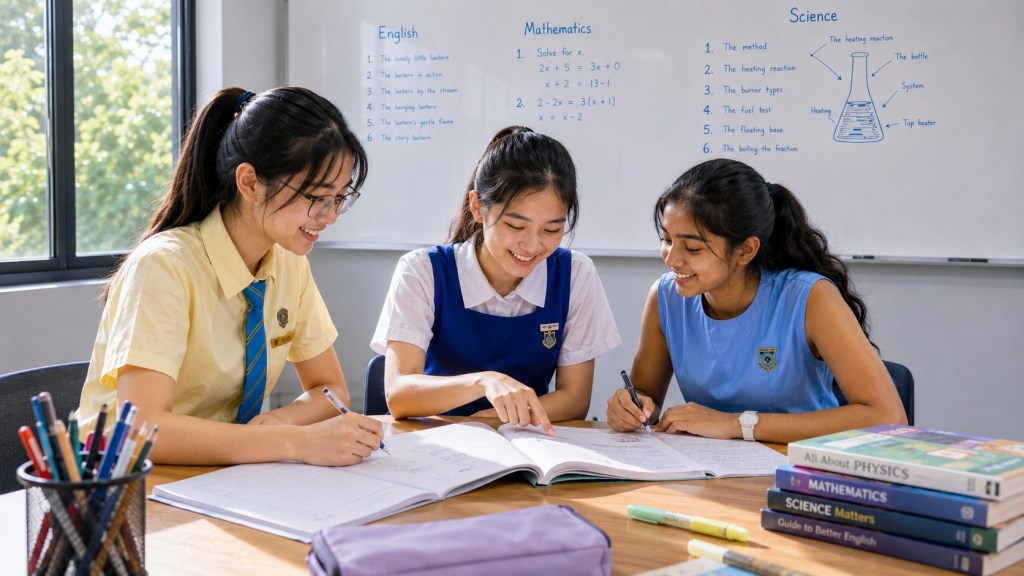
Parents searching for a Secondary Biology tutor in Sengkang often compare Biology tuition, Secondary Science tuition, cells, transport, nutrition, respiration, reproduction, genetics, ecology, practical skills and examination preparation. Biology becomes difficult when students memorise names and processes without seeing how structures, functions and systems fit together.
A strong Secondary Biology tuition programme in Sengkang should therefore teach students to connect scale: organelle → cell → tissue → organ → organ system → organism → population → ecosystem. A learner who can label a diagram but cannot explain why a structure is adapted to its function has incomplete understanding.
At eduKate Sengkang, Biology is taught in small groups of up to three students. That lets the tutor see whether the first weak link lies in vocabulary, diagram interpretation, process sequence, cause-and-effect, data reading or transfer to unfamiliar contexts. The aim is a connected model of living systems rather than a stack of facts.
The One-Sentence Goal
A strong Biology learner can connect structure to function, process to consequence and evidence to explanation across levels of organisation.
Biology Is a Systems Subject
Biology often appears to contain many separate topics, but the same ideas recur: exchange, transport, regulation, energy, reproduction, variation and interaction.
For example, transport appears in cell membranes, blood circulation, xylem and phloem, gas exchange and nutrient movement. Students improve when they recognise the shared job—moving substances from where they are to where they are needed.
What “Weak in Biology” Can Actually Mean
| Visible problem | Possible first weak link | What we investigate |
|---|---|---|
| Diagram labels are memorised but explanations are weak | Structure-function reasoning | Can the learner explain why the structure helps the function? |
| Processes are listed out of order | Sequence model | Can the student trace inputs, transformations and outputs? |
| Transport topics blur together | Scale and mechanism | Can the learner distinguish diffusion, osmosis, active transport and bulk flow? |
| Data questions feel unrelated to the chapter | Evidence interpretation | Can the student read tables and graphs before recalling theory? |
| Long answers contain many facts but miss the question | Relevance control | Can the learner select the mechanism required by this scenario? |
| Genetics becomes symbol manipulation | Inheritance model | Can the student connect alleles, genotype and phenotype? |
| New examples cause panic | Transfer | Has the learner understood a biological principle rather than a named case? |
Cells: Structure Supports Function
Cell biology is strongest when students move beyond labelling. A red blood cell’s shape, lack of nucleus in mature mammalian cells and haemoglobin content relate to oxygen transport. A root hair cell’s extended surface helps absorption. A palisade cell’s chloroplast-rich structure supports photosynthesis.
The useful question is: How does this feature help the cell perform its job?
Diffusion and Osmosis: Define the Moving Substance
Students often confuse diffusion and osmosis because both involve movement down a concentration-related gradient.
Diffusion describes net movement of particles from a region of higher concentration to lower concentration. Osmosis specifically concerns water moving through a partially permeable membrane according to water potential or concentration conditions at the level taught.
We ask: what substance is moving, across what boundary, and in which direction?
Transport in Humans
The circulatory system makes more sense when students follow a route. Blood moves between heart, lungs and body tissues. Different vessels are adapted to pressure, exchange and return flow.
Instead of memorising arteries and veins as isolated definitions, students compare wall thickness, lumen, valves and pressure in relation to function.
Gas Exchange: Surface Area, Distance and Gradient
Efficient gas exchange surfaces share recurring principles: large surface area, short diffusion distance and maintained gradients. These ideas connect lungs, leaves and other exchange systems.
Nutrition and Digestion
Digestion is not simply “breaking food down”. Large insoluble molecules are converted into smaller soluble molecules that can be absorbed. Enzymes accelerate specific chemical reactions under suitable conditions.
Students should connect enzyme specificity, temperature, pH and substrate to the biological purpose of digestion.
Respiration: Release of Usable Energy
Respiration is often confused with breathing. Breathing ventilates gas-exchange surfaces; cellular respiration releases usable energy from chemical substrates through biochemical processes.
Keeping the levels separate prevents a common language error.
Photosynthesis: Matter and Energy
Photosynthesis converts light energy into chemical energy stored in organic molecules, using carbon dioxide and water under suitable conditions. Students need to distinguish raw materials, conditions and products.
Questions about limiting factors become easier when the learner asks which required factor is currently restricting the process.
Homeostasis: Regulation Around Useful Ranges
Living systems regulate internal conditions. Temperature, blood glucose, water balance and other variables may be controlled through feedback mechanisms at the syllabus level.
Students should identify sensor, control process and effector where appropriate rather than memorise the word “homeostasis” alone.
Reproduction and Inheritance
Inheritance becomes clearer when students distinguish gene, allele, chromosome, genotype and phenotype.
Genetic diagrams are not just symbol exercises. They model how allele combinations can produce different offspring probabilities under simplified inheritance assumptions.
Variation and Natural Selection
Variation exists within populations. When heritable variation affects survival or reproduction under particular environmental conditions, allele frequencies can change over generations.
Students should avoid teleological language such as “organisms change because they need to”. Selection acts on existing variation; individuals do not redesign themselves intentionally.
Ecology: Follow Matter and Energy Through Systems
Food chains, food webs, nutrient cycles and population relationships become more coherent when students trace energy flow and matter cycling.
Energy transfer between trophic levels is not perfectly efficient. Matter may be recycled; energy is progressively dissipated into less useful forms.
Biology Data Questions
Students should read graph axes, units and trends before explaining them. If a graph shows enzyme activity increasing to an optimum and then falling, the student first describes the pattern, then applies biological knowledge.
Practical Biology: Variables and Evidence
Investigations may involve rate of photosynthesis, enzyme activity, diffusion, transpiration or ecological sampling. The same experimental logic applies: identify variables, control relevant factors, measure consistently and interpret evidence proportionately.
A Practical Answer Sequence
- Identify: what biological system or process is involved?
- Locate: what condition or evidence in the question matters?
- Explain: state the relevant mechanism.
- Connect: show how the mechanism produces the observed outcome.
- Check: make sure the claim does not exceed the evidence.
- Transfer: test the same principle in a new organism or context.
Why Three Students Can Work Well for Biology
Biology explanations benefit from comparison. One student may remember the structure, another the process and another the evidence. The tutor can connect them into one complete mechanism while every learner remains responsible for an independent explanation.
What Progress Looks Like
- Diagrams are explained through function rather than labels alone.
- Processes are sequenced more reliably.
- Diffusion and osmosis are distinguished by what moves and where.
- Transport systems are understood as routes.
- Respiration and breathing are less frequently confused.
- Genetics diagrams connect symbols to inheritance.
- Data answers describe before explaining.
- Ecology answers track matter and energy more carefully.
- Unfamiliar organisms are approached through known principles.
Frequently Asked Questions
Why does Biology feel like so much memorisation?
There is vocabulary to learn, but facts become easier to retain when connected through structure-function, systems and cause-and-effect relationships.
How do you teach long-answer questions?
We identify the biological mechanism, connect each step causally and remove unrelated facts. Complete does not mean unnecessarily long.
What should parents bring to a consultation?
A recent Biology or Secondary Science paper is ideal, especially questions with diagrams, data and written explanations.
The End Goal Is Systems Thinking
Biology becomes more manageable when students stop seeing cells, organs, genetics and ecosystems as unrelated chapters and begin seeing recurring principles across living systems.
Continue through Biology & Living Systems, the Secondary & Post-Secondary Science route, the Secondary Science Experimental Skills route, or the Sengkang tuition enquiry process.
