
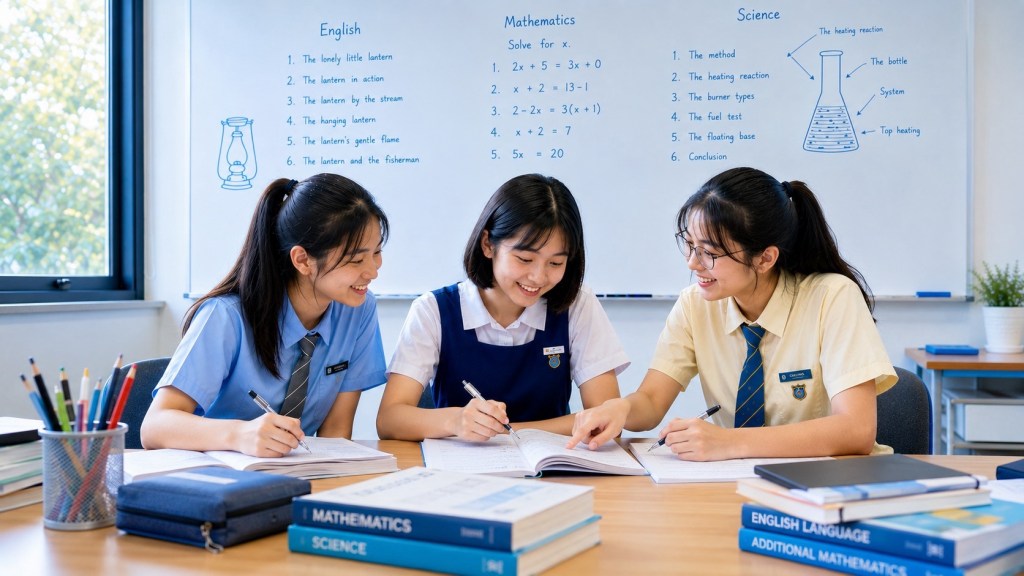
There is a strange way we talk about tuition.
We say the tutor teaches Mathematics.
Or English.
Or Science.
That sounds reasonable.
But it also hides what the tutor is actually supposed to be doing.
Because if teaching simply meant transferring information, the problem should already have been solved.
There are textbooks.
There are worksheets.
There are videos.
There are school notes.
There are websites containing explanations for a great deal of what a student is likely to encounter in school.
And now there is AI.
The information is widely available.
Yet one child can look at a question and know exactly what to do.
Another child looks at the same question and freezes.
So perhaps information was never the main product.
The tutor is doing something else.
The Tutor Is Building Something
A better analogy is construction.
The tutor is in the construction business.
The student arrives with a structure that is already partly built.
Some parts are strong.
Some parts are unfinished.
Some rooms connect properly.
Some staircases lead nowhere.
Some foundations were never properly laid.
Some walls look perfectly fine until weight is placed on them.
And sometimes an impressive-looking upper floor has been built over something underneath that is much less stable than it appears.
This changes the question.
The question is no longer:
How much content did I teach?
It becomes:
What can this student now reliably support?
That is a construction question.
You Cannot Build The Fifth Floor First
Imagine hiring a contractor to build a five-storey house.
On the first morning, the contractor arrives and says:
“We are going to start with the fifth floor.”
You would probably stop him.
There is nowhere to put it.
The fifth floor may be perfectly designed.
The materials may be excellent.
The architect may have produced beautiful drawings.
But that does not change the construction sequence.
Some things must exist before other things can exist.
Learning behaves like this too.
A Primary Mathematics student struggling with fractions may actually have an earlier weakness in multiplication.
A Secondary Mathematics student struggling with algebra may not be reliably manipulating negative numbers.
A student struggling to write an argumentative essay may have plenty of opinions but insufficient vocabulary, sentence control, evidence selection or paragraph architecture.
A Science student may remember individual facts yet be unable to connect them into a mechanism.
The visible problem appears upstairs.
The structural problem may be downstairs.
That is why simply repeating the current lesson often does not work.
You are repairing the fifth floor while the fourth floor is moving.
This Is Also Why “Think Critically” Is Such a Strange Instruction
In the previous discussion, we used the analogy of handing someone the keys to a car and saying:
Drive.
There is only one problem.
They cannot drive.
Giving them the keys does not create the missing capability.
“Develop critical thinking skills” can suffer from a similar problem.
We have named something desirable.
But we have not necessarily built what is required to produce it.
A student cannot simply decide to become a sophisticated thinker because we tell them:
“Think deeper.”
“Analyse.”
“Evaluate.”
“Be more critical.”
Those may be descriptions of the upper floors.
They are not necessarily construction instructions.
Before sophisticated judgement becomes possible, the student may need to build:
- observation,
- vocabulary,
- representation,
- comparison,
- categorisation,
- memory,
- retrieval,
- sequencing,
- causal reasoning,
- pattern recognition,
- evidence handling,
- alternative generation,
- error detection,
- verification,
- and the ability to hold several possibilities in mind without immediately collapsing them into one answer.
Now something much more interesting becomes possible.
We can stop treating intelligence as a mysterious property someone either possesses or does not possess.
At least part of what looks like intelligent behaviour can be constructed.
Learning Skills Are Abstract — But Buildable
This is the important distinction.
Learning skills are abstract.
You cannot point at “reasoning” sitting inside the brain.
You cannot physically see “transfer”.
You cannot watch “comprehension” the way you can watch someone lift a box.
That makes education difficult.
A building reveals itself.
A crack appears.
A column bends.
A pipe leaks.
A door does not close.
But structural weaknesses in learning can remain hidden for a surprisingly long time.
They may memorise.
They may copy.
They may follow a familiar template.
They may reproduce yesterday’s method.
They may even score reasonably well.
Then the question changes slightly.
And the structure fails.
That failure is extremely useful information.
Because now the tutor can ask:
What exactly was this performance depending on?
That is diagnosis.
And diagnosis comes before construction.
A Tutor Should Not Arrive With Cement and Start Pouring
Imagine a builder arriving at an old house.
Without checking anything, he starts pouring concrete.
More concrete must make the house stronger.
Right?
Of course not.
He first needs to know what he is dealing with.
Where are the load-bearing structures?
What has already been built?
What is damaged?
What was never completed?
What can be retained?
What needs reinforcement?
What is merely cosmetic?
What connects to what?
Teaching should work the same way.
Before adding more material, we need some estimate of the student’s present state.
Not:
Is this student good or bad?
That is far too crude.
Instead:
What can the student already do independently?
What can they do with prompting?
What collapses under time pressure?
What has been memorised but not understood?
What can they explain?
What can they transfer?
Where does the chain break?
That gives the tutor a construction site.
The Beginner and the Expert Do Not Have the Same Building
This becomes especially important when comparing beginners and experts.
Give both of them the same problem.
The expert may appear to “think critically”.
But what we see at the end is not necessarily what happened at the beginning.
The expert has accumulated an enormous hidden structure.
They recognise familiar patterns.
They discard irrelevant possibilities quickly.
They retrieve useful representations.
They have seen previous failures.
They know which assumptions are dangerous.
They can estimate where the problem is probably going.
They may compress many small operations into a single mental chunk.
So the expert looks fast.
The beginner looks slow.
It is tempting to conclude:
The expert is a better thinker.
That may be true.
But it is incomplete.
The expert is also standing on a much larger building.
Beginner
The beginner sees:
Question → ???
They may have to consciously work through almost everything.
What does this word mean?
Which formula applies?
Where do I begin?
Is this information important?
What happened in the previous step?
Why did the sign change?
Can I use this method here?
What should the answer approximately look like?
Every operation consumes attention.
Their mental workspace becomes crowded very quickly.
So when we tell this student:
“Now think critically.”
we have added another load to a structure that may already be near capacity.
Expert
The expert sees something very different.
The same question may immediately activate:
Question → family of problems → likely structure → candidate methods → abnormal feature → test → solution → verification
Several beginner operations have disappeared from conscious view.
Not because they are absent.
Because they have already been built.
The expert can spend more attention on the unusual part of the problem because familiar operations now require less conscious effort.
That spare capacity matters enormously.
It creates room for what we later recognise as sophisticated reasoning.
Expertise Creates Mental Floorspace
This gives us another way to understand expertise.
Expertise creates floorspace.
When basic operations become reliable, the learner no longer has to occupy their entire working capacity performing them.
That leaves more attention available.
That attention can now be used to compare.
Question.
Predict.
Test alternatives.
Notice contradictions.
Evaluate evidence.
Change strategy.
Check whether the answer makes sense.
And eventually create something new.
What we casually call “higher-order thinking” may therefore depend partly on a large amount of lower-level construction already being stable.
The penthouse still matters.
But the penthouse has foundations.
Scaffolding Is Not The Building
Education already has an excellent construction word:
scaffolding.
But even this idea can be misunderstood.
Scaffolding helps us construct something that cannot yet support itself.
A tutor gives prompts.
Worked examples.
Sentence starters.
Diagrams.
Hints.
Questions.
Partial solutions.
Templates.
These can be extremely useful.
But scaffolding has one critical property.
Eventually, it must come down.
If the building falls when the scaffolding is removed, the building was never finished.
The same applies to tuition.
If the student can solve the problem only while the tutor is beside them—
the tutor may have produced performance without producing independent capability.
That distinction matters.
The goal is not:
Student + Tutor = Correct Answer
The eventual goal is:
Student = Capable of Reconstructing the Answer
The tutor should gradually become less necessary for a capability that has become stable and independent.
A Good Tutor Is Constantly Inspecting Load
Construction is not merely about adding.
It is about testing.
Can this beam carry the next floor?
Can this student handle the next abstraction?
Can they still perform yesterday’s skill after a week?
Can they use it when the wording changes?
Can they recognise when it should not be used?
Can they explain why the method works?
Can they detect their own mistake?
This is why worksheets alone are not enough.
Correct answers can hide weak structures.
A student may answer a run of familiar questions correctly because they have learned the surface pattern.
Change the representation.
Combine two topics.
Remove the hint.
Reverse the question.
Ask for an explanation.
Place it under time pressure.
Suddenly we discover what was actually built.
Cracks Are Not Annoyances
When a building inspector discovers a crack, the useful response is not:
“Why can’t this building try harder?”
The crack is evidence.
Something about the structure needs investigation.
Student errors should be treated in much the same way.
A mistake can reveal:
- a missing concept,
- an unstable procedure,
- an overloaded working memory,
- a misleading representation,
- a vocabulary problem,
- a transfer failure,
- a forgotten prerequisite,
- or a perfectly sensible rule being used in the wrong location.
The mistake tells us where to look.
That makes failure diagnostically valuable.
Not because failure is the objective.
Because hidden construction becomes visible when it is placed under load.
Some Students Need Renovation, Not More Floors
This is particularly important in tuition.
A student can arrive in Secondary 3 carrying ten years of educational history.
We cannot treat them as an empty plot of land.
They already have habits.
Shortcuts.
Misconceptions.
Strong areas.
Weak areas.
Ways of interpreting questions.
Methods that worked before but have now reached their limit.
The tutor may therefore be doing something closer to renovation than new construction.
Sometimes we retain almost everything.
Sometimes we reinforce one weak section.
Sometimes we need to remove a workaround that no longer supports the next stage well.
And sometimes we have to go back surprisingly far.
That is not regression.
If a missing foundation is preventing further construction, returning to repair it is forward progress.
The Tutor Also Needs a Blueprint
There is another side to this.
The tutor cannot merely react to mistakes forever.
Construction needs direction.
Where are we trying to go?
What kind of student are we trying to produce?
For eduKateSengkang, the answer cannot simply be:
A student who gets the next question correct.
That target is too small.
We want knowledge that increasingly becomes:
Installed → Reliable → Independent → Transferable → Maintainable
A student should gradually require less external support.
They should become better at reconstructing knowledge themselves.
They should become better at noticing when they do not know.
They should become better at finding the missing part.
They should become better at selecting an approach.
And they should become better at checking whether their own reasoning survives contact with reality.
That is a much larger construction project.
We Are Building the Capabilities That Later Look Like Intelligence
This returns us to the previous article.
Perhaps “critical thinking” is too late in the story to be our starting point.
It describes something important.
But it may describe an emergent capability produced by many smaller structures working together.
So instead of beginning with:
Teach critical thinking.
We might begin with:
What underlying capabilities must exist for this learner to produce increasingly intelligent behaviour?
Then the problem becomes much more concrete.
Can they observe accurately?
Can they distinguish?
Can they hold information?
Can they retrieve it?
Can they represent it differently?
Can they connect two pieces?
Can they detect a mismatch?
Can they generate alternatives?
Can they test them?
Can they reject a bad route?
Can they explain the reason for their choice?
Can they update when new evidence arrives?
Now we have things that can be taught.
Practised.
Observed.
Stress-tested.
Repaired.
And eventually combined.
Learning skills remain abstract.
But their construction does not have to be mysterious.
The Finished Building Is Not The Lesson
This may be the biggest change in perspective.
A lesson is an event.
A capability is a structure.
A lesson begins and ends within a particular period.
But what matters is what remains afterwards.
What can the student still do tomorrow?
Next month?
Without the worksheet?
Without the tutor?
In a different chapter?
In an examination?
Eventually, outside school?
That is the building.
The lesson is construction activity; the capability is what remains.
And One Day, The Tutor Hands Over The Keys
There is a beautiful ending to the construction analogy.
Builders do not remain inside the house forever.
Eventually there is a handover.
The scaffolding disappears.
The equipment leaves.
The owners receive the keys.
The building has to stand without the construction crew.
That should also be one of the aims of tutoring.
At the beginning, a tutor may do a great deal.
Diagnose.
Explain.
Sequence.
Prompt.
Correct.
Model.
Question.
Test.
Repair.
But if the construction succeeds, the relationship changes.
The student increasingly becomes able to do these things for themselves.
They can enter unfamiliar territory and begin finding their own way through it.
Now those car keys from the previous article finally make sense.
We are no longer handing the keys to someone who cannot drive and shouting:
“Think critically!”
We have spent the time building the underlying capabilities.
They understand the controls.
They recognise the road.
They can judge distance.
They can react when conditions change.
They can notice danger.
They can choose another route.
They can check where they are going.
And eventually—
they can drive.
That is the real construction business of education.
The tutor does not merely deliver knowledge.
The tutor helps construct the learner who can use it.
