
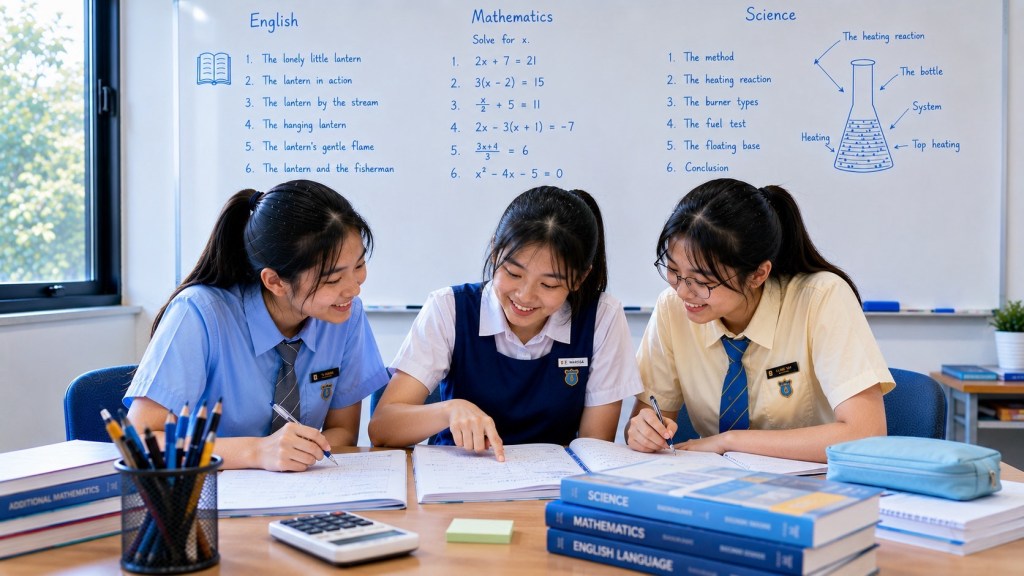
A student is ready to move ahead when the current capability is stable enough to survive less support and more variation.
Finishing quickly can be one clue. A high score can be another. Neither is sufficient on its own.
Move ahead when the learner needs a larger problem space—not merely another page.
First check whether the learning is independent
Can the learner start without the tutor choosing the route? Retrieve the idea after time has passed? Explain why it works? Notice an error without being told where to look?
If success still depends heavily on recent demonstration or prompts, moving ahead can hide fragility rather than solve boredom.
Then change the surface
A learner who has mastered familiar practice should be able to recognise the underlying idea when the wording, numbers, representation or context changes.
Transfer is a stronger readiness signal than completing many near-identical questions.
Moving ahead does not always mean next year’s syllabus
Depth can be more useful than acceleration.
- Compare two valid methods.
- Explain why one representation is more useful.
- Solve a problem with less obvious cues.
- Justify an inference with stronger evidence.
- Design a fairer Science test.
- Find a counterexample.
- Transfer the same relationship to a new context.
These enlarge capability without turning learning into a race through content.
Strong learners still need diagnosis
A student can score highly because current work is familiar while still having a narrow range. Another may have a small execution weakness that becomes more expensive as difficulty rises.
The question shifts from “what is broken?” to “what capability is ready to be stretched, and where would greater complexity expose a useful edge?”
What parents can look for
- stable performance across time rather than one peak result;
- success without immediate prompts;
- accurate explanation, not only fast completion;
- transfer to unfamiliar questions;
- self-correction and purposeful checking;
- interest in harder relationships rather than simply more volume.
A readiness ladder parents can actually observe
Readiness is stronger when several kinds of evidence converge. A learner who is simply fast on familiar work is not at the same stage as one who can retrieve, explain, transfer and self-correct.
| Signal | What it adds to the case for moving ahead |
|---|---|
| Accurate routine work | The current procedure is becoming stable. |
| Successful delayed retrieval | The learning is not dependent on the recent explanation. |
| Changed-context success | The learner can recognise the underlying relationship, not only the surface pattern. |
| Explanation and comparison | The learner can reason about why a route works and when another route may be better. |
| Self-correction with less prompting | Monitoring is moving from tutor to learner. |
A useful stress test before acceleration
Take a capability the learner appears to have mastered and remove one familiar support: the chapter label, the worked-example cue, the usual representation or the tutor’s opening prompt. Then alter the surface without altering the underlying idea.
If the learner can still recognise the relationship, choose a route and recover from a small error, the case for greater challenge becomes stronger. If performance collapses, the next job may be transfer or independence rather than acceleration.
Moving ahead should produce a better learner, not merely an earlier syllabus
The useful sign is greater range: the student can handle more ambiguity, compare more possibilities, explain with greater precision and operate with less external structure. If “moving ahead” produces only more content coverage, the extension may be fast without being deep.
What this page does not mean
Readiness is not a permanent status. A learner can be ready to move ahead in one part of a subject while still needing stabilisation elsewhere.
It also does not mean every strong student needs tuition. If school and independent learning already provide enough range, another programme may add little.
Where to go next
For the broader developmental map, use the Voyage Series. For whether current learning is truly stable, see How We Know Learning Has Really Held. For the full set of parent decision routes, return to the Parents’ Guide.
eduKate Sengkang · Move ahead because capability is ready, not because the worksheet is finished.
