
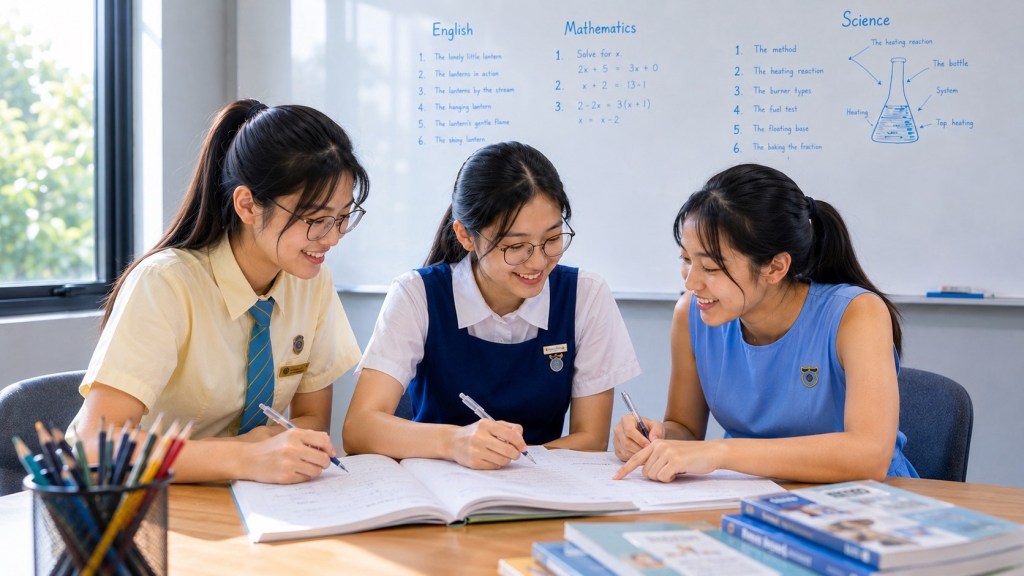
“We take the stress away” does not mean we make education easy.
Learning can be difficult. Examinations matter. Children sometimes have to persist through confusion, practise something they would rather avoid, and discover that an answer they were confident about is wrong.
The stress we should try to remove is the stress that does not need to be there.
Do not remove the challenge that builds capability. Remove the unnecessary uncertainty and friction around it.
It begins by making the problem smaller
A parent may arrive with a large concern: “My child is weak in Mathematics.” “English has dropped.” “Science is becoming a problem.” “We do not know whether tuition is working.”
Large concerns create large emotional fields because everything appears to be wrong at once.
Our first useful job is to reduce the field. Which part is actually unstable? What evidence do we have? What can the learner already do? Which explanation is still uncertain? What should we inspect first?
Clarity is calming because it gives the family somewhere sensible to stand.
It means not manufacturing urgency
One poor test can matter without becoming a crisis. One good test can be encouraging without proving that every weakness is gone. A strong student does not automatically need more tuition. A struggling student does not automatically need more hours.
Parents should be able to make decisions from evidence rather than from the fear that every week not spent adding something is a week lost forever.
Sometimes the next move is tuition. Sometimes it is a narrower repair, a school conversation, independent practice, a lighter schedule or time to see whether a recent change holds.
It means giving the family a clear next step
Uncertainty becomes stressful when nobody knows what to do with it.
A good next step should be proportionate:
- bring one recent paper;
- reattempt one question without the correction;
- compare timed and untimed work;
- ask the school teacher what a specific comment means;
- reduce one prompt and see what the learner can carry;
- repair one prerequisite before adding more current-level work;
- pause an unnecessary commitment if the week is overloaded.
The next move does not have to solve the whole problem. It should make the next decision easier to make well.
It means not turning the parent into the second tutor
Home should not have to become another classroom in order for tuition to work.
Parents can support sleep, routines, materials, emotional safety and the conditions for independent study. They can preserve useful evidence and tell us what homework looks like at home.
They should not need to learn the teaching programme, mark every line and reconstruct every lesson after dinner.
How Can Parents Help Without Becoming the Second Tutor? explores how to help while leaving room for independence.
It means not turning the child into a problem to be managed
A lower mark should not automatically become “lazy”, “careless”, “weak” or “not academic”.
We can describe the educational pattern more precisely: the learner waits for the first step, loses evidence in comprehension answers, retrieves slowly under time, or succeeds on familiar questions but not changed ones.
Specific observations are kinder partly because they are more accurate. They create something teachable instead of turning a temporary performance pattern into identity.
It means protecting the child from duplicate systems
A child should not need to attend school, repeat school at tuition and then repeat tuition again at home simply because three environments are all trying to help.
School, tuition and home should exchange useful information while contributing different functions.
Reducing duplication can remove a remarkable amount of unnecessary academic friction without reducing standards.
It means allowing teaching to be difficult without making the relationship difficult
A student may need to redo an error, confront a weak foundation or discover that familiar practice created more confidence than transfer.
That can be uncomfortable.
The tutor can still be calm, precise and respectful. Challenge does not require humiliation, fear or constant comparison.
The learner should be able to fail at a question without feeling that the failure has become a verdict on the person.
It means making progress legible
Families become anxious when they cannot tell whether anything is changing.
Marks remain important, but progress can also become visible through smaller prompts, stronger independent starts, more durable corrections, better transfer, more purposeful checking and improved recovery.
Parents should be able to understand what the current teaching job is and what evidence would cause us to continue, change direction or reduce support.
It means being willing to say tuition is not the answer
Sometimes the most reassuring answer we can give is not an enrolment recommendation.
School support may already be enough. Independent study may be the missing space. The learner may need a different format. The week may be overloaded. A concern may sit outside ordinary academic tutoring and belong with an appropriately qualified professional.
If tuition does not have a clear educational job, adding tuition can create exactly the kind of stress we say we are trying to reduce.
It means allowing tuition to end
A service that genuinely values independence should be able to become smaller when the learner becomes stronger.
When Should Tuition Reduce, Change Direction or End? explains the practical decision.
The principle underneath it is simple: we should not create dependency in order to preserve continuity.
A stress test: useful difficulty or avoidable friction?
Not all academic stress means the same thing. Some difficulty belongs to real learning. Other stress comes from preventable confusion, duplication or poorly matched support.
| What the learner is experiencing | Useful difficulty may look like… | Avoidable friction may look like… |
|---|---|---|
| A hard question | The learner has enough knowledge to make a serious attempt, struggles, then learns something from feedback or recovery. | The task depends on a missing prerequisite nobody has identified, so repeated effort mainly reproduces the same block. |
| Homework | The learner has to retrieve, organise and persist independently for a reasonable period. | The same work is being retaught by school, tuition and home, creating hours of duplicate explanation. |
| Examination preparation | Realistic timing and mixed questions reveal where performance needs strengthening. | Paper volume keeps increasing even though the same errors are not being repaired between attempts. |
| Parent involvement | The parent protects routines and allows the child to carry more of the thinking. | The parent has become responsible for starting, checking and rescuing nearly every task. |
| Tuition itself | The lesson adds a distinct educational function and gradually transfers more control to the learner. | The service continues mainly because stopping feels risky, even though its current job is unclear. |
The aim is not zero stress
A learner who is extending their capability will sometimes feel uncertain, tired after serious work, or frustrated by a question that resists the first attempt. Removing every difficult feeling would remove part of learning itself.
The aim is less unnecessary uncertainty around the difficult work
The family should know what the current problem is, who owns the next action, what evidence matters, what is still uncertain and when the plan will be reviewed. That clarity does not make the work easier. It makes the surrounding system less noisy.
What that promise should look like in practice
“We take the stress away” has earned its place when the family needs fewer emergency decisions, the learner experiences less duplicated help, progress is easier to interpret, and difficult academic work can remain difficult without becoming chaotic.
If tuition itself is creating unnecessary workload, dependency or uncertainty, the promise requires us to change the tuition—not simply repeat the slogan.
What “stress away” does not mean
It does not mean promising effortless grades. It does not mean removing deadlines, difficult questions, practice, examination pressure or the responsibility to work.
It does not mean telling parents that everything is fine when the evidence says otherwise.
And it does not mean shielding children from every productive discomfort. Learning sometimes requires the dignity of being allowed to struggle long enough to discover that they can recover.
What we are trying to leave behind
A parent should leave a useful conversation with fewer unnecessary possibilities, a clearer sense of what is known and unknown, and more control over the next decision.
A student should gradually leave tuition with more of the learning process inside themselves.
That is what “we take the stress away” means to us.
Not less education.
Less noise around the education that matters.
Where to begin
If your question is still broad, start with Does My Child Actually Need Tuition?. If you already know tuition has a job but are trying to define it, use What Are We Actually Hiring Tuition to Change?.
For the wider learning system, see the eduKate Sengkang Education Runtime. For the full set of parent decision routes, return to the Parents’ Guide.
eduKate Sengkang · Clear teaching, thoughtful support and room for the learner to grow.
