
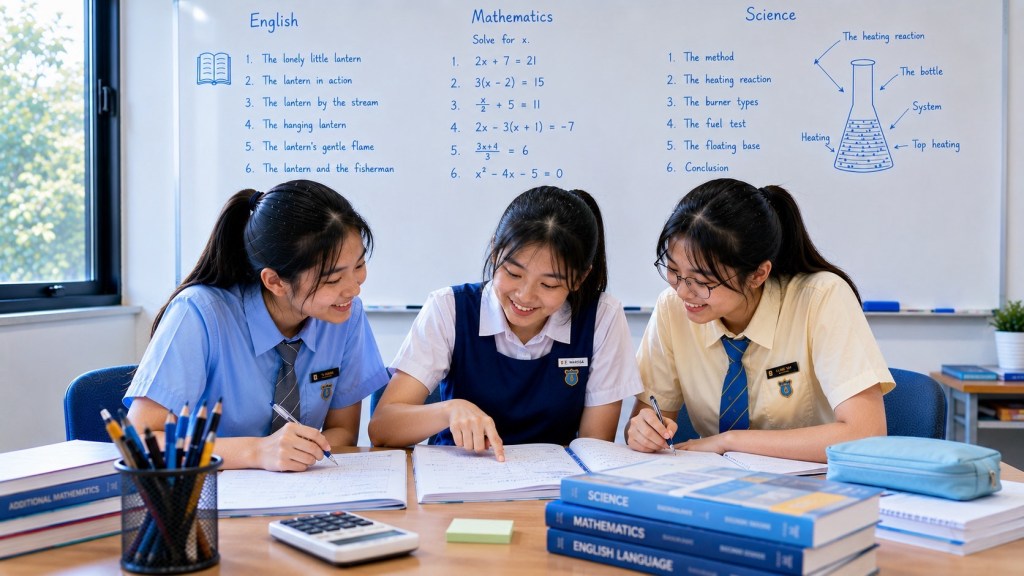
A Parents’ Guide to understanding what MOE actually does, how curriculum, schools, examinations and pathways fit together, and why Singapore education needs a system above the classroom
The Short Answer
The Ministry of Education is not your child’s teacher.
It does not sit beside every Primary 4 student deciding how tonight’s Mathematics homework should be explained.
It does not personally mark every PSLE paper.
It does not determine every activity carried out by every school.
Yet almost everything in Singapore’s national education system operates inside an environment that MOE helps design.
MOE shapes:
- the broad purposes of education,
- the national curriculum,
- school structures,
- educational pathways,
- subject frameworks,
- assessment policy,
- teacher and school capacity,
- resourcing,
- system-level reforms,
- and the direction in which Singapore education develops.
That is why, inside The Voyage Series, a useful metaphor is:
MOE is the Control Tower.
Not because it flies every aircraft.
Because it helps organise the airspace.
Why a Control Tower?
Imagine hundreds of schools.
Thousands of teachers.
Hundreds of thousands of students.
Different ages.
Different subjects.
Different strengths.
Different educational needs.
Different schools.
Different examinations.
Different future routes.
Without some national coordination, these could become hundreds of separate education systems.
Instead, Singapore has a national architecture.
A simplified version looks like this:
                    SINGAPORE
                        │
                        ↓
                       MOE
                NATIONAL DIRECTION
                        │
        ┌───────────────┼───────────────┐
        ↓               ↓               ↓
   CURRICULUM        PATHWAYS         SYSTEM
   & STANDARDS       & ROUTING        CAPACITY
        │               │               │
        └───────────────┼───────────────┘
                        ↓
                      SCHOOLS
                        ↓
                     TEACHERS
                        ↓
                     LEARNERS
                        ↓
                       WORLD
The control tower does not perform every action.
It creates enough common structure that the many parts can operate together.
But We Need One Important Correction
A real airport control tower gives relatively direct instructions to aircraft.
Education is not that mechanical.
So the metaphor has limits.
MOE does not operate schools as though every lesson were centrally remote-controlled.
Schools exercise professional judgement.
Teachers interpret learners.
Students make choices.
Parents make decisions.
Different schools create different programmes and cultures.
SEAB has its own specific national assessment role.
Institutes of Higher Learning have their own domains.
So the better model is:
MOE provides national steering, architecture and coordination while distributed institutions perform local execution.
That is much closer to how a complex education system actually works.
What Is Being Controlled?
Not children.
That is an important distinction.
The object of system-level control is better understood as the education environment.
MOE can influence questions such as:
What should students broadly learn?
At what stage?
What subject pathways should exist?
How should learners with different strengths move through them?
What national standards should examinations preserve?
What capabilities will Singapore need in the future?
How should schools be staffed and supported?
How much assessment pressure is appropriate?
When does an old structure need redesigning?
The control tower manages the conditions and routes.
The learner remains the traveller.
The Ministry Sets the Direction of Travel
Every education system contains assumptions about what an educated person should eventually become capable of doing.
A system built entirely around examination recall would look one way.
A system concerned with:
knowledge,
skills,
values,
adaptability,
collaboration,
judgement,
and lifelong learning
must be designed differently.
MOE’s current public direction explicitly goes beyond narrow academic attainment. Its 2026 Education Conversations material describes education as a foundation for values, growth and opportunity and emphasises holistic development and 21st Century Competencies alongside academic learning. (Education Conversations)
That is national steering.
The Ministry is not merely choosing textbook chapters.
It is helping answer:
What kinds of people should this education system help develop?
That Question Eventually Reaches the Classroom
A national idea can look very abstract.
Suppose the national system says:
Students need stronger critical thinking.
That idea has to travel.
NATIONAL INTENT↓CURRICULUM↓SYLLABUS↓SCHOOL PROGRAMME↓TEACHER DESIGN↓CLASSROOM TASK↓STUDENT EXPERIENCE
If any connection breaks, the policy can exist beautifully on paper without becoming student capability.
This is why implementation matters as much as aspiration.
Curriculum Is Part of the Navigation System
A curriculum tells the education system something about:
- what should be taught,
- when it should broadly appear,
- how concepts progress,
- what practices students should develop,
- and what learning outcomes matter.
The syllabus is therefore more than a chapter list.
It is closer to a navigation chart.
For example, Primary Mathematics does not randomly place every mathematical concept into every year.
There is progression.
Primary Science deliberately builds increasing conceptual resolution.
English expands the learner’s ability to understand, represent and communicate increasingly complex meaning.
The Voyage Series uses the same principle.
Our collection law is:
One World. Many Voyages. Three Ways of Seeing.
with English giving the world communicable meaning, Science building defensible explanations of its behaviour, and Mathematics extracting structures and relationships that can be transformed and verified.
MOE supplies the official school-level operating envelope within which those Voyages must remain educationally truthful.
MOE Is Why We Cannot Simply Invent the P3 Water Cycle
This sounds like a small example.
It is actually very revealing.
When we designed The Voyage of Water, Water existed from Primary 1.
But we did not simply teach the entire Water Cycle immediately.
Why?
Because curriculum progression matters.
The learner’s aperture matters.
The official science architecture matters.
So the Water object remained the same while scientific resolution increased.
That is the relationship between:
world
and:
curriculum.
The world contains everything at once.
A curriculum does not.
A good curriculum creates a route through complexity.
The World Has No Primary 4 Label
Rain does not know that a child is in Primary 4.
A circle does not know whether it belongs in P6 Mathematics.
A plant does not care which Science chapter it appears in.
A newspaper article does not arrive labelled:
Secondary 2 inference question.
Those divisions are human educational structures.
They exist to sequence learning.
This is where the Ministry’s role becomes clearer.
MOE does not create the world children study.
It creates a national educational route through that world.
The Control Tower Has to Adjust the Aperture
A seven-year-old does not need the same representation of the world as a sixteen-year-old.
So the system has to decide:
How much complexity now?
Which concepts now?
Which representations now?
Which examinations now?
Which choices now?
How much independence now?
That is why school has levels.
WORLD████████████████████████████P1 APERTURE██P3 APERTURE████P6 APERTURE████████S2 APERTURE████████████S4 APERTURE████████████████
The world did not expand.
The educational aperture did.
MOE Also Designs Routes
A national education system cannot assume that every learner develops identically.
Singapore’s recent structural changes make this increasingly explicit.
Full Subject-Based Banding has been fully implemented in secondary schools since 2024, giving students greater flexibility to customise their secondary education according to strengths, interests and learning needs. (Education Conversations)
That is not merely a curriculum change.
It is a routing-system change.
Old Model: Route the Whole Student
A simplified older architecture looked more like:
STUDENT↓STREAM↓MOST SUBJECTS FOLLOW STREAM
Full SBB moves further towards:
STUDENT↓INDIVIDUAL SUBJECT PROFILE│├── English → appropriate subject level├── Mathematics → appropriate subject level├── Science → appropriate subject level└── other subjects → appropriate routes
The system has become more granular.
That changes what the control tower is routing.
Not only:
Which school?
But increasingly:
Which learning aperture for which subject?
This Is Why Posting Group Is Not Identity
A Posting Group helps organise admission and initial subject-level expectations.
It should not be confused with the whole learner.
Likewise:
G1,
G2,
G3
belong to subject levels.
They are coordinates.
Not identities.
This is one of the strongest ideas parents can carry from the whole Voyage Series:
ROUTE ≠ CHILDLEVEL ≠ CHILDEXAMINATION SCORE ≠ CHILD
The control tower needs coordinates.
The traveller should not become the coordinate.
MOE Also Changes the Routes When the System Changes
Control towers cannot operate from a frozen map forever.
Singapore itself changes.
Technology changes.
Work changes.
Population needs change.
Social expectations change.
Knowledge changes.
AI changes the information environment.
The education architecture therefore has to adapt.
MOE’s 2026 initiatives explicitly include strengthening AI literacy across curriculum, co-curriculum and self-directed learning, updating Code for Fun, and teaching students to validate generative-AI information and identify deepfakes. (MOE Singapore)
That is a perfect control-tower example.
The outside world changed.
The education system is adjusting its routes.
The Tower Receives Information Too
A control system that only sends instructions is weak.
It also needs feedback.
MOE’s Education Conversations, launched in 2026, explicitly gathers feedback from students, parents, educators and the wider public and describes that input as feeding actionable recommendations for policymakers. (Education Conversations)
So the model is not:
MOE↓EVERYONE ELSE
It is closer to:
                 MOE
             ↓        ↑
        DIRECTION   FEEDBACK
             ↓        ↑
          SCHOOLS
             ↓        ↑
          TEACHERS
             ↓        ↑
          STUDENTS
             ↓        ↑
           WORLD
A functioning system needs both.
Policy Is a Hypothesis About the Future
Consider Full SBB.
Or PSLE scoring reform.
Or reducing assessment load.
Or incorporating AI literacy.
Each intervention implicitly says:
If we change this part of the system, we expect some educational outcome to improve.
Then reality answers.
Did students benefit?
Did schools cope?
Did unintended effects appear?
Did new inequalities emerge?
Did teacher workload change?
Did learners behave differently?
A good control tower must therefore be capable not only of implementing policy but of learning from its consequences.
MOE Has Already Been Changing Its Model of Success
Singapore’s education architecture has changed significantly over time.
Recent MOE material traces shifts including:
- replacing the PSLE T-score with broader Achievement Levels,
- reducing excessive differentiation by marks,
- implementing Full SBB,
- expanding definitions of merit,
- emphasising lifelong learning,
- and moving away from viewing education as an “arms race” towards more holistic development and multiple forms of excellence. (Education Conversations)
The control tower is therefore not simply maintaining traffic.
It is redesigning parts of the airspace.
Then What Does SEAB Do?
This distinction matters.
If MOE is the control tower, it would be inaccurate to say that MOE alone directly performs every national assessment function.
The Singapore Examinations and Assessment Board is a statutory board established in 2004 to develop and conduct national examinations and provide assessment services. Its stated mission includes assessing educational performance, certifying individuals and upholding national standards. (SEAB)
For PSLE, MOE and SEAB are joint examining authorities. (SEAB)
For the 2027 Singapore-Cambridge SEC, students sit subjects at G1, G2 or G3, and the qualification is jointly examined and awarded by SEAB, MOE and Cambridge International Education. (SEAB)
So our map needs another component.
MOE and SEAB Are Not the Same Machine
A useful simplification is:
MOESYSTEM DIRECTIONCURRICULUMPOLICYPATHWAYSEDUCATIONAL ARCHITECTURE │ ↓SEABASSESSMENT DESIGNEXAMINATION OPERATIONSCERTIFICATIONNATIONAL STANDARDS
They interact closely.
But their functions are not identical.
The distinction protects our control-tower metaphor from becoming too crude.
Examinations Are System Sensors — But Not Perfect Ones
Why have national examinations?
One role is certification.
Another is selection or placement.
Another is maintaining comparable standards.
But examinations also return information into the education system.
They reveal what students can demonstrate under defined assessment conditions.
In that sense, an examination is partly a sensor.
LEARNING↓ASSESSMENT↓OBSERVABLE PERFORMANCE↓SIGNAL
But a sensor measures only what it is designed to measure.
A Mathematics examination does not fully measure:
kindness,
leadership,
curiosity,
creativity,
friendship,
or every form of mathematical potential.
That is why MOE’s current direction explicitly emphasises holistic development beyond academic grades. (Education Conversations)
The Sensor Must Not Become the Mission
This is a very important control-system failure.
Suppose the purpose is:
Build capable learners.
But everyone starts optimising entirely for:
Maximise examination outputs.
Then the measurement can begin replacing the purpose.
The system risks becoming:
EDUCATION↓EXAM↓EXAM PREPARATION↓MORE EXAM PREPARATION↓EDUCATION BECOMES THE EXAM
That is not the intended relationship.
Assessment should provide useful information about educational outcomes.
It should not become the whole reason those outcomes exist.
Schools Are Local Control Rooms
Now zoom down one level.
A school receives:
national curriculum,
policies,
resources,
professional frameworks,
assessment requirements,
and pathway rules.
But the school also possesses local information.
It knows:
its students,
its community,
its teachers,
its strengths,
its culture,
its programmes,
and its challenges.
So a school can be understood as a local control room.
                    MOE
              NATIONAL LEVEL
                     ↓
                   SCHOOL
               LOCAL SYSTEM
                     ↓
         ┌───────────┼───────────┐
         ↓           ↓           ↓
      TEACHERS    PROGRAMMES   SUPPORT
         ↓                       ↓
                   STUDENT
National coherence.
Local execution.
Both are necessary.
Teachers Are Not Delivery Pipes
This is perhaps even more important.
A syllabus does not walk into a classroom and teach itself.
Teachers interpret:
where students are,
what misconception exists,
what example will work,
which representation is needed,
when to slow down,
when to stretch,
when to question,
and when to revisit.
So this model is wrong:
MOE↓SYLLABUS↓TEACHER↓TRANSFER INFORMATION↓CHILD
A more realistic model is:
MOE INTENT↓CURRICULUM↓TEACHER PROFESSIONAL JUDGEMENT↓LEARNER STATE↓TEACHING ACTION↓LEARNER RESPONSE↓ADJUSTMENT
Teaching is a feedback process.
Not packet delivery.
The Classroom Is Where the National System Meets One Child
This is the smallest but perhaps most important junction.
National policy might concern:
hundreds of thousands of learners.
The teacher sees:
this child.
At 10.15 a.m.
On Tuesday.
Who does not understand fractions.
Or is afraid to answer.
Or has already mastered the lesson.
Or misunderstood one word in the question.
Education eventually has to travel from:
national scale
to:
human scale.
That scaling problem is one of the hardest things any education system has to solve.
Parents Are Part of the System Too
A control tower cannot replace parents.
Parents see things school may not see.
Sleep.
Stress.
Motivation.
Homework behaviour.
Confidence.
Interests.
Changes in personality.
How long a task really takes at home.
Parents therefore contribute another information stream.
The parent is neither:
school inspector
nor:
passive customer.
A healthier relationship is:
SCHOOL↕PARENT↕LEARNER
with different parties seeing different parts of the child.
The Learner Is Not Cargo
This is where we need to stop the aviation metaphor from going too far.
Children are not packages being routed through an airport.
They gradually become agents.
At P1, adults make most educational decisions.
By Secondary school, the learner increasingly develops:
preferences,
interests,
strengths,
judgements,
and responsibility.
The eventual educational objective should therefore be:
SYSTEM ROUTES LEARNER↓SYSTEM + LEARNER CHOOSE↓LEARNER CHOOSES WITH GUIDANCE↓LEARNER CAN ROUTE THEMSELVES
A successful education system eventually produces people who need less external control.
The Best Control Tower Creates Capable Pilots
That may be the more mature version of our metaphor.
The national system initially provides:
routes,
standards,
support,
signals,
constraints,
and guidance.
But the ultimate goal cannot be permanent dependence on the tower.
A mature learner should increasingly be able to:
identify what they do not know,
seek information,
judge its reliability,
learn,
test,
correct,
choose,
communicate,
and continue developing.
MOE’s recent public framing explicitly describes education as a continuing journey extending beyond the first years of school into lifelong learning. (MOE Singapore)
So the control tower’s success is partly measured by whether the traveller eventually becomes capable of navigating far beyond school.
There Is Another Layer: Why Does Each Route Exist?
Parents often encounter educational choices as labels.
Triple Science.
Additional Mathematics.
G3.
IP.
JC.
Polytechnic.
CCA leadership.
Advanced modules.
A better question is:
What capability or future route does this option exist to develop or open?
That question prevents status from replacing purpose.
A subject should have a reason.
A pathway should have a reason.
An examination should have a reason.
A policy should have a reason.
A tuition programme should have a reason.
If nobody can explain why a route exists except:
because stronger students take it,
then the route has been poorly understood.
The Control Tower Needs Reasons, Not Just Rules
A weak education architecture would say:
Do X because the regulation says X.
A stronger architecture asks:
What problem was this rule created to solve?
That gives us:
PROBLEM↓EDUCATIONAL OBJECTIVE↓POLICY / CURRICULUM / ROUTE↓IMPLEMENTATION↓OUTCOME↓DID IT SOLVE THE PROBLEM?
This is how rules remain connected to purpose.
Otherwise a system can preserve procedures long after their original purpose has disappeared.
Curriculum Also Needs a Reason for Existence
Why learn fractions?
Not merely:
because fractions are in P3–P6 Mathematics.
Fractions represent relationships.
Why learn evidence in Science?
Because explanations should be constrained by what the world actually does.
Why learn argument in English?
Because humans need to build, interrogate and communicate positions.
Subjects are not arbitrary obstacles inserted before adulthood.
They are specialised cognitive technologies.
This is one of the foundational laws underneath The Voyage Series:
English = meaning and communication
Mathematics = structure and reliable transformation
Science = observation, evidence and explanation.
MOE Protects the Separation of the Subjects Too
The Voyage Series constantly connects English, Mathematics and Science.
But we do not merge them.
Why?
Because a Science claim cannot be made true merely by writing it beautifully.
A mathematical model cannot be validated merely because the story around it is persuasive.
An English interpretation cannot be reduced to a measurement.
Different disciplines have different rules for producing reliable knowledge.
A national curriculum preserves those specialist traditions while still developing a common learner.
That is another control-tower function:
Keep the routes interoperable without making them identical.
One World, Many Educational Corridors
Take Water again.
                         WATER
                           │
            ┌──────────────┼──────────────┐
            ↓              ↓              ↓
         ENGLISH      MATHEMATICS      SCIENCE
            │              │              │
        meaning         quantity       mechanism
        viewpoint       relation       evidence
        argument        model          experiment
            │              │              │
            └──────────────┼──────────────┘
                           ↓
                     MORE CAPABLE
                        LEARNER
The official curriculum tells us when and how deeply each corridor should open.
The Voyage Series lets parents see why the corridors belong to the same world.
MOE Is Also a Time Machine
This is another way to see its role.
A curriculum is partly a decision made today about what a child will need tomorrow.
A Primary 1 child entering school in 2026 will enter adulthood in a world we cannot describe precisely.
Some future jobs do not yet exist.
Some technologies will disappear.
New ones will emerge.
AI will change information work.
Social and geopolitical conditions will change.
The Ministry therefore has to educate under uncertainty.
That means it cannot only ask:
What knowledge is useful today?
It must also ask:
What capabilities remain useful when today’s knowledge changes?
This Is Why Learning How to Learn Matters
Facts matter.
Foundational knowledge matters.
But in a changing world, learners also need:
adaptability,
discernment,
communication,
collaboration,
self-direction,
and the ability to acquire new knowledge.
MOE’s recent policy framing repeatedly emphasises lifelong learning and preparing people for a fast-changing world rather than confining education to the first 15 years of formal schooling. (MOE Singapore)
The control tower therefore has to prepare travellers for destinations it cannot fully see.
AI Makes the Control Problem Harder
Imagine students can instantly generate:
an essay,
a summary,
an equation solution,
a Science explanation,
or a presentation.
Then the educational question changes.
It is no longer enough to ask:
Can the student produce an output?
We also need:
Does the student understand it?
Can they verify it?
Can they detect error?
Can they recognise manipulation?
Can they judge source quality?
Can they use AI responsibly?
MOE’s 2026 announcement to strengthen AI literacy and teach validation of generative-AI information directly reflects this changed environment. (MOE Singapore)
The tower has detected new traffic.
It is updating the navigation rules.
But MOE Cannot Know Everything
No control system is omniscient.
A Ministry works with:
research,
data,
teachers,
schools,
parents,
students,
public feedback,
international comparisons,
economic needs,
social objectives,
and political decisions.
But uncertainty remains.
Policies can have unintended consequences.
Different groups can experience the same policy differently.
Local implementation can vary.
New technology can invalidate assumptions.
This is why feedback and revision are necessary.
A strong system should not behave as though:
national policy = perfect truth.
It should behave more like:
best current system model → implementation → evidence → improvement.
That Is Why Education Conversations Matter
In 2026, MOE began Education Conversations as a renewed effort to gather perspectives from people closest to education, explicitly inviting students, parents, educators and the public to help shape what comes next. (Education Conversations)
For our Control Tower model, that creates:
CONTROL TOWER ↓SYSTEM ACTION ↓REAL EXPERIENCE ↓FEEDBACK ↓CONTROL TOWER ↓RECONFIGURE
That loop is much more important than a one-way command structure.
The Control Tower Also Protects Continuity
Singapore cannot redesign the entire education system every Monday.
Children need continuity.
Teachers need planning horizons.
Schools need stable structures.
Qualifications need public trust.
Employers and post-secondary institutions need to understand standards.
So the control tower has another job:
Change enough to remain relevant, but preserve enough stability that the system remains intelligible.
That is a difficult balance.
Too little change produces obsolescence.
Too much change produces confusion.
National Examinations Are Part of That Continuity
SEAB’s role in national examinations and certification helps maintain common assessment standards across the system. (SEAB)
The 2027 SEC demonstrates both continuity and reform.
The old N(T), N(A) and O-Level structures are being consolidated into the Singapore-Cambridge Secondary Education Certificate, while students still sit subjects at their respective G1, G2 or G3 levels and the qualification continues to preserve recognised examination standards. (SEAB)
So:
OLD ARCHITECTURE↓REFORM↓NEW ARCHITECTURE↓STANDARD CONTINUITY
This is controlled evolution.
Why 2027 Matters
From 2027, the SEC replaces the separate N- and O-Level examination structure for the graduating cohort under Full SBB. (MOE Singapore)
That means parents with children of different ages may encounter apparently different systems.
The underlying control tower is actively rebuilding the routing architecture while the education system continues operating.
This is important to understand.
Singapore education is not a frozen machine.
It is a live system.
Then Where Does The Voyage Series Sit?
The Voyage Series is not another Ministry.
It does not replace the national curriculum.
It does not invent alternative subject standards.
It should sit much lower in the architecture.
                    WORLD
                      │
                     MOE
             NATIONAL EDUCATION
                 ARCHITECTURE
                      │
              OFFICIAL CURRICULA
                      │
                   SCHOOLS
                      │
                  TEACHING
                      │
                 THE LEARNER
                      │
             THE VOYAGE SERIES
          helps make the structure
             visible and traversable
                      │
                    WORLD
The Voyage Series is a navigation aid for the learner and parent.
MOE determines the official national educational envelope.
The Voyage Series tries to make that envelope intelligible through the same world.
Why This Matters for eduKate
A tuition centre should not behave as though it owns the curriculum.
It does not.
The official national system comes first.
Our job is different.
We can:
- interpret curriculum,
- teach,
- diagnose,
- repair,
- extend,
- connect,
- give practice,
- explain progression,
- prepare students for examinations,
- and help parents understand why learning changes from year to year.
But we should remain anchored to official curriculum truth.
That is why the Water Voyage sometimes deliberately refuses an attractive connection.
If a concept belongs later, we wait.
If a subject connection is artificial, we do not force it.
The control tower establishes real boundaries.
MOE Is Therefore an External Reality Check
Imagine The Voyage Series develops a beautiful educational theory.
But it contradicts:
the actual syllabus,
current Full SBB rules,
current examination structures,
or official subject progression.
Then our beautiful theory has failed contact with reality.
The correct response is:
update the model.
Not:
insist reality is wrong because the diagram looked elegant.
This is exactly the evidence discipline we teach children.
It must apply to us too.
The Parent Guide and the Control Tower Fit Together
Our previous guide asked:
How Primary and Secondary School Works in Singapore?
This article answers the next question:
Who designs the system in which those routes exist?
The parent guide maps:
P1
→ P6
→ PSLE
→ Secondary
→ G1/G2/G3
→ SEC
→ onward routes.
The Control Tower article explains why those routes can operate as a coherent national system.
Together:
CONTROL TOWERMOE↓SYSTEM MAPPRIMARY → SECONDARY↓SUBJECT ROUTESENGLISH / MATHEMATICS / SCIENCE↓INDIVIDUAL VOYAGESWATER / RICE / TREE / SHIP / ...↓LEARNER
We now have several resolutions of the same education system.
The Control Tower Cannot Be the Destination
This is another important limit.
Education can become overly institutional if we forget why the institution exists.
The final object is not:
MOE.
Not:
school.
Not:
PSLE.
Not:
SEC.
Not:
the syllabus.
These are system structures.
The endpoint is the person who leaves those structures more capable than when they entered.
So the correct orientation is:
INSTITUTION↓CREATES CONDITIONS↓FOR LEARNING↓WHICH BUILDS CAPABILITY↓IN A PERSON↓WHO RETURNS TO THE WORLD
The world remains the destination.
The Ministry’s Deepest Job May Be Maintaining the Corridor
A child enters P1.
Twelve or more years later, they leave school.
During that time:
teachers change,
schools may change,
subjects change,
technology changes,
examinations change,
the learner changes.
Yet there must remain enough continuity that learning can accumulate.
That corridor looks like:
P1↓P2↓P3↓P4↓P5↓P6↓SECONDARY↓POST-SECONDARY↓LIFELONG LEARNING
MOE’s role is partly to ensure that these stages are not merely neighbouring buildings.
They form a traversable system.
And the Corridor Must Have Doors
A rigid corridor would force everyone through the same route.
A modern system increasingly needs:
branches,
crossings,
different subject levels,
different post-secondary routes,
different strengths,
second chances,
and lifelong re-entry.
Full SBB is one visible example of that movement towards more porous educational pathways. (Education Conversations)
The better the architecture becomes, the less one early coordinate has to determine the whole future.
A Good Control Tower Preserves Options
This gives parents another way to evaluate education decisions.
A good decision may:
build capability now,
while preserving useful future options.
A poor decision may:
maximise short-term status,
while exhausting the learner or prematurely closing routes.
So ask:
What does this choice open?
What does it close?
What does it cost?
Is the learner ready?
Can the route be changed later?
Education is partly the management of future option space.
Capability and Responsibility Must Grow Together
There is one final part of the Control Tower that is easy to miss.
A good education system is not merely producing more powerful humans.
It is producing humans capable of using power responsibly.
A learner who can:
argue,
model,
code,
use AI,
analyse,
persuade,
or manipulate information
has greater capability.
That increases the importance of:
values,
judgement,
responsibility,
integrity,
and awareness of consequences.
MOE’s current public framing explicitly places values and holistic development alongside skills and academic learning. (Education Conversations)
The system needs both.
Intelligence Without Direction Is Not Enough
Imagine a very capable learner who asks only:
Can I do this?
A more mature learner also asks:
Should I?
Why?
Who is affected?
What evidence am I missing?
What happens later?
What happens if everyone does this?
Is there a better route?
This is where education stops being merely technical capability.
It becomes judgement.
The Control Tower Is Therefore Not Just About Traffic
It is about direction.
The tower helps answer:
Where are we trying to go?
And the answer cannot simply be:
higher examination scores.
MOE’s own recent direction increasingly frames education around holistic development, strengths, lifelong learning, contribution and preparing students for a changing future. (MOE Singapore)
The educational destination is larger than certification.
The Full Voyage Architecture
We can now build the whole picture.
                         THE WORLD
                             │
                             ↓
                    SINGAPORE SOCIETY
                             │
                             ↓
                            MOE
                       CONTROL TOWER
                             │
        ┌────────────────────┼────────────────────┐
        ↓                    ↓                    ↓
   CURRICULUM            PATHWAYS            CAPACITY
   & STANDARDS           & POLICY            & SUPPORT
        │                    │                    │
        └────────────────────┼────────────────────┘
                             ↓
                          SCHOOLS
                             │
                          TEACHERS
                             │
                          LEARNERS
                             │
          ┌──────────────────┼──────────────────┐
          ↓                  ↓                  ↓
       ENGLISH          MATHEMATICS          SCIENCE
       meaning           structure           evidence
          │                  │                  │
          └──────────────────┼──────────────────┘
                             ↓
                     MORE CAPABLE PERSON
                             │
                             ↓
                           WORLD
                             │
                             ↓
                       NEW QUESTIONS
                             │
                             └────────→ LEARN AGAIN
That is The Voyage Series at national scale.
One World. Many Voyages. One National Airspace.
The Ministry does not create every Voyage.
It creates much of the formal educational airspace through which those Voyages travel.
English has its corridor.
Mathematics has its corridor.
Science has its corridor.
Primary school has one operating envelope.
Secondary school opens another.
Full SBB creates additional routing flexibility.
SEAB provides national examination and certification machinery.
Schools turn national architecture into local programmes.
Teachers transform programmes into human learning interactions.
Parents contribute another view of the learner.
And eventually the child increasingly takes control of the route.
That is the whole system.
Coming Home
A Primary 1 child walks into school.
They do not know:
what PSLE is,
what G3 Mathematics is,
what Additional Mathematics is,
what the SEC is,
what university they may attend,
or what work they may eventually do.
They do not need to.
The education system holds much of that future complexity away from them.
It opens the next appropriate route.
Then another.
Then another.
The child acquires capability.
The aperture widens.
Choice increases.
Responsibility increases.
Eventually, the tower does less of the navigation.
The learner does more.
That may be the best way to understand the Ministry of Education inside The Voyage Series:
MOE is not the destination.
It is the national control architecture that tries to keep millions of individual educational Voyages coherent, safe, adaptable and capable of reaching many different futures.
Use Case
Use this article whenever a parent asks:
Why is the syllabus organised this way?
Who decides what my child learns?
Why did the system change to Full SBB?
What is the relationship between MOE and SEAB?
Why does the curriculum change?
Why can’t tuition simply teach everything earlier?
Why are there different subject levels and routes?
It provides the institutional map above the school journey.
The companion parent guide then explains how the learner travels through that map from Primary to Secondary school.
Education Value
After reading this article, a parent should understand that:
- MOE provides national educational direction, architecture and coordination rather than personally controlling every lesson.
- Curriculum sequences complexity so learners encounter the world at appropriate levels of resolution.
- Schools and teachers are essential local decision-makers rather than simple delivery pipes.
- SEAB has a distinct national assessment and certification role.
- Full SBB is a routing architecture that gives more subject-level flexibility rather than a new way to label whole children.
- Examinations are important system signals and certification mechanisms, but they are not the entire purpose of education.
- Policy needs feedback and revision because education operates in a changing world.
- AI, social change and future uncertainty require the national education system itself to keep adapting.
- The ultimate purpose of the system is not institutional completion but a learner who becomes increasingly capable of navigating, learning, judging and acting independently.
