
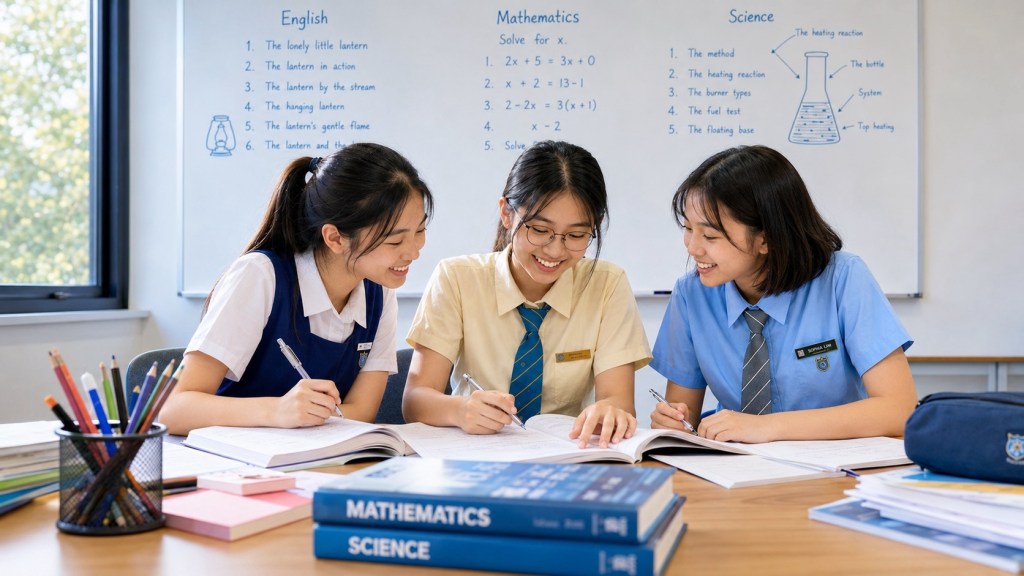
G1, G2, G3 Mathematics & Additional Mathematics
The Voyage Series by eduKate Sengkang
Place one tank of Water in front of five Secondary students.
Do not tell them which chapter they are studying.
Do not provide a formula.
Do not label the worksheet.
Just give them the world.
One learner may ask:
How much Water is there now?
Another:
How does the amount change with time?
Another:
What equation represents that relationship?
Another:
Which graph belongs to the model?
Another:
Can I transform this function so that its maximum becomes visible?
The Water is the same.
The available mathematical machinery is not.
This is why Singapore’s current Secondary Mathematics landscape should not be imagined as one vertical staircase containing increasingly valuable children.
Under Full Subject-Based Banding, Mathematics can be offered at G1, G2 and G3 subject levels, and MOE separately publishes syllabuses for G2/G3 Additional Mathematics. Students have greater flexibility to take different subjects at different subject levels rather than being defined by the former Express, N(A) or N(T) stream structure.
For the 2027 Singapore-Cambridge Secondary Education Certificate, SEAB lists Mathematics as G1 K110, G2 K210 and G3 K310. Additional Mathematics is separately listed as G2 K232 and G3 K341.
That gives The Voyage of Water a much cleaner architecture:
                    SECONDARY MATHEMATICS
                            │
                 SAME MATHEMATICAL WORLD
                            │
              ┌─────────────┼─────────────┐
              │             │             │
             G1            G2            G3
              │             │             │
              │             ├── A-MATH    ├── A-MATH
              │             │             │
              └─────────────┴─────────────┘
                            │
                      DIFFERENT APERTURES
Not:
G1 → G2 → G3 → A-MATH → "BEST"
That second diagram confuses curriculum route with human worth.
The first describes a mathematical system.
Quick Read
Secondary Mathematics progresses from abstraction, to coordinating systems, to choosing routes, to integrating and verifying them; G1, G2 and G3 change curriculum load, while Additional Mathematics adds a separate transformation-heavy toolkit where taken.
- Secondary 1: abstraction and general rules.
- Secondary 2: systems, interacting relationships and constraints.
- Secondary 3: routes, method choice and strategic efficiency.
- Secondary 4: synthesis, verification and reliable execution under constraint.
- Additional Mathematics: a separate branch that increases transformation and function control.
- Diagnostic path: recognition → representation → route → transformation → execution → verification → interpretation.
The developmental destination is not “more formulas”. It is a learner who can recognise mathematical structure, select a useful representation and route, verify what must remain true, and return the answer to the world.
One World, Different Mathematical Apertures
Suppose a tank begins with:
20\text{ litres}
and gains Water steadily.
The underlying world is rich enough to support many questions.
At one aperture, the learner may read a table and calculate the new amount.
At another, the learner may construct:
W=20+5t
At another, several equations may operate simultaneously.
At another, the relationship may become quadratic, trigonometric or differentiable.
The physical Water did not graduate from G1 to G3.
The mathematical representation increased in abstraction and power.
That is an important distinction.
Secondary 1: The Great Abstraction
The Primary Mathematics traveller spent years learning:
quantity,
relationship,
representation,
hidden structure,
relative quantity,
and integration.
Then Secondary Mathematics makes a major move.
A number becomes a variable.
Suppose the tank contains some unknown amount.
Call it:
x
Add five litres:
x+5
Now one expression describes many possible states.
The learner has crossed from:
this case
into:
a general relationship.
This is the essential Secondary 1 Voyage.
PARTICULAR STATE ↓ VARIABLE ↓ EXPRESSION ↓ EQUATION ↓ GENERAL RULE
Mathematics Has Stopped Waiting for the Number
This is one of the most beautiful changes in Secondary Mathematics.
At Primary level, the learner often needs particular quantities before calculation can proceed.
Algebra allows Mathematics to begin thinking before the particular value is known.
If:
W=a+rt
then the relationship exists regardless of whether we currently know:
a,
r,
or:
t.
The variables preserve places for information that may arrive later.
Mathematics has become capable of representing possibility.
Secondary 2: One Rule Is No Longer Enough
Now add a second tank.
Tank A:
A=20+5t
Tank B:
B=50+2t
When do they contain the same amount?
The learner must recognise that at the meeting state:
A=B
Therefore:
20+5t=50+2t
and the system can be solved.
Something new has happened.
The answer is a state satisfying both relationships simultaneously.
That is the Secondary 2 Voyage:
systems and constraints.
Mathematics Begins Eliminating Possibilities
Consider:
x+y=20
Many pairs work.
Now add:
x-y=4
Most possibilities disappear.
The second condition constrains the first.
The solution is not merely:
a number calculated correctly.
It is:
a state that survives all the active conditions.
This gives Secondary Mathematics an increasingly powerful way to think about problems:
POSSIBLE STATES ↓CONSTRAINT 1 ↓FEWER STATES ↓CONSTRAINT 2 ↓SURVIVING STATE
Graphs Become Meeting Places
The equation:
A=20+5t
has a graph.
So does:
B=50+2t
Their intersection is not merely where two pretty lines touch.
It represents the common state satisfying both mathematical relationships.
Algebra says:
solve simultaneously.
Geometry says:
find the intersection.
The representations are different.
The mathematical event is the same.
This ability to move between representations is one of the central powers of Secondary Mathematics.
Secondary 3: The Problem Opens More Than One Door
By Secondary 3, the learner may know several methods.
Now comes a new difficulty.
Which one should be used?
Imagine:
             WATER PROBLEM
                  │
        ┌─────────┼──────────┐
        │         │          │
     ALGEBRA    GRAPH     GEOMETRY
        │         │          │
        └─────────┼──────────┘
                  ↓
                TARGET
Several routes may be valid.
They may not have equal cost.
One may expose the structure immediately.
Another may be cumbersome.
Another may introduce unnecessary error.
The developmental object has therefore shifted from:
know a procedure
to:
choose among procedures.
A Correct Calculation Can Be a Poor Move
Suppose the problem asks for a time.
The learner spends three minutes finding a perimeter that is never used.
The perimeter is mathematically correct.
The route is strategically poor.
This distinction matters increasingly in upper Secondary Mathematics.
There is:
local correctness
and:
global usefulness.
A strong solver needs both.
The First Move Matters
A useful question becomes:
Which calculation opens access to something I need later?
If the target is time but time depends on volume change, perhaps volume change must come first.
If volume depends on geometry, geometry becomes upstream.
A difficult word problem may actually contain a dependency chain:
DIMENSIONS ↓VOLUME ↓CHANGE IN VOLUME ↓RATE ↓TIME
Once the chain is visible, the long question becomes navigable.
This Is Where G1, G2 and G3 Should Be Understood Carefully
The same rich Water world can remain available across G1, G2 and G3 Mathematics.
But the required mathematical aperture can differ.
A more supported task may make the important quantities explicit and ask the learner to interpret and operate on them.
A wider task may require the learner to identify variables, construct relationships, connect several representations and choose a method with less scaffolding.
MOE’s current Full SBB structure deliberately allows subjects such as Mathematics to be taken at G1, G2 or G3 rather than using the old streams as the organising identity of the student.
So the teaching question should not be:
Which kind of child is this?
It should be:
What level of mathematical load is this learner currently being asked to carry, and where is the actual breakdown?
Same Water, Different Load
Take:
A container fills steadily.
One learner may work with a table:
| Time | Water |
|---|---|
| 0 | 20 |
| 1 | 25 |
| 2 | 30 |
Another may write:
W=20+5t
Another may compare:
W_1=20+5t
and:
W_2=50+2t
Another may encounter a non-linear function.
The mathematical dignity of the object does not change.
What changes is:
symbolic load,
abstraction,
independence,
number of interacting conditions,
and the expected depth of reasoning.
This Is Aperture, Not Reduction
A common educational mistake is to make the world intellectually smaller when a learner needs more support.
But support can be added without making the object trivial.
We can preserve the same meaningful Water problem while providing:
a diagram,
a partially completed table,
defined variables,
or a clearer sequence of constraints.
The world remains real.
The access route becomes more structured.
Additional Mathematics Opens Sideways
Now we arrive at the most important architectural correction.
Additional Mathematics does not sit above G3 Mathematics like a crown.
SEAB’s current 2027 SEC listings treat Mathematics and Additional Mathematics as distinct subjects: G2 Mathematics and G2 Additional Mathematics are separately listed, as are G3 Mathematics and G3 Additional Mathematics.
Therefore our Voyage should branch:
G2 MATHEMATICS ──────────────┐ ├── G2 ADDITIONAL MATHEMATICS │G3 MATHEMATICS ──────────────┤ └── G3 ADDITIONAL MATHEMATICS
A-Math is a specialised mathematical toolkit.
Not a final verdict on the learner.
What Does the Additional Mathematics Branch Actually Add?
Consider:
h(x)=-x^2+6x+2
Ordinary substitution can tell us selected values.
But transform:
h(x)=-(x-3)^2+11
Now the maximum becomes visible.
The mathematical object was not replaced.
Its representation was transformed into a form better suited to the question.
This is the heart of our Secondary 3 Additional Mathematics Voyage:
TRANSFORMATION
Additional Mathematics Gives Representation More Power
A polynomial can be factorised.
A quadratic can be completed into another form.
A rational expression can be decomposed.
A trigonometric expression can be transformed using identities.
A geometric relationship can be written algebraically.
A function can be differentiated.
Each move changes what the learner can see.
The mathematical world becomes increasingly representation-sensitive.
The question is not only:
What is the answer?
It is:
Which equivalent form exposes the property I need?
One Function, Several Useful Faces
Take a quadratic.
Expanded:
x^2-9x+14
Factorised:
(x-2)(x-7)
Completed-square form:
another equivalent representation may expose its turning point.
Which is best?
If we want roots:
factorised form.
If we want coefficient manipulation:
expanded form may help.
If we want turning-point structure:
completed square.
So the function has not one ideal appearance.
It has several interfaces.
The best one depends on the operation.
That Is Mathematical Sophistication
The learner is no longer asking:
What form did my teacher use?
The learner increasingly asks:
What form gives me access to the property required now?
This is why Additional Mathematics is not usefully described as:
more difficult sums.
It trains a different degree of symbolic control.
Secondary 4 Additional Mathematics: Dynamic Control
Now the system changes again.
Suppose:
V(t)
represents Water volume through time.
Ordinary Mathematics can describe state.
Calculus asks:
How quickly is the state changing now?
The derivative:
\frac{dV}{dt}
provides a new layer of information.
Now we distinguish:
state
from:
rate of state change.
And potentially:
change in the rate itself.
The learner has acquired a mathematical instrument for observing the runtime of the function.
One Water System, Several Resolutions
Imagine:
V(t)
Volume now.
Then:
V'(t)
Rate of change.
Then:
V”(t)
How the rate itself changes.
The same underlying system is being viewed at several mathematical resolutions.
That is a huge conceptual leap from:
Which cup has more Water?
And yet the thread is continuous.
Calculus Connects Local and Global Change
Differentiation moves towards local change.
Integration can reconnect local change into accumulated change.
So the learner may travel:
STATE ↓RATE ↓LOCAL CHANGE
and, under suitable mathematical conditions:
RATE ↓ACCUMULATION ↓TOTAL CHANGE
The specialised toolkit opens reversible relationships that would have been inaccessible to the younger learner.
But More Powerful Mathematics Creates More Ways to Fail
Suppose the learner chooses the correct calculus method.
Then makes one sign error.
Every later line may be beautifully executed.
The answer fails.
Powerful machinery amplifies both:
capability
and:
foundation error.
So A-Math requires a strong trunk.
Fractions still matter.
Signs still matter.
Algebraic equivalence still matters.
Function interpretation still matters.
A-Math does not replace Mathematics.
It depends on it.
This Gives Us a Better Secondary Mathematics Tree
The Water Voyage now looks like:
PRIMARY MATHEMATICSP1 quantity ↓P2 relationship ↓P3 representation ↓P4 hidden structure ↓P5 relative/change ↓P6 integration ↓SECONDARY MATHEMATICSS1 abstraction ↓S2 systems ↓S3 route choice ↓S4 synthesis / verification │ ├───────────────┐ │ │ G2 A-MATH G3 A-MATH │ │ transformation transformation ↓ ↓ integration deeper integration
This is not an official MOE progression diagram.
It is The Voyage Series developmental architecture laid over the current subject structure.
MOE’s Secondary curriculum page separately publishes G1 Mathematics, G2/G3 Mathematics and G2/G3 Additional Mathematics syllabuses, which supports keeping those curricular routes distinct.
What Is Shared Across the Routes?
Even as the curriculum branches, several mathematical habits remain valuable.
The learner still needs to:
recognise structure,
represent relationships,
choose methods,
execute accurately,
check constraints,
and interpret results.
What changes is the mathematical toolkit available and the complexity expected.
So the core Voyage kernel survives:
WORLD ↓RECOGNISE STRUCTURE ↓REPRESENT ↓CHOOSE ROUTE ↓OPERATE ↓VERIFY ↓RETURN TO WORLD
Additional Mathematics inserts stronger transformation machinery into the middle.
G1 Mathematics Still Has a Complete Mathematical Job
This is worth making explicit.
A route does not become intellectually meaningless because it does not contain the widest symbolic machinery.
G1 Mathematics still exists to develop useful mathematical understanding and competence within its curriculum.
SEAB’s 2027 SEC structure lists G1 Mathematics as its own examinable subject, K110.
The relevant educational question is:
Can the learner use the Mathematics of that route accurately, independently and in unfamiliar situations?
That is a complete educational objective.
G2 Mathematics Has Its Own Destination
Likewise G2 Mathematics is not merely:
waiting to become G3.
It is a defined subject route in the SEC architecture, with G2 Additional Mathematics separately available as another mathematical subject where taken.
A learner may therefore possess:
G2 Mathematics
and:
G2 Additional Mathematics
without that structure needing to be reinterpreted as one failed attempt at a G3 ladder.
The route itself is legitimate.
G3 Mathematics Is Not A-Math
Likewise:
G3 Mathematics ≠ Additional Mathematics.
SEAB lists G3 Mathematics K310 and G3 Additional Mathematics K341 separately.
That means the subjects have different curricular identities.
A student taking both owns two related mathematical toolkits.
The A-Math branch expands the field.
It does not rename G3 Mathematics.
This Matters for Tuition Diagnosis
Suppose a Secondary 3 student says:
I am bad at Maths.
We still know almost nothing.
Perhaps they can solve routine algebra but cannot recognise it inside a word problem.
Perhaps symbolic manipulation is weak.
Perhaps graph interpretation is strong but modelling is poor.
Perhaps they understand G3 Mathematics but A-Math transformations collapse.
Perhaps they understand calculus conceptually but basic algebra damages every derivative solution.
Those are different problems.
The correct repair depends on the exact mathematical location of the break.
One Wrong Answer Can Hide Several Different Failures
Imagine two students both get:
x=7
when the correct answer is:
x=5
Student A built the wrong equation.
Student B built the correct equation but made an arithmetic mistake.
Their final marks may look identical.
Their mathematical states are not.
A good tutor needs to look upstream.
The Real Secondary Mathematics Diagnostic
Instead of asking only:
Did the student get it wrong?
ask:
WORLD / QUESTION ↓RECOGNITION ↓REPRESENTATION ↓METHOD SELECTION ↓TRANSFORMATION ↓EXECUTION ↓VERIFICATION ↓INTERPRETATION
Where did the signal break?
That is the repair target.
If Recognition Failed
The learner knows linear equations in a chapter exercise.
Then fails when a Water problem hides the same relationship.
This is not necessarily missing algebra.
It is a transfer failure.
Repair:
rotate the surface form while holding the underlying relationship constant.
If Representation Failed
The learner understands the story.
But translates:
Tank A has ten litres less than Tank B
incorrectly.
The mathematical failure occurred before solving began.
Practising another fifty algebra transformations may not repair it.
The translation boundary needs work.
If Route Selection Failed
The learner knows several methods.
But chooses an unnecessarily difficult one.
Now we need comparison.
Ask:
Which method is shortest?
Which preserves structure?
Which is easiest to check?
Which remains stable under examination conditions?
The learner needs a route map, not another tool.
If Transformation Failed
This becomes especially important in A-Math.
The learner recognises the object.
Chooses the correct general method.
Then transforms:
2(x+3)
into:
2x+3
The problem is equivalence control.
The repair is not calculus.
It is algebraic structure.
If Verification Failed
The learner finds:
-4\text{ cm}
for a physical length.
Writes it down.
Moves on.
The mathematical machinery produced an inadmissible state.
A simple contextual check could have caught it.
Feedback needs to become part of solving.
Mathematics Should Become Self-Correcting
At Secondary 4, a strong learner increasingly develops internal alarms:
My sign is inconsistent with the graph.
This value exceeds the tank capacity.
These units cannot be added.
My result should be increasing, not decreasing.
The solution does not satisfy the original equation.
The transformation changed the value.
Those alarms are part of mathematical expertise.
They make the learner less dependent on somebody else telling them:
wrong.
Examination Pressure Changes the Value of Routes
A method may be valid.
But if it consumes twelve minutes when another route takes four, that matters.
Yet the shortest method is not automatically best if it creates frequent errors.
So under assessment conditions, route quality becomes:
accuracy + reliability + time cost + clarity
This is why upper-secondary preparation cannot be reduced to content coverage alone.
Compression Should Be Earned
Experts often write fewer steps.
Beginners imitate the appearance.
Then lose the reasoning.
A useful progression is:
UNDERSTAND ↓EXTERNALISE ↓AUTOMATE ↓COMPRESS
Not:
SKIP STEPS ↓HOPE
The learner should compress operations only after their structure has become reliable.
Some Steps Should Remain Visible
High-risk steps deserve protection.
For example:
equation construction,
sign changes,
unit conversion,
important substitutions,
critical transformations.
One extra line may cost five seconds.
It may save five marks.
Efficiency is selective.
Water Is Useful Because the Mathematics Can Grow
At Secondary 1, Water can be:
W=a+rt
At Secondary 2:
several Water relationships interact.
At Secondary 3:
several solution routes appear.
At Secondary 4:
the learner integrates the route field.
In Additional Mathematics:
functions become richer,
representations become transformable,
rates become differentiable,
and accumulated change becomes recoverable through integration.
One world object supports a surprisingly large mathematical ascent.
But Water Does Not Own Mathematics
This rule still matters.
We should not force every Secondary Mathematics concept into a Water-themed word problem.
Sometimes a geometric object,
financial problem,
probability setting,
or pure algebraic expression
carries the Mathematics more naturally.
The Voyage object serves mathematical understanding.
Mathematics does not serve the theme.
The Shared Object Has Done Its Job When It Can Disappear
This sounds strange.
But eventually the learner should be able to recognise:
f(x)=x^2-6x+11
without needing a tank story.
The Water context helped us see the developmental continuity.
The abstract mathematical object must eventually stand independently.
That is success.
Context provided the bridge.
Abstraction allows the traveller to leave it.
Then Mathematics Can Return to the World
After operating abstractly, the learner returns.
Suppose the model produces:
t=17.3
What does that mean?
17.3 seconds?
minutes?
hours?
Does the physical system permit that value?
Did our assumptions remain valid?
The mathematical voyage should therefore end where it began:
the world.
WORLD ↓MATHEMATICAL REPRESENTATION ↓ABSTRACT OPERATION ↓SOLUTION ↓CHECK ↓WORLD
Without the return, Mathematics risks becoming symbol manipulation detached from meaning.
Secondary Mathematics at eduKate Sengkang
The current Singapore Secondary curriculum provides Mathematics across G1, G2 and G3 subject levels under Full SBB, while MOE also publishes separate G2/G3 Additional Mathematics syllabuses.
For the 2027 SEC, the subject structure is concrete: G1 Mathematics is K110, G2 Mathematics K210, G3 Mathematics K310, G2 Additional Mathematics K232 and G3 Additional Mathematics K341.
For teaching, the important point is not merely knowing those labels.
It is knowing what the learner currently needs.
At eduKate Sengkang, Secondary Mathematics can therefore be approached as a capability system:
conceptual depth × method selection × execution accuracy × transfer
with Additional Mathematics adding stronger transformation demands where the learner actually takes that subject.
The goal is not to make every learner perform identical Mathematics.
It is to make the Mathematics of their actual route increasingly understood, connected, transferable and reliable.
The Completed Secondary Mathematics Voyage
| Stage | Voyage developmental job |
|---|---|
| Secondary 1 Mathematics | Abstraction — particular quantities become variables and general rules |
| Secondary 2 Mathematics | Systems — several relationships constrain one mathematical world |
| Secondary 3 Mathematics | Routes — select among increasingly powerful mathematical methods |
| Secondary 4 Mathematics | Synthesis — integrate, transform, solve, verify and interpret under constraint |
| Secondary 3 Additional Mathematics | Transformation — richer functions and representations become deliberately transformable |
| Secondary 4 Additional Mathematics | Dynamic control — calculus, functions and specialised tools recombine into integrated mathematical reasoning |
This table is The Voyage Series developmental architecture, not an official MOE year-by-year allocation of A-Math topics. MOE publishes complete G2/G3 Additional Mathematics syllabuses, while individual schools may sequence their two-year teaching differently. The official curriculum distinction we preserve is the separation between G1/G2/G3 Mathematics and G2/G3 Additional Mathematics.
Coming Home
Take the tank away.
Leave only:
f(x)
The learner can still reason.
Now bring the tank back.
Can the learner identify which mathematical structure belongs?
That two-way movement is the real aim.
world → abstraction → operation → world
A strong Secondary Mathematics learner is not simply someone who possesses more formulas.
They are someone who increasingly knows:
what kind of mathematical object they are facing,
what representations are available,
which route is suitable,
what must remain invariant,
where the method stops being valid,
and how to detect when their own Mathematics has gone wrong.
That is a much more useful definition of mathematical strength.
And it works whether the learner’s current route is:
G1 Mathematics, G2 Mathematics, G3 Mathematics, G2 Additional Mathematics or G3 Additional Mathematics.
One world.
Different mathematical apertures.
Different toolkits.
Still Mathematics.
The Voyage Series
One World. Many Voyages. Different Ways of Seeing.
The Water does not care which subject code is printed on an examination paper.
It simply presents a world containing:
quantity,
change,
shape,
rate,
constraint,
uncertainty,
and structure.
The curriculum determines which mathematical instruments the learner is expected to carry.
Teaching determines whether those instruments become usable.
And the traveller determines what becomes possible when an unfamiliar problem appears.
How We Teach the Secondary Mathematics Voyage
A wrong answer does not tell us where Mathematics broke. The failure may be in recognising the structure, representing the world, choosing a route, transforming expressions, executing accurately, verifying the result or interpreting what it means. We diagnose that location first, then use diagnose → repair → practise → transfer.
Why three students can be useful
A three-student lesson can make mathematical judgement visible. One learner acts as the modeller, turning the world into quantities, relationships and conditions. A second becomes the route challenger, proposing another legitimate method and comparing cost, clarity and robustness. A third is the verifier, checking invariants, units, assumptions, admissible values and the return to the original world. The roles rotate so every learner must build, challenge and verify.
What parents can look for
- Can the student identify the mathematical structure before calculating?
- Can they recognise the same structure when the surface story changes?
- Can they explain why one route is more suitable than another?
- Can they notice an impossible value, broken assumption or invalid domain?
- If they take Additional Mathematics, are the underlying algebra and equivalence skills reliable enough to carry the extra transformation load?
Frequently Asked Questions
Are G1, G2 and G3 Mathematics a single ladder?
No. They are subject-level routes with different curricular demands. The useful question is whether the learner can understand and use the Mathematics of the route they actually take.
Is Additional Mathematics simply the next level after G3 Mathematics?
No. Additional Mathematics is a separate subject branch where taken. It adds a transformation-heavy toolkit and depends strongly on ordinary mathematical foundations rather than replacing them.
Why does method choice matter if several methods are correct?
Because routes have different time costs, error risks and visibility. Under examination conditions, a good route must be not only valid but reliable, efficient enough and easy to check.
Why can a student know the chapter and still fail an unfamiliar problem?
They may know a procedure without recognising when the underlying structure is present. That is a transfer problem, so repeating the same chapter-shaped exercise is not always the right repair.
What is the destination of the Secondary Mathematics Voyage?
A learner who can move from world to representation, choose and execute a suitable route, verify what must remain true, and return the result to the world with meaning intact.
One World. Many Voyages. Different Ways of Seeing.
Return to the Voyage Series to explore the connected English, Mathematics and Science journeys.
