
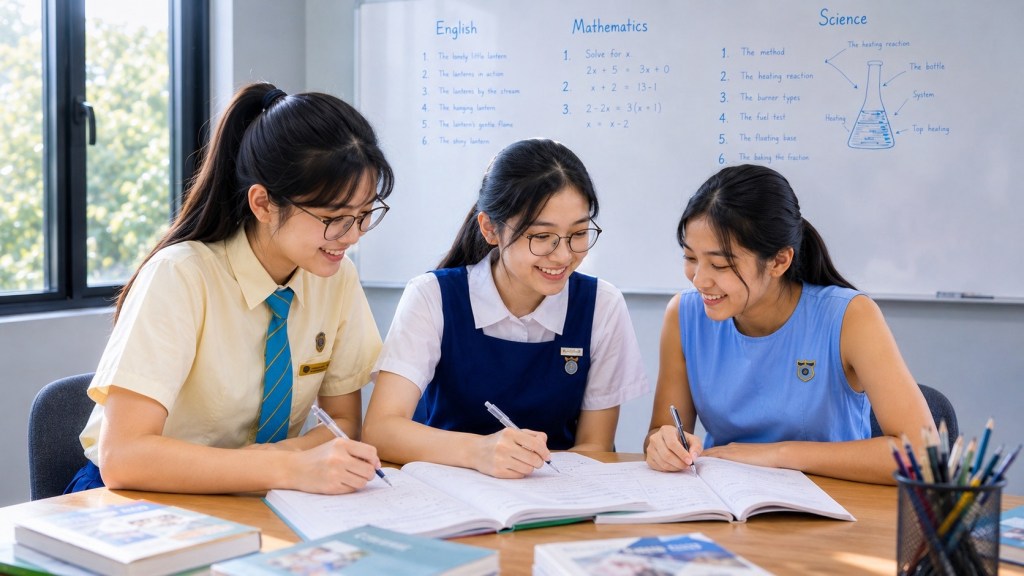
The Voyage Series by eduKate Sengkang
Rain begins over Sengkang.
A child sees puddles forming beside the path.
A gardener sees thirsty plants receiving water.
A cyclist sees a slippery road.
A shopkeeper sees customers hurrying under shelter.
A drain carries the same rain somewhere else.
One event.
Several viewpoints.
At Primary 1, the child learned to notice and describe.
At Primary 2, the child began connecting events and making simple inferences.
At Primary 3, the English Voyage widens again.
Now we ask:
How are the details connected, what can different people understand from the same event, and what can we infer from information that is not stated directly?
The water is still familiar.
The reading and thinking are becoming more powerful.
One Rainstorm Is Not One Story
Imagine this scene:
Heavy rain begins just before school dismissal.
Four people experience it.
Ethan
He has forgotten his umbrella.
Mrs Tan
She is waiting under shelter for her daughter.
Uncle Ravi
He is clearing leaves away from a nearby drain.
Sarah
She has been hoping all afternoon to use her new umbrella.
What is the weather?
The same for everyone.
But what does the rain mean to each person?
Ethan may feel worried.
Mrs Tan may be watching the school gate carefully.
Uncle Ravi may become concerned about drainage.
Sarah may be delighted.
The event is shared.
The meaning is not identical.
That is one of the things English allows us to explore.
Describe What Matters to the Viewpoint
Suppose Ethan tells the story.
He might notice:
Rain hammered against the covered walkway as he stared at the long distance between the school gate and the bus stop.
Sarah might describe:
Bright drops bounced from her new blue umbrella as she stepped happily into the rain.
Both are describing the same weather.
But they select different details.
Why?
Because their situations are different.
This gives us a useful writing principle:
Description is selection.
A writer does not include everything that exists.
The writer chooses what helps the reader understand the scene, character or purpose.
The Same Detail Can Mean Different Things
Consider:
The drain was filling quickly.
To one person, this might simply be an observation.
To Uncle Ravi, it could be a warning.
Why?
Because he understands what may happen if the drain becomes blocked.
The sentence itself is simple.
Its importance depends partly on what the reader or character knows.
This is why comprehension increasingly involves more than recognising words.
The reader has to connect:
detail
- ●
context
- ●
knowledge
to form meaning.
Follow the Clues
Read this:
Arjun stepped onto the pavement. He immediately returned under the shelter. A moment later, he pulled the zip of his bag closed and looked towards the darkening sky.
The text does not say:
Arjun expected heavy rain.
But the clues suggest something.
What are they?
- he returned to shelter,
- he closed his bag,
- he looked at the sky.
Together, the clues support an inference.
Perhaps:
Arjun thought it was about to rain heavily.
This is stronger than simply guessing.
We are reconstructing an unstated idea from several visible details.
One Clue May Not Be Enough
Suppose we only know:
Arjun looked at the sky.
Can we confidently conclude:
He expected a storm?
No.
Perhaps he saw a bird.
Perhaps he was looking for an aeroplane.
Perhaps he simply noticed a cloud.
One clue leaves many possibilities open.
Add:
He hurried beneath the shelter.
Now the interpretation becomes stronger.
Add:
Large drops began hitting the pavement.
Stronger still.
So Primary 3 comprehension can begin teaching another important habit:
The strength of an inference depends on the clues supporting it.
What Is Stated and What Is Inferred?
Consider:
The rain had stopped, but Mei refused to step onto the grass. She carefully walked around the edge of the field instead.
Stated
The rain had stopped.
Mei avoided the grass.
Possible inference
The grass may have been wet or muddy.
The author did not say:
The field was muddy.
But the character’s action gives us evidence.
Now ask:
Could there be another explanation?
Yes.
Perhaps Mei did not want to damage the grass.
Perhaps there was something on the field.
A thoughtful reader considers alternatives before becoming too certain.
Build a Scene From Several Details
Primary 3 writing can now become richer because the learner can coordinate several observations.
Start with:
It was raining.
Add sound:
Rain drummed against the metal roof.
Add movement:
Water rushed along the edge of the pavement.
Add people:
Students crowded beneath the covered walkway.
Add a focal character:
Zara stood near the steps, clutching a broken umbrella.
Now we have a scene.
But we still need organisation.
Which detail should come first?
What should the reader notice next?
Where should Zara enter?
Writing becomes more than producing descriptive sentences.
It becomes arranging information for a reader.
The Camera Can Move
Imagine writing like a camera.
Wide view
Dark clouds hung over the neighbourhood as heavy rain swept across the roads.
Move closer
Water streamed towards the drains beside the pavement.
Closer again
Near the school gate, a boy struggled with an umbrella that had turned inside out.
This movement helps a reader reconstruct the scene.
We could reverse it too:
character
→ surroundings
→ wider event.
There is no single correct route.
The writer chooses the route that serves the story.
Strong Description Is Not Maximum Description
Consider this:
The enormous, unbelievably gigantic, extremely wet, amazingly shiny, incredibly beautiful puddle sat on the grey, rough, hard, cold pavement.
Many describing words.
But is the image strong?
Not necessarily.
Try:
A wide puddle covered the pavement, reflecting the yellow lights from the sheltered walkway.
Fewer modifiers.
Clearer image.
Good vocabulary is not about decorating every noun.
It is about choosing words that carry useful information.
Verbs Can Carry the Scene
Compare:
Water went into the drain.
with:
Water flowed into the drain.
Water rushed into the drain.
Water trickled into the drain.
Water swirled around the drain.
Each verb gives the reader a different picture.
Now choose one.
Suppose the rain is very heavy.
Which verb fits best?
Perhaps:
rushed
Suppose only a little water remains.
Perhaps:
trickled
Vocabulary becomes powerful when it matches the observed situation.
Cause, Consequence and Connection
At Primary 2, we used words such as because.
At Primary 3, relationships can become richer.
Consider:
The drain was blocked.
What might follow?
Water began collecting on the pavement.
Now connect the ideas:
Because the drain was blocked, water began collecting on the pavement.
Or:
The drain was blocked, so water began collecting on the pavement.
Or:
Water began collecting on the pavement after leaves blocked the drain.
The sentences contain similar information.
But their structures emphasise the relationship differently.
Language gives us several ways to represent cause and sequence.
But Sequence Is Not Always Cause
This distinction becomes increasingly important.
Suppose:
The bell rang. Then it began to rain.
Did the bell cause the rain?
No.
One event happened after another.
That does not mean the first caused the second.
Compare:
Heavy rain fell for an hour. As a result, the field became waterlogged.
Here, there is a plausible causal connection.
So ask:
Did one event merely happen before the other, or did it help produce the other?
That question improves both reading and writing.
The Missing Middle
Here is a short passage:
The children left their classroom at 1.30 p.m. Ten minutes later, they were back inside with wet shoes and dripping umbrellas.
What happened in between?
The passage leaves a gap.
We can reconstruct possibilities:
- they went outside,
- it began or continued raining,
- they opened umbrellas,
- their shoes became wet,
- they returned.
But which details can we support?
We know their shoes and umbrellas were wet.
We know they had returned indoors.
We do not know exactly where they went.
That distinction matters.
A reader can reconstruct the likely shape of an event without inventing every missing detail.
Find the Strongest Explanation
Suppose a story says:
The playground was empty. Puddles covered the basketball court. Several umbrellas stood open beside the entrance.
Which explanation is strongest?
A
It had probably been raining.
B
Everyone had gone on holiday.
C
A water tanker had sprayed the basketball court.
All might be possible in some imaginable world.
But which is best supported by the clues?
A.
Good comprehension is often not about finding something merely possible.
It is about choosing the interpretation that best fits the available information.
Viewpoint Changes What Becomes Important
Now return to the same school scene.
The student
Notices:
whether the rain will stop before dismissal.
The cleaner
Notices:
wet floors and slippery entrances.
The gardener
Notices:
plants and soil.
The bus driver
Notices:
visibility and road conditions.
The writer
May choose any of these viewpoints.
This opens a useful Primary 3 exercise:
Describe the same rainstorm from two different viewpoints.
The facts should remain compatible.
The selected details can change dramatically.
Rewrite the Same Moment
Version 1 — Student
Dylan groaned when another sheet of rain swept across the courtyard. His football match was supposed to begin in twenty minutes.
Version 2 — Gardener
Mr Lim watched the rain soak into the dry soil around the young trees. He smiled and put away the hose.
The rain is the same.
The descriptions are different because the characters’ concerns differ.
The writer has rotated the viewpoint.
What Does the Character Know?
Suppose we write:
Daniel saw a puddle beside the drain.
Can Daniel know where every drop of water came from?
No.
Can the narrator know more than Daniel?
Possibly, depending on how the story is written.
This creates another useful question:
Who knows what?
A character may have incomplete information.
A narrator may reveal more.
A reader may sometimes infer something that the character has not yet understood.
That makes stories much more interesting.
The Reader Can Know More Than the Character
Consider:
Marcus left his open bag beside the window and ran downstairs. Outside, the sky darkened. A strong gust pushed the first drops of rain against the glass.
What can the reader predict?
Perhaps:
The bag may get wet.
Does Marcus know this yet?
Perhaps not.
This difference creates anticipation.
The reader sees a possible consequence before the character does.
That is one way writers control a story.
A Story Is a Chain of Changing States
Consider:
Beginning
A child has an umbrella.
Event
A strong gust breaks it.
New state
The child no longer has a useful umbrella.
That changes the available choices.
Now the child might:
- wait under shelter,
- call a parent,
- borrow an umbrella,
- run through the rain.
The event changes what can happen next.
So stories are not merely sequences of random actions.
Good stories often have:
SITUATION↓EVENT↓CHANGE↓NEW PROBLEM OR POSSIBILITY↓RESPONSE↓NEW SITUATION
That is useful for both comprehension and composition.
Ask What Each Event Changes
Suppose:
A girl’s water bottle develops a leak.
What changes?
She loses water.
Her bag may become wet.
Her books may be affected.
She may need another bottle.
Now the story has several possible routes.
A writer chooses one.
This gives Primary 3 children a stronger way to develop a plot:
Do not merely ask, “What happens next?”
Ask:
What did the last event change?
Then let the next event grow from that change.
The Voyage of a Message
Rain itself can carry information.
Imagine:
The school sends a message informing parents that an outdoor activity has been moved indoors because of severe weather.
Now several representations of the same situation may exist:
- the actual weather,
- a photograph,
- a parent message,
- a student’s description,
- a weather report.
Do they all contain exactly the same information?
No.
Each representation selects what matters for its purpose.
The parent message may focus on:
what has changed and what parents need to know.
The student’s story may focus on:
how the change felt.
Purpose changes representation.
Write for a Purpose
Suppose the rain causes a school event to move indoors.
Message to a friend
The carnival is inside now because of the rain!
Formal notice
Due to heavy rain, today’s outdoor activities will be conducted in the indoor hall.
Same event.
Different receiver.
Different purpose.
Different language choices.
Primary 3 learners can begin becoming more aware that communication is not one-size-fits-all.
A Short Comprehension Voyage
Read:
The rain had stopped by the time Jia Wen reached the park. She looked towards the playground, but instead of running towards the swings, she remained on the paved path. Her younger brother took one step onto the grass before she quickly called him back.
Ask:
What do we know?
The rain had stopped.
Jia Wen remained on the path.
She stopped her brother from stepping onto the grass.
What can we reasonably infer?
The grass may have been wet, muddy or slippery.
Which clue is strongest?
Her decision to remain on the paved path and call her brother back.
Do we know exactly why?
No.
We can form a well-supported inference without pretending the text gave us certainty.
A Short Writing Voyage
Use this situation:
A sudden rainstorm begins while two friends are walking home.
Plan using five stages.
1. Starting state
Where are they?
What are they doing?
2. Change
The rain begins.
3. Immediate consequence
What becomes difficult?
4. Choice
What options do they have?
5. Result
What happens because of their choice?
This gives the story a causal spine.
Now add:
- useful description,
- character response,
- dialogue where appropriate,
- viewpoint,
- and a clear ending.
The writing grows from the situation rather than from decorative vocabulary.
Better Dialogue Has a Job
Weak dialogue:
“It is raining,” said Ben.
“Yes,” said Ali.
“We are wet,” said Ben.
“Yes,” said Ali.
The dialogue tells us little.
Try:
“The bus stop is closer,” Ben shouted.
Ali pointed towards the covered walkway. “But we’ll have to cross the open court first.”
Now dialogue reveals:
- the problem,
- two possible routes,
- and what each character is thinking.
Dialogue becomes part of the story’s movement.
What Should the Reader Notice?
This is one of our central Primary 3 questions.
When writing:
What should the reader notice here?
When reading:
What is the writer making me notice?
When answering comprehension:
Which detail matters for this question?
This introduces a deeper kind of selection.
Not all information deserves equal attention.
The learner needs to find the salient information for the task.
The Same Passage Can Support Different Questions
A paragraph about rain might be used to ask:
Vocabulary:
What does “rushed” suggest about the movement of water?
Literal comprehension:
Where did the children wait?
Inference:
Why did Hana close her bag?
Character:
How did the rain affect Hana’s decision?
Sequence:
What happened immediately before the children returned indoors?
Same passage.
Different questions extract different structures.
Reading well means learning which part of the passage matters for the question being asked.
The Primary 3 English Voyage
We can now see the development:
OBSERVE↓SELECT↓CONNECT↓SHIFT VIEWPOINT↓FOLLOW CLUES↓INFER↓ORGANISE↓REPRESENT↓CHECK
Primary 3 is not simply Primary 2 with harder vocabulary.
The learner is beginning to coordinate more information at once.
That increases the load.
The solution is not simply to read faster.
The learner needs stronger organisation.
A Parent Can Try This at Home
Choose one event from an ordinary day.
Perhaps:
- sudden rain,
- a missed bus,
- a broken umbrella,
- a bird taking food,
- a crowded lift,
- a spilled drink.
Ask:
What happened?
Then:
Which three details matter most?
Then:
How might another person describe it differently?
Then:
What can we infer?
Then:
Which clue supports that inference?
Then:
What changed because of the event?
Finally:
Tell me the whole thing again, but organise it so I can see why each event led to the next.
That final retelling forces the child to integrate observation, inference and structure.
Read Water Another Way
The same Water Voyage is now becoming more sophisticated across all three lenses.
English
What information matters, how do viewpoints differ, and what can we infer from connected clues?
Science
What can systematic observation and evidence tell us about the process?
Mathematics
What quantities and representations reveal the underlying relationship?
The shared world remains stable.
The disciplinary operations are becoming increasingly specialised.
That is exactly what should happen.
The Voyage Returns Home
The next time rain changes your plans, notice the event.
Then ask:
What changed?
What did I notice first?
What did somebody else notice?
What do I know for certain?
What am I inferring?
Which detail made me think that?
These questions make English much larger than an exercise in producing sentences.
English becomes a way of building and communicating a structured model of experience.
Primary 3 English at eduKate Sengkang
Primary 3 is an important stage in the development of English because children increasingly need to coordinate skills that were previously easier to practise separately.
They need vocabulary.
They need grammatical control.
They need sentence construction.
They also increasingly need to:
- follow relationships across a passage,
- identify important details,
- infer from several clues,
- recognise viewpoint,
- maintain paragraph unity,
- develop a coherent sequence,
- select language for purpose,
- and express ideas clearly enough for another person to reconstruct them.
At eduKate Sengkang, we therefore treat progress as more than accumulating isolated language exercises.
The learner needs to bring:
understanding + language + structure + execution
together in one performance.
The Voyage Series gives those capabilities a real world to operate on.
Families considering Primary 3 English tuition in Sengkang can speak with us about their child’s current English profile and the most useful next learning route.
Continue the Voyage
Next English Voyage
Primary 4 English Sengkang | The Voyage of Water
The learner moves into stronger causal relationships, larger information fields, deeper inference and more deliberate control over viewpoint and representation.
See Water Another Way
Primary 3 Mathematics Sengkang | The Voyage of Water
How can diagrams, measurement and mathematical representations expose relationships that are becoming harder to hold mentally?
Primary 3 Science Sengkang | The Voyage of Water
The Discovery Voyage reaches formal Primary Science: observation and questioning now connect to increasingly systematic concepts, processes and explanations.
The Voyage Series
One World. Many Voyages. Three Ways of Seeing.
The water has not become harder.
The learner has become capable of seeing more inside it.
