
The Voyage Series by eduKate Sengkang
A raindrop lands on a window.
For an adult, it may be nothing unusual.
For a Primary 1 child, it can be the beginning of a very large journey.
Where did the drop come from?
Where will it go?
What does it look like?
What sound does it make?
What happened before it appeared on the window?
What might happen next?
This is the idea behind Primary 1 English Sengkang | The Voyage of Water.
We begin with something real and familiar, then use English to help a child notice it, describe it, organise what happened and communicate an idea clearly.
The lesson is not really about memorising facts about water.
It is about learning how to turn the world into language.
Start With One Raindrop
Imagine a rainy afternoon in Sengkang.
A child is looking through the window.
A drop of water appears near the top of the glass.
It moves.
Slowly at first.
Then another drop joins it.
The larger drop begins to move more quickly.
Finally, it disappears below the window frame.
Ask the child:
What did you see?
The first answer might be:
A raindrop.
Good.
Now look again.
Was it:
- big or small?
- moving or still?
- clear or cloudy?
- alone or beside other drops?
- moving quickly or slowly?
Suddenly, one noun is no longer enough.
The child needs words that carry more information.
drop
becomes:
small drop
then:
a small drop of rain
then:
a small drop of rain moving slowly down the window
The world has not changed.
The child’s representation of it has.
Primary 1 English Begins With Learning to Notice
Children cannot describe what they have not noticed.
That makes attention an important part of language learning.
Consider two sentences:
It was raining.
and:
Heavy rain tapped against the window while small drops raced down the glass.
Both describe rain.
But the second sentence required the writer to notice more.
The writer noticed:
- sound,
- movement,
- size,
- place,
- and perhaps speed.
Better vocabulary helps.
Grammar helps.
Sentence construction helps.
But before any of them can be used well, there has to be something worth putting into the sentence.
So one of our first Voyage habits is very simple:
Look once.
Then:
Look again.
The second look often gives the child more to say.
The Raindrop Starts to Travel
Now we move from description to sequence.
Ask:
What happened first?
Perhaps:
Rain fell from the sky.
Then:
A drop landed on the window.
Then:
It moved down the glass.
Then:
It disappeared.
We can now introduce useful sequence language:
First…
Next…
Then…
Finally…
The child is doing more than writing four sentences.
The child is learning that events have an order and that language can preserve that order for another person.
Try it:
First, a raindrop landed on the window.
Next, it slowly moved down the glass.
Then, another drop joined it.
Finally, the large drop disappeared from sight.
The reader was not standing beside the window.
Yet the reader can reconstruct part of what happened.
That is one of the powers of English.
But Did We Really See Everything?
Here is the next Voyage question.
Where did the raindrop go?
A child might answer:
Into the drain.
Perhaps.
But did we actually see that happen?
No.
We saw the drop disappear below the window.
So now we can make a very small but important distinction.
What we saw:
The drop moved below the window frame.
What we think might have happened:
Perhaps it continued down the glass.
That gives a Primary 1 child the beginnings of another useful habit:
Know the difference between what you saw and what you guessed.
We do not need complicated terminology.
We can simply ask:
Do we know that, or do we think that?
That tiny question can travel a very long way through a child’s education.
The Same Rain Can Look Different
Now move away from the window.
It is still raining in Sengkang.
But imagine four people.
The child
The child may think:
I cannot go to the playground.
The gardener
The gardener may think:
The plants are getting water.
The person carrying groceries
That person may think:
I need to reach the shelter quickly.
A child wearing new rain boots
That child may think:
This is wonderful!
There is only one rainstorm.
But there are several experiences of it.
This lets a Primary 1 learner discover something important without needing a difficult explanation:
Different people can notice different things about the same event.
Ask:
Is anyone necessarily lying?
No.
They may simply be standing in different places, wanting different things and noticing different parts of the same situation.
Try the Viewpoint Switch
Give the child this sentence:
It began to rain heavily.
Now choose a person.
You are going to the playground.
Finish:
I felt __________ because __________.
Now change the person.
You are taking care of a thirsty garden.
Finish:
I felt __________ because __________.
Same rain.
Different viewpoint.
Then ask:
Did the weather change?
No.
What changed?
The person looking at it.
That is a surprisingly powerful English lesson hidden inside a very small exercise.
Give the Raindrop a Voice
Now we can use imagination.
Suppose the raindrop could speak.
What might it say?
I fell through the grey sky.
Or:
I landed with a tiny splash.
Or:
Another drop bumped into me.
Or:
Down the window I went!
This gives the child permission to create.
But there is another useful distinction.
A raindrop does not really talk.
So this time we are imagining deliberately.
Earlier we tried to separate what we observed from what we guessed.
Now we are doing something different again:
creating something we know is imaginary.
These are all valid uses of English.
The important skill is learning which one we are doing.
From Words to a Small Story
We can now assemble what the child has learned.
Start with five questions:
Where was the raindrop?
What did it look like?
What did it do?
What happened next?
How did someone feel about it?
A simple Primary 1 story might become:
One rainy afternoon, Mia looked out of her window. A tiny raindrop landed on the glass. It moved slowly downwards and joined another drop. Soon, the two drops became one big drop and disappeared below the window. Mia smiled. She wanted to put on her yellow rain boots and splash in the puddles downstairs.
There is vocabulary here.
There is grammar.
There are sentences.
There is sequence.
There is description.
There is viewpoint.
There is imagination.
But the language skills are not sitting in separate boxes.
They are working together to help the child communicate one coherent experience.
A Parent Can Try This at Home
You do not need a worksheet.
Choose something ordinary:
- rain on a window,
- an ant walking across the floor,
- a bus arriving,
- an ice cube melting,
- a bird on a railing,
- a leaf falling from a tree.
Then use five prompts:
1. What do you notice?
2. What else do you notice?
3. What happened first, next and last?
4. What do we know, and what are we only guessing?
5. How might somebody else see this differently?
Then ask the child to tell you about it.
You can help with vocabulary or sentence construction after the child has formed the idea.
That order matters.
We are not merely asking:
Can you produce a correct sentence?
We are also helping the child build something worth expressing.
The Voyage Continues Beyond Primary 1
The raindrop does not have to disappear when Primary 1 ends.
A Primary 2 learner can sequence a longer journey.
A Primary 3 learner can describe different viewpoints.
A Primary 4 learner can make stronger inferences.
A Primary 5 learner can compare different accounts.
A Primary 6 learner can examine what a text states, implies or leaves uncertain.
Later, a Secondary student can study how language, evidence, perspective and purpose change the way the same event is represented.
The raindrop stays small.
The learner’s aperture becomes larger.
That is the progression behind The Voyage Series.
Read the Same Water Another Way
There is another surprise.
English is only one way to encounter the raindrop.
English Voyage
What happened, what does it mean, and how can I communicate it?
Science Voyage
What is changing, and how could I investigate it?
Mathematics Voyage
How much is there, what can I compare, and what relationship can I represent?
There are not three different raindrops.
There is one world.
We are learning different ways to look at it.
Coming Home
A good voyage should change the traveller.
So after reading this, do something very simple.
The next time it rains, look at one raindrop.
Then look again.
Ask yourself:
What did I miss the first time?
If a child begins doing that independently, something important has happened.
English is no longer only something that appears inside an exercise book.
It has become another way of seeing the world.
Primary English at eduKate Sengkang
At eduKate Sengkang, we want children to develop the language needed for school while also learning how to notice, understand, organise and express ideas clearly.
Vocabulary matters.
Grammar matters.
Sentence construction matters.
Comprehension matters.
But their value becomes much greater when a child can bring them together to communicate what they see, think and understand.
The Voyage Series is one way we make that progression visible.
If you are considering Primary English tuition in Sengkang and would like to understand how we approach your child’s learning, you can speak with us about whether the programme is a suitable fit.
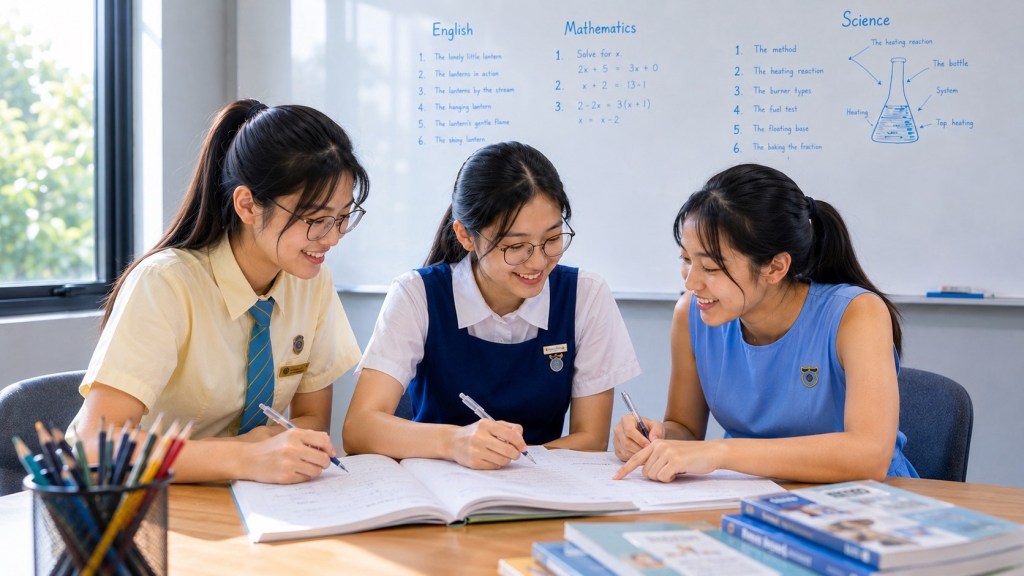
The Voyage Series
One World. Many Voyages. Three Ways of Seeing.
