
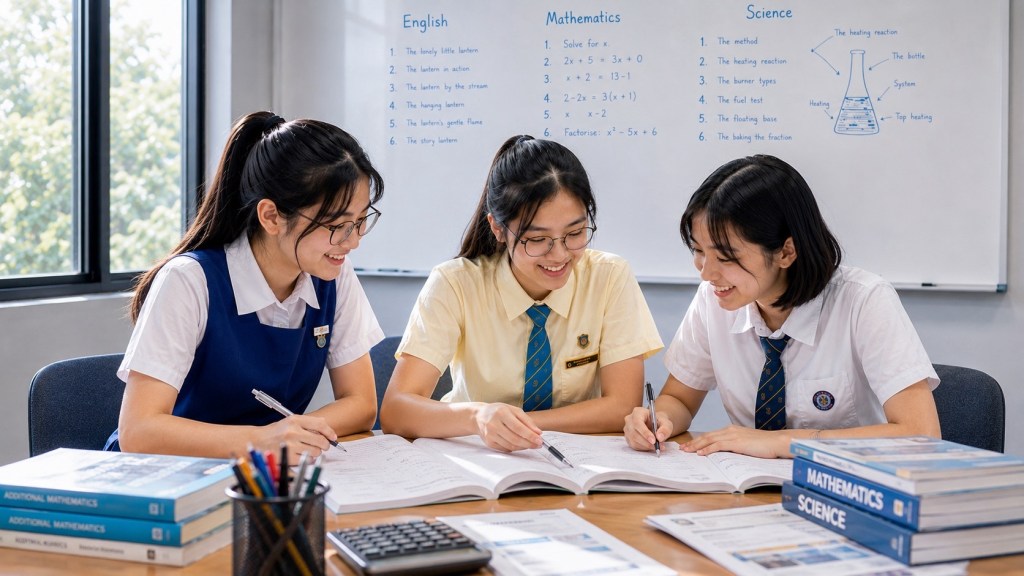
Secondary 4 Mathematics changes the operating condition of learning. The learner is no longer working inside one chapter with the method announced in advance. A paper mixes algebra, graphs, geometry, trigonometry, statistics, probability, percentages, rates and real-world contexts. The mathematical knowledge still matters, but now that knowledge has to be found, selected, executed and checked under time pressure.
This guide develops the first Secondary 4 habit: build an examination route before you calculate. It belongs to the Secondary Mathematics Sengkang | S1–S4 Capability Map and the Secondary 4 Mathematics Learning Guide series.
In Secondary 4, knowing Mathematics is necessary. Being able to access the right Mathematics at the right moment is the examination skill.
The Secondary 4 Shift: From Topic Practice to Mixed-Route Performance
Chapter practice is useful because it isolates a skill. It lets a learner build fluency without also having to decide which topic is being tested. An examination removes that support. The chapter name disappears. Several familiar ideas may sit inside one unfamiliar surface. The learner must decide what the question is asking before any procedure can help.
This creates a common Secondary 4 puzzle: a student can complete a worksheet on a topic but still struggle when the same idea appears in a mixed paper. The weakness is not always the topic itself. The missing capability may be classification, representation, route selection, verification or recovery.
| Practice condition | What the learner is told | What the learner must decide |
|---|---|---|
| Single-topic worksheet | The topic and often the expected method | Mainly execution |
| Mixed revision | Only that several topics may appear | Classification and method selection |
| Examination paper | The question, marks and conditions | Classification, representation, route, timing, checking and communication |
Know the Examination System, Then Learn Beyond the Labels
Singapore is in a transition period. For 2026 school candidates, the legacy GCE Mathematics syllabuses still operate, including O-Level Mathematics 4052, N(A)-Level Mathematics 4045 and N(T)-Level Mathematics 4046. From 2027, the Singapore-Cambridge Secondary Education Certificate uses G1, G2 and G3 Mathematics, with K110, K210 and K310 respectively. The official syllabus pages are maintained by the Singapore Examinations and Assessment Board.
The labels matter because students should use the syllabus and paper format for their own cohort. But the deeper learning system is shared: read accurately, identify the mathematical structure, represent it, choose a valid technique, show enough working, interpret the result and check that the answer still fits the original problem.
The Examination Route
classify → represent → select route → execute → verify → communicate → recover if needed
This sequence is not a rigid script. In routine questions, several stages happen almost instantly. In unfamiliar questions, making the stages visible can stop a learner from committing too early to the wrong method.
Stage 1 | Classify the Mathematical Job
Before touching the calculator, identify what the question is actually asking. The topic label is less important than the mathematical job.
- Find a value?
- Form an equation?
- Compare two quantities?
- Use a graph to infer a relationship?
- Show that a statement is true?
- Calculate a probability?
- Interpret data?
- Optimise or compare choices in a real-world situation?
- Use geometry or trigonometry to recover an unknown length or angle?
Two questions can contain the same numbers but demand different mathematics. Numbers are inputs. Relationships determine the route.
Stage 2 | Separate Given, Unknown, Relationship and Constraint
| Role | Question to ask |
|---|---|
| Given | What information is supplied directly? |
| Unknown | What must eventually be found or shown? |
| Relationship | How are the quantities connected? |
| Constraint | What must remain true while solving? |
A constraint may be a domain restriction, a geometrical condition, a unit, an integer requirement, a maximum capacity, a time window, a probability between 0 and 1, or a statement such as “not drawn to scale”. Conditions are not decoration. They define which answers are possible.
Worked Example 1 | Route Before Arithmetic
Question: A taxi fare consists of a fixed booking charge of $3.60 and a distance charge of $0.75 per kilometre. A passenger pays $18.60. Find the distance travelled.
A rushed learner may divide 18.60 by 0.75 immediately. The route is wrong because the total contains a fixed component. First separate the structure: total = fixed charge + distance charge.
18.60 = 3.60 + 0.75d
Subtract the fixed charge first: 15.00 = 0.75d, so d = 20. The distance is 20 km.
The arithmetic was simple. The examination skill was identifying the model before calculating.
Stage 3 | Choose the Representation That Exposes the Structure
Representation is the bridge between reading and method selection. A difficult paragraph may become a simple equation. A cluttered geometry problem may become manageable after a clean labelled sketch. A pattern may become obvious in a table. A proportional relationship may become clearer as a ratio or graph.
- Words → equation when an unknown is bound by relationships.
- Data → table when corresponding values need comparison.
- Relationship → graph when behaviour and change matter.
- Geometry statement → labelled diagram when constraints must be visible.
- Repeated outcomes → sample space when probability events must be organised.
- Financial context → timeline or rate model when amounts change over time.
The best representation is not the fanciest one. It is the form that makes the next mathematical decision easier.
Stage 4 | Select the Route, Not Just a Formula
A formula is one tool inside a route. Route selection asks a wider question: what sequence of steps preserves the relationship and reaches the required unknown efficiently?
For example, a geometry question may be solvable by Pythagoras, trigonometry or similarity. A data question may be answered by direct calculation or by reading a graph. An algebraic unknown may be isolated by forming one equation, two simultaneous equations or a proportion. Efficient learners choose the simplest valid route they can execute reliably.
Worked Example 2 | Two Possible Routes
A right-angled triangle has hypotenuse 13 cm and one shorter side 5 cm. Find the remaining side.
You could use trigonometry if an angle were known, but no angle is needed. Pythagoras gives the direct route:
x² + 5² = 13² → x² = 144 → x = 12
The remaining side is 12 cm. Route quality means doing enough thinking before doing more working.
Stage 5 | Execute With Working That Can Be Read
Secondary 4 working should make the mathematical chain visible. This matters for both accuracy and marks. In the 2026 O-Level Mathematics 4052 syllabus, SEAB explicitly notes that omission of essential working results in loss of marks. Good working is therefore not decorative presentation. It is evidence of the method.
- Write the equation before solving it.
- Show the substitution before giving the calculator result.
- State the theorem or relationship when justification matters.
- Keep exact values until rounding is required.
- Carry units through measurement and rate questions.
- Do not compress three fragile transformations into one unreadable line.
Clear working also helps recovery. If something looks wrong, the learner can inspect the chain and locate the first divergence instead of restarting the entire question.
Stage 6 | Verify Before the Answer Leaves the Page
“Check your work” is too vague. A useful check must match the problem.
| Problem type | Useful verification |
|---|---|
| Equation | Substitute the solution back into the original equation. |
| Percentage / finance | Estimate direction and size; reverse the percentage if possible. |
| Geometry | Check angle totals, length plausibility and diagram constraints. |
| Trigonometry | Check whether the side/angle relationship is plausible and units are correct. |
| Probability | Ensure 0 ≤ P ≤ 1 and check whether events were counted consistently. |
| Statistics | Compare the answer with the data range and context. |
| Real-world model | Put the answer back into the story and ask whether it makes practical sense. |
Worked Example 3 | Verification Catches the Wrong Branch
Suppose a quadratic-style context leads to two numerical solutions, 4 and −7, but the unknown represents a physical length. Algebra can produce both values correctly while the context allows only the positive one. Verification is the stage where mathematical solutions are tested against the original meaning.
A solution can be algebraically valid and contextually impossible.
Stage 7 | Communicate the Answer Precisely
A correct number can still be an incomplete response. Secondary 4 answers should respect the requested form, accuracy, units and context.
- If the question asks for dollars, write the money appropriately.
- If it asks for an angle, include degrees.
- If it asks for a probability, use a valid probability form.
- If it asks for an explanation, a naked number is not enough.
- If it asks for exact form, do not convert to a decimal unnecessarily.
- If a stated accuracy is required, round only at the correct stage.
Recovery: What to Do When the First Route Fails
Examinations contain uncertainty. A mature learner needs a recovery protocol rather than a panic response.
| Signal | Recovery move |
|---|---|
| The algebra becomes unexpectedly messy | Return to the original relationship and check representation. |
| A geometry answer is impossible | Check whether the wrong side, angle or theorem was used. |
| The calculator gives a strange magnitude | Estimate independently and inspect units. |
| You cannot start | Write what is given, what is unknown and one relationship that must be true. |
| You have spent too long | Leave a clear partial route, move on, and return later if time permits. |
Recovery is not giving up on the question. It is changing the operating state so that one stuck route does not consume the entire paper.
The Marks Are Also Information
The mark allocation can help calibrate the expected depth. A one-mark item usually does not require a page of algebra. A longer question may require several linked stages, interpretation or explanation. Marks do not reveal the method, but they can warn you when your response is far too short or far too elaborate.
Time Control Without Racing
Time management is not simply “work faster”. It is the distribution of attention across a paper. A student who rushes every question can create avoidable errors. A student who spends ten minutes forcing one low-progress route can lose opportunities elsewhere.
- Secure routine marks efficiently.
- Do not let one question monopolise the paper.
- Leave readable working so you can re-enter the question later.
- Reserve checking time for high-risk calculations, units, accuracy and answers that feel implausible.
- Use the calculator after the mathematical setup is stable, not as a substitute for setup.
Calculator Discipline
A calculator is powerful because it executes numerical operations quickly. It is dangerous when it makes an unstable model look precise. A wrong formula entered perfectly produces a precise wrong answer.
Before pressing equals, ask: What quantity should this result represent? What approximate size should I expect? Should it be positive or negative? Is the unit already determined? Does the result need to be exact or rounded?
A Secondary 4 Mixed-Paper Training Cycle
| Cycle | Purpose |
|---|---|
| 1. Attempt | Work under realistic mixed-topic conditions. |
| 2. Mark | Separate correct, incomplete and wrong responses. |
| 3. Diagnose | Find the first weak link: knowledge, reading, representation, method, execution, checking or time. |
| 4. Repair | Practise the narrow capability that failed. |
| 5. Reattempt | Solve the original problem again without copying the correction. |
| 6. Transfer | Attempt a different-looking question using the same underlying capability. |
This cycle prevents revision from becoming answer collection. The purpose of corrections is to change the next attempt.
Error Log: Record the Failure Type, Not Only the Question Number
A useful Secondary 4 error log classifies mistakes by cause. “Question 7 wrong” does not tell you what to fix. “Formed the equation before subtracting the fixed charge” does.
- Knowledge gap — concept or theorem not available.
- Representation error — words, diagram or data translated incorrectly.
- Route error — valid information, wrong method.
- Execution error — arithmetic, algebra or calculator input failed.
- Communication error — working, units, accuracy or explanation incomplete.
- Verification failure — implausible result was not caught.
- Time failure — too much time spent for too little progress.
Checkpoint | Is the Student Becoming Examination-Ready?
- Can the student identify the mathematical job before calculating?
- Can the learner separate given information, unknowns, relationships and constraints?
- Can the student choose a useful representation without being prompted?
- Can the learner explain why a method fits the structure?
- Is essential working visible?
- Can the student estimate enough to detect absurd results?
- Can the learner recover when the first method fails?
- Can the student move between topics in a mixed paper without waiting for a chapter label?
- Can errors be classified by cause rather than dismissed as carelessness?
A Parent-Friendly View of Secondary 4 Mathematics
Parents do not need to become the Mathematics teacher. Useful observations are operational. Does the learner know why an answer is wrong? Can the student explain the route without reading the solution? Are corrections repeated from memory or reconstructed from understanding? Does a mistake reappear when the surface changes?
These questions reveal whether revision is producing independence. The final year should gradually transfer more route selection and error control to the learner.
How This Connects to the Next Guides
The examination route is the control layer. The next guides apply it to major Secondary 4 mathematical systems: Algebra, Functions and Graphs Under Mixed-Topic Conditions, Geometry, Trigonometry and Measurement as a Constraint System, and Statistics, Probability and Real-World Problems Under Exam Conditions.
Final Thought
Secondary 4 Mathematics is where several years of learning have to become a reliable operating system. The student needs more than stored procedures. The learner needs to recognise structure, preserve relationships, choose an efficient route, execute accurately, detect failure and communicate the answer clearly.
Do not begin by asking, “What can I calculate?” Begin by asking, “What route makes this problem solvable?”
Return to the Secondary Mathematics Sengkang | S1–S4 Capability Map.
Examination-route Mathematics inside the Tutor System
This guide owns the Mathematics examination route. When a learner needs human tutoring to stabilise method selection, timing, checking or recovery, use The Tutor System to connect the Mathematics evidence to the right tutor function and to parent/student responsibilities.
