
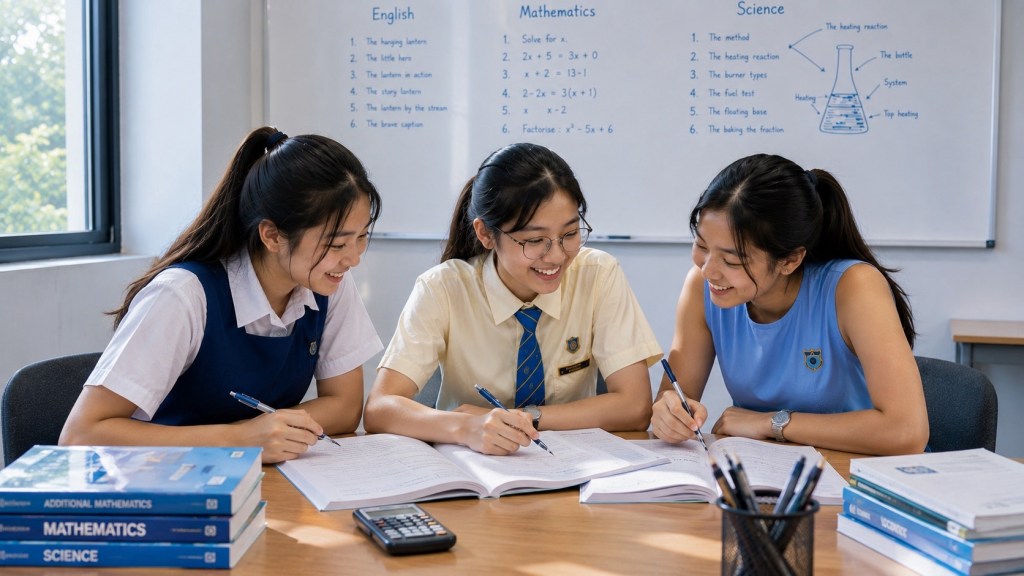
Use this page to choose among eight Secondary 4 lessons. For other stages or teaching support, return to the Mathematics Hub.
SECONDARY 4 MATHEMATICS CLASSROOM · CHAPTER-BY-CHAPTER LEARNING ROUTE · SEC G3 K310
Secondary 4 Mathematics: Learn the Whole Course as One Connected System
This is not a page to read once. It is the entrance to eight teaching classrooms. Enter the chapter that owns the first weak step, complete the lesson, retry the original problem, then return later without notes.
Secondary 4 Mathematics becomes manageable when you stop treating the syllabus as a pile of separate topics. Sets supports probability language. Algebra supports graphs and formulae. Ratio supports similarity. Pythagoras supports vectors, coordinates and three-dimensional geometry. Statistics depends on careful representation. Full-paper questions can combine several of these in one real-world situation.
Classroom rule: diagnose the first incorrect decision, enter the classroom that owns it, repair it, and return to the larger question.
This classroom route follows the current Singapore-Cambridge Secondary Education Certificate G3 Mathematics syllabus, subject code K310. The syllabus is organised into Number and Algebra, Geometry and Measurement, and Statistics and Probability, while also assessing application, connections, reasoning and mathematical communication.
Official reference: 2027 SEC G3 syllabuses | Singapore Examinations and Assessment Board.
Featured Answer: What Is the Secondary 4 Mathematics Classroom?
The Secondary 4 Mathematics Classroom is a complete teaching route through eight connected classrooms. Each classroom begins from first principles, models the method, gives guided practice, diagnoses common errors, builds examination transfer and ends with retrieval work.
The route is designed around one operating question:
What is the smallest mathematical idea that must become reliable before the student can solve the larger problem independently?
That question changes revision. Instead of completing more pages blindly, you identify the first missing relationship, representation or procedure and repair exactly that.
The Simple Classroom Answer
Use this route in four movements:
- Enter: choose the classroom from the first weak step.
- Learn: follow teacher model, guided practice and misconception correction.
- Return: retry the original question without copying the worked example.
- Transfer: place the skill into mixed and full-paper practice.
Diagnosis → teaching → guided attempt → correction → variation → delayed retrieval → examination transfer.
How to Use This Classroom Route
- Attempt a question before opening the relevant classroom.
- Circle the first line that is wrong, unsupported or uncertain.
- Use the diagnostic table below to find the owning classroom.
- Complete the teacher model and at least one guided practice set.
- Close the page and retry the original question.
- Change one condition and solve again.
- Return after a delay to test retrieval.
- Use a mixed paper only after the local method is stable.
You do not need to complete all eight classrooms in order. Start where the evidence says you should start. Then reconnect the skill to the wider course.
1. See the Course as Three Strands and One Problem-Solving System
| K310 strand | Core classroom work | Where it appears here |
|---|---|---|
| Number and Algebra | number operations, ratio, percentage, rates, algebra, functions, equations, inequalities, sets and matrices | Chapters 1, 4 and 6 |
| Geometry and Measurement | angles, construction, similarity, circles, trigonometry, mensuration, coordinates and vectors | Chapters 5 and 7 |
| Statistics and Probability | data, representations, centre, spread, probability, possibility diagrams and tree diagrams | Chapters 2, 3 and 8 |
The strands organise content, but examination questions can cross them. A finance question may require percentage, algebra and graphs. A navigation problem may require bearings, trigonometry, scale and coordinates. A data question may require percentage comparison and written interpretation.
2. Learn the Assessment Objectives as Study Instructions
K310 assesses three broad forms of mathematical performance.
| Assessment objective | Approximate weighting | What to practise |
|---|---|---|
| AO1: Use and apply standard techniques | 45% | facts, notation, direct reading, routine procedures and accurate calculation |
| AO2: Solve problems in varied contexts | 40% | translation, method selection, connections, modelling, relevant information and interpretation |
| AO3: Reason and communicate mathematically | 15% | justification, explanation and mathematical argument |
A revision programme that trains only routine procedures leaves a large part of the examination unprepared. Every classroom therefore includes method selection, written reasoning and transfer.
3. Use the Examination Structure to Shape Practice
K310 has two papers of equal weighting. Paper 1 is 2 hours 15 minutes, carries 90 marks and contains about 26 short-answer questions. Paper 2 is 2 hours 15 minutes, carries 90 marks and contains 9 to 10 questions of varying length. The final Paper 2 question focuses specifically on applying mathematics to a real-world scenario.
An approved calculator may be used in both papers. Relevant mathematical formulae are provided, but essential working still matters. Geometrical instruments should be available for both papers.
Therefore practise three modes:
- short retrieval: fast, accurate access to standard techniques;
- extended reasoning: multi-step questions with visible justification;
- real-world transfer: extracting the mathematics from unfamiliar information.
3A. Turn the 2027 SEC Paper Structure Into a Practice Architecture
The examination structure tells us how practice should be distributed. Paper 1 has about 26 short-answer questions in 2 hours 15 minutes for 90 marks. Paper 2 has 9–10 questions of varying length in 2 hours 15 minutes for 90 marks, with the final question focused specifically on applying mathematics to a real-world scenario. Both papers carry 50% of the qualification.
| Training mode | Main purpose | Typical demand | What to inspect after marking |
|---|---|---|---|
| Paper 1 retrieval | breadth, recognition and clean execution | AO1 with fast AO2 switching | Was the topic recognised quickly? Was the standard method executed without avoidable notation, calculator or algebra errors? |
| Paper 2 connected problem | multi-step modelling and topic handoffs | AO2 with AO1 embedded | Where did the representation or method choice first fail? Did an earlier result get carried forward correctly? |
| Reasoning item | justify, explain, prove and communicate | AO3 | Is every conclusion supported by a mathematical reason rather than appearance or assertion? |
| Real-world final-question rehearsal | translate a messy context into mathematics and return an interpretable answer | AO2 + AO3 | Were irrelevant details filtered out? Were units, assumptions, constraints and the final contextual conclusion handled explicitly? |
Teacher rule: do not allow a student to spend an entire revision week inside only one of these modes. Technique, selection, connection and explanation must all remain available because the SEC examination samples the whole performance system.
4. Start With the First-Wrong-Step Diagnostic
Do not diagnose from the title of the question. Diagnose from the first incorrect decision.
| What goes wrong first? | Enter this classroom |
|---|---|
| set symbol, Venn region, overlap, complement or “neither” | Chapter 1: Sets |
| sample space, route, replacement, tree branch, “at least one”, independence or mutual exclusivity | Chapter 2: Probability of Combined Events |
| mean, median, grouped data, cumulative frequency, quartiles, box plots, standard deviation or misleading graph | Chapter 3: Statistical Data Analysis |
| matrix order, corresponding entries, scalar multiplication, compatibility or row-by-column product | Chapter 4: Matrices |
| vector direction, magnitude, translation, position vector, ratio, parallelism or collinearity | Chapter 5: Vectors |
| indices, ratio, percentage, rate, algebra, formulae, equations, inequalities, functions or graphs | Chapter 6: Numbers and Algebra Revision |
| angle fact, congruence, similarity, circle property, trigonometry, bearings, mensuration, radians or coordinates | Chapter 7: Geometry and Measurement Revision |
| difficulty switching between data and chance, or mixed final-paper transfer | Chapter 8: Probability and Statistics Revision |
5. Chapter 1 Classroom — Sets
Enter Chapter 1 when the student confuses membership with subsets, union with intersection, one-set complements with “neither”, or set totals with exclusive regions.
The classroom teaches the student to move through:
universal set → condition → notation → region → count → conservation check.
- set membership and subset notation;
- empty and universal sets;
- complements;
- union and intersection;
- two-set Venn diagrams;
- “at least one”, “exactly one” and “neither”;
- counting from the overlap outward;
- algebraic unknowns in Venn regions;
- worked practice, misconception clinics and exit tickets.
Enter Chapter 1 Classroom: Sets →
6. Leave Chapter 1 Only When the Language Is Stable
The student should be able to read a phrase, point to the correct Venn region, write the notation and calculate without changing the meaning midway.
Chapter 1 readiness check
Can you distinguish ∈ from ⊆? Can you take a complement only after identifying the universal set? Can you translate A only, B only, both, at least one, exactly one and neither? Can you fill the intersection first and make all four regions add to the universal total?
7. Chapter 2 Classroom — Probability of Combined Events
Enter Chapter 2 when the student begins by guessing whether to add or multiply, forgets an ordering, keeps an unchanged denominator without replacement, or confuses independent with mutually exclusive events.
The classroom teaches:
sample space → event → representation → replacement check → routes → probability → boundary check.
- probability as a measure from 0 to 1;
- outcomes, events and sample spaces;
- single-event probability and complements;
- possibility diagrams;
- tree diagrams;
- replacement and non-replacement;
- multiplying along routes and adding alternatives;
- exactly one and at least one;
- mutually exclusive and independent events;
- worked practice and examination routines.
Enter Chapter 2 Classroom: Probability of Combined Events →
8. Leave Chapter 2 Only When the Route Is Visible
The student should be able to label endpoints, explain why route probabilities multiply, explain why alternative successful routes add and check that branch probabilities and final probabilities are valid.
Chapter 2 readiness check
Can you decide between a possibility diagram and a tree? Can you change later probabilities after no replacement? Can you list all valid orderings? Can you distinguish exactly one from at least one? Can you use a complement strategically rather than automatically?
9. Chapter 3 Classroom — Statistical Data Analysis
Enter Chapter 3 when the student reaches for a calculator before identifying the variable, chooses a statistic by habit, reads cumulative frequency as ordinary frequency, compares only means or gives a vague statement such as “more consistent” without naming a measure.
The classroom teaches:
variable → units → representation → centre/spread/position → calculation → interpretation → limitation.
- data classification and frequency tables;
- bar graphs, line graphs, pie charts, dot diagrams, histograms and stem-and-leaf diagrams;
- mean, median and mode;
- grouped mean;
- cumulative frequency;
- quartiles and percentiles;
- range and interquartile range;
- box-and-whisker plots;
- standard deviation for grouped and ungrouped data;
- comparison and misleading diagrams.
Enter Chapter 3 Classroom: Statistical Data Analysis →
10. Leave Chapter 3 Only When Every Number Has Meaning
The student should attach every statistic to a variable and units, compare centre and spread separately, identify when grouped values are estimates and explain the precise mechanism that makes a diagram misleading.
Chapter 3 readiness check
Can you choose a representation from its purpose? Can you construct cumulative totals? Can you locate median, quartiles and percentiles from the frequency axis first? Can you interpret standard deviation as spread around the mean? Can you keep a conclusion inside the evidence?
11. Chapter 4 Classroom — Matrices
Enter Chapter 4 when the student reverses rows and columns, adds matrices with different orders, multiplies entry by entry, ignores compatibility or obtains a product but cannot explain what its rows and columns mean.
The classroom teaches:
labels → order → compatibility → operation → result order → interpretation.
- matrices as compressed data tables;
- order as rows × columns;
- entries identified by row and column;
- matrix addition;
- scalar multiplication;
- matrix-product compatibility;
- row-by-column multiplication;
- why AB need not equal BA;
- quantity-price applications;
- category alignment and output interpretation.
Enter Chapter 4 Classroom: Matrices →
12. Leave Chapter 4 Only When the Structure Survives the Arithmetic
The student should predict whether an operation is defined, predict the result order, perform the calculation and interpret the output without losing the category labels.
Chapter 4 readiness check
Can you read rows before columns? Can you explain why addition needs the same order? Can you explain why multiplication needs matching inner dimensions? Can you calculate one product entry from one row and one column? Can you state the meaning and units of every output entry?
13. Chapter 5 Classroom — Vectors
Enter Chapter 5 when the student loses direction, writes destination and start in the wrong order, adds disconnected segments, finds magnitude by adding components or derives a scalar multiple without stating the geometric conclusion.
The classroom teaches:
start → arrow → route → vector substitution → simplification → geometric conclusion.
- scalar and vector quantities;
- directed line segments;
- column vectors;
- addition and subtraction;
- magnitude;
- scalar multiples;
- translation;
- position vectors and destination minus start;
- midpoints and division ratios;
- parallelism and collinearity.
Enter Chapter 5 Classroom: Vectors →
14. Leave Chapter 5 Only When Every Expression Is Still a Journey
The student should be able to trace the algebra back to a directed route, interpret positive and negative scalars, derive a division point from the path and state what a scalar relationship proves.
Chapter 5 readiness check
Can you reverse a vector and change its sign? Can you find magnitude using Pythagoras? Can you translate a point? Can you find AB from OA and OB? Can you convert AP:PB into a fraction of AB? Can you prove parallelism or collinearity and state the conclusion?
15. Chapter 6 Classroom — Numbers and Algebra Revision
Enter Chapter 6 when the student can name the topic but cannot identify the earlier dependency: a quadratic fails because of factorisation, a graph fails because of substitution, a percentage fails because of the base quantity, or a rate fails because of units.
The classroom teaches the complete Number and Algebra system:
classify the object → identify the dependency → model → execute → interpret → check → vary.
- number operations, accuracy and standard form;
- positive, negative, zero and fractional indices;
- ratio, scale, direct and inverse proportion;
- percentage and reverse percentage;
- rate, speed and unit conversion;
- expressions, identities, equations, formulae and inequalities;
- expansion, factorisation and algebraic fractions;
- nth-term patterns;
- functions and graphs;
- linear, simultaneous, quadratic and fractional equations;
- linear inequalities;
- cumulative retrieval of Sets and Matrices.
Enter Chapter 6 Classroom: Numbers and Algebra Revision →
16. Leave Chapter 6 Only When Methods Can Be Chosen Without Labels
The student should recognise the mathematical object, choose a legal transformation, preserve equivalence, keep units and restrictions visible, and connect equations to graphs or contexts.
Chapter 6 readiness check
Can you identify the percentage base? Can you distinguish direct from inverse proportion? Can you cancel factors rather than terms? Can you rearrange a formula by applying operations to both sides? Can you choose a quadratic method from structure? Can you interpret gradient and intercept in context? Can you solve an inequality and represent its boundary correctly?
17. Chapter 7 Classroom — Geometry and Measurement Revision
Enter Chapter 7 when the student trusts how the diagram looks, chooses a formula before identifying the active shape, mixes corresponding sides, uses a length scale factor for area, places a bearing from the wrong north line, or confuses surface area with volume.
The classroom teaches:
evidence → target → smallest useful shape → governing fact → calculation → units → plausibility → conclusion.
- angle facts, triangles, quadrilaterals and polygons;
- geometrical construction;
- congruence and similarity;
- length, area and volume scale factors;
- circle vocabulary and properties;
- Pythagoras and its converse;
- right-triangle trigonometry;
- bearings, elevation and depression;
- sine rule, cosine rule and triangle area;
- 2D and 3D applications;
- perimeter, area, surface area and volume;
- arcs, sectors, segments and radians;
- coordinate geometry and vectors.
Enter Chapter 7 Classroom: Geometry and Measurement Revision →
18. Leave Chapter 7 Only When Every Step Has a Geometric Owner
The student should be able to name the property, theorem or relationship behind each line, carry correct units, choose triangle methods from information patterns and state the final geometric conclusion.
Chapter 7 readiness check
Can you distinguish guaranteed markings from appearance? Can you preserve corresponding vertices? Can you square and cube scale factors correctly? Can you choose among Pythagoras, right-triangle trigonometry, sine rule and cosine rule? Can you separate degree and radian work? Can you calculate surface area without counting internal joined faces?
19. Chapter 8 Classroom — Probability and Statistics Revision
Enter Chapter 8 when the student can perform isolated statistics and probability questions but struggles to recognise which system is active in mixed or real-world problems.
This classroom is the switching classroom:
classify data/chance → define objects → choose representation → calculate visibly → interpret → test assumptions and limits.
- observed data versus modelled chance;
- population, sample, variable and units;
- categorical, numerical, discrete and continuous data;
- statistical representations and their purposes;
- centre, spread, position and standard deviation;
- sample spaces, events, complements, possibility diagrams and trees;
- replacement, mutually exclusive and independent events;
- mixed real-world interpretation;
- first-wrong-step diagnostics;
- full-paper transition.
Enter Chapter 8 Classroom: Probability and Statistics Revision →
20. Leave Chapter 8 Only When the Student Can Switch Systems
The student should distinguish a statistic from a probability, observed frequency from theoretical chance, and a data conclusion from a future-event model without relying on the chapter heading.
Chapter 8 readiness check
Can you write DATA, CHANCE or MIXED at the top of an unfamiliar question and justify the choice? Can you define the variable or event before calculating? Can you compare centre and spread separately? Can you build and check a probability tree? Can you state a limitation of a real-world conclusion?
21. The Eight-Classroom Route at a Glance
| Classroom | Central question | Core routine |
|---|---|---|
| 1. Sets | Which objects satisfy which conditions? | universe → condition → region → count |
| 2. Combined Probability | Which routes through the chance process satisfy the event? | sample space → routes → combine |
| 3. Statistical Data Analysis | What does the observed distribution justify? | variable → representation → measure → interpretation |
| 4. Matrices | What do the rows, columns and operations preserve? | labels → order → compatibility → output |
| 5. Vectors | What directed journey reaches the target? | arrow → route → algebra → conclusion |
| 6. Numbers and Algebra | Which structure and representation owns the problem? | classify → model → transform → check |
| 7. Geometry and Measurement | Which guaranteed constraint reaches the target? | evidence → shape → theorem → units |
| 8. Probability and Statistics | Is this observed evidence, modelled chance or both? | classify → represent → interpret → limit |
22. Do Not Mistake Coverage for Mastery
A chapter is not complete because every page has been read. It is complete when the student can retrieve the method, recognise when it applies, execute it, explain it and transfer it to an unfamiliar question.
Use five levels:
- Recognise: identify the topic when labelled.
- Reproduce: repeat a demonstrated method.
- Select: choose the method without a label.
- Explain: justify why the method applies.
- Transfer: use it in a mixed or real-world context.
Secondary 4 preparation must reach Levels 3 to 5, not stop at imitation.
23. Use Teacher Modelling Correctly
A teacher model should expose decisions, not only display a polished answer.
- Read the wording aloud.
- Name the mathematical object.
- Mark the givens and target.
- Explain why one method is selected.
- Show the working line by line.
- Check the answer through a second representation or boundary.
- State what would change if one condition changed.
The student must hear the decision process, not only see the final form.
24. Use Guided Practice as a Handover
After modelling, the teacher should not immediately assign an unrelated difficult problem. Use a nearby problem and transfer control in stages.
- Teacher identifies the structure; student executes.
- Student identifies the structure; teacher verifies.
- Student completes the full route with prompts available.
- Student completes a changed version without prompts.
The goal is independent method selection.
25. Use Misconception Clinics as Repair Rooms
Every classroom includes errors that look careless but usually have a stable cause.
- Union excludes the overlap.
- Tree routes are added along a branch.
- Percentile means a percentage of the maximum.
- Matrix multiplication is entry by entry.
- Destination and start are reversed in vectors.
- Terms are cancelled instead of factors.
- A diagram is trusted because it looks to scale.
- Mean is mistaken for probability.
Do not merely show the correct answer. Recreate the wrong decision, name why it fails and replace it with a repeatable check.
26. Use Exit Tickets to Decide What Happens Next
An exit ticket should be short enough to complete without fatigue and varied enough to expose whether the method transfers.
Use the result diagnostically:
- secure: move to delayed retrieval and mixed practice;
- partly secure: redo one guided variation;
- unstable: return to the earliest failed section;
- misclassified: review method selection before calculation.
27. Retrieval Must Happen With the Notes Closed
Reading creates familiarity. Retrieval tests whether the knowledge can be produced.
At the start of the next lesson, ask the student to reconstruct:
- the central routine;
- one key definition;
- one worked method;
- one boundary check;
- one common error and its correction.
Only then reopen the classroom if needed.
28. Variation Proves the Student Learned the Method
After one successful question, change one feature:
- give the union instead of the intersection;
- remove replacement;
- ask for a percentile instead of a median;
- reverse the matrix product order;
- reverse the vector direction;
- ask for the original percentage base;
- replace a right triangle with a non-right triangle;
- move from isolated statistics to a mixed data-and-chance context.
If the method survives the change, learning is becoming flexible.
29. Interleave Only After Local Stability
Mixed practice is essential because the examination does not always announce the topic. But interleaving too early can hide the source of failure.
- Learn one local structure.
- Complete guided variation.
- Retrieve after a delay.
- Mix with one earlier topic.
- Increase the number of possible methods gradually.
- Move to full-paper conditions.
30. Use a Four-Column Error Log
| Question | First wrong step | Cause | Repair and return date |
|---|---|---|---|
| Q5(b) | placed total n(A) in A-only region | forgot that set total includes overlap | Chapter 1 counting routine; retry tomorrow |
| Q9 | used 5 as second denominator | ignored no replacement | Chapter 2 tree model; retry in two days |
| Q14 | compared means only | spread not considered | Chapter 3 comparison routine; retry Friday |
“Careless” is not a useful cause. Write something specific enough to change the next attempt.
31. Classify Every Lost Mark
- Knowledge unavailable: definition, fact or formula not retrievable.
- Method not recognised: the topic was known but not selected.
- Representation misread: table, graph, diagram, matrix or vector interpreted wrongly.
- Execution failure: algebra, arithmetic, calculator or construction error.
- Units or accuracy failure: conversion, rounding or unit missing.
- Communication failure: working or justification incomplete.
- Time failure: method known but not completed efficiently.
- Context failure: result not interpreted or checked against reality.
Each category requires a different repair. More of the same worksheet does not solve every category.
32. Turn Full Papers Into Diagnostic Maps
A full paper first measures performance. It becomes teaching material only after the errors are mapped back to classrooms.
- Complete the paper under appropriate conditions.
- Mark every uncertain answer, not only wrong answers.
- Identify the first wrong step.
- Assign an owning classroom.
- Repair one or two high-leverage dependencies.
- Redo the original questions without the solutions visible.
- Complete one changed version.
- Repeat the paper section later, not immediately.
The paper should produce a repair plan, not only a score.
33. Use Paper 1 to Train Breadth and Retrieval
Paper 1 contains many short-answer questions. Train fast classification, clean standard procedures, calculator control, notation and short checks.
A student who spends too long identifying the topic may need more mixed retrieval. A student who identifies correctly but loses marks in execution needs local procedural repair.
34. Use Paper 2 to Train Depth and Connection
Paper 2 contains fewer, longer questions. Train multi-step structure, handoffs between parts, interpretation, reasoning and real-world translation.
When one part depends on an earlier result, keep the chain visible. If an earlier result is unavailable, preserve the method using the information the question allows.
35. Prepare Specifically for the Final Real-World Question
Practise a repeatable reading sequence:
- Name the decision or target.
- Identify the quantities and units.
- Separate relevant from decorative information.
- Translate tables, graphs and text into mathematical relationships.
- Identify assumptions.
- Calculate in stages.
- Interpret the result in the original context.
- Check whether the answer is practically and mathematically sensible.
Real-world wording is part of the mathematics because it determines what the symbols mean.
36. Use Working as Communication
Essential working can carry marks and, more importantly, makes the reasoning checkable.
- Write the set relationship before substituting numbers.
- Write route labels before probability arithmetic.
- Write the statistic and variable before interpreting.
- Write matrix orders before multiplication.
- Write the vector route before simplifying.
- Write the equation before solving.
- Write the geometry property before using it.
37. Use Accuracy as a Final Decision, Not a Habit at Every Line
Keep exact values or fuller calculator values through multi-stage work where practical. Apply the required final accuracy at the end unless the question instructs otherwise.
For the K310 papers, non-exact numerical answers are generally given to 3 significant figures, or 1 decimal place for angles in degrees, unless another accuracy is specified.
38. Use the Calculator as a Tool, Not an Authority
- Estimate before entering.
- Use brackets around negative substitutions.
- Check degree or radian mode.
- Verify frequency and data entry in statistics mode.
- Keep event, units or quantity labels beside the result.
- Reject outputs that violate mathematical boundaries.
A calculator can execute a wrongly modelled expression perfectly.
39. The Boundary Checks Every Student Should Know
| Topic | Boundary check |
|---|---|
| Sets | all disjoint regions add to the universal total |
| Probability | probability lies from 0 to 1; branch totals equal 1 |
| Statistics | frequency totals agree; Q1 ≤ median ≤ Q3; SD is non-negative |
| Matrices | result order matches predicted outer dimensions |
| Vectors | direction and scalar sign match the diagram |
| Percentage | final size agrees with increase or decrease direction |
| Algebra | solution satisfies the original equation and restrictions |
| Geometry | length, angle, area and volume fit the constraints and units |
40. A One-Hour Teaching Lesson
- 5 minutes: retrieval from the previous lesson.
- 10 minutes: diagnose one new or recurring failure.
- 15 minutes: teacher model with decisions spoken aloud.
- 15 minutes: guided practice with decreasing prompts.
- 10 minutes: one changed problem and one mixed problem.
- 5 minutes: exit ticket and next-return date.
The lesson should end with evidence of what the student can now do independently.
41. A Ninety-Minute Teaching Lesson
- 10 minutes: delayed retrieval and corrections.
- 15 minutes: diagnostic set.
- 20 minutes: first-principles teaching and model.
- 20 minutes: guided practice.
- 15 minutes: examination transfer.
- 5 minutes: oral explanation.
- 5 minutes: exit ticket and homework selection.
42. A Four-Week Intensive Route
| Week | Main classroom route | Transfer work |
|---|---|---|
| 1 | Sets, Combined Probability, Statistical Data Analysis | mixed S1–S2 and language-to-representation questions |
| 2 | Matrices, Vectors | representation, direction and application problems |
| 3 | Numbers and Algebra Revision | mixed Paper 1 number/algebra and one real-world model |
| 4 | Geometry and Measurement; final Probability and Statistics switching | Paper 2 extended problems and full-paper diagnosis |
This route assumes the student already has some topic knowledge. If foundational gaps are large, slow down and use the eight-week route.
43. An Eight-Week Classroom Route
- Week 1: Sets and Venn-diagram language.
- Week 2: Combined probability and route structures.
- Week 3: Statistical representations, centre and spread.
- Week 4: Matrices and structured data operations.
- Week 5: Vectors, position and geometric proof.
- Week 6: Numbers and Algebra dependency repair.
- Week 7: Geometry and Measurement constraint systems.
- Week 8: Probability and Statistics switching, full-paper transfer and final diagnostics.
44. A Twelve-Week Consolidation Route
Use two weeks for the large cumulative classrooms and one week for each specialist classroom, leaving additional weeks for full papers and returns.
- Sets
- Combined Probability
- Statistical Data Analysis
- Matrices
- Vectors
- Numbers and Algebra I
- Numbers and Algebra II
- Geometry and Measurement I
- Geometry and Measurement II
- Probability and Statistics switching
- Paper 1 diagnosis and repair
- Paper 2 diagnosis and repair
45. Start With High-Leverage Dependencies
Some skills affect many later topics. Repair these early:
- negative signs and fractions;
- ratio and percentage bases;
- algebraic expansion and factorisation;
- equation balance;
- graph and axis reading;
- units and conversion;
- diagram evidence versus appearance;
- language-to-representation translation.
A single stable dependency can repair several apparent chapters at once.
46. Do Not Let Strong Topics Disappear
A strong topic can weaken when it is not retrieved. Use a small cumulative return in every lesson.
- one old notation question;
- one old procedure;
- one explanation;
- one mixed decision question.
This keeps earlier classrooms available without consuming the whole lesson.
47. Use Oral Mathematics to Expose Hidden Uncertainty
Ask the student to explain:
- why the overlap is subtracted;
- why probabilities multiply along a route;
- why a smaller standard deviation means tighter clustering;
- why matrix inner dimensions must match;
- why a vector sign changes when direction reverses;
- why cancelling terms across addition is invalid;
- why sine rule needs opposite pairs;
- why a statistical claim may exceed the evidence.
Fluent calculation can sometimes hide weak understanding. Oral explanation reveals it.
48. Use Student-Created Questions as a Mastery Test
Ask the student to create a valid problem and solution.
- Create a Venn diagram whose totals are consistent.
- Create a two-stage chance process whose branch probabilities are valid.
- Create two data sets with the same mean but different spread.
- Create matrices whose product is defined in one order but not the other.
- Create a vector ratio point and derive its position vector.
- Create a reverse-percentage problem.
- Create a geometry diagram that requires two different theorems.
Creating a coherent question requires deeper structural control than copying one.
49. A Parent’s Role: Ask for the First Wrong Step
A parent does not need to reteach the whole syllabus. Use three questions:
- Where is the first line you became uncertain?
- Which classroom owns that step?
- When will you retry the original question without the solution visible?
This keeps support focused on learning rather than only the final score.
50. A Teacher’s Role: Reduce Help Gradually
Help should move from high support to low support:
- model the entire route;
- provide the structure but not the arithmetic;
- ask one discriminating question;
- require the student to choose the method;
- remove the chapter label;
- require explanation and checking.
The endpoint is independent selection and execution.
51. One Discriminating Question Is Better Than Ten Hints
| Topic | Discriminating question |
|---|---|
| Sets | Which region does the phrase describe before you count? |
| Probability | Is this one route or several alternative routes? |
| Statistics | Is the question asking about centre, spread, position or representation? |
| Matrices | What do the rows and columns mean, and do the inner categories match? |
| Vectors | Where does the journey start and end? |
| Algebra | What mathematical object are you transforming? |
| Geometry | What fact is guaranteed, and what smallest shape contains the target? |
| Mixed data/chance | Has this already happened, or is it a future possibility model? |
52. Build Confidence From Verified Competence
Confidence should come from evidence:
- the student can retrieve the method;
- the student can solve a changed version;
- the student can explain why it works;
- the student can check the answer;
- the student can recognise it inside a mixed paper.
Repeated rereading can feel comfortable without producing these abilities.
53. Use Topic Scores Carefully
A high score on a labelled topic worksheet can show local fluency. It does not automatically show mixed-paper readiness. A low full-paper score can also hide several strong topics behind one or two high-leverage failures.
Track both:
- local accuracy: can the student execute the known topic?
- selection accuracy: can the student identify the topic and method without a label?
54. Use a Mastery Grid
| Classroom | Recognise | Execute | Explain | Transfer | Return date |
|---|---|---|---|---|---|
| Sets | □ | □ | □ | □ | |
| Combined Probability | □ | □ | □ | □ | |
| Statistical Data Analysis | □ | □ | □ | □ | |
| Matrices | □ | □ | □ | □ | |
| Vectors | □ | □ | □ | □ | |
| Numbers and Algebra | □ | □ | □ | □ | |
| Geometry and Measurement | □ | □ | □ | □ | |
| Probability and Statistics | □ | □ | □ | □ |
Do not mark a classroom complete because one exercise was correct. Require evidence at the transfer level.
55. The Seven-Day Return Cycle
- Day 0: learn and complete guided practice.
- Day 1: retrieve the routine and solve one variation.
- Day 3: solve one mixed problem.
- Day 7: solve one examination-style problem without notes.
If retrieval fails, return to the smallest failed section rather than restarting the entire chapter.
56. The Final-Month Weekly Rhythm
- Monday: Paper 1 section and error classification.
- Tuesday: repair two high-leverage dependencies.
- Wednesday: Paper 2 extended problem and written reasoning.
- Thursday: delayed return to Tuesday’s repairs.
- Friday: mixed retrieval across all three strands.
- Weekend: one full paper or two timed half-papers, followed by diagnosis rather than immediate repetition.
57. Do Not Turn Every Day Into a Full Paper
Full papers are useful for stamina, timing and method selection. They are inefficient when repeated without repairing the causes of lost marks.
Alternate measurement with teaching:
paper → diagnose → classroom repair → variation → delayed return → next paper.
58. Know When to Stop a Practice Set
Stop and teach when the same structural error repeats. Continuing ten more similar questions can automate the wrong routine.
Resume practice after the student can explain the corrected decision and complete one changed example independently.
59. Know When to Increase Difficulty
Increase difficulty when the student can:
- identify the structure quickly;
- complete the basic method accurately;
- explain why it applies;
- check the result;
- survive one changed condition.
Difficulty should come from richer connections, not merely larger numbers.
60. Know When to Return to Foundations
Return when the student repeatedly:
- changes signs unpredictably;
- cannot explain the denominator;
- chooses a method from a keyword;
- forgets what rows, axes or arrows mean;
- relies on diagram appearance;
- cannot state units or the meaning of the answer;
- recognises the correction but cannot reproduce it later.
61. The Complete Secondary 4 Learning Loop
read → classify → model → solve → explain → check → diagnose → repair → vary → retrieve → transfer.
This loop is the common operating system across all eight classrooms.
62. Full Classroom Navigation
- Secondary 4 Mathematics Classroom | Chapter 1: Sets
- Secondary 4 Mathematics Classroom | Chapter 2: Probability of Combined Events
- Secondary 4 Mathematics Classroom | Chapter 3: Statistical Data Analysis
- Secondary 4 Mathematics Classroom | Chapter 4: Matrices
- Secondary 4 Mathematics Classroom | Chapter 5: Vectors
- Secondary 4 Mathematics Classroom | Chapter 6: Numbers and Algebra Revision
- Secondary 4 Mathematics Classroom | Chapter 7: Geometry and Measurement Revision
- Secondary 4 Mathematics Classroom | Chapter 8: Probability and Statistics Revision
63. Deeper Secondary 4 Mathematics Learning Guides
Use these topic-level guides when the classroom diagnosis identifies a narrower skill to repair.
- Set Language, Venn Diagrams and Counting
- Probability, Combined Events and Tree Diagrams
- Cumulative Frequency, Box Plots and Standard Deviation
- Mean, Median, Mode, Range and Comparing Data Sets
- Histograms, Statistical Diagrams and Misleading Data
- Matrices, Data and Matrix Operations
- Vectors, Ratios and Collinearity
- Algebraic Expansion, Factorisation and Equivalent Forms
- Algebraic Formulae, nth-Term Patterns and Change of Subject
- Direct and Inverse Proportion, Scale and Rate Models
- Quadratic Functions: Forms, Roots, Turning Points and Symmetry
- Geometry, Trigonometry and Measurement as a Constraint System
- Pythagoras, Right-Triangle Trigonometry and Three-Dimensional Reasoning
- Bearings, Sine Rule, Cosine Rule and Triangle Area
- Real-World Geometry: Floor Plans, Surveying, Navigation and Interpretation
64. Secondary Mathematics Capability Map
Use the wider capability map to locate prerequisites across Secondary 1 to Secondary 4 when the first weak step sits below the immediate chapter.
Open the Secondary Mathematics Sengkang S1–S4 Capability Map →
65. Final Readiness Test
A student is ready for sustained full-paper work when the student can:
- identify the active mathematical structure without a topic label;
- move between words, diagrams, tables, graphs, equations, matrices and vectors;
- select a method and justify why it applies;
- keep essential working visible;
- use calculator output critically;
- carry units and accuracy correctly;
- check answers against mathematical boundaries and context;
- classify errors by their first wrong step;
- repair a local dependency and return to the original problem;
- interpret results in real-world situations;
- write a concise mathematical explanation;
- retain earlier chapters through delayed retrieval.
66. Enter the First Classroom
Start with Chapter 1 when building the complete route in sequence. Start elsewhere when a diagnostic question reveals a more urgent owner.
