
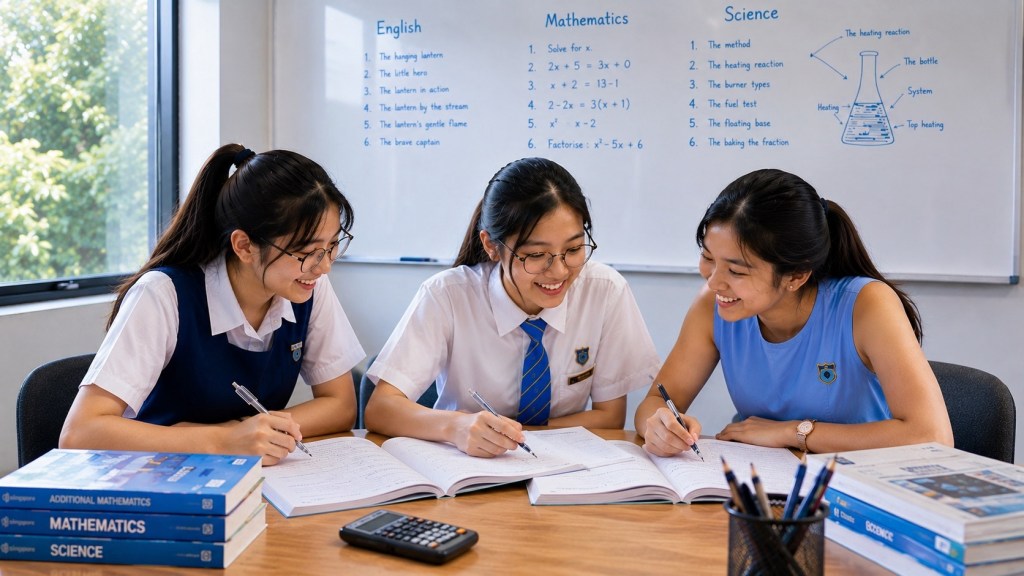
SECONDARY 3 MATHEMATICS CLASSROOM · CHAPTER 10 · SIMILAR FIGURES · AREA SCALE · VOLUME SCALE · G2/G3
Area and Volume of Similar Figures and Solids: When One Scale Factor Changes Dimension
Similarity begins with one linear scale factor. But area has two dimensions and volume has three. That is why the same enlargement produces three different numerical effects.
Chapter 9 proved similarity. Chapter 10 uses it quantitatively. Once two figures or solids are known to be similar, corresponding lengths scale by k, areas by k² and volumes by k³. This is not a collection of separate rules; it is dimensional reasoning.
Classroom rule: establish similarity → define the direction of the length scale factor → square it for area → cube it for volume → reverse with square roots or cube roots when needed → preserve units → test whether the answer should increase or decrease.
Current syllabus boundary. Similar figures and solids, area/volume scale factors and mensuration remain part of upper-secondary Mathematics. Schools may distribute specific applications differently, but the dimensional relationships in this chapter are durable and directly transferable.
Official reference: MOE G2 and G3 Mathematics Syllabuses.
Featured Answer: Why Does Area Use k² and Volume Use k³?
If every corresponding length is multiplied by k, then two independent dimensions in an area are each multiplied by k, giving k×k=k². A volume has three independent dimensions, giving k×k×k=k³.
1. Length Scale Factor Comes First
If a 6 cm side corresponds to a 15 cm side, the small→large scale factor is 15/6=5/2.
2. Direction Matters
Small→large gives 5/2. Large→small gives 2/5. Keep one direction throughout the problem.
3. Area Scale Factor Is the Square of Length Scale Factor
Area scale factor = k²
4. Teacher Model 1: Find a Similar Area
Length scale factor small→large=3/2. Smaller area=40 cm².
Area factor=(3/2)²=9/4.
Larger area=40×9/4=90 cm².
5. Reverse Area Problems Need a Square Root
If area ratio is 49:81, then corresponding length ratio is √49:√81=7:9.
6. Teacher Model 2: Recover a Length Scale From Area
Two similar shapes have areas 72 cm² and 200 cm².
Area ratio=72:200=9:25. Therefore length ratio=3:5.
7. Volume Scale Factor Is the Cube of Length Scale Factor
Volume scale factor = k³
8. Teacher Model 3: Find a Similar Volume
Length scale factor=2.5. Smaller volume=64 cm³.
Volume factor=2.5³=15.625.
Larger volume=1000 cm³.
9. Reverse Volume Problems Need a Cube Root
If volume ratio is 64:125, then corresponding length ratio is ∛64:∛125=4:5.
10. Teacher Model 4: Recover Length Scale From Volume
Similar solids have volumes 216 cm³ and 1000 cm³.
Volume ratio=216:1000=27:125. Cube roots give length ratio=3:5.
11. Surface Area Uses the Same k² Relationship
Surface area is still an area measurement, even though it belongs to a 3D solid. Therefore corresponding surface areas scale by k², not k³.
12. Teacher Model 5: Surface Area and Volume Together
Two similar solids have length scale factor 3.
- surface-area factor=9;
- volume factor=27.
If the smaller surface area is 50 cm², the larger is 450 cm². If the smaller volume is 20 cm³, the larger is 540 cm³.
13. Perimeter Uses the Linear Scale Factor
Perimeter is a length, so similar perimeters scale by k, not k².
14. Teacher Model 6: Perimeter and Area From One Scale
If two similar figures have length ratio 4:7, their perimeter ratio is 4:7 and area ratio is 16:49.
15. Dimensional Table
| Quantity | Scale factor |
|---|---|
| length / perimeter | k |
| area / surface area | k² |
| volume | k³ |
16. Units Reveal the Dimension
cm suggests length, cm² suggests area, cm³ suggests volume. Unit type often tells you which power of k belongs in the problem.
17. Teacher Model 7: Similar Cylinders
Two similar cylinders have radii 3 cm and 5 cm. The smaller volume is 216 cm³.
Length factor=5/3. Volume factor=(5/3)³=125/27.
Larger volume=216×125/27=1000 cm³.
18. Similarity Can Avoid Recalculating Full Mensuration Formulae
If two solids are known to be similar, scale-factor reasoning may be far faster than separately calculating both volumes or surface areas from raw dimensions.
19. Teacher Model 8: Similar Cones
Two similar cones have heights 8 cm and 12 cm. Their volume ratio is (8/12)³=(2/3)³=8:27.
20. Reverse Problems Often Hide the Scale Factor
Do not guess k from area or volume directly. First take the appropriate root.
21. Teacher Model 9: Surface Area to Volume Ratio
If similar solids have surface-area ratio 25:49, length ratio=5:7 and volume ratio=125:343.
22. Composite Problems May Require Similarity First, Mensuration Second
A truncated solid, nested shape or enlarged model may reveal one missing dimension through similarity. Only then should a direct area or volume formula be used.
23. Teacher Model 10: Scale Model
A model is built at scale 1:20. Its surface area is 75 cm² and volume is 40 cm³.
Real surface-area factor=20²=400, so real surface area=30,000 cm².
Real volume factor=20³=8000, so real volume=320,000 cm³.
24. Capacity Can Be Transferred Through Volume Scale
If two similar containers differ by length factor 1.5, their capacities differ by factor 1.5³=3.375, assuming geometrically similar internal dimensions.
25. Misconception Clinic: Area Factor Equals Length Factor
Repair: area has two dimensions, so square k.
26. Misconception Clinic: Volume Factor Equals k²
Repair: volume has three dimensions, so cube k.
27. Misconception Clinic: Surface Area Uses k³ Because the Object Is 3D
Repair: surface area measures two-dimensional surfaces, so it uses k².
28. Misconception Clinic: Reverse Area Ratio by Halving the Exponent
Repair: take the square root of the area ratio. For volume, take the cube root.
29. Misconception Clinic: Mix Directions Between Ratios
Repair: write “small→large” or “large→small” before calculating.
30. Guided Practice A: Direct Scale Factors
- Length factor 4. Find area and volume factors.
- Length factor 3/5. Find area and volume factors.
- Length ratio 2:7. Find perimeter, area and volume ratios.
Solutions
16 and 64. 9/25 and 27/125. 2:7, 4:49, 8:343.
31. Guided Practice B: Reverse Scale Factors
- Area ratio 36:81. Find length ratio.
- Volume ratio 8:125. Find length ratio.
- Surface-area ratio 49:121. Find volume ratio.
Solutions
2:3. 2:5. Length ratio 7:11, so volume ratio 343:1331.
32. Guided Practice C: Missing Quantity
Two similar solids have length ratio 3:4. Smaller surface area=135 cm² and smaller volume=216 cm³. Find the larger surface area and volume.
Worked solution
Area factor=16/9, so larger surface area=240 cm². Volume factor=64/27, so larger volume=512 cm³.
33. Challenge Practice: Recover Everything From One Ratio
Two similar figures have areas 98 cm² and 200 cm². Find their length ratio and perimeter ratio.
Worked solution
Area ratio=98:200=49:100. Length ratio=7:10. Perimeter ratio is also 7:10.
34. Assessment Method: Label the Dimension
Write L, A or V beside the requested quantity before using k, k² or k³.
35. Assessment Method: Predict Increase or Decrease
If k>1, corresponding lengths, areas and volumes should all increase. If your calculation produces a decrease, inspect the direction.
36. Assessment Method: Use Units as a Final Check
A volume result in cm² or a perimeter ratio treated as k² signals a dimensional mismatch.
37. Oral Classroom Check
- What is the relationship between length factor and area factor?
- What is the relationship between length factor and volume factor?
- Why does surface area use k²?
- How do you recover length ratio from area ratio?
- How do you recover length ratio from volume ratio?
- How do perimeters scale?
- Why is direction important?
- How can units reveal the correct scale power?
- When can similarity be faster than direct mensuration?
- Why must similarity be established before scale-factor transfer?
38. Exit Ticket
- Length factor 5. Find area factor.
- Length factor 5. Find volume factor.
- Area ratio 25:64. Find length ratio.
- Volume ratio 27:216. Find length ratio.
- Length ratio 4:9. Find surface-area ratio.
- Length ratio 4:9. Find volume ratio.
- Explain why perimeter uses k rather than k².
- Explain why surface area uses k² rather than k³.
- A model is scale 1:10. Find volume scale factor model→real.
- Name one way to detect a reversed scale factor.
Exit-ticket solutions
25. 125. 5:8. 1:2. 16:81. 64:729. Perimeter is a length measurement. Surface area is a two-dimensional measurement. 1000. Check whether the larger figure actually received the larger corresponding quantity.
39. The Seven-Day Return Cycle
- Day 0: k, k² and k³ relationships.
- Day 1: reverse area and volume problems.
- Day 3: surface-area and volume transfer in similar solids.
- Day 7: mixed model/composite problem requiring scale-factor selection.
40. The Full Chapter 10 Routine
prove/accept similarity → set scale direction → find k → use k for length, k² for area, k³ for volume → reverse with roots if necessary → apply units → verify magnitude.
41. Connect Back to Chapter 9
Return to Secondary 3 Chapter 9: Congruence and Similarity Tests when correspondence or proof of similarity is unstable. Chapter 10 assumes the shape relationship is already justified before transferring scale.
42. Specialist Companion
43. Why This Chapter Matters for Chapter 11
Chapter 10 uses proportional geometry. Chapter 11 moves to the exact angle and chord relationships inside circles. Similarity may still appear inside proofs, but circle geometry introduces a new network of theorems about centres, chords, tangents and angles.
44. Ready for Chapter 11?
- calculate directed length scale factors;
- square k for area and surface area;
- cube k for volume;
- recover length factors using square and cube roots;
- transfer perimeter, area and volume correctly;
- solve similar-solid problems efficiently;
- use units to identify dimensional structure;
- verify whether the scale direction is sensible.
If one item is weak, return to the smallest section that owns it and solve a changed example. When the route is stable, continue to Chapter 11: Geometrical Properties of Circles.
