
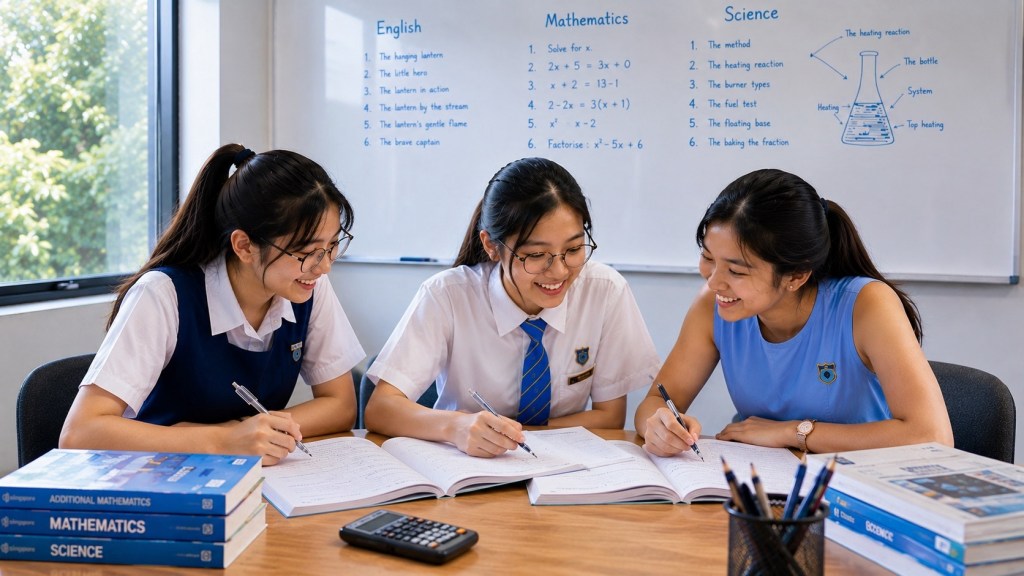
SECONDARY 2 MATHEMATICS CLASSROOM · CHAPTER 9 · MENSURATION · COMPOSITE FIGURES · SURFACE AREA · VOLUME · G2/G3
Mensuration: When Geometry Has to Be Measured Correctly
Perimeter, area, surface area and volume are not four versions of the same calculation. They measure different properties of an object, use different dimensions and demand different units.
Chapter 8 used right-triangle structure to recover missing lengths and angles. Chapter 9 uses those recovered dimensions inside measurement problems. The central skill is not formula recall. It is identifying exactly what is being measured, decomposing the figure or solid correctly, reconstructing hidden dimensions, keeping units consistent and counting only the boundaries or surfaces that actually belong to the requested quantity.
Classroom rule: identify the measure → identify the shape structure → reconstruct missing dimensions → decompose without overlap → choose the correct formula → preserve dimensional units → exclude internal boundaries or contact faces → verify the scale of the answer.
Level boundary. The shared G2/G3 Secondary 2 core includes perimeter, area, composite figures, prisms, cylinders, pyramids, cones and spheres, surface area, volume, capacity and unit conversion. Pyramids, cones and spheres are not merely later-course enrichment here; they belong in the current Secondary 2 mensuration floor. Use school-specific sequencing only to control timing and depth.
Official reference: MOE G2 and G3 Mathematics Syllabuses.
Navigate: what is measured · composite figures · units · prisms · cylinders · surface area · volume and capacity · composite solids · misconceptions · guided practice · assessment transfer · exit ticket.
Featured Answer: What Is the Difference Between Perimeter, Area, Surface Area and Volume?
- Perimeter measures distance around a plane figure.
- Area measures a two-dimensional region.
- Surface area measures the exposed outside faces of a three-dimensional object.
- Volume measures three-dimensional space occupied.
The units reveal the dimension: cm, cm² and cm³ are fundamentally different measurements.
How to Use This Classroom
- Read the requested quantity before selecting a formula.
- Shade or trace the region, boundary or faces being measured.
- Infer missing dimensions only from stated constraints.
- Split composite shapes into familiar non-overlapping parts.
- For prisms, identify the constant cross-section.
- For cylinders, distinguish radius from diameter.
- For surface area, count exposed faces only.
- For volume, add non-overlapping component volumes.
- Square unit-conversion factors for area and cube them for volume.
- Check whether the magnitude and unit of the final answer make sense.
1. The Requested Quantity Controls the Formula
A rectangle 8 cm by 5 cm has perimeter 26 cm and area 40 cm². The same dimensions create different answers because the questions measure different properties.
2. Units Are Structural Evidence
A surface-area answer in cm rather than cm² signals a dimensional error even before the arithmetic is checked.
3. Irrelevant Data Can Appear in the Diagram
A triangle may display three side lengths and a perpendicular height. If area is requested, only a valid base and its perpendicular height are required. Do not force every printed number into a formula.
4. Composite Figures Become Simpler When Decomposed
A composite figure can often be split into rectangles, triangles, circles or semicircles, or treated as a large familiar figure with a smaller part removed.
5. Teacher Model 1: L-Shaped Area
An L-shape fits inside a 10 cm by 8 cm rectangle with a 4 cm by 3 cm corner removed.
Area=10×8−4×3=80−12=68 cm².
6. Missing Lengths Often Come From Alignment
If the full width is 15 cm and one aligned segment is 9 cm, the remaining segment is 6 cm. Never estimate such a length from the picture.
7. Shared Internal Edges Are Not External Perimeter
When two plane regions are joined, the common edge lies inside the composite figure and is not part of the outside boundary.
8. Teacher Model 2: Rectangle Plus Semicircle
A 12 cm by 6 cm rectangle has a semicircle attached along the 6 cm side. Radius=3 cm.
Area=12×6+½π(3²)=72+4.5π≈86.1 cm².
The joined diameter is internal and should not be counted in the external perimeter.
9. Unit Conversion Depends on Dimension
If 1 m=100 cm, then 1 m²=10,000 cm² and 1 m³=1,000,000 cm³.
10. Teacher Model 3: Area Conversion
0.35 m²=0.35×10,000=3500 cm².
11. Teacher Model 4: Volume Conversion
0.004 m³=0.004×1,000,000=4000 cm³.
12. Similarity Connects to Measurement Scale
If all lengths scale by k, areas scale by k² and volumes by k³. This is the same dimensional reasoning introduced in Chapter 7.
13. A Prism Has a Constant Cross-Section
Volume of prism = area of cross-section × length.
14. Teacher Model 5: Triangular Prism
Right-triangle cross-section with perpendicular sides 6 cm and 8 cm; prism length 15 cm.
Cross-sectional area=½×6×8=24 cm².
Volume=24×15=360 cm³.
15. Composite Cross-Sections Are Solved Before the Prism Step
If an L-shaped cross-section has area 36 cm² and the prism length is 10 cm, volume=360 cm³. The composite work belongs in the cross-section first.
16. A Cylinder Uses a Circular Cross-Section
Volume = πr²h.
17. Teacher Model 6: Cylinder Volume
Radius 4 cm, height 10 cm.
Volume=π(4²)(10)=160π cm³≈503 cm³.
18. Radius and Diameter Must Not Be Confused
Using diameter 8 as r instead of radius 4 multiplies the correct r² term by four.
19. Teacher Model 7: Find Cylinder Height
Volume=900π cm³ and radius=6 cm.
900π=π(36)h, so h=25 cm.
20. Surface Area Counts Exposed Faces
A net helps reveal the two-dimensional faces making up a solid. For joined solids, contact faces become internal and are excluded from external surface area.
21. The Curved Surface of a Cylinder Unwraps to a Rectangle
Its dimensions are circumference 2πr and height h, so curved surface area=2πrh.
22. Teacher Model 8: Closed Cylinder Surface Area
Radius 3 cm, height 8 cm.
Total surface area=2πr²+2πrh=18π+48π=66π cm².
23. Open Containers Have Fewer Exposed Faces
If the previous cylinder is open at the top, subtract one circle πr² from the closed-cylinder total.
24. Teacher Model 9: Triangular Prism Surface Area
A right-triangular prism has triangle sides 3,4,5 cm and length 10 cm.
Two triangular ends: 2(½×3×4)=12 cm².
Rectangular side faces: 10(3+4+5)=120 cm².
Total=132 cm².
25. Volume and Capacity Are Closely Related
In common school contexts, 1 cm³ corresponds to 1 mL and 1000 cm³ corresponds to 1 L.
26. Teacher Model 10: Tank Capacity
Internal dimensions 50 cm by 30 cm by 40 cm.
Volume=60,000 cm³=60 L.
27. Internal and External Dimensions Are Not Interchangeable
A container’s external dimensions can overstate capacity if wall thickness is significant. Match the geometry to the quantity being interpreted.
28. Teacher Model 11: Liquid Depth
Base 40 cm by 25 cm and liquid volume 15,000 cm³.
Base area=1000 cm², so depth=15,000/1000=15 cm.
29. Composite Solids: Volume Adds, Surface Area Needs Exposed-Face Control
For non-overlapping pieces, volumes add directly. For surface area, touching faces disappear from the exterior.
30. Teacher Model 12: Two Joined Cubes
Two cubes of side 4 cm are joined face-to-face.
Volume=2(4³)=128 cm³.
Separate surface area=2×6×4²=192 cm². Two touching faces of area 16 cm² each become internal, so exposed surface area=192−32=160 cm².
31. Secondary 2 Core: Pyramids, Cones and Spheres
These solids are part of the Secondary 2 mensuration floor. The important distinction is between perpendicular height, slant height, radius and the surfaces actually exposed.
- Pyramid volume: ⅓ × base area × perpendicular height.
- Cone volume: ⅓πr²h.
- Sphere volume: 4/3 πr³.
- Sphere surface area: 4πr².
- Cone curved surface area: πrl, where l is slant height; include the circular base only when it is exposed and the question asks for total surface area.
- Pyramid surface area: base area plus the areas of the exposed triangular faces.
Teacher model: a cone with radius 3 cm and perpendicular height 4 cm has volume ⅓π(3²)(4)=12π cm³. If its slant height is 5 cm and the base is included, total surface area=π(3)(5)+π(3²)=24π cm².
Teacher model: a sphere of radius 3 cm has volume 4/3π(3³)=36π cm³ and surface area 4π(3²)=36π cm². The numerical coefficient happens to match here, but the units show that the quantities are different.
32. Misconception Clinic: Use Perimeter Formula for Area
Repair: identify whether the question measures boundary distance or enclosed region.
33. Misconception Clinic: Count a Shared Edge in External Perimeter
Repair: trace only the outside boundary.
34. Misconception Clinic: Count Contact Faces in Surface Area
Repair: internal faces are not exposed.
35. Misconception Clinic: Convert m² to cm² by ×100
Repair: square the length conversion, so ×10,000.
36. Misconception Clinic: Write Volume in cm²
Repair: volume uses cubic units.
37. Misconception Clinic: Use Diameter as Radius
Repair: radius is half the diameter.
38. Misconception Clinic: Measure Missing Lengths From the Picture
Repair: diagrams may not be drawn to scale. Infer lengths from stated totals, alignment, Pythagoras or trigonometry where justified.
39. Guided Practice A: Plane Measurement
- Find area and perimeter of a 9 cm by 4 cm rectangle.
- A 12 cm by 10 cm rectangle has a 3 cm by 4 cm corner removed. Find remaining area.
- Convert 0.42 m² to cm².
- Length scale factor 3. Find area scale factor.
Solutions
36 cm² and 26 cm. 108 cm². 4200 cm². 9.
40. Guided Practice B: Prisms and Cylinders
- Triangular cross-section base 8 cm, height 5 cm, prism length 12 cm. Find volume.
- Cylinder radius 5 cm, height 9 cm. Find exact volume.
- Find its total surface area.
- Cylinder volume 288π cm³ and radius 4 cm. Find height.
Solutions
240 cm³. 225π cm³. 140π cm². 18 cm.
41. Guided Practice C: Capacity and Depth
- Tank internal dimensions 60×25×30 cm. Find capacity in litres.
- Tank base 50×20 cm contains 12,000 cm³ of water. Find depth.
Solutions
45 L. 12 cm.
42. Guided Practice D: Joined Solids
Two cubes of side 3 cm are joined face-to-face. Find total volume and exposed surface area.
Worked solution
Volume=2×27=54 cm³. Separate surface area=108 cm². Remove two touching 9 cm² faces: exposed area=90 cm².
43. Challenge Practice: Recover a Hidden Dimension First
A triangular-prism cross-section is right-angled with hypotenuse 13 cm and one shorter side 5 cm. The prism length is 20 cm. Find the prism volume.
Worked solution
Pythagoras gives the other side 12 cm. Cross-sectional area=½×5×12=30 cm². Volume=30×20=600 cm³.
44. Assessment Method: State the Quantity First
Write perimeter, area, surface area or volume before choosing a formula.
45. Assessment Method: Trace What Counts
For perimeter, trace the outside boundary. For surface area, mark exposed faces. For volume, identify non-overlapping solid regions.
46. Assessment Method: Keep Units Attached
- length → cm;
- area → cm²;
- volume → cm³;
- capacity → mL or L where appropriate.
47. Assessment Method: Use Geometry Before Measurement
If a needed length is missing, recover it first from alignment, Pythagoras, trigonometry or another valid constraint. Do not substitute invented dimensions.
48. Oral Classroom Check
- What does perimeter measure?
- What does area measure?
- What does surface area measure?
- What does volume measure?
- Why is 1 m² equal to 10,000 cm²?
- What makes a solid a prism?
- What is the difference between perpendicular height and slant height in a cone or pyramid?
- State the volume formula for a pyramid or cone.
- State the surface-area and volume formulas for a sphere.
- Why are touching faces excluded from external surface area?
- Why can Pythagoras appear inside a mensuration question?
49. Exit Ticket
- Find area and perimeter of a 7 cm by 5 cm rectangle.
- Convert 0.18 m² to cm².
- Convert 0.003 m³ to cm³.
- Find volume of a triangular prism with triangle base 6 cm, height 4 cm and prism length 10 cm.
- Find volume of a cylinder radius 3 cm and height 12 cm.
- Find total surface area of that cylinder.
- A 20,000 cm³ tank has base area 1000 cm². Find liquid depth.
- Explain why a shared face is excluded from external surface area.
- State the correct units for area and volume.
- Explain why a hidden dimension should not be measured from the diagram.
Exit-ticket solutions
35 cm² and 24 cm. 1800 cm². 3000 cm³. 120 cm³. 108π cm³. 90π cm². 20 cm. It is internal after the solids are joined. Square units and cubic units. Diagrams may not be drawn to scale; use mathematical constraints.
50. Homework: Retrieval, Variation and Transfer
- solve four composite-area questions;
- solve two perimeter questions with internal edges;
- convert three area and three volume units;
- solve two prism and two cylinder problems;
- solve one open-container surface-area question;
- solve one capacity problem;
- solve one problem where a missing dimension must first be recovered by Pythagoras or trigonometry.
51. The Seven-Day Return Cycle
- Day 0: measurement type and composite decomposition.
- Day 1: units and one prism/cylinder question.
- Day 3: mixed area/surface-area/volume selection.
- Day 7: changed exit ticket with one hidden-dimension problem.
52. The Full Mensuration Routine
name the quantity → identify the structure → recover hidden dimensions → decompose → calculate → remove internal boundaries/faces → convert units dimensionally → verify magnitude and units.
53. Connect Back to Chapter 8
Return to Secondary 2 Chapter 8: Right-Angled Triangle Trigonometry, Angles and Missing Lengths when a mensuration problem hides a right-triangle dimension. Chapter 8 recovers the geometry; Chapter 9 measures it.
54. Specialist Companions
- Secondary 2 Mathematics Learning Guide | Mensuration, Composite Figures, Surface Area and Volume
- Secondary 2 Mathematics Learning Guide | Dimensional Reasoning, Units, Scale, Rate and Conversion Chains
- Secondary 2 Mathematics Learning Guide | Right-Angled Triangle Trigonometry, Angles and Missing Lengths
55. Why This Chapter Matters for Chapter 10
Mensuration trains a learner to distinguish what is actually being measured from all the other information in a diagram. Chapter 10 makes the same demand with data: distinguish the quantity being represented, read the scale correctly, choose an appropriate statistical summary and avoid being misled by presentation. Measurement moves from geometry to information.
56. Ready for Chapter 10?
- distinguish perimeter, area, surface area and volume;
- decompose composite figures without overlap;
- recover missing dimensions from valid constraints;
- convert length, area and volume units correctly;
- find prism and cylinder volumes;
- find pyramid and cone volumes using perpendicular height;
- distinguish cone slant height from perpendicular height;
- find sphere volume and surface area;
- find exposed surface areas, including cones and pyramids where appropriate;
- interpret capacity from internal volume;
- exclude contact faces from external surface area;
- state final answers with dimensionally correct units.
If one item is weak, return to the smallest section that owns it and solve a changed example. When the route is stable, continue to Chapter 10: Statistics, Data Representation and Misleading Graphs.
