
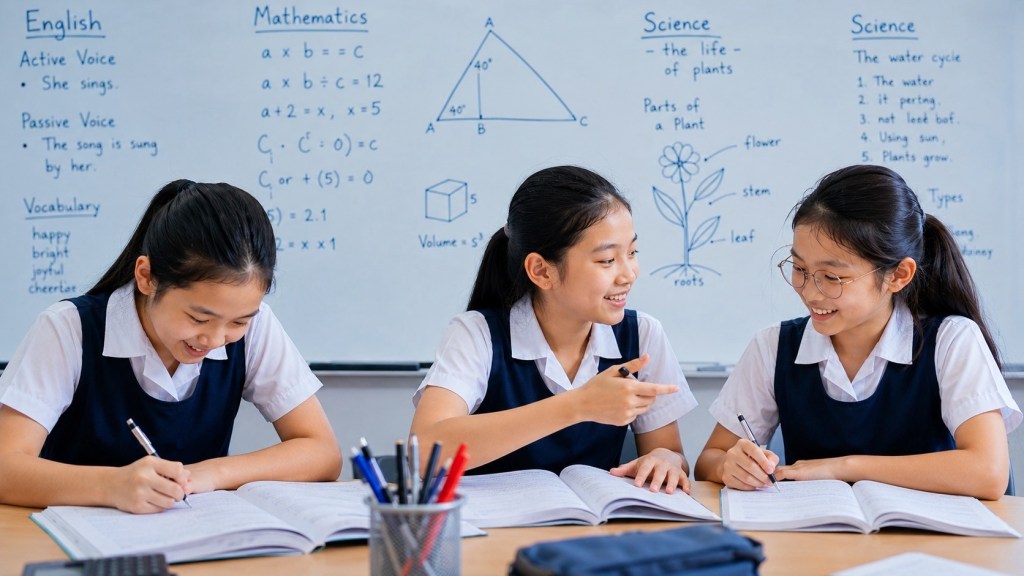
Primary 5 Science Learning Guide | Mixed-Concept Transfer Challenge Lab
The strongest Primary 5 Science learner is not the one who knows which chapter a question came from. It is the one who can identify the scientific relationship even when several chapters appear at once.
Wait, What? Real Questions Do Not Respect Chapter Boundaries
A plant-water experiment can test evaporation, transport, fair testing and data interpretation at the same time. An exercise question can combine respiratory and circulatory systems with rates and graphs. A conductor investigation can combine circuits, materials, controls and evidence. Mixed-concept questions are therefore not exceptions; they are the natural consequence of learning Science as connected systems.
This challenge lab deliberately removes chapter labels. Each scenario asks the learner to identify the active concepts, order them correctly and answer only the scientific job required.
The Mixed-Concept Routine
- Ignore the chapter label you expect.
- Identify the object or system.
- List the materials, parts and conditions.
- Identify what changes and what is measured.
- Find the first scientific relationship.
- Add the second relationship only if the outcome depends on it.
- Use evidence from the setup or data.
- Stop before unrelated topic knowledge enters the answer.
Challenge 1: Leaf Area + Water Transport + Evaporation
Two shoots stand in covered water containers. Shoot A has twice the leaf area of Shoot B. After two hours, A’s container loses more mass.
Concept chain: greater leaf area → more water can leave through leaves → more water is transported through the shoot → greater decrease in container mass.
Control logic: covering the container surface reduces direct evaporation from the water.
Challenge 2: Water Cycle + Condensation + Evidence
Droplets form under the lid of a sealed warm-water container.
Concept chain: liquid water evaporates → water vapour moves through the enclosed air → vapour cools at the lid → condensation forms liquid droplets.
Evidence: droplets appear on the cooler lid while the system remains sealed.
Challenge 3: Pollination + Fertilisation + Fruit Data
Open flowers form 16 fruits from 20 flowers. Covered flowers form 5 fruits from 20.
Concept chain: insect access may increase pollen transfer → more pollination opportunities → more possible fertilisation events → more fruit formation.
Evaluation: check whether the covering also changed other conditions.
Challenge 4: Human Systems + Exercise + Rate
A student’s pulse rises from 72 to 132 beats per minute after exercise, while breathing rate also rises.
Concept chain: working muscles require oxygen and produce carbon dioxide more quickly → respiratory gas exchange increases → heart pumps faster → blood transports gases more quickly → pulse rate rises.
Challenge 5: Circuit Branches + Fault Diagnosis
In a parallel circuit, Bulb A goes out while Bulb B remains lit.
Inference: the shared source and main path still work because B lights. The fault is likely local to Branch A or Bulb A.
Challenge 6: Conductor Test + Experimental Control
Material Q does not light the test bulb.
Next step: replace Q with a known conductor. If the bulb lights, the circuit is working and Q becomes a stronger candidate for insufficient conduction or poor contact.
Challenge 7: Data + Rate + Water
Dish A loses 18 g in 60 minutes. Dish B loses 14 g in 40 minutes.
A’s average rate is 0.30 g/min. B’s is 0.35 g/min. B loses less total water but has the faster average rate over the measured interval.
Challenge 8: Plant Transport + Tracer + Observation
Coloured water appears in leaf veins after a cut shoot is placed in dye.
Observation: colour appears higher in the plant.
Inference: water moved upward through the transport route.
Mechanism question: answer with the water-transport pathway rather than repeating the observation.
Challenge 9: Plant Reproduction + Comparison
A wind-pollinated flower has exposed anthers and a feathery stigma.
Structure–function: exposed anthers release pollen into moving air; the feathery stigma provides a large surface for trapping airborne pollen.
Challenge 10: Human Reproduction + Sequence
A fertilised egg is developing in the womb.
Reverse trace: a sperm must have fused with an egg earlier during fertilisation.
Challenge 11: Series Circuit + What-If
Two bulbs are in series. One bulb is removed, leaving a gap.
First effect: the only conducting path becomes incomplete.
Outcome: the remaining bulb goes out.
Challenge 12: Parallel Circuit + What-If
Two bulbs are on separate branches. One branch is opened.
The opened branch bulb goes out, while the other can remain lit if its own route is still complete.
Challenge 13: Boundary Case + Evaporation
A wet cloth becomes completely dry. Airflow is increased further.
No additional water can evaporate from the cloth because no liquid water remains. The earlier airflow relationship has reached a boundary condition.
Challenge 14: Boundary Case + Circuit
More batteries are added to an open circuit.
The bulb still does not light because path completeness is a necessary condition. Increasing the source does not repair a broken route.
Challenge 15: Correlation + Human Systems
Students with higher pulse rates also happened to run faster.
The pattern alone does not prove that high pulse caused faster running. Exercise intensity, fitness and other factors may differ.
Challenge 16: Scaling + Fruit Formation
Group A forms 8 fruits from 10 flowers. Group B forms 12 from 20.
Group B has more fruits in total, but Group A has the greater proportion. Choose count or fraction according to the question.
Challenge 17: Measurement + Evaporation
Expected water loss is 3 g, but the balance reads in 10 g steps.
The main weakness is measurement resolution, not lack of repetition. Use a finer-resolution balance.
Challenge 18: Reliability + Biology
One plant in each group is tested and a large difference appears.
Use several similar plants per condition because individual biological variation can dominate a one-versus-one comparison.
Challenge 19: Observation + Inference + Conclusion
Material P makes a bulb light in a known working circuit.
- Observation: bulb lights.
- Inference: P allows current to pass sufficiently.
- Conclusion: P behaves as a conductor under the test conditions.
Challenge 20: Evidence + Plant Water Loss
Large-leaf shoot: 17 g water lost. Small-leaf shoot: 6 g lost in the same time.
Evidence sentence: the large-leaf shoot lost 11 g more water over the same interval.
Mechanism sentence: greater leaf area allowed more water to leave through leaves, increasing water transport through the shoot.
Challenge 21: Reproduction + Missing Stage
No pollen reaches a stigma.
Pollination fails first. Fewer later fertilisation opportunities occur, so fewer fertilised ovules may develop into seeds and fruits.
Challenge 22: Human Systems + Blockage
Blood flow to a muscle is reduced.
Direct effect: less blood reaches the muscle through that route.
Downstream effect: less oxygen may be delivered and carbon dioxide removal may be reduced.
Challenge 23: System Boundary + Water
Water disappears from the bottom of a sealed container but droplets appear on the lid.
Within the whole sealed system, the water has changed location and state rather than leaving the system.
Challenge 24: System Boundary + Plant
Water leaves a covered plant container.
The covered surface reduces direct evaporation, so the measured loss is stronger evidence that water moved through the plant and left through leaves.
Challenge 25: Compare Plant and Human Transport
Shared principle: internal systems move materials between parts.
Difference: plant transport tissues and human blood/vessels move different materials using different structures.
Challenge 26: Compare Plant and Human Reproduction
Shared principle: male and female reproductive cells join during fertilisation.
Difference: flowering plants have pollination and later seed/fruit development; humans have sperm and egg production and fertilised-egg development in the womb.
Challenge 27: Mixed Investigation Design
A student compares pulse after jumping for one minute with pulse after running for three minutes and concludes running causes a higher pulse.
Exercise type and duration both changed. The design cannot isolate one factor. Choose one changed variable and control the other.
Challenge 28: Mixed Evidence Chain
Build a complete answer from this information: a plant with more leaves loses more water from a covered container.
- Claim: greater leaf area increased water loss.
- Evidence: the container with the greater-leaf shoot lost more mass under the same time and conditions.
- Reasoning: greater leaf area allowed more water to leave through leaves, so more water was transported through the shoot.
Challenge 29: Multi-Step Explanation Control
A question asks why fruit number decreased after insects were excluded.
Complete chain: less insect access → less pollen transfer → fewer pollination events → fewer opportunities for fertilisation → fewer fertilised ovules → fewer seeds/fruits.
Challenge 30: When to Stop
If the question asks why Bulb B stays lit when Branch A is open, stop after explaining that B has a separate complete branch. Do not add conductor classification, battery chemistry or electrical safety unless the question requires it.
Mixed-Concept Misconception Repair
- Every question belongs to exactly one chapter.
- More concepts in the question means every concept belongs in the answer.
- A longer answer handles mixed questions better.
- One familiar keyword identifies the entire mechanism.
- Data interpretation is separate from topic knowledge.
- Investigation design is only for experiment chapters.
- System reasoning cannot transfer from plants to circuits or humans.
Transfer-Control Checklist
- What is the first relationship?
- Does the outcome require a second relationship?
- What is evidence and what is mechanism?
- Which conditions are controlled?
- What information is a distractor?
- What is the shortest complete chain?
Model Limit
Mixed-concept practice is useful only if the individual concepts remain accurate. Do not create artificial connections just to make an answer sound sophisticated. Integration means joining relationships that the actual system requires.
Delayed Return Challenge
One week later, solve ten unlabeled scenarios across all Primary 5 topics. Before answering each, write only the active scientific relationships. If the learner can identify the relationship without first naming the chapter, the knowledge is becoming flexible.
Mixed-Concept Transfer Receipt
- I identify relationships before chapter labels.
- I connect only the concepts needed for the outcome.
- I separate evidence, mechanism and evaluation.
- I transfer system logic across plants, humans and circuits.
- I integrate data and investigation reasoning with content knowledge.
- I can work from unfamiliar surfaces and diagrams.
- I recognise distractors and stop unnecessary explanation.
- I can solve multi-step questions without losing sequence.
Official Reference Routes
- Singapore Ministry of Education — Primary Science Teaching & Learning Syllabus 2023
- Singapore Examinations and Assessment Board — 2026 PSLE Science Syllabus
Continue the Batch 11 Laboratories
- Primary 5 Science Learning Hub
- Data, Graphs & Evidence Application Lab
- Experimental Design & Evaluation Application Lab
- Open-Ended Answer Construction Application Lab
The Quiet Return
Science becomes transferable when the learner no longer needs the chapter heading as a clue. The surface can change completely; the relationship underneath remains recognisable.
