
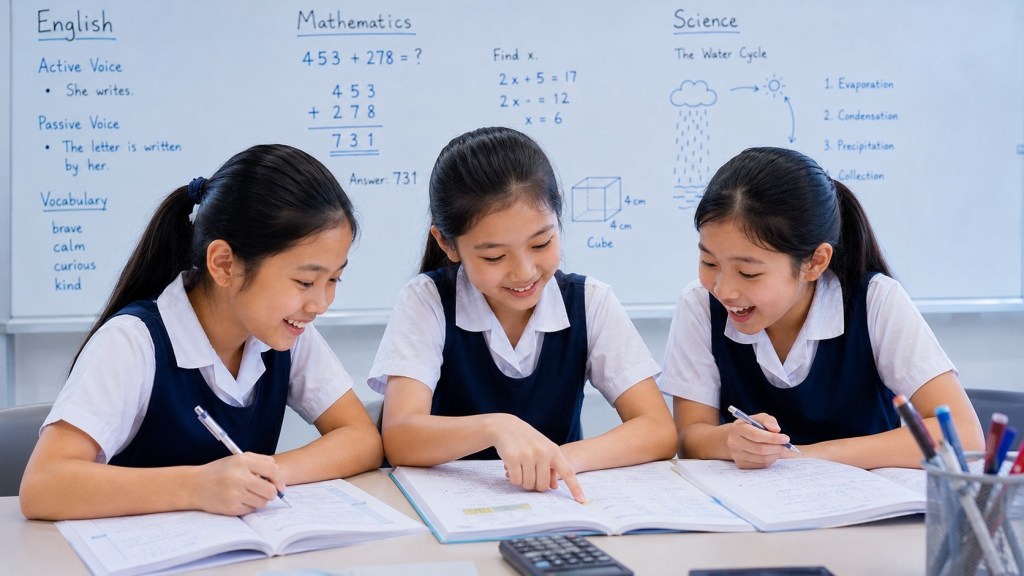
A Primary 4 pupil may look at a diagram and assume every line, size and position is exactly how the real world looks.
But Science often uses models: simplified representations that make one relationship easier to see.
A model is useful because it leaves things out. The learning job is to know what the model helps us explain—and what it does not justify.
This guide develops model awareness inside the Primary 4 Science Learning Hub.
Quick Answer: What Is a Scientific Model?
A scientific model is a simplified representation used to describe, explain or predict some part of the world.
At Primary 4, models can include:
- a labelled plant diagram;
- a digestive-system route;
- straight lines representing light paths;
- a table showing temperature over time;
- arrows showing heat-transfer direction;
- a solid/liquid/gas comparison table;
- a fair-test diagram showing changed and controlled conditions.
A useful eduKate routine is:
WHAT DOES THE MODEL SHOW? → WHAT DOES IT SIMPLIFY? → WHAT CAN I SAFELY CONCLUDE? → WHAT WOULD GO TOO FAR?
This is a teaching routine, not an official MOE marking formula.
Why Models Matter in Primary Science
Many scientific ideas are difficult to observe directly.
We cannot see a line of light printed in the air exactly like a textbook ray.
We do not see a digestive system as five neat boxes.
A plant does not naturally come with arrows showing part functions.
Models make hidden relationships visible enough to reason about them.
Wait, What? A Diagram Is Not a Photograph
A digestive diagram may enlarge the small intestine.
A plant diagram may make roots unusually thick.
A light diagram may draw only a few rays.
The drawing is not wrong merely because it is simplified.
Ask what relationship the drawing is designed to show.
Model Purpose
Every useful model has a job.
| Model | Main job |
|---|---|
| Digestive route | Show order and function of organs |
| Plant part diagram | Show parts and their functions |
| Light-ray diagram | Show straight-line light paths and blocking |
| Heat arrow | Show direction of heat transfer |
| State table | Compare shape and volume properties |
| Investigation table | Show conditions and measured results |
The model is judged by whether it performs its job.
Model Limits: What Is Left Out?
A model can leave out:
- exact shape;
- exact size;
- minor structures;
- complex mechanisms;
- real-world variation;
- other factors not needed for the question.
Leaving something out does not automatically make a model misleading.
Original Model Case: Digestive Route
A page shows five boxes:
Mouth → Gullet → Stomach → Small Intestine → Large Intestine.
Useful: route and order are clear.
Limit: exact anatomy and shape are simplified.
Safe conclusion: food moves through these parts in that sequence.
Unsafe conclusion: the organs are actually square boxes of equal size.
Original Model Case: Plant Diagram
A plant is drawn with three large leaves, one stem and several roots.
Useful: root, stem and leaf positions and part-function relationships are easy to discuss.
Limit: real plants vary in number, size and arrangement of parts.
Safe conclusion: the labelled roots perform root functions.
Unsafe conclusion: every plant must have exactly three leaves.
Original Model Case: Light Rays
A torch shines toward a screen and two straight lines are drawn around an object.
The lines represent light paths.
They help show which region is blocked.
The model does not mean the torch emits only two rays.
Why Straight Lines Are Useful
At Primary 4, straight-line ray diagrams help explain:
- seeing a source;
- seeing reflected light;
- alignment experiments;
- shadow formation;
- shadow changes when positions change.
The model is intentionally simple enough to use.
Heat Arrows
An arrow from hot water to a cooler spoon represents direction of heat transfer.
The arrow is not a physical object travelling through the water.
It is a representation of a process.
Models Can Be Wrong for the Question
Even a scientifically useful model can be irrelevant to a particular question.
If a question asks about liquid volume, using a heat-transfer model does no work.
If a question asks which organ comes after the stomach, a detailed plant model is irrelevant.
Model selection matters.
Model Assumptions
Simple classroom models often assume:
- conditions not mentioned stay stable;
- measurements are taken correctly;
- the representation focuses on one relationship;
- the named variable is the main changed factor.
These assumptions help simplify reasoning, but pupils should not treat them as universal truths outside the stated set-up.
Original Assumption Case: Cooling
Two identical cups start at the same temperature and contain the same water volume. One is wrapped in foam.
The comparison assumes:
- same room conditions;
- same measurement time;
- same cup type;
- wrapping is the important difference.
If those assumptions fail, the model of the comparison becomes weaker.
Model and Evidence Work Together
A model can suggest what to look for.
Evidence tells us whether the model fits the tested case.
Heat model predicts that a hotter object should lose heat to cooler surroundings.
Temperature measurements can then show whether cooling occurred.
The model and evidence support each other without being identical.
Models Can Be Revised
A pupil may begin with an incomplete model:
“Metal is cold.”
Evidence and teaching refine it:
“Metal often feels colder because it transfers heat from the hand faster.”
Science learning often involves replacing a weak model with a stronger one.
Model Revision Is Not Failure
Changing a model after new evidence is a normal scientific habit.
Primary 4 pupils can learn:
- my first idea can be tested;
- evidence can show that it is incomplete;
- I can revise the explanation;
- the revised model should work on more than one example.
Original Model-Revision Case: Air
Initial model: “An empty cup contains nothing.”
Evidence: an upside-down cup pushed into water prevents water entering until bubbles escape.
Revised model: the cup contained air, and air occupies space.
The demonstration repairs the hidden assumption that invisible means absent.
Original Model-Revision Case: Liquid Volume
Initial model: “Lower water level means less water.”
Evidence: 100 mL measured before and after pouring into a wider bowl remains 100 mL.
Revised model: liquid height depends on container shape; volume can remain the same.
Original Model-Revision Case: Seeing
Initial model: “Eyes send something toward the object.”
Evidence and model: light from source reaches object and enters the eye after reflection.
Revised model: seeing depends on light entering the eye.
One Model Can Have Several Representations
The same scientific relationship can be shown as:
- a sentence;
- a diagram;
- a table;
- a sequence of arrows;
- a demonstration.
A strong learner recognises the same model across representations.
Original Multi-Representation Example: Heat
Sentence: “Heat transfers from hotter to colder.”
Arrow: hot water → cool spoon.
Table: spoon temperature rises over time.
Demonstration: spoon handle becomes warmer.
Different surfaces, same model.
When a Model Should Not Be Extended
A classroom model can be accurate at one level and incomplete at another.
Primary 4 pupils may use “metals are good conductors” without needing detailed electron explanations.
They may use “light travels in straight lines” without formal optics equations.
They may use part-function models without advanced anatomy.
The model should match the level and question.
More Detail Can Reduce Clarity
Adding advanced terminology can make a Primary 4 answer worse if the learner loses the main relationship.
The goal is not maximum complexity.
The goal is enough model to explain the evidence.
Model Boundary Language
Useful phrases include:
- “in this simplified model”;
- “under the tested conditions”;
- “the diagram shows…”;
- “the model helps explain…”;
- “the diagram does not show…”;
- “at Primary 4 level…”
These phrases teach intellectual control without making answers unnecessarily cautious.
Common Model Errors
- treats diagram as exact photograph;
- assumes arrow meaning without context;
- uses page position as biological fact;
- thinks a simplified model includes everything;
- uses advanced detail when a simpler model is sufficient;
- extends a model beyond tested conditions;
- refuses to revise a model after conflicting evidence;
- confuses model with measurement.
Original Practice Set
Question 1
Why is a digestive-system box diagram useful even though organs are not boxes?
Question 2
What does a straight line in a light-ray diagram represent?
Question 3
Why does rotating a digestive diagram not change the biological route?
Question 4
A plant diagram has exactly four roots drawn. Can we conclude every plant has four roots?
Question 5
Why is “metal is cold” a weaker model than “metal transfers heat from the hand quickly”?
Question 6
How can evidence revise a model?
Question 7
Why can advanced vocabulary be unnecessary in a Primary 4 explanation?
Question 8
What should a learner ask before using any model?
Practice Answers
1. It simplifies shape so route and function are easier to see.
2. A path or direction of light travel in the simplified representation.
3. Page orientation is a drawing choice; biological sequence is defined by the system.
4. No. The diagram is simplified and does not justify that universal claim.
5. The second explains the sensation through a heat-transfer mechanism rather than treating metal as naturally cold.
6. If observations do not fit the current model, the explanation can be corrected or refined.
7. Extra detail can obscure the required relationship and exceed the learning boundary.
8. What does this model show, what does it simplify, and is it the right model for this question?
Transfer Test: Same Model, Different Representation
Give the learner:
- a diagram;
- then a written description;
- then a table;
- then a new object.
Ask whether the same model still applies.
If understanding collapses when representation changes, the learner may have memorised the surface.
The Model Diagnostic
| If the learner… | Likely weak link | Repair |
|---|---|---|
| Treats diagram literally | Representation-model distinction | Ask what is simplified |
| Uses wrong model | Model selection | Name question target first |
| Adds irrelevant detail | Boundary control | Use minimum sufficient model |
| Cannot revise wrong idea | Evidence integration | Compare model predictions with results |
| Works only in one format | Transfer | Translate across representations |
A 25-Minute Model Lesson
Minutes 1–5: identify the purpose of four models.
Minutes 6–10: list what each model simplifies.
Minutes 11–15: decide what conclusions are safe.
Minutes 16–20: revise one misconception using evidence.
Minutes 21–25: translate one model into a new representation.
This is an eduKate teaching suggestion, not an official school programme.
What Parents and Tutors Can Ask
- “What is this model trying to show?”
- “What has been left out?”
- “Which parts of the drawing are scientifically important?”
- “What conclusion can you safely make?”
- “What conclusion would go too far?”
- “What evidence supports the model?”
- “Can you represent the same idea another way?”
How This Connects to the Whole Primary 4 Science System
Plants use part-function models.
Digestion uses route models.
Matter uses property models.
Light uses path models.
Heat uses transfer models.
Investigations use variable and evidence models.
Model awareness helps the learner use all of them without mistaking the representation for reality.
Continue the Primary 4 Science Series
- Primary 4 Science Learning Guide | Change Over Time, Sequences and Before–After Reasoning
- Primary 4 Science Learning Guide | Comparison and Controlled Reasoning
- Primary 4 Science Learning Guide | Confidence, Uncertainty and Evidence
For representation reading, use Diagrams, Tables, Data and Patterns.
The Quiet Return
Models make Science simpler without making the world simple.
Use the model for the job it was built to do. Notice what it leaves out. Test it against evidence. Revise it when necessary. Then carry the relationship into a new representation.
