
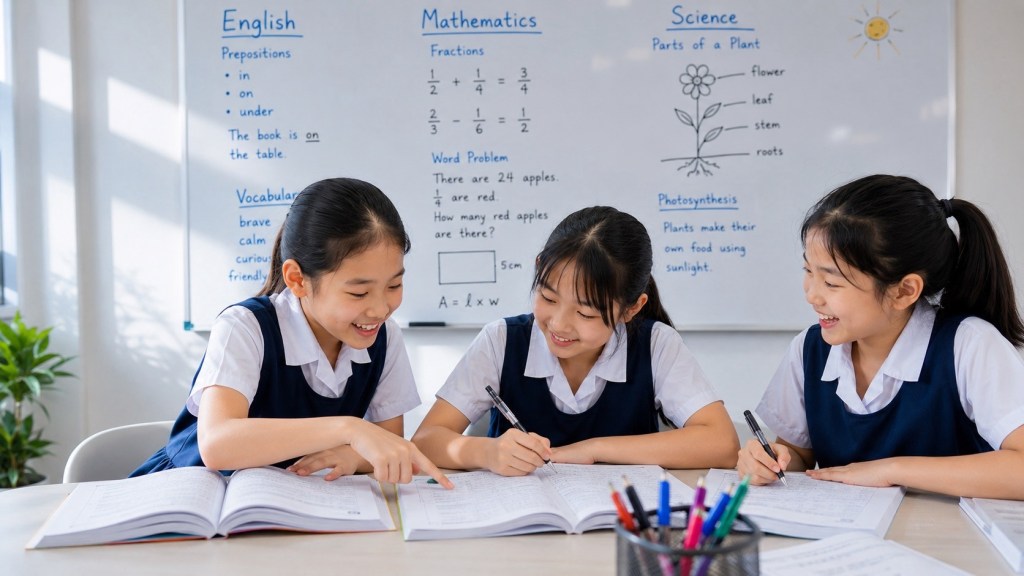
A family Science challenge should not become a second school exam.
Its best use is to create short, safe situations where the child has to retrieve a model, explain it, test one claim, make one measurement and defend one conclusion.
The goal is not to catch the learner out. It is to make scientific thinking visible in ordinary conversation.
This challenge pack belongs to the Primary 4 Science Learning Hub.
How to Use This Pack
- Choose one challenge, not all of them.
- Ask the child to answer before giving hints.
- If stuck, give one discriminating prompt.
- Ask for evidence or the scientific model.
- Change the surface example once.
- Stop when the relationship is clear.
A useful eduKate family loop is:
NOTICE → ASK → EXPLAIN → TEST → CHECK → TRANSFER
Challenge 1 | The Two Spoons
A metal spoon and wooden spoon have been on the same table for an hour. The metal feels cooler.
Question: Must the metal have a lower temperature?
Worked answer: Not necessarily. Metal generally transfers heat from the warmer hand more quickly, so it can feel cooler even when measured temperatures are similar.
Follow-up: What measurement would check the temperature claim?
Answer: Use a suitable thermometer.
Challenge 2 | The Wide Bowl
100 mL water is poured into a wide bowl. The level becomes much lower.
Question: Did the volume decrease?
Worked answer: No, if none was lost. A liquid changes shape to fit the container but keeps fixed volume.
Challenge 3 | The Cold Bottle Outside
A cold bottle is taken from an air-conditioned room into a warm corridor.
Question: Which way does heat transfer?
Worked answer: From the warmer surroundings to the cooler bottle, causing its temperature to rise.
Challenge 4 | The Book in a Dark Room
A book is in a completely dark room.
Question: Why can it not be seen?
Worked answer: A non-light-source object is seen when light reaches it and reflected light enters the eye. In complete darkness, that path is not available.
Challenge 5 | The Root Question
A plant with damaged roots wilts.
Question: Which root function matters here?
Worked answer: Water absorption, not anchoring.
Follow-up: When would anchoring be the relevant root function?
Answer: In a question about preventing uprooting or holding the plant in the soil.
Challenge 6 | The “Empty” Bottle
An empty bottle is shown.
Question: Is it scientifically empty?
Worked answer: It usually still contains air. Air is matter and occupies space.
Challenge 7 | The Two Cups
Cup A ends at 52°C and Cup B at 60°C.
Question: Which cooled more?
Worked answer: Cannot determine without starting temperatures.
This challenge tests whether the learner knows when not to guess.
Challenge 8 | The Shadow Move
“The object moved closer.”
Question: What information is missing?
Worked answer: Closer to the light source or closer to the screen.
Challenge 9 | The Ruler Trick
An object begins at the 3 cm mark and ends at the 17 cm mark.
Question: What is its length?
Worked answer: 14 cm.
This checks scale reading versus difference.
Challenge 10 | The Better Material
Someone says, “Plastic is better than metal.”
Question: What is wrong with the claim?
Worked answer: “Better” needs a function or criterion. Metal may be better for conducting heat; plastic may be better for slowing heat transfer to a hand.
Challenge 11 | The Foam Claim
Two identical cups contain equal water at the same starting temperature. One is foam-wrapped. After 15 minutes, the foam cup shows the smaller temperature decrease.
Question: What claim is supported?
Worked answer: Under the tested conditions, foam reduced cooling more than the comparison condition.
Challenge 12 | The Advertisement
An advertisement says, “Keeps drinks warm 2× better.”
Question: What should you ask?
Worked answer: Better in what measurement, compared with what product, under which starting temperature, volume, time and surroundings?
Challenge 13 | Observation or Inference?
Statement A: “The leaves are drooping.”
Statement B: “The plant cannot absorb enough water.”
Question: Which is observation?
Worked answer: A. B is an inference/explanation.
Challenge 14 | True but Irrelevant
Question: Why does root damage cause wilting?
Answer: “Roots anchor the plant.”
Question: Is the fact true? Does it answer the job?
Worked answer: The fact is true, but the relevant function is water absorption.
Challenge 15 | Final Value vs Change
Water starts at 70°C and ends at 58°C.
Question: What is final temperature? What is the decrease?
Worked answer: Final = 58°C. Decrease = 12°C.
Challenge 16 | The Unexpected Result
Repeated shadow widths are 14 cm, 14 cm and 29 cm.
Question: What should happen before deleting 29 cm?
Worked answer: Check the method, source/object position and measurement, then repeat if appropriate.
Challenge 17 | Draw the Light Path
Use three words only:
lamp, book, eye.
Question: Arrange them to show how the book is seen.
Worked answer: Lamp → book → eye.
Challenge 18 | Digestive Route
Arrange:
small intestine, stomach, mouth, large intestine, gullet.
Worked answer: Mouth → gullet → stomach → small intestine → large intestine.
Challenge 19 | The Fair Test
One cup has 100 mL water at 70°C; another has 150 mL at 80°C. Different wraps are used.
Question: Can the wraps be compared fairly?
Worked answer: Not well. Water volume and starting temperature also differ.
Challenge 20 | Improve the Method
Question: Give one improvement to Challenge 19.
Worked answer: Use the same water volume and starting temperature so wrapping is the key changed condition.
Challenge 21 | The Plant Log
A plant grows from 12 cm to 15 cm over several days.
Question: What is the measured change?
Worked answer: 3 cm.
Follow-up: Does this prove why the plant grew?
Answer: No. It describes change; cause requires stronger evidence.
Challenge 22 | The Flexible Bottle
A plastic bottle bends when squeezed.
Question: Does that make it a liquid?
Worked answer: No. Flexible solids can deform under force while remaining solids.
Challenge 23 | The Shadow Pattern
| Distance | Shadow width |
|---|---|
| 10 cm | 18 cm |
| 20 cm | 14 cm |
| 30 cm | 11 cm |
Question: Describe the pattern.
Worked answer: Shadow width decreases as object–torch distance increases across the tested positions.
Challenge 24 | Predict Carefully
Using Challenge 23:
Question: What may happen at 35 cm?
Worked answer: The shadow may become smaller if the same relationship continues under the same arrangement.
Challenge 25 | The Family Debate
Person A: “The foam cup is warmer, so foam created heat.”
Person B: “The foam cup lost heat more slowly.”
Question: Which explanation is better?
Worked answer: Person B. Insulation reduces heat transfer; it does not necessarily create heat.
Challenge 26 | The Measuring Cup
One measuring cup has 50 mL intervals; another has 10 mL intervals.
Question: Which allows more precise volume reading?
Worked answer: The one with finer 10 mL intervals, if both are used correctly.
Challenge 27 | Missing Units
Someone writes:
“The temperature is 58.”
Question: What is missing?
Worked answer: °C.
Challenge 28 | Cause or Sequence?
Food moves stomach → small intestine.
Question: Does the arrow mean the stomach causes the small intestine to exist?
Worked answer: No. The arrow represents route sequence, not cause.
Challenge 29 | Journal Honesty
A result does not match the prediction.
Question: Should the prediction be rewritten?
Worked answer: No. Keep the original prediction and record how the evidence changed the explanation.
Challenge 30 | One Next Question
Foam reduces cooling more than cloth in one test.
Question: What is one high-value follow-up?
Worked answer: Repeat the comparison under the same controlled conditions to test repeatability, or compare another material while preserving controls.
How to Use Hints
Good hint:
“Which property is the question asking about?”
Better than:
“The answer is volume.”
Hints should restart the learner’s reasoning, not replace it.
How to Use Confidence
Ask after each challenge:
- high confidence;
- medium confidence;
- low confidence.
High-confidence wrong answers are especially useful because they reveal stable misconceptions.
How to Turn One Challenge Into Three
Example: metal spoon.
- Explain familiar case.
- Change object to metal rod.
- Reverse temperature condition.
The model must survive the changes.
Family Challenge Rules
- keep it safe;
- keep it short;
- ask for the model;
- do not shame wrong answers;
- separate confidence from correctness;
- change one surface detail;
- stop after successful transfer.
The Family Challenge Diagnostic
| If the child… | Likely weak link | Next move |
|---|---|---|
| knows fact but not why | Relationship | Ask cause/effect |
| needs same example | Transfer | Change object |
| guesses missing data | Evidence boundary | Ask what is unknown |
| uses vague words | Scientific language | Name property/object |
| is confidently wrong | Misconception | Use counterexample/evidence |
Complete Batch 14 | Primary 4 Science Learning Guide
- Primary 4 Science Learning Guide | Safe Mini-Investigations at Home
- Primary 4 Science Learning Guide | Science Journals and Observation Logs
- Primary 4 Science Learning Guide | Evaluating Everyday Claims and Advertisements
- Primary 4 Science Learning Guide | Family Science Challenge Pack with Worked Cases
Return to the Primary 4 Science Learning Hub.
The Quiet Return
Family Science does not need more worksheets.
Ask one good question. Let the learner explain. Use one hint only if needed. Demand evidence. Change the example. Then stop when the model transfers independently.
