
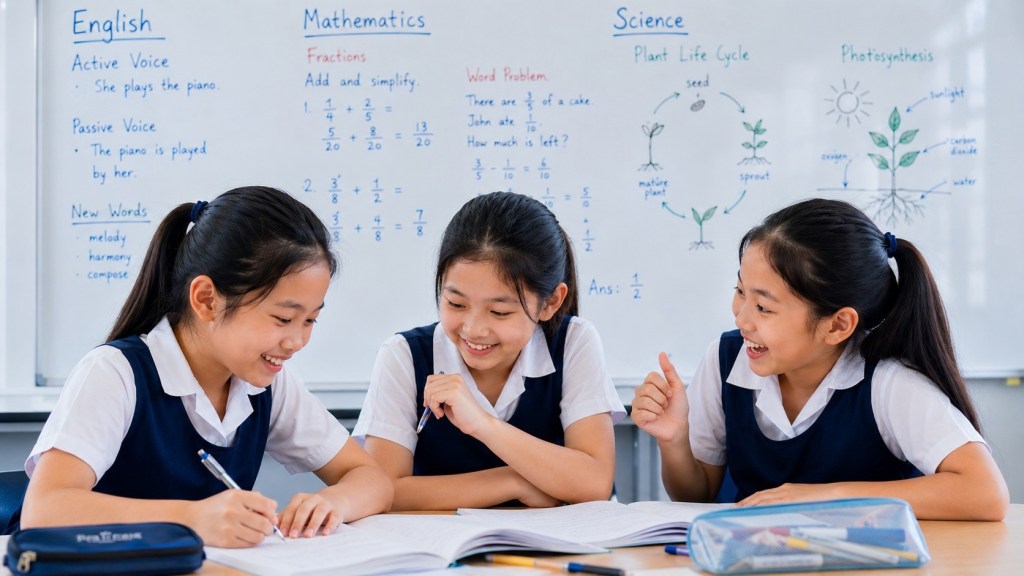
A Primary 4 pupil may know the concept being tested and still be unsure whether an investigation is fair, which variable was changed, what should be kept the same, or how to improve a weak method.
That is because investigation questions contain two layers at once: the Science concept and the logic of the comparison.
A fair test is not “everything stays the same”. It is “change the factor you want to study, measure the result, and keep other important conditions comparable enough to make the conclusion meaningful”.
This guide deepens the fair-test and method branch of the Primary 4 Science Learning Hub.
Quick Answer: What Is the Fair-Test Job?
When reading an investigation, identify four roles:
- Question: what relationship is being investigated?
- Changed condition: what factor is deliberately altered?
- Measured result: what outcome is observed or measured?
- Controlled conditions: what other relevant factors are kept comparable?
A useful eduKate routine is:
ASK → CHANGE → KEEP → MEASURE → COMPARE → CONCLUDE → IMPROVE
This is a teaching routine, not an official MOE marking formula.
Why This Matters at Primary 4
The current MOE Primary Science syllabus develops scientific practices across Primary Science, and Primary 4 topics naturally support investigations involving mass, volume, shadows, temperature, heat conduction and plant conditions.
Official reference: MOE Science Teaching & Learning Syllabus — Primary.
Schools may use different variable terminology. This guide starts with plain-language roles so the reasoning remains visible even if vocabulary changes.
Wait, What? If Everything Is the Same, Nothing Is Being Tested
Suppose a pupil wants to test whether wrapping material affects how quickly hot water cools.
If both cups have the same wrapping, the wrapping variable does not change.
The test needs one deliberate difference.
For example:
- Cup A: cloth wrapping;
- Cup B: foam wrapping.
Other important conditions should then be kept comparable.
Changed Condition
The changed condition is the factor deliberately varied because the investigation question is about its effect.
Examples:
- distance between object and torch;
- type of wrapping material;
- condition of plant roots;
- shape of an object;
- amount of water supplied.
Do not confuse the changed condition with the result.
Measured Result
The measured or observed result is what responds to the changed condition.
Examples:
- shadow width;
- temperature after 15 minutes;
- temperature decrease;
- degree of wilting;
- mass or volume;
- time taken for an event.
The result should directly help answer the investigation question.
Controlled Conditions
Controlled conditions are other relevant factors kept sufficiently similar so they do not become competing explanations.
There is no single universal control list.
Ask:
What else could change the result if I allowed it to vary?
That question generates useful controls.
Original Investigation: Wrapping Material
Question: Which wrapping helps water remain warm for longer?
Two identical cups each contain 100 mL of water at 70°C. Cup P is wrapped in cloth. Cup Q is wrapped in foam. Both remain in the same room for 15 minutes.
Changed condition: wrapping material.
Measured result: final temperature or temperature decrease after 15 minutes.
Useful controls: cup type, water volume, starting temperature, time, room conditions and comparable wrapping amount.
Why Starting Temperature Must Be Controlled
If one cup starts at 90°C and another at 60°C, the final temperatures cannot cleanly show the effect of wrapping alone.
The starting condition already differs.
This is a general investigation principle: if the outcome depends strongly on where the system starts, initial conditions matter.
Original Investigation: Shadow Distance
Question: How does object–torch distance affect shadow width?
The same torch and screen remain fixed. The same object is placed at 10 cm, 20 cm and 30 cm from the torch. Shadow width is measured each time.
Changed condition: object–torch distance.
Measured result: shadow width.
Controls: same object, same orientation, same torch, same screen, same measuring method.
Why Object Shape Must Stay the Same Here
If the pupil also changes a circle into a triangle at each distance, any shadow difference may be due to distance, shape or both.
Changing two important variables weakens causal interpretation.
Original Investigation: Plant Roots
Question: How does severe root damage affect wilting under otherwise similar conditions?
Two similar plants receive the same water, light and soil conditions. One has healthy roots. Many roots of the other are damaged.
Changed condition: root condition.
Observed result: degree of wilting after the same duration.
Controls: plant type, approximate starting size, water amount, light, soil and duration.
Why Plant Investigations Need Careful Language
Living organisms naturally vary.
Two plants are not perfectly identical.
The aim is to make them sufficiently comparable for the classroom question, not to pretend biological variation does not exist.
This is a good early lesson in evidence quality.
Changing Two Things at Once
Suppose a pupil compares:
- a metal spoon in 80°C water;
- a wooden spoon in 50°C water.
If the handles become different temperatures, what caused the difference?
Material changed and water temperature changed.
The test cannot isolate material cleanly.
Method Improvement Must Be Specific
Weak improvement:
“Be more careful.”
Strong improvement:
“Use the same starting temperature for both cups so temperature difference is not another cause of the final result.”
A useful method improvement identifies:
- the weakness;
- the exact change;
- why the change improves the evidence.
Method Improvement Table
| Weakness | Improvement | Why it helps |
|---|---|---|
| Different water volumes | Measure equal volumes | Removes water amount as a competing cause |
| Different starting temperatures | Start at same temperature | Makes cooling comparison more meaningful |
| Shadow object shifts | Mark positions on table | Keeps distance consistent |
| Readings taken at different times | Use same timing schedule | Compares equal durations |
| One doubtful reading | Repeat the trial | Checks whether result is repeatable |
Repeatability
Repeating a trial can show whether the same method gives similar results.
Suppose a shadow-width test gives:
Trial 1: 13 cm.
Trial 2: 13 cm.
Trial 3: 14 cm.
The values are reasonably close.
If Trial 3 were 31 cm, the learner should inspect the method before accepting the result as normal.
Repeating Does Not Fix a Systematic Error
If the ruler is wrongly calibrated or the thermometer is consistently misread, repeating the same mistake produces consistent but inaccurate results.
Primary 4 pupils do not need the formal term systematic error to understand the principle:
Repeating a flawed method does not automatically make it correct.
Why Averages Can Help—and When They Do Not
If several repeated measurements estimate the same quantity under the same conditions, an average can summarise them.
But averaging cannot rescue trials that used different conditions.
Do not combine unlike cases just because arithmetic is possible.
Observation Method Should Be Defined
Suppose the result is “how wilted is the plant?”
Different pupils may judge wilting differently.
A simple defined scale can make observations more comparable:
- 0 = leaves firm;
- 1 = a few leaves drooping;
- 2 = many leaves drooping;
- 3 = severe drooping.
This example is an eduKate teaching device, not an official MOE scale.
The scientific lesson is that vague observations become stronger when the method is defined.
Method Limitations
A limitation is not necessarily a mistake.
For example:
- only one plant of each condition was tested;
- room temperature changed during the experiment;
- the shadow edge was difficult to define precisely;
- the measuring cylinder scale was coarse;
- human judgement was used for wilting.
A limitation tells us how strongly the conclusion should be trusted or how broadly it should be applied.
Mistake vs Limitation
Mistake: one cup accidentally received twice as much water.
Limitation: the thermometer can only be read to the nearest degree.
The first is a procedural error that should be corrected.
The second is a constraint of the method or instrument.
Conclusion Must Match the Evidence
Suppose foam kept water warmer than cloth in one classroom test.
Too weak: “Foam is better.”
Better: “The foam-wrapped cup had a smaller temperature decrease than the cloth-wrapped cup.”
Bounded conclusion: “Under the tested conditions, foam reduced the water’s temperature decrease more than cloth over 15 minutes.”
Overclaim: “Foam is always the world’s best insulating material.”
The strongest Science answer stays within the evidence.
Correlation Is Not Automatically Cause
Two changes can occur together without one being the only cause of the other.
If a plant receives less water and less light and then grows less, the result does not isolate which condition caused the difference.
A fairer design changes one factor while controlling the other relevant conditions.
Unexpected Results Are Useful
A strange result can reveal:
- a measurement mistake;
- a moved apparatus;
- a hidden variable;
- natural variation;
- a genuine effect worth checking.
Do not erase it automatically.
Investigate why it happened.
Original Workshop 1: Light
A pupil wants to test the effect of object size on shadow size.
Trial A uses a small object 10 cm from the torch.
Trial B uses a large object 25 cm from the torch.
What is wrong?
Object size and distance both changed.
Improvement: keep distance, source and screen conditions comparable while changing only object size.
Original Workshop 2: Heat
Two cups use different wrapping materials. Cup A contains 100 mL at 70°C. Cup B contains 150 mL at 80°C.
Can the wrapping effect be isolated?
No. Water amount and starting temperature also differ.
Improvement: use the same water volume and starting temperature.
Original Workshop 3: Matter
A pupil wants to compare the mass of two objects but uses two different scales, one of which is not zeroed correctly.
What is the weakness?
The measurement systems are not directly comparable and one scale has a calibration problem.
Improvement: use the same correctly zeroed scale, or verify both scales against a standard before comparison.
Original Workshop 4: Plants
One plant has damaged roots and receives 20 mL water. Another has healthy roots and receives 60 mL.
The damaged-root plant wilts more.
Can root damage alone explain the difference?
Not confidently. Water amount also differs.
Improvement: keep water amount comparable while changing root condition.
Original Practice Set
Question 1
What is the changed condition in an experiment comparing cloth and foam wrapping?
Question 2
What is the measured result if the pupil records water temperature after 15 minutes?
Question 3
Why should starting temperature be the same in a cooling comparison?
Question 4
Why is “do it more carefully” a weak method improvement?
Question 5
Three repeated readings are 12 cm, 12 cm and 29 cm. What should happen next?
Question 6
Can averaging compensate for the fact that one trial used a different water amount?
Question 7
What is the difference between a method mistake and a limitation?
Question 8
Why should a conclusion say “under the tested conditions” when appropriate?
Practice Answers
1. Wrapping material.
2. Water temperature after the specified time, or the temperature change if that is later calculated.
3. Otherwise starting temperature becomes another factor that can affect the final result.
4. It does not identify what was wrong, what should change or why the change helps.
5. Check the method and conditions, then repeat the doubtful trial if appropriate.
6. No. The trials are not equivalent if a relevant condition changed.
7. A mistake is an avoidable procedural error; a limitation is a constraint of the method, sample or instrument.
8. It keeps the conclusion within the evidence instead of turning one classroom result into a universal claim.
Transfer Test: Identify Roles in a New Topic
After practising a shadow experiment, switch to plant water amount.
After practising wrapping material, switch to object material.
After practising temperature, switch to mass or volume.
Ask the same four questions:
- What changed?
- What was measured?
- What should stay comparable?
- What conclusion is supported?
If the learner can answer across topics, the investigation logic is transferring.
The Fair-Test Diagnostic
| If the learner… | Likely weak link | Repair |
|---|---|---|
| Confuses changed and measured variables | Role mapping | Ask “what did I change?” vs “what did I record?” |
| Lists irrelevant controls | Causal reasoning | Ask what else could affect the result |
| Says “be careful” | Method specificity | Weakness → change → reason |
| Deletes odd results automatically | Evidence handling | Inspect method before rejecting data |
| Makes universal claims | Evidence boundary | Bound conclusion to tested conditions |
A 30-Minute Fair-Test Lesson
Minutes 1–5: identify changed and measured conditions in two examples.
Minutes 6–10: generate relevant controls.
Minutes 11–15: diagnose a flawed method.
Minutes 16–20: propose one specific improvement and explain why it helps.
Minutes 21–25: inspect an unexpected result.
Minutes 26–30: transfer the same investigation logic to a new topic.
This is an eduKate teaching suggestion, not an official school programme.
What Parents and Tutors Can Ask
- “What did you deliberately change?”
- “What result did you record?”
- “What else could have changed the result?”
- “Which conditions need to stay comparable?”
- “What exactly is wrong with the method?”
- “What exact change would improve it?”
- “Why would that improvement help?”
- “Does your conclusion go further than the evidence?”
How Fair Tests Connect to the Whole Primary 4 Science System
Light uses variable control in shadow investigations.
Heat uses controlled comparisons for materials and cooling.
Matter uses consistent measurement methods.
Plant questions use comparable conditions to support causal claims.
Fair-test thinking is therefore a shared reasoning engine across the Primary 4 curriculum.
Continue the Primary 4 Science Series
- Primary 4 Science Learning Guide | Digestive System Route, Parts and Functions
- Primary 4 Science Learning Guide | Measurement, Mass, Volume, Temperature and Units
- Primary 4 Science Learning Guide | Diagrams, Tables, Data and Patterns
For the wider investigation system, use Investigations, Data, Answers and Transfer.
The Quiet Return
A fair-test question becomes easier when the learner stops memorising variable vocabulary and starts reading the logic.
Ask the question. Change one important factor. Keep other relevant conditions comparable. Measure consistently. Bound the conclusion. Improve the exact weakness you found.
