
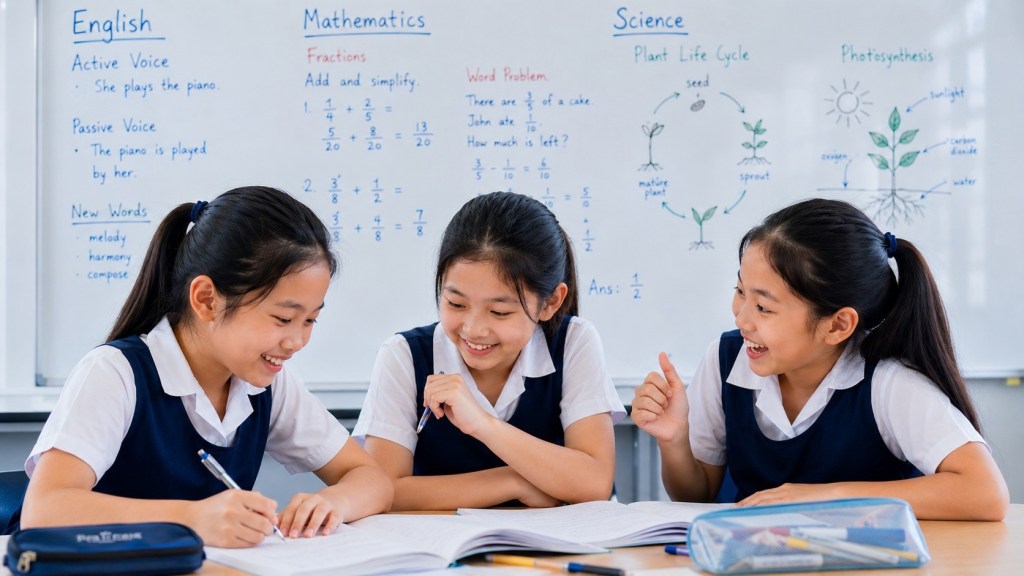
A classroom and playground are full of Primary 4 Science: sunlight through windows, shadows under tables, metal railings warming in the Sun, water bottles changing shape only when flexible, rulers measuring distance, balls occupying space and investigations hiding inside ordinary play.
Everyday transfer becomes powerful when the learner can recognise the scientific relationship without the worksheet naming the topic first.
This application guide belongs to the Primary 4 Science Learning Hub.
Quick Answer: What Science Lives in a Classroom and Playground?
- light sources, reflected light and seeing;
- straight-line light travel and shadows;
- distance and shadow-size relationships;
- matter, mass and volume;
- air occupying space;
- heat transfer and material choice;
- measurement and units;
- fair tests and variable control;
- patterns across time or position;
- evidence, prediction and follow-up questions.
A useful eduKate transfer loop is:
OBJECT → ROLE → PROPERTY → RELATIONSHIP → MEASURE → EXPLAIN → TRANSFER
Playground Case 1 | Shadows Under the Sun
A child standing in sunlight creates a shadow because the body blocks some straight-line light paths from reaching the ground.
The Sun acts as a light source.
The child acts as a blocker.
The ground acts as a receiving surface.
The shadow is the region receiving less direct light.
Shadow Is Not a Dark Substance
A shadow is not paint, smoke or matter.
It is a region created by blocked light.
This misconception becomes easier to repair when the learner watches the shadow move as the source-object relationship changes.
Playground Case 2 | Shadow Length Across the Day
A playground pole may cast different shadow lengths at different times.
A learner can:
- measure time;
- measure shadow length;
- record a table;
- describe the pattern;
- avoid jumping immediately to a causal explanation beyond the evidence.
This is a safe example of pattern observation.
Measure Before Explaining
Observation:
“The shadow was longer at 8 a.m. than at noon.”
Measurement:
“The shadow measured 240 cm at 8 a.m. and 90 cm at noon.”
Explanation requires a model involving source position and light geometry.
Classroom Case 1 | Window Light
A book near a bright window can be seen because light from outside or the room reaches the book and reflected light enters the eye.
The book does not emit its own light.
Seeing depends on light entering the eye.
Classroom Case 2 | Projector and Screen
A projector provides light.
The screen receives light.
Objects or people crossing the beam can block some light and create shadows.
This familiar context transfers directly to source–blocker–screen reasoning.
Classroom Case 3 | Aligning Holes
A classic straight-line light idea can be recreated conceptually with aligned openings.
If light is visible through several aligned holes but disappears when one shifts sideways, the evidence supports straight-line travel in the Primary 4 model.
Playground Case 3 | Metal Railings in the Sun
A metal railing exposed to sunlight can become warmer than it was earlier.
When a cooler hand touches a warmer railing, heat transfers from the railing to the hand.
Metal also conducts heat well, so temperature changes can spread through the material.
Do not touch dangerously hot surfaces to test this.
Playground Safety Is Part of Science
Do not use:
- hot metal surfaces;
- electrical boxes;
- moving equipment;
- high climbing structures;
- unsafe road areas
as experimental apparatus.
Observation and safe measurement are enough.
Classroom Case 4 | Metal Desk Leg vs Plastic Chair
Different materials can feel different at the same room conditions.
Ask:
- Which material is likely to conduct heat more readily?
- Does touch alone prove different temperatures?
- What measurement would check the claim?
The learner separates sensation from measured evidence.
Classroom Case 5 | Ruler as Measurement Tool
A ruler teaches:
- scale intervals;
- zero alignment;
- units;
- precision limits;
- consistent measurement method.
Measuring the same object from different starting marks without correcting can create error.
Zero Error at a Primary Level
If an object begins at the 2 cm mark and ends at the 15 cm mark, its length is not 15 cm.
Length = 13 cm.
The learner must distinguish scale reading from measured difference.
Playground Case 4 | Measuring a Bench Shadow
Question:
“How does the bench shadow length change over the morning?”
Possible table:
| Time | Shadow length |
|---|---|
| 8:00 | 220 cm |
| 9:00 | 180 cm |
| 10:00 | 135 cm |
Describe the pattern before explaining it.
Classroom Case 6 | Water Bottle Volume
A rigid bottle has fixed external shape because it is a solid.
The water inside takes the shape of the bottle while keeping its volume if none is added or removed.
Solid container and liquid content illustrate different state properties in the same object system.
Classroom Case 7 | Squeezing a Flexible Bottle
A plastic bottle can change shape when squeezed because the solid material is flexible.
This does not mean solids have no fixed shape in the Primary 4 classification model.
The model describes ordinary state properties; flexible solids can deform under force.
This is a useful model-limit discussion.
Playground Case 5 | Air in a Ball
A ball contains air.
Air occupies space.
An inflated ball is larger and firmer partly because air fills the interior.
Do not confuse the ball’s rubber or plastic shell with the air inside it.
Air Is Matter
Air is invisible but still occupies space.
This everyday example supports the idea that visibility is not required for matter to be present.
Classroom Case 8 | Empty Pencil Case
An “empty” pencil case still contains air.
The everyday word empty usually means “contains no pencils or objects of interest”.
Scientific language can be more precise.
Classroom Case 9 | Heating and Cooling of a Drink Bottle
A chilled bottle taken into a warmer classroom gains heat from the surroundings.
Its temperature rises over time.
The direction is warmer surroundings → cooler bottle.
Reverse the Condition
A warm bottle placed in an air-conditioned room loses heat to cooler surroundings.
The same model applies, but direction reverses because the temperature relation reverses.
Playground Case 6 | Shade and Surface Temperature
A shaded bench and a sunlit bench may have different temperatures.
A learner can ask:
- Are they made of the same material?
- Were they exposed for the same time?
- Is one shaded?
- What does a thermometer show?
Touch should not replace safe measurement.
Classroom Case 10 | Comparing Materials
Desk top, chair, ruler and water bottle may use different materials.
Classify by one criterion at a time:
- metal/non-metal;
- better/poorer heat conductor in the set;
- transparent/less transparent in an observational context;
- rigid/flexible.
Do not mix criteria between groups.
Playground Case 7 | Choosing a Slide Material
A design question can ask:
What material property matters for a playground slide or handrail?
Possible considerations include:
- surface temperature in sunlight;
- strength;
- smoothness;
- durability.
Primary 4 Science should focus only on the relevant taught properties rather than pretending one material is universally best.
Classroom Case 11 | Fair Test With Paper Materials
A safe classroom comparison can involve shadow size using:
- same light source;
- same screen;
- same object;
- different object distance.
Only one relevant factor should change.
Original Investigation 1 | Shadow Distance
Question:
How does object–torch distance affect shadow width?
Method principles:
- same card;
- same torch;
- same screen;
- same orientation;
- change distance;
- measure shadow width.
Original Investigation 2 | Surface Temperature
Question:
How do temperatures of two safe surfaces compare in sun and shade?
Use teacher-approved safe surfaces and measurement tools.
Control material where possible if shade exposure is the factor being studied.
Original Investigation 3 | Air Occupies Space
Use the familiar cup-and-water model conceptually or in a supervised classroom demonstration.
Observation:
water does not fully enter the inverted cup until air escapes.
Conclusion:
air occupies space.
Original Investigation 4 | Measurement Repeatability
Measure the same desk length three times using the same ruler and method.
Compare readings.
If results differ, inspect:
- starting point;
- ruler angle;
- parallax;
- recording.
Classroom Science and Dense Question Stems
An everyday context can be made into a long question.
Example:
“Two identical bottles contain equal water at the same starting temperature. Bottle P is placed in sunlight while Bottle Q is placed in shade for 20 minutes.”
Compress:
- same bottle;
- same water;
- same start;
- same time;
- changed = exposure condition;
- measure temperature.
Classroom Science and MCQs
Distractor:
“The shaded bottle is cooler because cold enters it.”
Reject because Heat is transferred, not cold.
The everyday context does not change the model.
Classroom Science and Open-Ended Answers
Question:
“Explain why a bottle taken from an air-conditioned room warms outside.”
Strong answer:
“The surroundings are hotter than the bottle, so heat is transferred to the cooler bottle and its temperature increases.”
Playground Science and Missing Information
One swing seat feels hotter than another.
Before concluding material caused the difference, ask:
- same material?
- same sunlight exposure?
- same time?
- measured temperature?
Several explanations may remain.
Playground Science and Pattern Recognition
Repeated shadow measurements can reveal a trend.
One shadow length cannot establish a time pattern.
Use several measurements.
Playground Science and Follow-Up Questions
If the shadow becomes shorter from 8 to 10 a.m., ask:
- What happens at 11 a.m.?
- Does the pattern reverse later?
- Would another object show a similar pattern?
The evidence generates the next question.
Common Classroom/Playground Errors
- treats shadow as matter;
- uses touch as proof of temperature;
- ignores units;
- measures from the wrong ruler starting point;
- confuses container shape with liquid volume;
- assumes flexible solid is a liquid;
- forgets air inside “empty” objects;
- makes unsafe tests on hot or electrical objects;
- overclaims from one observation.
Original Practice Set
Question 1
Why does a playground shadow form?
Question 2
What is needed to see a classroom book?
Question 3
Why can an inflated ball be evidence that air occupies space?
Question 4
A desk ruler measurement starts at 2 cm and ends at 18 cm. What is the length?
Question 5
Why can a plastic bottle change shape and still be a solid?
Question 6
What should be controlled in a shadow-distance experiment?
Question 7
Why is touching a sunlit railing not a good scientific temperature measurement?
Question 8
What does one shadow measurement fail to show?
Practice Answers
1. The object blocks straight-line light paths from reaching part of the surface.
2. Light from a source must reach the book and reflected light must enter the eye.
3. Air fills the inside and increases the space occupied by the inflated ball.
4. 16 cm.
5. Flexible solids can deform under force while remaining solids.
6. Same object, source, screen, orientation and measurement method while distance changes.
7. Sensation is subjective and can be unsafe; use a suitable thermometer.
8. It cannot establish a trend across time or position.
The Classroom/Playground Diagnostic
| If the learner… | Likely weak link | Repair |
|---|---|---|
| Sees context but not model | Transfer | Name source, blocker, property or variable |
| Trusts touch | Measurement | Use property-tool evidence |
| Misreads ruler | Scale reasoning | Final minus starting mark |
| Confuses material flexibility with state | Model limits | Separate deformation from state properties |
| Uses one observation as pattern | Evidence sufficiency | Collect multiple points |
A 30-Minute Application Lesson
Minutes 1–5: identify five classroom/playground objects and relevant properties.
Minutes 6–10: build one light-path model.
Minutes 11–15: measure one safe property accurately.
Minutes 16–20: design one fair comparison.
Minutes 21–25: describe a pattern from data.
Minutes 26–30: transfer the model to a different everyday object.
What Parents and Tutors Can Ask
- “What role does this object play in the model?”
- “What property are you measuring?”
- “What is the unit?”
- “What should stay the same?”
- “Is that a pattern or one observation?”
- “Can you explain it without the playground context?”
Continue Batch 13
- Home and Kitchen Everyday Science
- Garden and Plant Everyday Science
- Everyday Materials and Devices Science
The Quiet Return
A playground is not outside Science and a classroom is not only where Science is taught.
Find the source, object, property or variable. Measure safely. Separate observation from explanation. Keep comparisons fair. Then carry the same model back into the next unfamiliar question.
