
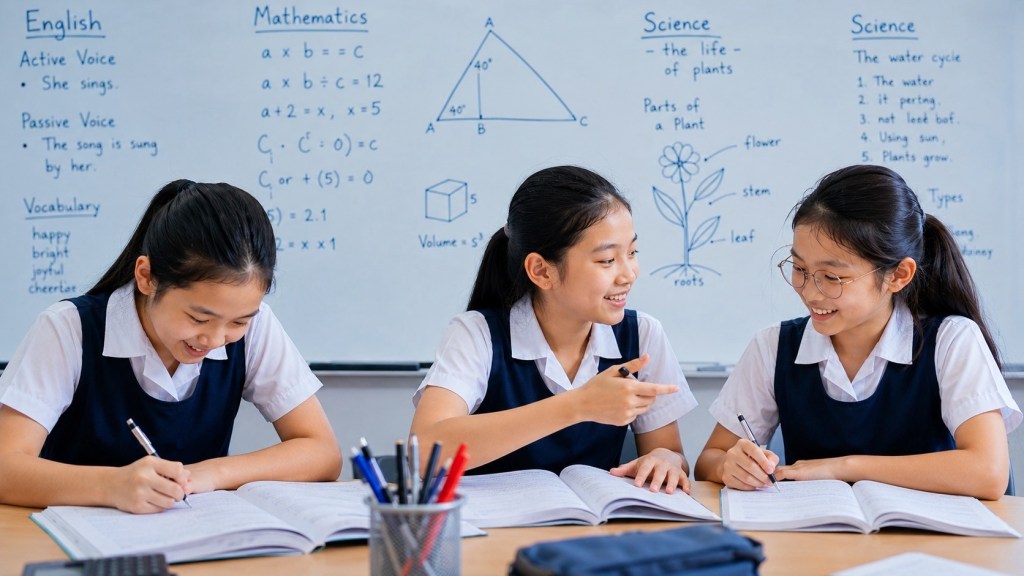
What happens when a habitat is destroyed? In Primary 6 Science, habitat loss changes the conditions living things depend on for food, water, shelter, breeding sites and space. Populations may decline, move elsewhere or face stronger competition as the remaining habitat becomes smaller or poorer.
Habitat destruction can also change food webs. Removing vegetation can reduce food for herbivores, which can then affect predators. Losing nesting sites can reduce reproduction even when food remains. Pollution can damage water quality and affect many organisms at once. A strong explanation traces the first environmental change before predicting later population effects.
At eduKate Sengkang, Primary 6 Science tuition teaches habitat questions as cause → resource or condition change → population effect → wider ecosystem consequence. Students learn to separate direct and indirect effects, recognise uncertainty and evaluate conservation actions without claiming one intervention automatically restores an entire ecosystem.
Use the Primary 6 Science Learning Hub, How to Explain Food Web Population Changes, Why Do Living Things Compete?, and the Human Impact on the Environment guide.
- Up to three students per class.
- 1.5-hour weekly lesson.
- Focus: habitat loss, resources, population change, food webs, pollution, conservation and PSLE explanations.
- Location: 83 Punggol Central, Singapore 828761.
- Enquiries: WhatsApp +65 8823 1234.
What a Habitat Provides
A habitat provides living things with the conditions and resources needed to survive and reproduce.
Food, water, shelter, space and suitable environmental conditions can all matter.
Students identify the specific habitat function affected rather than write only that animals ‘lose their home’.
In a 3-pax tutorial, students identify the first habitat condition changed before discussing population outcomes. This prevents them from jumping straight to ‘animals die’ without explaining the resource or process.
Habitat Loss
Habitat loss occurs when suitable living space is removed or changed so organisms can no longer use it in the same way.
The effect depends on which resources and conditions disappear.
Students connect the physical change to biological consequences.
In a 3-pax tutorial, students identify the first habitat condition changed before discussing population outcomes. This prevents them from jumping straight to ‘animals die’ without explaining the resource or process.
Habitat Fragmentation
A large habitat can be split into smaller isolated patches.
Even if some habitat remains, movement, breeding and access to resources can become more difficult.
Students learn that area alone does not describe habitat quality completely.
In a 3-pax tutorial, students identify the first habitat condition changed before discussing population outcomes. This prevents them from jumping straight to ‘animals die’ without explaining the resource or process.
Food Loss
Removing plants or prey can reduce food availability for consumers.
The first population affected may then influence predators through the food web.
Students trace direct effects before indirect ones.
In a 3-pax tutorial, students identify the first habitat condition changed before discussing population outcomes. This prevents them from jumping straight to ‘animals die’ without explaining the resource or process.
Water Loss
Draining wetlands or reducing clean water can affect organisms that depend on those water sources.
Water quantity and water quality are different issues.
Students identify whether the habitat change removes water or contaminates it.
In a 3-pax tutorial, students identify the first habitat condition changed before discussing population outcomes. This prevents them from jumping straight to ‘animals die’ without explaining the resource or process.
Shelter Loss
Removing trees, burrows, reefs or vegetation can reduce hiding and resting places.
Shelter can affect survival even if food remains.
Students avoid treating habitat solely as a food source.
In a 3-pax tutorial, students identify the first habitat condition changed before discussing population outcomes. This prevents them from jumping straight to ‘animals die’ without explaining the resource or process.
Breeding-Site Loss
Some organisms need particular nesting, spawning or breeding sites.
Population decline can occur if reproduction is disrupted even when adults can still find food.
Students connect habitat to life cycle and reproduction.
In a 3-pax tutorial, students identify the first habitat condition changed before discussing population outcomes. This prevents them from jumping straight to ‘animals die’ without explaining the resource or process.
Space Reduction
Smaller habitats can crowd organisms into less space.
Crowding can intensify competition for food, shelter, territories or mates.
Students connect habitat loss to the competition owner.
In a 3-pax tutorial, students identify the first habitat condition changed before discussing population outcomes. This prevents them from jumping straight to ‘animals die’ without explaining the resource or process.
Migration or Movement
Some organisms may move away when habitat quality declines.
Movement can reduce local population without every individual dying.
Students distinguish emigration from death.
In a 3-pax tutorial, students identify the first habitat condition changed before discussing population outcomes. This prevents them from jumping straight to ‘animals die’ without explaining the resource or process.
Mortality
Habitat destruction can directly kill organisms or increase exposure to predators, heat, pollution or starvation.
The exact pathway depends on the type of destruction.
Students avoid generic statements when a specific mechanism is provided.
In a 3-pax tutorial, students identify the first habitat condition changed before discussing population outcomes. This prevents them from jumping straight to ‘animals die’ without explaining the resource or process.
Food-Web Effects
A habitat change affecting one species can indirectly affect predators, prey and competitors.
Food-web consequences should follow the actual feeding relationships.
Students do not invent connections absent from the model.
In a 3-pax tutorial, students identify the first habitat condition changed before discussing population outcomes. This prevents them from jumping straight to ‘animals die’ without explaining the resource or process.
Producer Loss
Removing vegetation can reduce food and shelter simultaneously.
Primary consumers may decline, which can affect higher consumers.
Students recognise that producers can support several habitat functions.
In a 3-pax tutorial, students identify the first habitat condition changed before discussing population outcomes. This prevents them from jumping straight to ‘animals die’ without explaining the resource or process.
Predator Effects
Predators can decline if prey or hunting habitat disappears.
Alternative prey or neighbouring habitat may buffer the effect.
Students avoid guaranteed predictions.
In a 3-pax tutorial, students identify the first habitat condition changed before discussing population outcomes. This prevents them from jumping straight to ‘animals die’ without explaining the resource or process.
Prey Effects
Prey populations can either decline from habitat loss or increase if predator habitat is affected more strongly.
The direction is not automatic; evidence matters.
Students compare competing mechanisms.
In a 3-pax tutorial, students identify the first habitat condition changed before discussing population outcomes. This prevents them from jumping straight to ‘animals die’ without explaining the resource or process.
Competition Increase
When organisms are compressed into a smaller area, competition can intensify for limited resources.
This is a secondary effect of habitat loss, not the definition of habitat loss itself.
Students keep cause order clear.
In a 3-pax tutorial, students identify the first habitat condition changed before discussing population outcomes. This prevents them from jumping straight to ‘animals die’ without explaining the resource or process.
Pollution
Pollution can degrade habitat without physically removing it.
Water, soil or air quality can become unsuitable for organisms.
Students distinguish habitat destruction by contamination from habitat removal.
In a 3-pax tutorial, students identify the first habitat condition changed before discussing population outcomes. This prevents them from jumping straight to ‘animals die’ without explaining the resource or process.
Deforestation
Removing forests can reduce food, shelter, nesting sites and plant populations.
The ecological consequences depend on which organisms relied on the forest.
Students avoid one-size-fits-all claims.
In a 3-pax tutorial, students identify the first habitat condition changed before discussing population outcomes. This prevents them from jumping straight to ‘animals die’ without explaining the resource or process.
Wetland Drainage
Draining wetlands removes aquatic and semi-aquatic habitat and can change water availability.
The effect can reach organisms that feed or breed there.
Students trace resource and food-web changes.
In a 3-pax tutorial, students identify the first habitat condition changed before discussing population outcomes. This prevents them from jumping straight to ‘animals die’ without explaining the resource or process.
Coral Damage
Damage to coral habitat can remove shelter and feeding areas for many marine organisms.
The coral ecosystem provides more than one resource.
Students identify the relevant dependency in the question.
In a 3-pax tutorial, students identify the first habitat condition changed before discussing population outcomes. This prevents them from jumping straight to ‘animals die’ without explaining the resource or process.
Urban Development
Roads and buildings can replace or fragment natural habitat.
Some species adapt to urban conditions while others decline.
Students recognise different species can respond differently.
In a 3-pax tutorial, students identify the first habitat condition changed before discussing population outcomes. This prevents them from jumping straight to ‘animals die’ without explaining the resource or process.
Agricultural Change
Land conversion can remove native habitat but also create new food resources for some species.
Environmental change can benefit some organisms while harming others.
Students avoid assuming every population moves in the same direction.
In a 3-pax tutorial, students identify the first habitat condition changed before discussing population outcomes. This prevents them from jumping straight to ‘animals die’ without explaining the resource or process.
Noise and Light Boundary
Human activity can alter habitat conditions through noise or artificial light even when vegetation remains.
The question must establish the relevant organism response.
Students use evidence rather than broad human-impact statements.
In a 3-pax tutorial, students identify the first habitat condition changed before discussing population outcomes. This prevents them from jumping straight to ‘animals die’ without explaining the resource or process.
Climate Conditions
Long-term changes in temperature or rainfall can shift habitat suitability.
Primary 6 students can reason qualitatively without advanced climate modelling.
Students connect condition change to organism requirements.
In a 3-pax tutorial, students identify the first habitat condition changed before discussing population outcomes. This prevents them from jumping straight to ‘animals die’ without explaining the resource or process.
Invasive Species Boundary
Introduced species can alter habitat relationships and compete for resources.
This is distinct from direct habitat destruction but can interact with it.
Students classify the initial cause accurately.
In a 3-pax tutorial, students identify the first habitat condition changed before discussing population outcomes. This prevents them from jumping straight to ‘animals die’ without explaining the resource or process.
Conservation
Conservation aims to protect species, habitats or resources through planned actions.
One action should be linked to the problem it addresses.
Students avoid vague ‘save nature’ conclusions.
In a 3-pax tutorial, students identify the first habitat condition changed before discussing population outcomes. This prevents them from jumping straight to ‘animals die’ without explaining the resource or process.
Reforestation
Planting trees can restore vegetation and some habitat functions.
A young plantation may not immediately recreate all features of an old forest.
Students recognise restoration takes time.
In a 3-pax tutorial, students identify the first habitat condition changed before discussing population outcomes. This prevents them from jumping straight to ‘animals die’ without explaining the resource or process.
Protected Areas
Protected areas can reduce direct habitat destruction within defined boundaries.
Protection does not automatically solve pollution, climate or external resource pressures.
Students keep conservation claims proportional.
In a 3-pax tutorial, students identify the first habitat condition changed before discussing population outcomes. This prevents them from jumping straight to ‘animals die’ without explaining the resource or process.
Wildlife Corridors
Corridors can connect habitat fragments and support movement between populations.
They are useful when fragmentation is a key problem.
Students connect intervention to mechanism.
In a 3-pax tutorial, students identify the first habitat condition changed before discussing population outcomes. This prevents them from jumping straight to ‘animals die’ without explaining the resource or process.
Pollution Control
Reducing pollutant input can improve habitat quality.
Recovery depends on the pollutant, ecosystem and time.
Students distinguish stopping damage from instant restoration.
In a 3-pax tutorial, students identify the first habitat condition changed before discussing population outcomes. This prevents them from jumping straight to ‘animals die’ without explaining the resource or process.
Resource Management
Sustainable use can reduce pressure on forests, fisheries or water systems.
The conservation action should target the resource being overused.
Students link policy idea to ecological mechanism.
In a 3-pax tutorial, students identify the first habitat condition changed before discussing population outcomes. This prevents them from jumping straight to ‘animals die’ without explaining the resource or process.
Population Monitoring
Repeated counts can show whether a population is changing over time.
One count cannot establish a trend.
Students learn evidence quality and time-series reasoning.
In a 3-pax tutorial, students identify the first habitat condition changed before discussing population outcomes. This prevents them from jumping straight to ‘animals die’ without explaining the resource or process.
Habitat Area Data
Maps or satellite data can show habitat area change.
Area loss is evidence of physical change but does not directly measure every species population.
Students distinguish habitat measurement from organism outcome.
In a 3-pax tutorial, students identify the first habitat condition changed before discussing population outcomes. This prevents them from jumping straight to ‘animals die’ without explaining the resource or process.
Biodiversity Boundary
Habitat destruction can reduce biodiversity when species are lost or populations collapse.
A simple species count may not capture all ecosystem functions.
Primary students use biodiversity qualitatively and cautiously.
In a 3-pax tutorial, students identify the first habitat condition changed before discussing population outcomes. This prevents them from jumping straight to ‘animals die’ without explaining the resource or process.
Direct Versus Indirect Effects
A bulldozed nesting tree is a direct habitat change; a later predator decline from prey loss is an indirect effect.
Students label the chain one step at a time.
This prevents skipped causal links.
In a 3-pax tutorial, students identify the first habitat condition changed before discussing population outcomes. This prevents them from jumping straight to ‘animals die’ without explaining the resource or process.
Time Lag
Population effects may appear after months or years rather than immediately.
Adult animals can survive temporarily even when breeding sites are gone.
Students avoid expecting instant equilibrium.
In a 3-pax tutorial, students identify the first habitat condition changed before discussing population outcomes. This prevents them from jumping straight to ‘animals die’ without explaining the resource or process.
Threshold Effects
Small habitat changes may have limited effects until a critical resource becomes scarce.
Primary students do not need advanced threshold equations to understand non-linear responses.
Students stay cautious with simple proportional predictions.
In a 3-pax tutorial, students identify the first habitat condition changed before discussing population outcomes. This prevents them from jumping straight to ‘animals die’ without explaining the resource or process.
Recovery Time
Restoring habitat can take longer than destroying it.
Trees, soil, water quality and food webs may recover at different rates.
Students avoid assuming conservation produces immediate full recovery.
In a 3-pax tutorial, students identify the first habitat condition changed before discussing population outcomes. This prevents them from jumping straight to ‘animals die’ without explaining the resource or process.
Alternative Habitat
Some organisms can move into alternative suitable habitats.
Others are highly specialised and cannot relocate easily.
Students use species-specific evidence.
In a 3-pax tutorial, students identify the first habitat condition changed before discussing population outcomes. This prevents them from jumping straight to ‘animals die’ without explaining the resource or process.
Adaptation Link
Adaptations can help organisms use certain habitat conditions.
If conditions change beyond the range those adaptations support, survival can become harder.
Students connect adaptation to environment without saying organisms instantly adapt.
In a 3-pax tutorial, students identify the first habitat condition changed before discussing population outcomes. This prevents them from jumping straight to ‘animals die’ without explaining the resource or process.
Competition Link
Habitat compression can increase competition among survivors.
The shared limited resource must still be identified.
Students do not use competition as a vague synonym for crowding.
In a 3-pax tutorial, students identify the first habitat condition changed before discussing population outcomes. This prevents them from jumping straight to ‘animals die’ without explaining the resource or process.
Food-Web Link
Habitat loss can remove a producer, prey or predator and trigger population changes.
The arrows in the actual food web determine the direction of direct feeding relationships.
Students trace evidence rather than tell a generic story.
In a 3-pax tutorial, students identify the first habitat condition changed before discussing population outcomes. This prevents them from jumping straight to ‘animals die’ without explaining the resource or process.
Human Needs Boundary
Environmental decisions can involve human needs, economics and values in addition to Science.
Primary Science can explain ecological effects without pretending Science alone chooses every policy.
Students distinguish factual mechanism from wider social decisions.
In a 3-pax tutorial, students identify the first habitat condition changed before discussing population outcomes. This prevents them from jumping straight to ‘animals die’ without explaining the resource or process.
Evidence and Uncertainty
Environmental systems have many interacting variables.
Strong answers state what the evidence supports and where uncertainty remains.
Students learn that cautious conclusions are scientifically responsible.
In a 3-pax tutorial, students identify the first habitat condition changed before discussing population outcomes. This prevents them from jumping straight to ‘animals die’ without explaining the resource or process.
PSLE Transfer
A PSLE-style question may combine a habitat map, food web and population graph.
The reliable route is initial habitat change → resource or condition lost → direct population effect → supported indirect consequence.
Students keep the chain explicit.
In a 3-pax tutorial, students identify the first habitat condition changed before discussing population outcomes. This prevents them from jumping straight to ‘animals die’ without explaining the resource or process.
Worked Primary 6 Habitat Cases
Forest Clearing
A forest patch is cleared for construction.
Tree-dependent organisms lose food, shelter or nesting sites; populations can decline or move, and food-web effects may follow.
A useful follow-up asks which effect is direct, which is indirect, and what additional measurement would test the prediction. Students learn to keep the causal chain visible rather than compress an ecosystem into one sentence.
Wetland Drainage
A wetland is drained.
Aquatic organisms lose habitat and water-dependent breeding sites, while predators relying on them can later be affected.
A useful follow-up asks which effect is direct, which is indirect, and what additional measurement would test the prediction. Students learn to keep the causal chain visible rather than compress an ecosystem into one sentence.
Polluted Stream
A pollutant enters a stream and water quality falls.
Aquatic organisms can decline even though the physical stream remains; habitat quality has been degraded.
A useful follow-up asks which effect is direct, which is indirect, and what additional measurement would test the prediction. Students learn to keep the causal chain visible rather than compress an ecosystem into one sentence.
Fragmented Forest
A road splits one forest into two small patches.
Animals may find movement and breeding between patches more difficult, even though total tree area has not vanished.
A useful follow-up asks which effect is direct, which is indirect, and what additional measurement would test the prediction. Students learn to keep the causal chain visible rather than compress an ecosystem into one sentence.
Nesting Trees Removed
Food remains abundant but old hollow trees are removed.
Bird populations needing those hollows can decline because breeding sites, not food, became limiting.
A useful follow-up asks which effect is direct, which is indirect, and what additional measurement would test the prediction. Students learn to keep the causal chain visible rather than compress an ecosystem into one sentence.
Mangrove Loss
Mangroves are cleared along a coast.
Organisms using the roots for shelter or nursery habitat can decline, affecting later food-web relationships.
A useful follow-up asks which effect is direct, which is indirect, and what additional measurement would test the prediction. Students learn to keep the causal chain visible rather than compress an ecosystem into one sentence.
Reforestation
Native trees are replanted on cleared land.
Some habitat functions can recover over time, but full ecosystem structure may take years.
A useful follow-up asks which effect is direct, which is indirect, and what additional measurement would test the prediction. Students learn to keep the causal chain visible rather than compress an ecosystem into one sentence.
Wildlife Corridor
Two forest fragments are connected with a vegetated corridor.
Movement between patches can improve, potentially reducing isolation.
A useful follow-up asks which effect is direct, which is indirect, and what additional measurement would test the prediction. Students learn to keep the causal chain visible rather than compress an ecosystem into one sentence.
Protected Area
Hunting and clearing are restricted in one region.
Direct human pressure can decrease, but external pollution or climate effects may still matter.
A useful follow-up asks which effect is direct, which is indirect, and what additional measurement would test the prediction. Students learn to keep the causal chain visible rather than compress an ecosystem into one sentence.
Population Moves Away
A local animal count falls after construction, but nearby habitat counts rise.
The evidence is consistent with movement rather than proving all missing animals died.
A useful follow-up asks which effect is direct, which is indirect, and what additional measurement would test the prediction. Students learn to keep the causal chain visible rather than compress an ecosystem into one sentence.
Predator Declines Later
A prey species falls after habitat loss, then its predator falls months later.
The delayed predator change is an indirect food-web effect.
A useful follow-up asks which effect is direct, which is indirect, and what additional measurement would test the prediction. Students learn to keep the causal chain visible rather than compress an ecosystem into one sentence.
Competitors Crowded
Two herbivores are forced into a smaller remaining patch.
Competition for shared food may increase if the resource becomes limiting.
A useful follow-up asks which effect is direct, which is indirect, and what additional measurement would test the prediction. Students learn to keep the causal chain visible rather than compress an ecosystem into one sentence.
Alternative Habitat
One bird species moves successfully to nearby woodland while another specialist species declines.
Different species can respond differently based on habitat requirements.
A useful follow-up asks which effect is direct, which is indirect, and what additional measurement would test the prediction. Students learn to keep the causal chain visible rather than compress an ecosystem into one sentence.
Restored Water Quality
Pollution input is stopped and water quality improves.
Recovery is possible, but population restoration depends on recolonisation, breeding and remaining habitat.
A useful follow-up asks which effect is direct, which is indirect, and what additional measurement would test the prediction. Students learn to keep the causal chain visible rather than compress an ecosystem into one sentence.
No Immediate Change
A mature animal population appears stable immediately after nesting habitat is removed.
The lack of immediate decline does not prove no effect; reproduction may be affected later.
A useful follow-up asks which effect is direct, which is indirect, and what additional measurement would test the prediction. Students learn to keep the causal chain visible rather than compress an ecosystem into one sentence.
A Safe Environmental Investigation
Use maps, photographs, schoolyard observations and supplied population data rather than disturbing wildlife or habitats.
Students can compare shaded versus developed areas, count visible plant types or examine habitat features from a respectful distance.
Repeated observations at the same locations and times provide stronger evidence than one visit.
Do not remove nests, collect protected organisms or enter unsafe natural areas. Conservation learning should model responsible behaviour.
How We Build the Explanation
Name the habitat change first: clearing, pollution, drainage, fragmentation or another stated cause.
Identify which resource or condition changes: food, water, shelter, breeding site, space or environmental quality.
Predict the direct effect on the organism that depends on that resource.
Only then trace supported indirect effects through competition or the food web, and state uncertainty when several outcomes are possible.
Common Errors
- Habitat is described only as an animal’s home without naming resources.
- Every habitat change is said to kill all organisms immediately.
- Movement away is confused with death.
- Food-web consequences skip intermediate species.
- Conservation is said to restore the ecosystem instantly.
- Reforestation is treated as identical to an old mature forest.
- Competition is invoked without identifying the limited resource.
- One population count is treated as a long-term trend.
Habitat Loss and Competition
As usable space shrinks, survivors can become crowded and compete more intensely for food, shelter or nesting sites. The competition mechanism should be named explicitly.
The transfer is successful when the learner preserves the causal sequence and stops where evidence becomes uncertain rather than inventing a complete ecosystem future.
Habitat Loss and Adaptation
A species adapted to one habitat may struggle if key conditions change. Adaptations do not update instantly within individual organisms.
The transfer is successful when the learner preserves the causal sequence and stops where evidence becomes uncertain rather than inventing a complete ecosystem future.
Habitat Loss and Food Webs
Removing a plant community can reduce herbivores and then affect predators. Students trace arrows and time sequence rather than assuming every species declines simultaneously.
The transfer is successful when the learner preserves the causal sequence and stops where evidence becomes uncertain rather than inventing a complete ecosystem future.
Habitat Loss and Reproduction
Breeding-site loss can affect future population size before adult survival visibly changes. This helps explain delayed effects.
The transfer is successful when the learner preserves the causal sequence and stops where evidence becomes uncertain rather than inventing a complete ecosystem future.
Habitat Loss and Data
Maps, remote-sensing images and field counts measure different things. Habitat area does not directly equal animal abundance, so multiple evidence sources can strengthen conclusions.
The transfer is successful when the learner preserves the causal sequence and stops where evidence becomes uncertain rather than inventing a complete ecosystem future.
Conservation Trade-Offs
A protected area can reduce direct disturbance but may not solve problems outside its boundary. Strong students recognise what each action can and cannot address.
The transfer is successful when the learner preserves the causal sequence and stops where evidence becomes uncertain rather than inventing a complete ecosystem future.
Restoration Monitoring
After replanting, students can track vegetation cover, species presence and population trends over time. Improvement in one measure does not prove full ecosystem recovery.
The transfer is successful when the learner preserves the causal sequence and stops where evidence becomes uncertain rather than inventing a complete ecosystem future.
Human Impact Sequence
An infrastructure project changes land → habitat resources change → populations respond → food-web relationships may shift. Keeping this sequence explicit produces clearer PSLE answers.
The transfer is successful when the learner preserves the causal sequence and stops where evidence becomes uncertain rather than inventing a complete ecosystem future.
Alternative Explanations
A population can decline from disease, weather or overharvesting even when habitat area appears stable. Students compare causes instead of forcing habitat loss into every environmental question.
The transfer is successful when the learner preserves the causal sequence and stops where evidence becomes uncertain rather than inventing a complete ecosystem future.
Independent Retrieval
A week later, learners receive an unfamiliar map and food web and must identify the first habitat change, one direct population effect and one justified indirect effect without notes.
The transfer is successful when the learner preserves the causal sequence and stops where evidence becomes uncertain rather than inventing a complete ecosystem future.
Frequently Asked Questions
What is habitat destruction?
It is the removal or degradation of conditions and resources that make an area suitable for organisms.
Do all animals die when habitat is destroyed?
No. Some may die, some may move and some may survive in remaining or alternative habitat.
How does habitat loss affect food webs?
If a population loses food, shelter or breeding sites and declines, organisms that feed on or compete with it can also be affected.
Can habitat fragmentation matter even if some habitat remains?
Yes. Smaller isolated patches can restrict movement, breeding and access to resources.
Does reforestation restore a forest immediately?
No. Trees and ecosystem relationships take time to develop.
Why can habitat loss increase competition?
More organisms may be forced to share a smaller amount of food, space or shelter.
Does this replace the whole Environment topic?
No. It owns the focused habitat-destruction question. Use the Primary 6 Science Learning Hub for pollution, conservation, food webs and adaptation.
Primary 6 Habitat-Change Checklist
- What habitat condition changed first?
- Which resource or function was lost?
- Which population is directly affected?
- Could organisms move rather than die?
- What food-web or competition effect is genuinely supported?
- Is there a time lag?
- What conservation action addresses the actual cause?
- Does my conclusion go beyond the evidence?
Continue through the Primary 6 Science Learning Hub.
eduKate Sengkang teaches Primary Science in focused groups of up to three students. Lessons are by appointment. For current class availability, WhatsApp +65 8823 1234.
Properly Taught Kids Shine a Bright Light Into the Future.
