
Why do wet clothes dry faster on some days than others? In Primary 5 Science, the central process is evaporation: liquid water in and on the fabric changes into water vapour and leaves the wet surface. Temperature, moving air, exposed surface area and surrounding moisture conditions can all affect how quickly that happens.
A strong answer goes beyond saying that the Sun dries clothes. Sunlight can warm wet fabric; moving air can replace moist air near the surface; spreading the fabric can increase exposed wet surface area. These factors act through different mechanisms, so a good Science explanation identifies the changed condition and links it to evaporation rate.
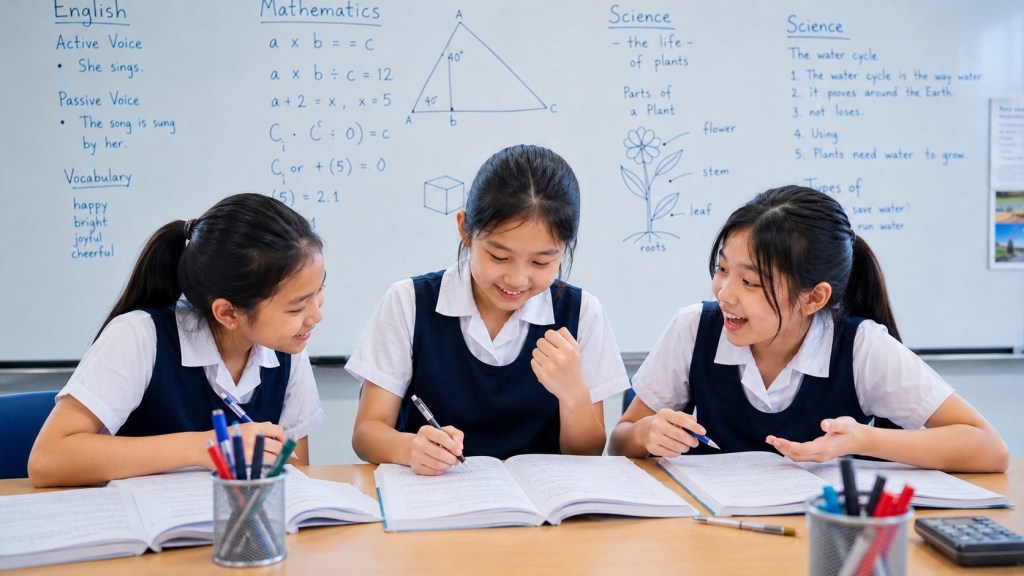
At eduKate Sengkang, this familiar question becomes a lesson in experiment design, data reading and explanation writing. Students learn to separate evaporation rate from total water amount, identify unfair comparisons and explain why a real-world observation may contain several changing variables at once.
Use the Primary 5 Science Learning Hub, the Water Cycle, Changes of State and Evidence guide, and Where Will Water Droplets Form?.
- Up to three students per class.
- 1.5-hour weekly lesson.
- Primary 5 evaporation, water-cycle reasoning, fair tests and open-ended explanations.
- Location: 83 Punggol Central, Singapore 828761.
- Enquiries: WhatsApp +65 8823 1234.
Evaporation
The first principle is that liquid water changes into water vapour at the exposed liquid surface. A learner should be able to explain this in ordinary language before using it inside a more complicated experiment or examination question.
The important boundary is that it can occur below boiling temperature, so ordinary wet clothes can dry without boiling. This prevents the concept from becoming a memorised slogan that is applied even when the conditions have changed.
In a 3-pax tutorial, each student can be given a different example and asked to identify the relevant evidence before writing. The tutor can then see whether the problem lies in recall, variable selection or explanation rather than assuming every wrong answer needs the same correction.
Temperature
The first principle is that a warmer wet surface usually has a faster evaporation rate under otherwise comparable conditions. A learner should be able to explain this in ordinary language before using it inside a more complicated experiment or examination question.
The important boundary is that the answer should identify what is warmer rather than use heat as a vague keyword. This prevents the concept from becoming a memorised slogan that is applied even when the conditions have changed.
In a 3-pax tutorial, each student can be given a different example and asked to identify the relevant evidence before writing. The tutor can then see whether the problem lies in recall, variable selection or explanation rather than assuming every wrong answer needs the same correction.
Moving air
The first principle is that airflow removes moist air from close to the wet surface and replaces it with less humid air. A learner should be able to explain this in ordinary language before using it inside a more complicated experiment or examination question.
The important boundary is that wind can increase evaporation rate without being a source of cold. This prevents the concept from becoming a memorised slogan that is applied even when the conditions have changed.
In a 3-pax tutorial, each student can be given a different example and asked to identify the relevant evidence before writing. The tutor can then see whether the problem lies in recall, variable selection or explanation rather than assuming every wrong answer needs the same correction.
Exposed surface area
The first principle is that spreading fabric exposes more wet area to the surrounding air. A learner should be able to explain this in ordinary language before using it inside a more complicated experiment or examination question.
The important boundary is that folding or crumpling can reduce the wet area directly exposed. This prevents the concept from becoming a memorised slogan that is applied even when the conditions have changed.
In a 3-pax tutorial, each student can be given a different example and asked to identify the relevant evidence before writing. The tutor can then see whether the problem lies in recall, variable selection or explanation rather than assuming every wrong answer needs the same correction.
Humidity
The first principle is that air already rich in water vapour can reduce the net rate of evaporation. A learner should be able to explain this in ordinary language before using it inside a more complicated experiment or examination question.
The important boundary is that a hot humid day does not guarantee the fastest drying. This prevents the concept from becoming a memorised slogan that is applied even when the conditions have changed.
In a 3-pax tutorial, each student can be given a different example and asked to identify the relevant evidence before writing. The tutor can then see whether the problem lies in recall, variable selection or explanation rather than assuming every wrong answer needs the same correction.
Starting water amount
The first principle is that a cloth with more water can take longer to dry even if its evaporation rate is sometimes faster. A learner should be able to explain this in ordinary language before using it inside a more complicated experiment or examination question.
The important boundary is that final drying time and evaporation rate are not identical quantities. This prevents the concept from becoming a memorised slogan that is applied even when the conditions have changed.
In a 3-pax tutorial, each student can be given a different example and asked to identify the relevant evidence before writing. The tutor can then see whether the problem lies in recall, variable selection or explanation rather than assuming every wrong answer needs the same correction.
Time
The first principle is that rate comparisons require corresponding intervals. A learner should be able to explain this in ordinary language before using it inside a more complicated experiment or examination question.
The important boundary is that a five-minute mass change should not be compared directly with a thirty-minute change. This prevents the concept from becoming a memorised slogan that is applied even when the conditions have changed.
In a 3-pax tutorial, each student can be given a different example and asked to identify the relevant evidence before writing. The tutor can then see whether the problem lies in recall, variable selection or explanation rather than assuming every wrong answer needs the same correction.
Fabric
The first principle is that different materials can hold and distribute water differently. A learner should be able to explain this in ordinary language before using it inside a more complicated experiment or examination question.
The important boundary is that material should be controlled when the question is testing wind, temperature or exposed area. This prevents the concept from becoming a memorised slogan that is applied even when the conditions have changed.
In a 3-pax tutorial, each student can be given a different example and asked to identify the relevant evidence before writing. The tutor can then see whether the problem lies in recall, variable selection or explanation rather than assuming every wrong answer needs the same correction.
Mass measurement
The first principle is that loss of mass can provide evidence that water has left a wet cloth. A learner should be able to explain this in ordinary language before using it inside a more complicated experiment or examination question.
The important boundary is that the measurement is evidence and the evaporation explanation is the mechanism. This prevents the concept from becoming a memorised slogan that is applied even when the conditions have changed.
In a 3-pax tutorial, each student can be given a different example and asked to identify the relevant evidence before writing. The tutor can then see whether the problem lies in recall, variable selection or explanation rather than assuming every wrong answer needs the same correction.
Evaporative cooling
The first principle is that water leaving a wet surface can carry energy away. A learner should be able to explain this in ordinary language before using it inside a more complicated experiment or examination question.
The important boundary is that this can help explain why wet skin may feel cooler in moving air. This prevents the concept from becoming a memorised slogan that is applied even when the conditions have changed.
In a 3-pax tutorial, each student can be given a different example and asked to identify the relevant evidence before writing. The tutor can then see whether the problem lies in recall, variable selection or explanation rather than assuming every wrong answer needs the same correction.
Open and closed spaces
The first principle is that vapour can accumulate in a closed space and alter the surrounding conditions. A learner should be able to explain this in ordinary language before using it inside a more complicated experiment or examination question.
The important boundary is that an open clothesline and a sealed plastic bag are different environments. This prevents the concept from becoming a memorised slogan that is applied even when the conditions have changed.
In a 3-pax tutorial, each student can be given a different example and asked to identify the relevant evidence before writing. The tutor can then see whether the problem lies in recall, variable selection or explanation rather than assuming every wrong answer needs the same correction.
Fair testing
The first principle is that one main condition should be changed while other important conditions remain comparable. A learner should be able to explain this in ordinary language before using it inside a more complicated experiment or examination question.
The important boundary is that an everyday drying comparison can be unfair even when the result is obvious. This prevents the concept from becoming a memorised slogan that is applied even when the conditions have changed.
In a 3-pax tutorial, each student can be given a different example and asked to identify the relevant evidence before writing. The tutor can then see whether the problem lies in recall, variable selection or explanation rather than assuming every wrong answer needs the same correction.
Rate versus amount
The first principle is that faster evaporation describes change per unit time. A learner should be able to explain this in ordinary language before using it inside a more complicated experiment or examination question.
The important boundary is that it does not automatically mean the greatest total water loss over every duration. This prevents the concept from becoming a memorised slogan that is applied even when the conditions have changed.
In a 3-pax tutorial, each student can be given a different example and asked to identify the relevant evidence before writing. The tutor can then see whether the problem lies in recall, variable selection or explanation rather than assuming every wrong answer needs the same correction.
Visible mist
The first principle is that water vapour is invisible. A learner should be able to explain this in ordinary language before using it inside a more complicated experiment or examination question.
The important boundary is that visible mist or droplets are liquid water and should not be confused with gaseous water vapour. This prevents the concept from becoming a memorised slogan that is applied even when the conditions have changed.
In a 3-pax tutorial, each student can be given a different example and asked to identify the relevant evidence before writing. The tutor can then see whether the problem lies in recall, variable selection or explanation rather than assuming every wrong answer needs the same correction.
Prediction
The first principle is that a prediction should be stated before the result and justified from the relevant factor. A learner should be able to explain this in ordinary language before using it inside a more complicated experiment or examination question.
The important boundary is that a wrong prediction is useful evidence about the learner’s model, not something to erase. This prevents the concept from becoming a memorised slogan that is applied even when the conditions have changed.
In a 3-pax tutorial, each student can be given a different example and asked to identify the relevant evidence before writing. The tutor can then see whether the problem lies in recall, variable selection or explanation rather than assuming every wrong answer needs the same correction.
Conclusion
The first principle is that a conclusion should answer the investigation question using the data. A learner should be able to explain this in ordinary language before using it inside a more complicated experiment or examination question.
The important boundary is that it should not claim that one condition always works best when several variables were not tested. This prevents the concept from becoming a memorised slogan that is applied even when the conditions have changed.
In a 3-pax tutorial, each student can be given a different example and asked to identify the relevant evidence before writing. The tutor can then see whether the problem lies in recall, variable selection or explanation rather than assuming every wrong answer needs the same correction.
Worked Primary 5 Evaporation Cases
Spread vs folded cloth
Two identical cloth pieces receive the same amount of water. One is spread flat and one folded. Under the same airflow and temperature, the spread cloth loses more mass in twenty minutes.
The evidence supports a faster evaporation rate for the spread cloth under those conditions because a larger wet surface was exposed.
A useful follow-up changes one condition while preserving the others. The student then predicts whether the original explanation still applies, states what evidence would be needed, and avoids claiming more than the new comparison can support.
Fan vs still air
Two equal damp cloths are arranged identically. One receives steady airflow from a safely positioned fan; the other remains in still air at similar temperature.
The fan condition can dry faster because moving air removes moist air from near the wet surface, helping evaporation continue more rapidly.
A useful follow-up changes one condition while preserving the others. The student then predicts whether the original explanation still applies, states what evidence would be needed, and avoids claiming more than the new comparison can support.
Warm vs cool room
Two comparable cloths are placed in controlled spaces with similar airflow and humidity but different temperatures.
If the warmer condition shows greater mass loss over the same time, the conclusion can link higher temperature to faster evaporation under those controls.
A useful follow-up changes one condition while preserving the others. The student then predicts whether the original explanation still applies, states what evidence would be needed, and avoids claiming more than the new comparison can support.
Warm humid vs cooler dry
One day is hotter but humid and still; another is slightly cooler but drier and windy.
Temperature alone cannot settle the comparison because humidity and air movement also differ. Use the observed data rather than a one-factor slogan.
A useful follow-up changes one condition while preserving the others. The student then predicts whether the original explanation still applies, states what evidence would be needed, and avoids claiming more than the new comparison can support.
Different starting water
Cloth A begins much wetter than Cloth B but both appear dry after an hour.
The final observation does not prove equal evaporation rates because the starting water amounts were different.
A useful follow-up changes one condition while preserving the others. The student then predicts whether the original explanation still applies, states what evidence would be needed, and avoids claiming more than the new comparison can support.
Wide tray vs narrow cup
Equal water volumes are placed in a wide shallow tray and a narrow cup under comparable conditions.
The wider exposed surface can produce faster evaporation, illustrating the surface-area mechanism without using fabric.
A useful follow-up changes one condition while preserving the others. The student then predicts whether the original explanation still applies, states what evidence would be needed, and avoids claiming more than the new comparison can support.
Sun and wind vs shade and still air
One cloth is in sunlight and wind while another is shaded and sheltered.
A faster result cannot be attributed to sunlight alone because airflow changed too. The test does not isolate one factor.
A useful follow-up changes one condition while preserving the others. The student then predicts whether the original explanation still applies, states what evidence would be needed, and avoids claiming more than the new comparison can support.
Wringing before hanging
One cloth is wrung out more thoroughly before both are hung in the same conditions.
The more-wrung cloth may dry first because it starts with less water; this does not prove wringing increased the evaporation rate.
A useful follow-up changes one condition while preserving the others. The student then predicts whether the original explanation still applies, states what evidence would be needed, and avoids claiming more than the new comparison can support.
Closed bag
A damp cloth is sealed in a small plastic bag while an identical cloth is exposed to room air.
The sealed space can become humid, reducing net evaporation. The bag changes the air conditions around the cloth.
A useful follow-up changes one condition while preserving the others. The student then predicts whether the original explanation still applies, states what evidence would be needed, and avoids claiming more than the new comparison can support.
Wet skin in wind
A person leaves water on the skin and feels cooler when air moves across it.
Moving air can increase evaporation from the wet skin, and evaporation can remove energy from the surface. The wind is not injecting a substance called cold.
A useful follow-up changes one condition while preserving the others. The student then predicts whether the original explanation still applies, states what evidence would be needed, and avoids claiming more than the new comparison can support.
Mass-time graph
A cloth’s mass decreases quickly at first and then more slowly.
The learner should describe the actual changing rate instead of assuming evaporation proceeds at one constant rate until completely dry.
A useful follow-up changes one condition while preserving the others. The student then predicts whether the original explanation still applies, states what evidence would be needed, and avoids claiming more than the new comparison can support.
Colour and thickness confounded
A dark thick shirt and a light thin shirt dry at different speeds in sunlight.
The comparison cannot isolate colour because thickness and material construction also changed.
A useful follow-up changes one condition while preserving the others. The student then predicts whether the original explanation still applies, states what evidence would be needed, and avoids claiming more than the new comparison can support.
Indoor night drying
Laundry left indoors overnight becomes drier even without sunlight.
This is evidence that direct sunlight is not required for evaporation; room temperature and air exchange can still allow water to leave.
A useful follow-up changes one condition while preserving the others. The student then predicts whether the original explanation still applies, states what evidence would be needed, and avoids claiming more than the new comparison can support.
Rainy-day laundry
Clothes dry slowly on a warm rainy day with high humidity and little airflow.
The case shows why temperature is only one factor and why surrounding moisture and air movement matter.
A useful follow-up changes one condition while preserving the others. The student then predicts whether the original explanation still applies, states what evidence would be needed, and avoids claiming more than the new comparison can support.
Surface feels dry
A towel feels dry on the outside but still has greater mass than its fully dried baseline.
Surface touch alone does not establish that all water has left; the measurement and conclusion need to match.
A useful follow-up changes one condition while preserving the others. The student then predicts whether the original explanation still applies, states what evidence would be needed, and avoids claiming more than the new comparison can support.
A Safe Evaporation Investigation
Use small identical cloth pieces, measured water, trays, a timer and a suitable balance if available. Electrical fans must be positioned safely away from water and used with adult supervision.
If testing airflow, keep material, cloth size, exposed area, starting water and observation time comparable. If testing surface area, keep airflow and temperature comparable while changing how the cloth is spread or folded.
Record starting and later mass rather than relying only on touch. A consistent measurement makes it possible to compare water loss over the same interval.
No hot plates, boiling water or unsafe heating are required. Supplied data can teach the same reasoning when practical work is inconvenient.
How We Build an Open-Ended Explanation
First identify the changed condition. Second name the process: evaporation. Third explain how the changed condition affects the rate. Fourth connect the rate to the measured or observed outcome.
For exposed surface area: the spread cloth exposes more wet area, so evaporation can occur over a larger area and more water leaves in the same time. For moving air: moist air near the cloth is removed and replaced, helping evaporation continue more rapidly. For temperature: a warmer wet surface usually has a faster evaporation rate under otherwise comparable conditions.
The answer should be no longer than necessary. A correct keyword without a relationship is incomplete, while a long paragraph containing several unrelated drying factors may be less precise than one focused causal chain.
Why 3-Pax Tutorials Help
Three students can work on the same experiment while receiving different diagnostic prompts. One may need to identify the controlled conditions, another the measured outcome, and another the mechanism.
Students can challenge one another’s conclusions by asking which evidence supports the claim. This makes unfair comparisons visible and turns correction into scientific reasoning.
After discussion, each learner completes a changed case independently. Transfer, not group agreement, is the evidence that the concept is becoming secure.
Common Evaporation Errors
- Evaporation happens only at boiling temperature.
- Sunlight is required for clothes to dry.
- Wind is a source of cold rather than a factor affecting evaporation.
- Faster drying and greater total water loss are treated as the same quantity.
- Two cloths with different starting wetness are compared as though the test were fair.
- Several factors change but the conclusion names only one cause.
- Water vapour is described as visible white steam.
- A cloth looking dry is treated as proof that no water remains.
- A mass decrease is reported without explaining why it is evidence of water loss.
Each error needs a specific repair. A boiling misconception needs state-change teaching; an unfair-test error needs variable reasoning; a vague answer needs a completed causal link. Calling all of them careless would hide the instructional job.
Drying a Puddle
A puddle can shrink because water evaporates from its surface. If water is also being added by rain or runoff, puddle size alone no longer measures evaporation. Students learn to separate input and output processes before drawing a conclusion.
The teaching goal is to identify which part of the original clothes-drying model transfers to this example and which new condition requires caution. Transfer means preserving the mechanism without pretending the situations are identical.
Drying Hair
Hair can dry faster with moving warm air, but hot electrical appliances introduce safety issues and several variables. A Science lesson can use supplied observations rather than asking children to experiment with heat near water.
The teaching goal is to identify which part of the original clothes-drying model transfers to this example and which new condition requires caution. Transfer means preserving the mechanism without pretending the situations are identical.
Drying Paint
Water-based paint can dry partly because water evaporates, but paint chemistry and film formation make the real process more complicated than a wet cloth. This is a transfer-boundary example: evaporation may contribute without being the whole explanation.
The teaching goal is to identify which part of the original clothes-drying model transfers to this example and which new condition requires caution. Transfer means preserving the mechanism without pretending the situations are identical.
Drying Soil
The top of wet soil can become dry while water remains deeper below. Surface appearance therefore does not directly measure total water content, just as a towel surface can feel dry while inner layers remain damp.
The teaching goal is to identify which part of the original clothes-drying model transfers to this example and which new condition requires caution. Transfer means preserving the mechanism without pretending the situations are identical.
Designing a Better Clothesline
Students can propose wider spacing, better airflow and greater exposed area, then identify which design change corresponds to which evaporation factor. The design task reinforces mechanism rather than asking for one memorised household tip.
The teaching goal is to identify which part of the original clothes-drying model transfers to this example and which new condition requires caution. Transfer means preserving the mechanism without pretending the situations are identical.
Reading a Drying Graph
A mass-versus-time graph can show changing evaporation behaviour. Students identify axes and units, describe the trend and then explain which conditions might account for differences between controlled trials.
The teaching goal is to identify which part of the original clothes-drying model transfers to this example and which new condition requires caution. Transfer means preserving the mechanism without pretending the situations are identical.
Evaluating an Advertisement
A product may claim to dry clothes twice as fast. Students ask what was measured, what comparison was used and whether the conditions were the same. This turns evaporation knowledge into evidence literacy.
The teaching goal is to identify which part of the original clothes-drying model transfers to this example and which new condition requires caution. Transfer means preserving the mechanism without pretending the situations are identical.
Planning the Next Test
After testing airflow, the class can plan a separate test of exposed surface area while keeping airflow similar. The learner sees how a sequence of fair tests can separate factors that are entangled in real life.
The teaching goal is to identify which part of the original clothes-drying model transfers to this example and which new condition requires caution. Transfer means preserving the mechanism without pretending the situations are identical.
Why Clothesline Spacing Matters
Clothes packed closely can overlap and reduce airflow around wet surfaces. Spacing garments changes more than appearance; it can increase exposed area and air circulation. A controlled test should identify which of those factors is being investigated.
The teaching goal is to identify which part of the original clothes-drying model transfers to this example and which new condition requires caution. Transfer means preserving the mechanism without pretending the situations are identical.
Why Wringing Is Different
Wringing removes liquid water mechanically before drying begins. A well-wrung cloth may become dry sooner because it starts with less water, even if its evaporation rate under later conditions is unchanged.
The teaching goal is to identify which part of the original clothes-drying model transfers to this example and which new condition requires caution. Transfer means preserving the mechanism without pretending the situations are identical.
Why Drying Can Slow
As a cloth dries, the location and amount of remaining water change. A graph may therefore show a different mass-loss rate later than earlier. Students should describe the evidence rather than force a constant-rate model.
The teaching goal is to identify which part of the original clothes-drying model transfers to this example and which new condition requires caution. Transfer means preserving the mechanism without pretending the situations are identical.
Rate and Total Amount
A small handkerchief can dry faster than a large towel but lose less total water. Rate, total amount and time-to-dry are related but not interchangeable quantities. Questions should be answered using the quantity actually measured.
The teaching goal is to identify which part of the original clothes-drying model transfers to this example and which new condition requires caution. Transfer means preserving the mechanism without pretending the situations are identical.
Open Versus Closed Space
A damp cloth in a sealed bag can create humid air around itself. A cloth in open moving air can exchange vapour with a much larger environment. This difference shows why surrounding conditions belong in the model.
The teaching goal is to identify which part of the original clothes-drying model transfers to this example and which new condition requires caution. Transfer means preserving the mechanism without pretending the situations are identical.
Invisible Vapour
Water vapour is invisible. The disappearance of visible liquid from the cloth does not mean the water ceased to exist; it changed state and mixed with the surrounding air.
The teaching goal is to identify which part of the original clothes-drying model transfers to this example and which new condition requires caution. Transfer means preserving the mechanism without pretending the situations are identical.
Question Design
A strong student can turn a vague question such as ‘What makes clothes dry?’ into a testable question: ‘How does air movement affect the mass of water lost from identical cloths in twenty minutes?’ Precision makes evidence possible.
The teaching goal is to identify which part of the original clothes-drying model transfers to this example and which new condition requires caution. Transfer means preserving the mechanism without pretending the situations are identical.
What Progress Looks Like
The learner can explain why spread clothes, moving air and warmer conditions may speed drying without treating those factors as interchangeable. The child also recognises that humidity, starting water amount and fabric can complicate real-world comparisons.
Experiment answers become more disciplined. Students state what changed, what was measured, what remained comparable and what the evidence supports. Conclusions become narrower and more defensible.
Older water-cycle ideas remain available through spaced retrieval, and the learner can connect evaporation to later condensation without confusing the direction of the state change.
Frequently Asked Questions
Do clothes need sunlight to dry?
No. Evaporation can occur without direct sunlight. Sunlight can warm clothes and increase the rate, but it is not an absolute requirement.
Why does wind help?
Moving air removes moist air near the wet surface and can increase the evaporation rate.
Why does spreading clothes help?
It increases the exposed wet surface area available for evaporation.
Does hotter always mean faster drying?
Temperature matters, but humidity, airflow, fabric, exposed area and starting water can also affect the observed result.
Is evaporation boiling?
No. Evaporation occurs at the surface and can happen below boiling temperature.
Why does wet skin feel cool?
Evaporation removes water from the surface and can transfer energy away, producing a cooling effect.
How do I answer a fair-test question?
Name the intended changed condition, the measured outcome and the relevant conditions kept comparable, then connect the evidence to evaporation.
Does this replace the full water cycle?
No. It owns the drying-rate question. Use the Primary 5 Science Learning Hub for condensation and the wider cycle.
Primary 5 Evaporation Checklist
- What liquid is evaporating?
- Which condition changed?
- What important conditions were kept comparable?
- What was measured?
- Does the evidence show a rate difference or only a final-state difference?
- Have I linked the factor to evaporation and then to the drying outcome?
- Did I confuse evaporation with boiling or condensation?
- Is my conclusion broader than the experiment?
Use the Primary 5 Science Learning Hub, the Water Cycle, Changes of State and Evidence guide, and Where Will Water Droplets Form?.
eduKate Sengkang teaches Primary Science in focused groups of up to three students. Lessons are by appointment. For current class availability, WhatsApp +65 8823 1234.
Properly Taught Kids Shine a Bright Light Into the Future.
