
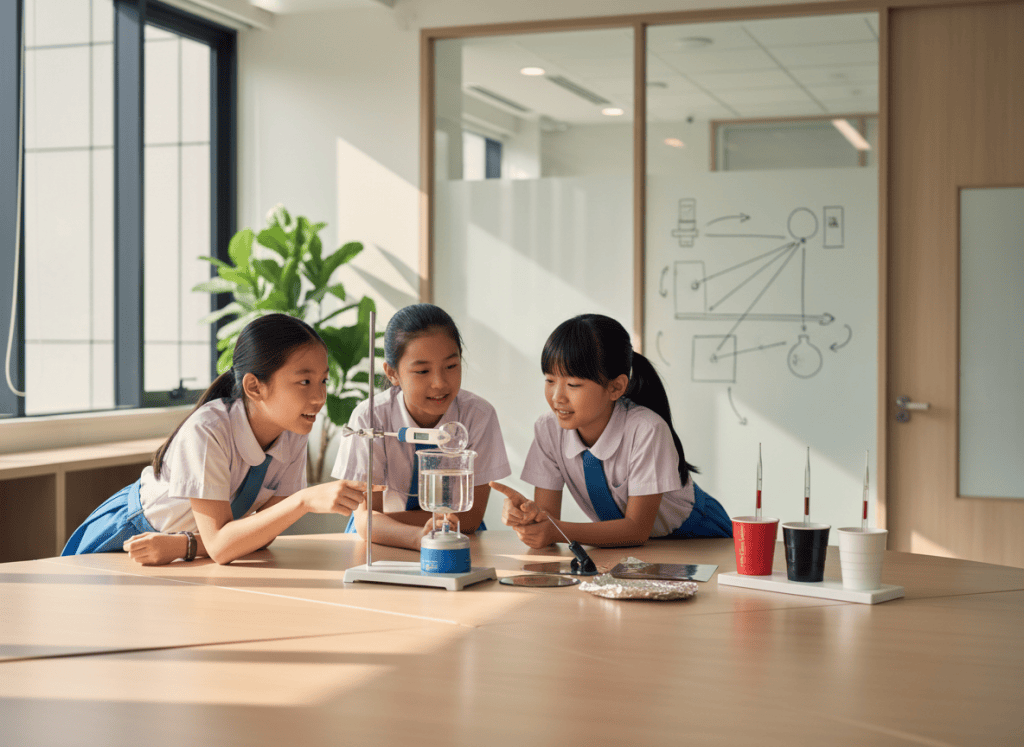
What do seeds need to germinate? In Primary Science, a viable seed needs water, air and a suitable temperature to begin germination. Light is not a universal requirement for the first germination stage in the way water, air and suitable warmth are, although seedlings later need light for healthy food making.
Seed germination is different from seed dispersal. Dispersal moves the seed away from the parent plant; germination begins when the seed starts developing into a new plant under suitable conditions. A seed can be dispersed successfully but fail to germinate if the landing site is too dry, waterlogged or too cold.
At eduKate Sengkang, germination is taught through condition → evidence → consequence. Students design fair tests, distinguish necessary conditions from helpful later conditions, interpret germination percentages and avoid saying that soil itself is always required for a seed to begin germinating.
Use the Primary 5 Science Learning Hub, Pollination, Fertilisation, Seeds and Fruits, and How Are Seeds Dispersed?.
- Up to three students per class.
- 1.5-hour weekly lesson.
- Focus: germination, water, air, suitable warmth, seed structure, fair tests, data and open-ended explanations.
- Location: 83 Punggol Central, Singapore 828761.
- Enquiries: WhatsApp +65 8823 1234.
Germination
Germination is the beginning of growth of a seed into a new plant.
It happens after seed formation and dispersal, not during pollination.
Students keep the reproduction sequence intact.
In a 3-pax tutorial, each learner first commits to an explanation independently. The tutor then checks the first unstable link before giving feedback, so the correction addresses the actual misconception rather than replacing the student’s thinking.
Water
Water activates processes in the seed and is required for germination.
Too little water prevents germination, while excessive water can reduce access to air.
Students learn that more is not always better.
In a 3-pax tutorial, each learner first commits to an explanation independently. The tutor then checks the first unstable link before giving feedback, so the correction addresses the actual misconception rather than replacing the student’s thinking.
Air
Seeds need air, including oxygen, for respiration during germination.
Waterlogged conditions can limit air spaces around seeds.
Students connect air need to living-process energy release.
In a 3-pax tutorial, each learner first commits to an explanation independently. The tutor then checks the first unstable link before giving feedback, so the correction addresses the actual misconception rather than replacing the student’s thinking.
Suitable Temperature
Seeds need a suitable temperature range for germination.
Too cold or too hot can slow or prevent germination.
Students avoid treating one exact temperature as universal for all species.
In a 3-pax tutorial, each learner first commits to an explanation independently. The tutor then checks the first unstable link before giving feedback, so the correction addresses the actual misconception rather than replacing the student’s thinking.
Light Boundary
Many seeds can begin germinating without light, though species differ.
Light becomes especially important once green seedlings need to make food.
Students avoid writing that light is always required for germination.
In a 3-pax tutorial, each learner first commits to an explanation independently. The tutor then checks the first unstable link before giving feedback, so the correction addresses the actual misconception rather than replacing the student’s thinking.
Soil Boundary
Seeds can germinate on moist cotton or paper under suitable conditions.
Soil is useful for later support, water and mineral supply but is not always required for the first visible germination stage.
Students distinguish medium from necessary condition.
In a 3-pax tutorial, each learner first commits to an explanation independently. The tutor then checks the first unstable link before giving feedback, so the correction addresses the actual misconception rather than replacing the student’s thinking.
Viable Seed
The seed itself must be alive and capable of germinating.
A dead or damaged seed will not germinate even if conditions are suitable.
Students learn that conditions are necessary but not sufficient for every individual seed.
In a 3-pax tutorial, each learner first commits to an explanation independently. The tutor then checks the first unstable link before giving feedback, so the correction addresses the actual misconception rather than replacing the student’s thinking.
Dormancy Boundary
Some seeds remain dormant even when water, air and temperature seem suitable.
Advanced dormancy triggers differ among species.
Students recognise the school model has limits.
In a 3-pax tutorial, each learner first commits to an explanation independently. The tutor then checks the first unstable link before giving feedback, so the correction addresses the actual misconception rather than replacing the student’s thinking.
Seed Coat
The seed coat protects the seed and water must reach the seed under suitable conditions.
Different seed coats can affect germination rate.
Students avoid assuming all seeds absorb water equally fast.
In a 3-pax tutorial, each learner first commits to an explanation independently. The tutor then checks the first unstable link before giving feedback, so the correction addresses the actual misconception rather than replacing the student’s thinking.
Stored Food
Seeds contain stored food that supports the young plant before leaves can make enough food.
This is why light is not always required at the very first germination stage.
Students connect stored food to early growth.
In a 3-pax tutorial, each learner first commits to an explanation independently. The tutor then checks the first unstable link before giving feedback, so the correction addresses the actual misconception rather than replacing the student’s thinking.
Radicle
The young root typically emerges early during germination.
Students can use root emergence as an observable germination criterion if defined.
The class agrees on what counts as germinated.
In a 3-pax tutorial, each learner first commits to an explanation independently. The tutor then checks the first unstable link before giving feedback, so the correction addresses the actual misconception rather than replacing the student’s thinking.
Shoot Emergence
The young shoot develops after germination progresses.
Shoot emergence is later than the first root in many examples.
Students distinguish start of germination from later seedling growth.
In a 3-pax tutorial, each learner first commits to an explanation independently. The tutor then checks the first unstable link before giving feedback, so the correction addresses the actual misconception rather than replacing the student’s thinking.
Respiration
The germinating seed releases energy from stored food through respiration.
Oxygen from air supports this process.
Students connect air need to mechanism rather than memorising it.
In a 3-pax tutorial, each learner first commits to an explanation independently. The tutor then checks the first unstable link before giving feedback, so the correction addresses the actual misconception rather than replacing the student’s thinking.
Waterlogged Seeds
Seeds fully submerged for long periods may receive less oxygen depending on setup.
Failure can therefore result from limited air even though water is abundant.
Students diagnose interacting conditions.
In a 3-pax tutorial, each learner first commits to an explanation independently. The tutor then checks the first unstable link before giving feedback, so the correction addresses the actual misconception rather than replacing the student’s thinking.
Dry Seeds
Dry seeds may remain dormant because water is unavailable.
Adding water can begin germination if other conditions are suitable and seeds are viable.
Students isolate the missing condition.
In a 3-pax tutorial, each learner first commits to an explanation independently. The tutor then checks the first unstable link before giving feedback, so the correction addresses the actual misconception rather than replacing the student’s thinking.
Cold Conditions
Low temperature can slow germination.
The exact suitable range depends on species.
Students avoid one-temperature rules.
In a 3-pax tutorial, each learner first commits to an explanation independently. The tutor then checks the first unstable link before giving feedback, so the correction addresses the actual misconception rather than replacing the student’s thinking.
High Temperature
Excessive heat can damage seeds or disrupt germination.
Suitable warmth is not the same as ‘the hotter the better’.
Students learn optimum-range thinking qualitatively.
In a 3-pax tutorial, each learner first commits to an explanation independently. The tutor then checks the first unstable link before giving feedback, so the correction addresses the actual misconception rather than replacing the student’s thinking.
Fair Test of Water
Keep seed type, number, temperature and air exposure similar while changing water availability.
Different seed species should not be mixed in one comparison.
Students isolate the condition.
In a 3-pax tutorial, each learner first commits to an explanation independently. The tutor then checks the first unstable link before giving feedback, so the correction addresses the actual misconception rather than replacing the student’s thinking.
Fair Test of Air
Keep water and temperature similar while changing air access.
The design should avoid introducing toxic chemicals or unsafe setups.
Students use simple teacher-approved methods.
In a 3-pax tutorial, each learner first commits to an explanation independently. The tutor then checks the first unstable link before giving feedback, so the correction addresses the actual misconception rather than replacing the student’s thinking.
Fair Test of Temperature
Use the same seed type, water and air conditions at different safe temperatures.
Temperature should be measured, not described only as warm or cold.
Students connect apparatus to variable.
In a 3-pax tutorial, each learner first commits to an explanation independently. The tutor then checks the first unstable link before giving feedback, so the correction addresses the actual misconception rather than replacing the student’s thinking.
Sample Size
One seed can fail by chance or because it is damaged.
Using several seeds provides stronger evidence about germination rate.
Students learn biological variability.
In a 3-pax tutorial, each learner first commits to an explanation independently. The tutor then checks the first unstable link before giving feedback, so the correction addresses the actual misconception rather than replacing the student’s thinking.
Germination Percentage
The number germinated divided by total seeds can be expressed as a percentage.
The percentage describes the sample, not a universal guarantee for the species.
Students connect data to evidence limits.
In a 3-pax tutorial, each learner first commits to an explanation independently. The tutor then checks the first unstable link before giving feedback, so the correction addresses the actual misconception rather than replacing the student’s thinking.
Observation Time
Seeds take time to germinate.
A short observation period can make viable seeds appear inactive.
Students consider duration before concluding a condition prevents germination.
In a 3-pax tutorial, each learner first commits to an explanation independently. The tutor then checks the first unstable link before giving feedback, so the correction addresses the actual misconception rather than replacing the student’s thinking.
Same End Point
Comparisons should use the same germination criterion, such as visible root emergence.
Changing the definition between groups invalidates comparison.
Students learn measurement consistency.
In a 3-pax tutorial, each learner first commits to an explanation independently. The tutor then checks the first unstable link before giving feedback, so the correction addresses the actual misconception rather than replacing the student’s thinking.
Mould Boundary
Mould can grow on moist setups and confuse observations.
Clean equipment and reasonable moisture reduce problems.
Students distinguish seed germination from fungal growth.
In a 3-pax tutorial, each learner first commits to an explanation independently. The tutor then checks the first unstable link before giving feedback, so the correction addresses the actual misconception rather than replacing the student’s thinking.
Seedling Growth
After germination, seedlings need light, water, air and mineral nutrients for healthy continued growth.
Conditions for continued growth extend beyond the minimal germination question.
Students keep stages separate.
In a 3-pax tutorial, each learner first commits to an explanation independently. The tutor then checks the first unstable link before giving feedback, so the correction addresses the actual misconception rather than replacing the student’s thinking.
Dispersal Link
A dispersed seed may land in a place lacking one required condition.
Successful movement does not equal successful germination.
Students connect reproduction stages without collapsing them.
In a 3-pax tutorial, each learner first commits to an explanation independently. The tutor then checks the first unstable link before giving feedback, so the correction addresses the actual misconception rather than replacing the student’s thinking.
Competition Link
Many seedlings germinating close together can later compete for light, water and space.
Germination success and long-term survival are different outcomes.
Students keep time scale clear.
In a 3-pax tutorial, each learner first commits to an explanation independently. The tutor then checks the first unstable link before giving feedback, so the correction addresses the actual misconception rather than replacing the student’s thinking.
Data Table
A germination table can compare percentages under different conditions.
Students identify the changed variable before interpreting the result.
This builds data literacy.
In a 3-pax tutorial, each learner first commits to an explanation independently. The tutor then checks the first unstable link before giving feedback, so the correction addresses the actual misconception rather than replacing the student’s thinking.
Graph
A graph can show cumulative germination over days.
Students describe the curve before explaining rate differences.
They should not treat final percentage and speed as the same measure.
In a 3-pax tutorial, each learner first commits to an explanation independently. The tutor then checks the first unstable link before giving feedback, so the correction addresses the actual misconception rather than replacing the student’s thinking.
Necessary Condition
A necessary condition must be present for germination in the school model.
Water, air and suitable temperature are necessary conditions.
Students distinguish necessary from merely helpful.
In a 3-pax tutorial, each learner first commits to an explanation independently. The tutor then checks the first unstable link before giving feedback, so the correction addresses the actual misconception rather than replacing the student’s thinking.
Sufficient Condition Boundary
Providing water, air and warmth does not guarantee every seed germinates.
Seed viability and species-specific factors still matter.
Students learn necessity does not mean certainty.
In a 3-pax tutorial, each learner first commits to an explanation independently. The tutor then checks the first unstable link before giving feedback, so the correction addresses the actual misconception rather than replacing the student’s thinking.
Question Demand
Some questions ask which condition is missing; others ask how to improve an experiment or interpret data.
Students identify the task before writing.
This prevents generic germination paragraphs.
In a 3-pax tutorial, each learner first commits to an explanation independently. The tutor then checks the first unstable link before giving feedback, so the correction addresses the actual misconception rather than replacing the student’s thinking.
Worked Questions and Transfer Cases
Dry Cotton
Seeds are placed on dry cotton in warm air.
They do not germinate because water is missing.
A follow-up changes one important condition and asks whether the first explanation still applies. The student must identify what stayed the same, what changed and which evidence justifies the revised answer.
Moist Cotton
Seeds on moist cotton with air and suitable warmth germinate.
The setup provides the standard conditions.
A follow-up changes one important condition and asks whether the first explanation still applies. The student must identify what stayed the same, what changed and which evidence justifies the revised answer.
Fully Submerged
Seeds are kept under water with very limited air access.
They may fail because oxygen availability is reduced despite abundant water.
A follow-up changes one important condition and asks whether the first explanation still applies. The student must identify what stayed the same, what changed and which evidence justifies the revised answer.
Cold Refrigerator
Moist seeds with air are kept very cold.
Germination can be slow or absent because temperature is unsuitable.
A follow-up changes one important condition and asks whether the first explanation still applies. The student must identify what stayed the same, what changed and which evidence justifies the revised answer.
Very Hot Place
Moist seeds are kept at excessive heat.
The temperature can damage seeds or prevent germination.
A follow-up changes one important condition and asks whether the first explanation still applies. The student must identify what stayed the same, what changed and which evidence justifies the revised answer.
Dark Cupboard
Viable seeds on moist cotton with air and suitable warmth germinate in darkness.
The result shows light is not always required for the start of germination.
A follow-up changes one important condition and asks whether the first explanation still applies. The student must identify what stayed the same, what changed and which evidence justifies the revised answer.
No Soil
Seeds germinate on moist paper.
The observation shows soil is not always required for initial germination.
A follow-up changes one important condition and asks whether the first explanation still applies. The student must identify what stayed the same, what changed and which evidence justifies the revised answer.
Dead Seeds
Boiled or damaged seeds fail while viable seeds germinate under the same environment.
Suitable conditions cannot restore a dead seed.
A follow-up changes one important condition and asks whether the first explanation still applies. The student must identify what stayed the same, what changed and which evidence justifies the revised answer.
One Seed Only
One seed does not germinate.
The evidence is too weak to conclude the condition prevents all seeds; more seeds improve reliability.
A follow-up changes one important condition and asks whether the first explanation still applies. The student must identify what stayed the same, what changed and which evidence justifies the revised answer.
Different Seed Types
Beans are tested warm and rice cold.
The comparison confounds species and temperature.
A follow-up changes one important condition and asks whether the first explanation still applies. The student must identify what stayed the same, what changed and which evidence justifies the revised answer.
Different Water Amounts
One group receives a few drops, another is flooded.
The outcome may reflect both water availability and air access.
A follow-up changes one important condition and asks whether the first explanation still applies. The student must identify what stayed the same, what changed and which evidence justifies the revised answer.
Germination Graph
Group A reaches 80% by Day 3; Group B reaches 80% by Day 6.
Final percentage is equal but germination speed differs.
A follow-up changes one important condition and asks whether the first explanation still applies. The student must identify what stayed the same, what changed and which evidence justifies the revised answer.
A Safe Investigation or Observation Route
Use clean viable seeds, moist cotton or paper, labelled containers and safe room-temperature conditions.
Test one condition at a time while keeping seed type, number and observation period comparable.
Use several seeds per condition and define germination consistently, such as visible root emergence.
Dispose of mouldy material hygienically and wash hands after handling seeds and growing media.
How We Build the Open-Ended Explanation
Identify which germination condition is changed: water, air or temperature.
Check whether the seeds are viable and whether observation time is sufficient.
Read the evidence: number germinated, percentage or time to germination.
Explain the result using the missing or unsuitable condition and avoid adding light or soil unless the question makes them relevant.
Common Errors
- Light is said to be always necessary for germination.
- Soil is said to be always necessary.
- More water is treated as always better.
- One failed seed is used to condemn the whole condition.
- Dead seeds and viable seeds are mixed without control.
- Germination and later seedling growth are treated as the same stage.
- Final germination percentage and germination speed are confused.
- Different seed species are used in an unfair comparison.
Each error requires a different repair. A concept error needs reteaching, a diagram-reading error needs a representation routine, an evidence error needs better observation or comparison, and an incomplete answer needs the missing causal link restored.
Seed Dispersal
A seed can travel far but still fail to germinate if it lands in a dry or unsuitable place.
The transfer is successful only when the original scientific relationship remains visible and the changed condition is handled explicitly. Strong Science is not repeating one sentence everywhere; it is knowing why the sentence fits here.
Stored Food
Early seedlings use stored food before leaves are fully functional, explaining why germination can begin in darkness.
The transfer is successful only when the original scientific relationship remains visible and the changed condition is handled explicitly. Strong Science is not repeating one sentence everywhere; it is knowing why the sentence fits here.
Competition
High germination density can later create competition among seedlings; success at one stage creates a new ecological challenge.
The transfer is successful only when the original scientific relationship remains visible and the changed condition is handled explicitly. Strong Science is not repeating one sentence everywhere; it is knowing why the sentence fits here.
Plant Transport Bridge
Once roots and leaves develop, the seedling depends increasingly on water uptake, transport and food making rather than only stored seed reserves.
The transfer is successful only when the original scientific relationship remains visible and the changed condition is handled explicitly. Strong Science is not repeating one sentence everywhere; it is knowing why the sentence fits here.
Data Analysis
Germination experiments naturally produce percentages and time-series graphs, preparing students for upper-primary data interpretation.
The transfer is successful only when the original scientific relationship remains visible and the changed condition is handled explicitly. Strong Science is not repeating one sentence everywhere; it is knowing why the sentence fits here.
Experimental Validity
Using several seeds, consistent criteria and one changed variable teaches biological fair-test design.
The transfer is successful only when the original scientific relationship remains visible and the changed condition is handled explicitly. Strong Science is not repeating one sentence everywhere; it is knowing why the sentence fits here.
What Progress Looks Like
The learner identifies water, air and suitable temperature as core germination conditions.
Light and soil are no longer treated as universal initial requirements.
Fair-test designs control seed type, number and observation time.
Data answers distinguish germination rate, final percentage and seed viability.
Frequently Asked Questions
What do seeds need to germinate?
Water, air and a suitable temperature in the standard Primary Science model.
Do seeds need light to germinate?
Not all seeds do. Light is especially important later when green seedlings make food.
Do seeds need soil to germinate?
No. Many seeds can begin germinating on moist cotton or paper under suitable conditions.
Why can too much water be a problem?
Waterlogged conditions can reduce air and oxygen available to the seed.
Why use several seeds?
Individual seeds vary, so several seeds provide more reliable evidence.
Does every viable seed germinate when conditions are suitable?
Not necessarily. Biology varies and some seeds can remain dormant or be damaged.
Does this replace the whole Reproduction topic?
No. It owns the focused germination-condition question.
Primary 5 Germination Checklist
- Is water available?
- Is air available?
- Is temperature suitable?
- Are the seeds viable?
- Was the observation long enough?
- Was the same germination criterion used?
- Were seed type and number controlled?
- Am I adding light or soil as universal requirements without evidence?
Use the Primary 5 Science Learning Hub, Pollination, Fertilisation, Seeds and Fruits, and How Are Seeds Dispersed?.
eduKate Sengkang teaches Primary Science in focused groups of up to three students. Lessons are by appointment. For current class availability, WhatsApp +65 8823 1234.
Properly Taught Kids Shine a Bright Light Into the Future.
Evidence Before Explanation
Students should be able to point to the exact observation, diagram feature, table value or stated condition that supports the answer. A familiar scientific fact can still be irrelevant when it is detached from the evidence in the question.
Applied to seed germination conditions, the learner must keep the exact conditions visible, avoid replacing evidence with a memorised slogan, and stop once the scientific job is complete.
Delayed Retrieval
The topic returns after several days in a new representation. The learner attempts before reopening notes, marks uncertainty honestly and then checks the answer. This reveals durable access rather than immediate familiarity.
Applied to seed germination conditions, the learner must keep the exact conditions visible, avoid replacing evidence with a memorised slogan, and stop once the scientific job is complete.
From Guided to Independent
Early examples may include labels, prompts or partially completed explanations. Those supports are removed progressively until the learner identifies the target, retrieves the concept, applies the evidence and checks the final response independently.
Applied to seed germination conditions, the learner must keep the exact conditions visible, avoid replacing evidence with a memorised slogan, and stop once the scientific job is complete.
Parent-Friendly Review
Parents do not need to reteach the chapter. Ask what the question wanted, which evidence mattered, what scientific relationship explained it and why the corrected answer is stronger than the first attempt.
Applied to seed germination conditions, the learner must keep the exact conditions visible, avoid replacing evidence with a memorised slogan, and stop once the scientific job is complete.
Exam Transfer
Mixed practice removes the chapter label. The learner has to decide which concept applies before answering. This selection step is an important part of examination readiness.
Applied to seed germination conditions, the learner must keep the exact conditions visible, avoid replacing evidence with a memorised slogan, and stop once the scientific job is complete.
Evidence Before Explanation 2
Students should be able to point to the exact observation, diagram feature, table value or stated condition that supports the answer. A familiar scientific fact can still be irrelevant when it is detached from the evidence in the question.
Applied to seed germination conditions, the learner must keep the exact conditions visible, avoid replacing evidence with a memorised slogan, and stop once the scientific job is complete.
Delayed Retrieval 2
The topic returns after several days in a new representation. The learner attempts before reopening notes, marks uncertainty honestly and then checks the answer. This reveals durable access rather than immediate familiarity.
Applied to seed germination conditions, the learner must keep the exact conditions visible, avoid replacing evidence with a memorised slogan, and stop once the scientific job is complete.
From Guided to Independent 2
Early examples may include labels, prompts or partially completed explanations. Those supports are removed progressively until the learner identifies the target, retrieves the concept, applies the evidence and checks the final response independently.
Applied to seed germination conditions, the learner must keep the exact conditions visible, avoid replacing evidence with a memorised slogan, and stop once the scientific job is complete.
Parent-Friendly Review 2
Parents do not need to reteach the chapter. Ask what the question wanted, which evidence mattered, what scientific relationship explained it and why the corrected answer is stronger than the first attempt.
Applied to seed germination conditions, the learner must keep the exact conditions visible, avoid replacing evidence with a memorised slogan, and stop once the scientific job is complete.
Exam Transfer 2
Mixed practice removes the chapter label. The learner has to decide which concept applies before answering. This selection step is an important part of examination readiness.
Applied to seed germination conditions, the learner must keep the exact conditions visible, avoid replacing evidence with a memorised slogan, and stop once the scientific job is complete.
Evidence Before Explanation 3
Students should be able to point to the exact observation, diagram feature, table value or stated condition that supports the answer. A familiar scientific fact can still be irrelevant when it is detached from the evidence in the question.
Applied to seed germination conditions, the learner must keep the exact conditions visible, avoid replacing evidence with a memorised slogan, and stop once the scientific job is complete.
Delayed Retrieval 3
The topic returns after several days in a new representation. The learner attempts before reopening notes, marks uncertainty honestly and then checks the answer. This reveals durable access rather than immediate familiarity.
Applied to seed germination conditions, the learner must keep the exact conditions visible, avoid replacing evidence with a memorised slogan, and stop once the scientific job is complete.
From Guided to Independent 3
Early examples may include labels, prompts or partially completed explanations. Those supports are removed progressively until the learner identifies the target, retrieves the concept, applies the evidence and checks the final response independently.
Applied to seed germination conditions, the learner must keep the exact conditions visible, avoid replacing evidence with a memorised slogan, and stop once the scientific job is complete.
