
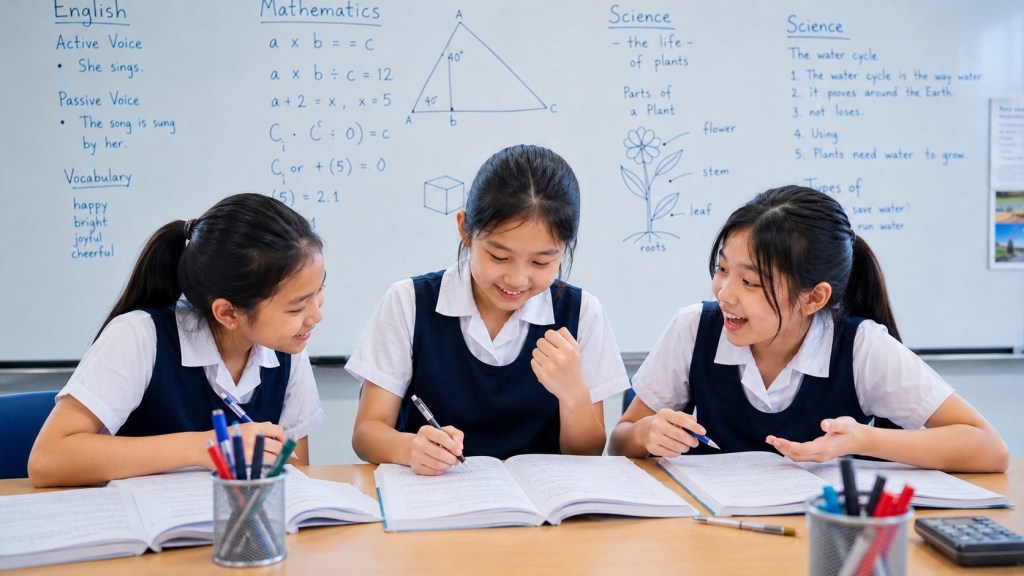
This Primary 3 Mathematics Worked Examples Library turns the learning system into visible solutions. The aim is not to give students a page of answers to copy. Each example shows the mathematical job, the first useful decision, the working, the check and the reason the method belongs.
This is Guide 52 in the Primary 3 Mathematics Learning Hub. It contains 24 fully explained examples spanning the main Primary 3 strands and the reasoning habits developed across Guides 1–51.
Start Here | Choose the Closest Route
- Number route: Examples 1–7.
- Fraction and money route: Examples 8–11.
- Measurement and time route: Examples 12–16.
- Geometry and data route: Examples 17–20.
- Problem-solving route: Examples 21–24.
How to use the library: Attempt each problem first. Read the worked solution only after producing your own route. Then close the example and solve a changed version without support.
Worked examples are useful when they reveal decisions. Copying is not the learning job.
Example 1 | Place Value and Comparison
Question: Which is greater, 4 708 or 4 780?
- Thousands: both have 4.
- Hundreds: both have 7.
- Tens: 0 versus 8.
- Therefore 4 780 > 4 708.
Check: The first place where the numbers differ is the tens place. Compare there; later digits cannot reverse the result.
Example 2 | Four-Digit Addition
Question: Find 2 867 + 1 948.
- Ones: 7 + 8 = 15. Write 5, regroup 1 ten.
- Tens: 6 + 4 + 1 = 11. Write 1, regroup 1 hundred.
- Hundreds: 8 + 9 + 1 = 18. Write 8, regroup 1 thousand.
- Thousands: 2 + 1 + 1 = 4.
- Answer: 4 815.
Estimate: 2 900 + 1 900 is about 4 800, so 4 815 is reasonable.
Example 3 | Four-Digit Subtraction Across Zeros
Question: Find 5 002 − 1 876.
Regroup 5 002 carefully through the zero places. The calculation gives 3 126.
Check: 3 126 + 1 876 = 5 002. The inverse operation restores the original whole.
Example 4 | Mental Compensation
Question: Find 398 + 57 mentally.
- Move 2 from 57 to 398.
- 398 + 2 = 400.
- 57 − 2 = 55.
- 400 + 55 = 455.
The total is unchanged because the same 2 was transferred between addends.
Example 5 | Multiplication by Decomposition
Question: Find 6 × 24.
- 24 = 20 + 4.
- 6 × 20 = 120.
- 6 × 4 = 24.
- 120 + 24 = 144.
Check: 6 × 25 = 150, so the answer should be 6 less than 150. 144 fits.
Example 6 | Division With a Three-Digit Dividend
Question: Find 386 ÷ 7.
- 7 × 55 = 385.
- 386 − 385 = 1.
- Answer: 55 remainder 1.
Check: 55 × 7 + 1 = 386, and remainder 1 is smaller than divisor 7.
Example 7 | Remainder in Context
Question: 38 pupils travel in vans that hold 6 pupils each. How many vans are needed?
- 38 ÷ 6 = 6 remainder 2.
- Six vans carry only 36 pupils.
- The remaining 2 pupils still need transport.
- Answer: 7 vans.
The arithmetic quotient is not yet the practical answer; the remainder must be interpreted.
Example 8 | Equivalent Fractions
Question: Write an equivalent fraction for 3/4 with denominator 8.
- 4 × 2 = 8.
- Multiply the numerator by the same 2.
- 3 × 2 = 6.
- Therefore 3/4 = 6/8.
The fraction changes form, but not value.
Example 9 | Fraction Comparison With a Benchmark
Question: Which is greater, 3/5 or 4/8?
- 4/8 = 1/2.
- 3/5 is greater than 1/2 because half of 5 is 2.5 and the numerator is 3.
- Therefore 3/5 > 4/8.
Example 10 | Adding Related Fractions
Question: Find 3/8 + 1/4.
- 1/4 = 2/8.
- 3/8 + 2/8 = 5/8.
The fractions are first represented using equal-sized eighths.
Example 11 | Money, Total Cost and Change
Question: A book costs $7.85 and a pen set costs $4.60. Amir pays $20. Find the change.
- Total cost = $7.85 + $4.60 = $12.45.
- Change = $20.00 − $12.45 = $7.55.
Do not stop at total cost because the final unknown is change.
Example 12 | Length Conversion and Subtraction
Question: A ribbon is 5 m long. 175 cm is cut off. How much remains?
- 5 m = 500 cm.
- 500 − 175 = 325 cm.
- 325 cm = 3 m 25 cm.
Units are aligned before subtraction.
Example 13 | Mass in a Multi-Step Problem
Question: A box contains 2 kg 400 g of rice. 850 g is added, then 1 kg is removed. How much remains?
- 2 kg 400 g = 2400 g.
- 2400 + 850 = 3250 g.
- 3250 − 1000 = 2250 g.
- Answer: 2 kg 250 g.
Example 14 | Liquid Volume
Question: A jug contains 3 l of water. 750 ml is poured out. How much remains?
- 3 l = 3000 ml.
- 3000 − 750 = 2250 ml.
- 2250 ml = 2 l 250 ml.
Example 15 | Finding Finish Time
Question: A lesson starts at 13:35 and lasts 1 h 45 min. When does it end?
- 13:35 + 1 h = 14:35.
- 14:35 + 25 min = 15:00.
- 15:00 + 20 min = 15:20.
Example 16 | Finding Duration
Question: An activity starts at 9:35 and ends at 11:05. How long does it last?
- 9:35 → 10:00 = 25 min.
- 10:00 → 11:00 = 1 h.
- 11:00 → 11:05 = 5 min.
- Total = 1 h 30 min.
Example 17 | Area and Perimeter of the Same Rectangle
Question: A rectangle measures 9 cm by 6 cm. Find its area and perimeter.
- Area = 9 × 6 = 54 cm².
- Perimeter = 9 + 6 + 9 + 6 = 30 cm.
The same dimensions support two different quantities and therefore two different units.
Example 18 | Missing Dimension From Perimeter
Question: A rectangle has perimeter 30 cm and length 9 cm. Find its width.
- Two lengths = 9 + 9 = 18 cm.
- Remaining perimeter = 30 − 18 = 12 cm.
- Two equal widths share 12 cm.
- Width = 12 ÷ 2 = 6 cm.
Example 19 | Geometry Properties
Question: Two straight lines meet to form a right angle. What is their relationship?
Lines that meet at a right angle are perpendicular. Rotation of the diagram does not change the property.
Example 20 | Bar Graph With Scale 5
Question: A bar graph uses intervals of 5. Category A reaches 25 and Category B reaches 40. How many more does B have than A?
- Read values after checking the scale: 25 and 40.
- Difference = 40 − 25 = 15.
The graph-reading step comes before subtraction.
Example 21 | Comparison Word Problem
Question: Hana has 224 stamps. She has 79 more stamps than Mei. How many stamps does Mei have?
- Hana is the larger quantity: 224.
- Difference: 79.
- Mei is the smaller unknown.
- 224 − 79 = 145 stamps.
The word “more” does not decide the operation; the quantity roles do.
Example 22 | Multi-Step Equal Groups
Question: Six cartons contain 35 bottles each. 48 bottles are sold. How many remain?
- Total at first = 6 × 35 = 210 bottles.
- Remaining = 210 − 48 = 162 bottles.
Label the Step 1 answer because it becomes the updated whole for Step 2.
Example 23 | Equality and Missing Value
Question: □ − 36 = 47. Find the missing value.
- The starting whole is unknown.
- Reverse the subtraction: 47 + 36 = 83.
- Check: 83 − 36 = 47.
Example 24 | Systematic Search With Fixed Perimeter
Question: Find all rectangles with whole-number side lengths and perimeter 24 cm. Which has the greatest area?
- 1 × 11 → area 11 cm²
- 2 × 10 → area 20 cm²
- 3 × 9 → area 27 cm²
- 4 × 8 → area 32 cm²
- 5 × 7 → area 35 cm²
- 6 × 6 → area 36 cm²
The next pair 7 × 5 duplicates 5 × 7, so the search is complete. The 6 cm by 6 cm square has the greatest area, 36 cm².
Student Route | How to Learn From a Worked Example
- Cover the solution.
- Attempt the problem independently.
- Compare the first different step, not only the final answer.
- Explain why the worked route is valid.
- Close the example.
- Solve a changed question without looking.
Parent Route | Use Examples to Locate the Break
If the child cannot start Example 21, the difficulty may be mathematical reading or comparison structure. If the child chooses subtraction correctly but calculates 224 − 79 inaccurately, the repair belongs to arithmetic. The example becomes diagnostic evidence.
Teacher Route | Fade the Example
- show the full example;
- remove one step;
- remove the representation;
- change one surface feature;
- move the unknown;
- mix the problem among unrelated topics.
The final goal is independent method selection, not permanent dependence on a model answer.
Diagnostic Map | What the Example Can Reveal
| Failure point | Likely next route |
|---|---|
| cannot interpret wording | Guide 49 Mathematical Reading |
| cannot draw or translate model | Guide 50 Representation Translation |
| calculation unstable | Guides 9, 10 or 41 |
| cannot find all cases | Guide 51 Systematic Search |
| correct only with support | Guide 48 Mastery Evidence |
Exam Craft | Reconstruct, Do Not Recall the Picture
An examination question will rarely reproduce the worked example exactly. The learner should remember the relationship and decision route, then rebuild the solution under new numbers, wording or diagrams.
Learn the reason the method belongs, not the appearance of the page where you first saw it.
Next Route
Use this library together with Guide 44: Lesson Sequencing and Worked Examples, Guide 48: Mastery Evidence, Guide 49: Mathematical Reading, and Guide 50: Representation Translation.
Return to the Primary 3 Mathematics Learning Hub.
