
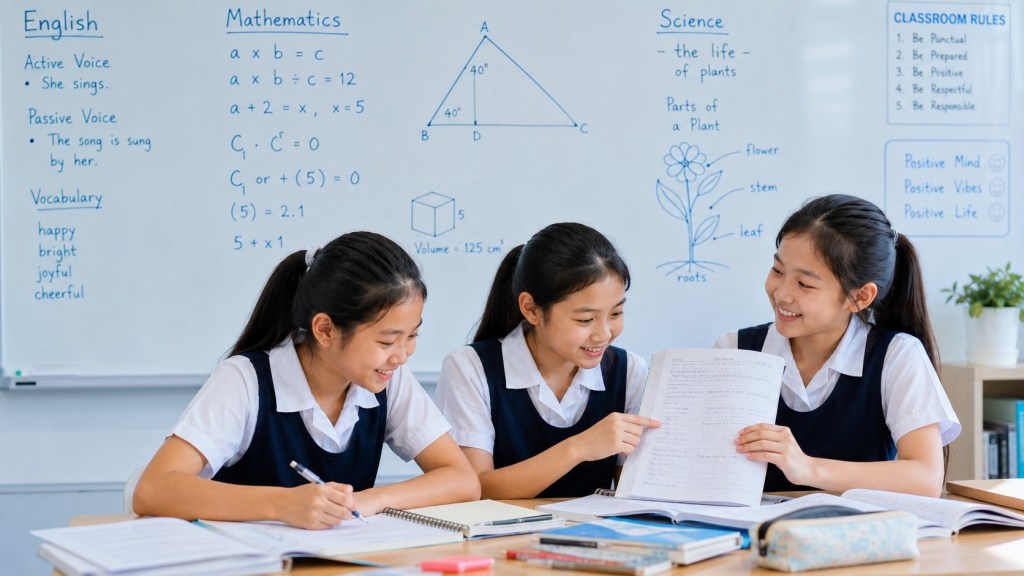
Times-table fluency is not the same thing as memorising forty isolated answers. Strong Primary 3 students learn to rebuild difficult facts from facts they already know. Sixes can grow from fives plus one more group. Sevens can grow from fives plus twos. Eights can be built by doubling. Nines can be seen as ten groups minus one group. These relationships make the 6, 7, 8 and 9 times tables more durable, more explainable and easier to recover under pressure.
This is Guide 65 in the Primary 3 Mathematics Learning Hub. It is an enrichment and transfer guide built on the Primary 3 multiplication-table core. Its reader job is not to replace Guide 10, but to show how students can derive, connect, check and recover facts across the 6, 7, 8 and 9 tables.
Start Here | Four Ways to Recover a Fact
- Build from a nearby table: 7 × 8 = 5 × 8 + 2 × 8.
- Double: 8 × 6 is double 4 × 6.
- Use ten and subtract one group: 9 × 7 = 10 × 7 − 7.
- Turn the fact around: 6 × 8 = 8 × 6.
A memorised fact can be forgotten. A connected fact can often be rebuilt.
What Fluency Should Look Like
Fluency has several layers. The fastest layer is immediate recall: 7 × 8 = 56 appears without effort. The next layer is rapid derivation: if the fact does not appear immediately, the learner can rebuild it from a known relationship within a few seconds. The weakest layer is repeated counting from the beginning.
| Response | What it suggests |
|---|---|
| “56” immediately for 7 × 8 | retrieved fact |
| “5 × 8 = 40, plus 2 × 8 = 16, so 56” | connected derivation |
| “8, 16, 24, 32, 40, 48, 56” every time | fact still depends on full skip counting |
The Commutative Shortcut
Multiplication can be turned around without changing the product: 6 × 8 = 8 × 6. This means students do not need to treat every reversed fact as new information.
Arrays make the relationship visible. A rectangle with 6 rows of 8 objects contains the same total as the same rectangle viewed as 8 rows of 6 objects.
Why 6 × 8 and 8 × 6 Are the Same Product
Imagine 6 rows with 8 counters in each row. There are 48 counters. Turn the array by a quarter-turn: now it can be described as 8 rows of 6 counters. The arrangement changes orientation, but the number of counters does not change.
This reduces memory load. Once 8 × 6 is secure, 6 × 8 is not a separate fact family to relearn from zero.
The 6 Times Table | Five Groups Plus One More
Sixes can be derived from fives because 6 groups = 5 groups + 1 group.
- 6 × 7 = 5 × 7 + 1 × 7 = 35 + 7 = 42.
- 6 × 8 = 5 × 8 + 1 × 8 = 40 + 8 = 48.
- 6 × 9 = 5 × 9 + 1 × 9 = 45 + 9 = 54.
This strategy works well because the 5 times table is usually highly accessible and the extra group is easy to add.
The 6 Times Table | Double the 3 Times Table
Six groups are twice as many as three groups. So 6 × 7 can also be seen as double 3 × 7.
- 3 × 7 = 21.
- Double 21 = 42.
- Therefore 6 × 7 = 42.
Different derived-fact routes are useful because not every learner has the same strongest anchor.
The 7 Times Table | Five Groups Plus Two More
Seven groups can be decomposed as five groups plus two groups.
- 7 × 6 = 5 × 6 + 2 × 6 = 30 + 12 = 42.
- 7 × 8 = 5 × 8 + 2 × 8 = 40 + 16 = 56.
- 7 × 9 = 5 × 9 + 2 × 9 = 45 + 18 = 63.
The 7 Times Table | Six Groups Plus One
If a sixes fact is already secure, a sevens fact may be just one more group away.
- 6 × 8 = 48.
- One more group of 8 gives 48 + 8 = 56.
- Therefore 7 × 8 = 56.
The 8 Times Table | Double the 4 Times Table
Eight groups are double four groups. This produces a powerful recovery route.
- 4 × 7 = 28.
- Double 28 = 56.
- Therefore 8 × 7 = 56.
The 8 Times Table | Repeated Doubling
Another way to understand 8 × 6 is to begin with one group of 6 and double repeatedly:
- 1 × 6 = 6
- 2 × 6 = 12
- 4 × 6 = 24
- 8 × 6 = 48
This links multiplication facts with doubling fluency and powers-of-two structure without requiring formal terminology.
The 9 Times Table | Ten Groups Minus One
Nine groups are one group less than ten groups.
- 9 × 6 = 10 × 6 − 6 = 60 − 6 = 54.
- 9 × 7 = 70 − 7 = 63.
- 9 × 8 = 80 − 8 = 72.
This is especially efficient because multiplying by 10 is easy to access mentally.
Patterns Help, but Patterns Need Explanations
Products in the 9 times table increase by 9 each time: 9, 18, 27, 36, 45, 54, 63, 72, 81, 90. Students may notice digit patterns too. Pattern noticing is useful, but the structural reason remains repeated groups of 9. A pattern should support understanding, not replace it.
Nearby Facts Can Repair a Forgotten Fact
If 7 × 8 is forgotten but 6 × 8 = 48 is known, add one more group of 8: 48 + 8 = 56. If 8 × 7 is forgotten but 8 × 8 = 64 is known, subtract one group of 8: 64 − 8 = 56.
Good fact fluency includes knowing which neighbour can rescue you.
Fact Families Connect Multiplication and Division
One multiplication relationship generates related division facts.
- 7 × 8 = 56
- 8 × 7 = 56
- 56 ÷ 7 = 8
- 56 ÷ 8 = 7
This means better multiplication fluency also improves division fluency.
Worked Example 1 | Recover 6 × 9
- Use 5 × 9 = 45.
- Add one more 9.
- 45 + 9 = 54.
Worked Example 2 | Recover 7 × 8
- Use 5 × 8 = 40.
- 2 × 8 = 16.
- 40 + 16 = 56.
Worked Example 3 | Recover 8 × 7
- Use 4 × 7 = 28.
- Double 28.
- Answer = 56.
Worked Example 4 | Recover 9 × 7
- 10 × 7 = 70.
- Subtract one group of 7.
- 70 − 7 = 63.
Worked Example 5 | Use a Reversed Fact
If 8 × 6 is known as 48, then 6 × 8 is also 48. The fact is not “almost the same”; it is the same multiplicative quantity viewed with the array dimensions exchanged.
Worked Example 6 | Division Recovery
Find 63 ÷ 7. Think: 7 × ? = 63. Since 7 × 9 = 63, the quotient is 9.
Derived Facts Reduce Working-Memory Load
In a multi-step problem, a child should not need to devote most attention to reconstructing every multiplication fact from skip counting. Derived strategies create a bridge from effortful counting toward fast retrieval. As more facts become automatic, working memory becomes available for the actual problem structure.
But Derived Facts Should Become Faster Over Time
A recovery strategy is useful, but the long-term goal remains fluent access. If the child still needs five separate steps for 7 × 8 after extensive practice, the fact has not yet consolidated enough for efficient multi-step work.
Choose the Shortest Reliable Route
For 8 × 7, a child might use double 4 × 7. Another may know 7 × 8 immediately. Another may use 10 × 7 − 2 × 7. All are mathematically valid, but the most efficient route is the shortest one the learner can execute accurately.
Common Fluency Misconceptions
- Every fact must be memorised independently. Many facts are structurally connected.
- Skip counting is enough forever. It is a bridge, not the final speed target.
- Turning a fact around creates a different answer. Commutative reasoning prevents this.
- Derived strategies are cheating. They are legitimate number reasoning.
- Any derived route is equally efficient. Strategy selection matters.
- Multiplication facts and division facts are separate topics. Fact families connect them.
Diagnostic Set
- Explain two ways to find 6 × 8.
- Use 5 × 7 to find 7 × 7.
- Use doubling to find 8 × 6.
- Use 10 × 9 to find 9 × 9.
- If 7 × 8 = 56, write three related facts.
- Which route is shorter for 8 × 9: double 4 × 9 or 10 × 9 − 2 × 9?
- Recover 7 × 6 from a nearby known fact.
Student Route | If You Forget, Do Not Restart From Zero
Ask which nearby fact you know. Can you add one group? Subtract one group? Double? Turn the fact around? Use ten groups and adjust? A strong recovery habit is faster than counting every group again.
Parent Route | Listen for the Recovery Strategy
If a child pauses on 7 × 8, ask “What fact nearby do you know?” rather than immediately supplying 56. The goal is to build a reliable route back to the fact while retrieval is still developing.
Teacher Route | Build a Connected Fact Network
Teach a small number of anchor facts and ask students to derive neighbours. For example, use 5 × n, 10 × n, doubles and known square facts as anchors. Then compare strategies for the same target fact and discuss which are efficient.
Diagnostic Map
| Observed behaviour | Likely weak link | Repair |
|---|---|---|
| counts from zero every time | fact network not formed | teach nearby anchors and derivation |
| knows 8 × 6 but not 6 × 8 | commutative connection | rotate arrays and pair reversed facts |
| forgets 9s frequently | no efficient anchor | use 10 groups minus one |
| derived route is very slow | fact not consolidated | short retrieval practice after reasoning |
| division facts remain weak | fact-family transfer | write multiplication and division family together |
Practice Progression
- secure anchor facts;
- derive sixes from fives;
- derive sevens from fives plus twos;
- derive eights through doubling;
- derive nines from tens;
- pair reversed facts;
- build fact families;
- mix retrieval and derivation;
- apply facts inside multi-step questions.
Exam Craft | Recover Fast, Then Move On
If a multiplication fact disappears during an assessment, use one compact recovery route and continue. Do not spend excessive time repeatedly skip-counting when a nearby fact can reconstruct the answer in one or two steps.
Next Route
Continue with Guide 10: Multiplication Tables, Division, Fact Families & Remainders, Guide 41: Mental Computation, and Guide 58: Multiplication & Division Algorithms.
Return to the Primary 3 Mathematics Learning Hub.
